


Report Overview
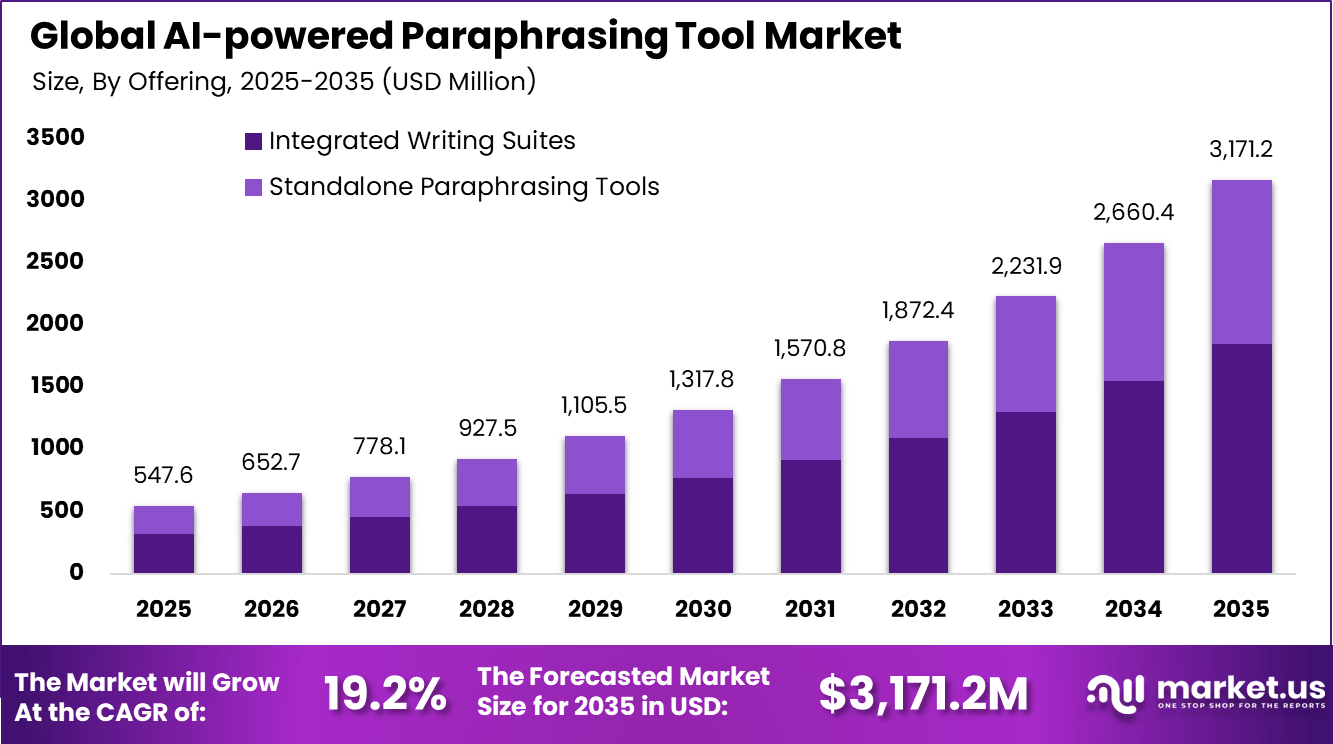
The Global AI-powered Paraphrasing Tool Market size is expected to be worth around USD 3,171.2 million by 2035, from USD 547.6 million in 2025, growing at a CAGR of 19.2% during the forecast period from 2025 to 2035. North America held a dominant market position, capturing more than a42.4% share, holding USD 232.1 million in revenue.
The AI powered paraphrasing tool market refers to software applications that use artificial intelligence to rewrite text while preserving the original meaning. These tools analyze sentence structure, context, and language patterns to generate alternative versions of content. AI paraphrasing tools are widely used in education, content creation, marketing, research, and corporate communication. Adoption supports faster writing workflows and improved language clarity.
One major driving factor of the AI powered paraphrasing tool market is the demand for content efficiency and scalability. Businesses and individuals produce large amounts of written material for websites, reports, and communication. Paraphrasing tools reduce the effort required to rewrite content for different purposes. This efficiency supports wider adoption.
For instance, in August 2025, Grammarly rolled out a major interface revamp with enhanced AI paraphrasing features, including a dedicated Paraphraser agent for tone and style adjustments. This update integrates generative AI across editing tools, helping users craft clearer content faster.
Demand for AI powered paraphrasing tools is influenced by growth in digital marketing and online publishing. Content creators frequently need multiple versions of similar text for different platforms. Paraphrasing tools support this requirement while reducing repetition. This content reuse strengthens demand.
Key Takeaway
- Integrated writing suites led the market with a 58.4% share, as users preferred all in one platforms that combine paraphrasing with grammar checking, tone adjustment, and content optimization.
- The subscription pricing model dominated with a 65.2% share, reflecting steady demand for continuous access, regular feature updates, and predictable usage costs.
- Content creation and marketing emerged as the primary application area with a 34.5% share, driven by high content volumes, SEO needs, and demand for faster copy adaptation across channels.
- Cloud based deployment accounted for a commanding 97.1% share, supported by instant accessibility, scalability, and minimal infrastructure requirements for users.
- English language support remained dominant with a 73.9% share, reflecting its central role in global digital content creation and online communication.
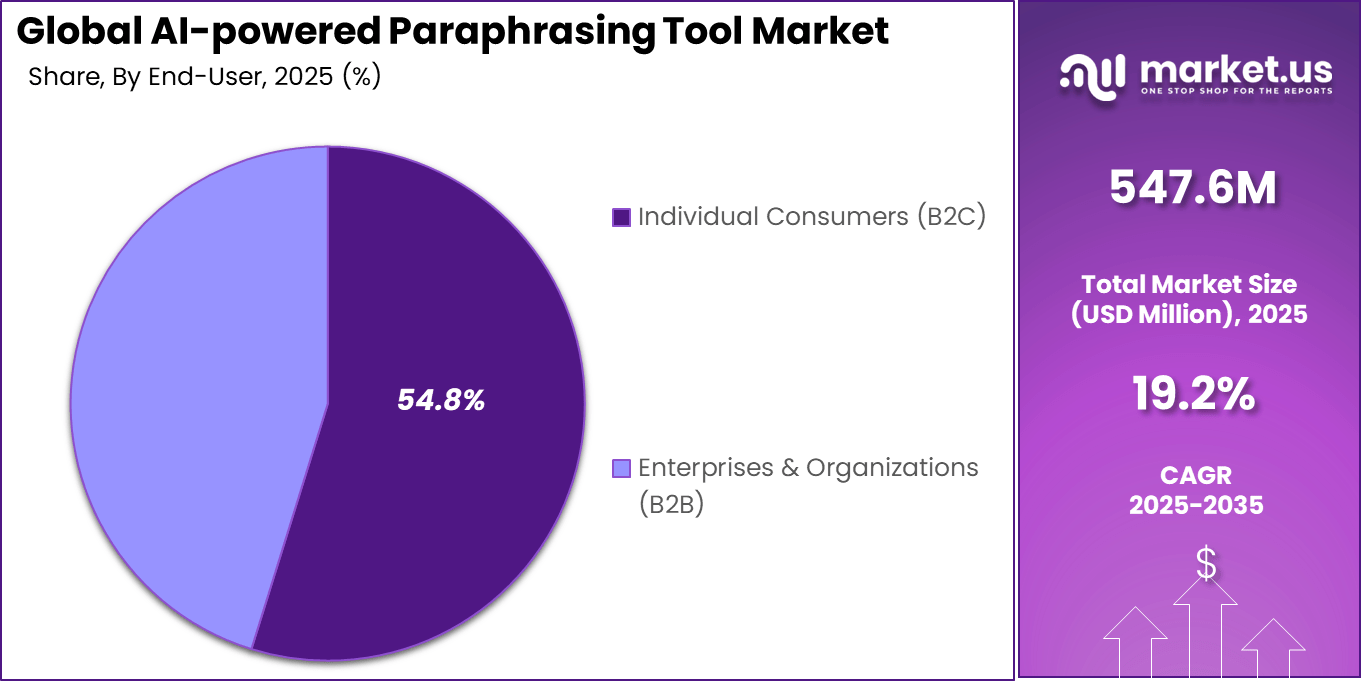
- Individual consumers (B2C) represented 54.8% of total adoption, highlighting strong use among students, freelancers, and independent creators.
- North America held a leading 42.4% share, supported by high AI adoption, strong digital content economies, and mature SaaS usage patterns.
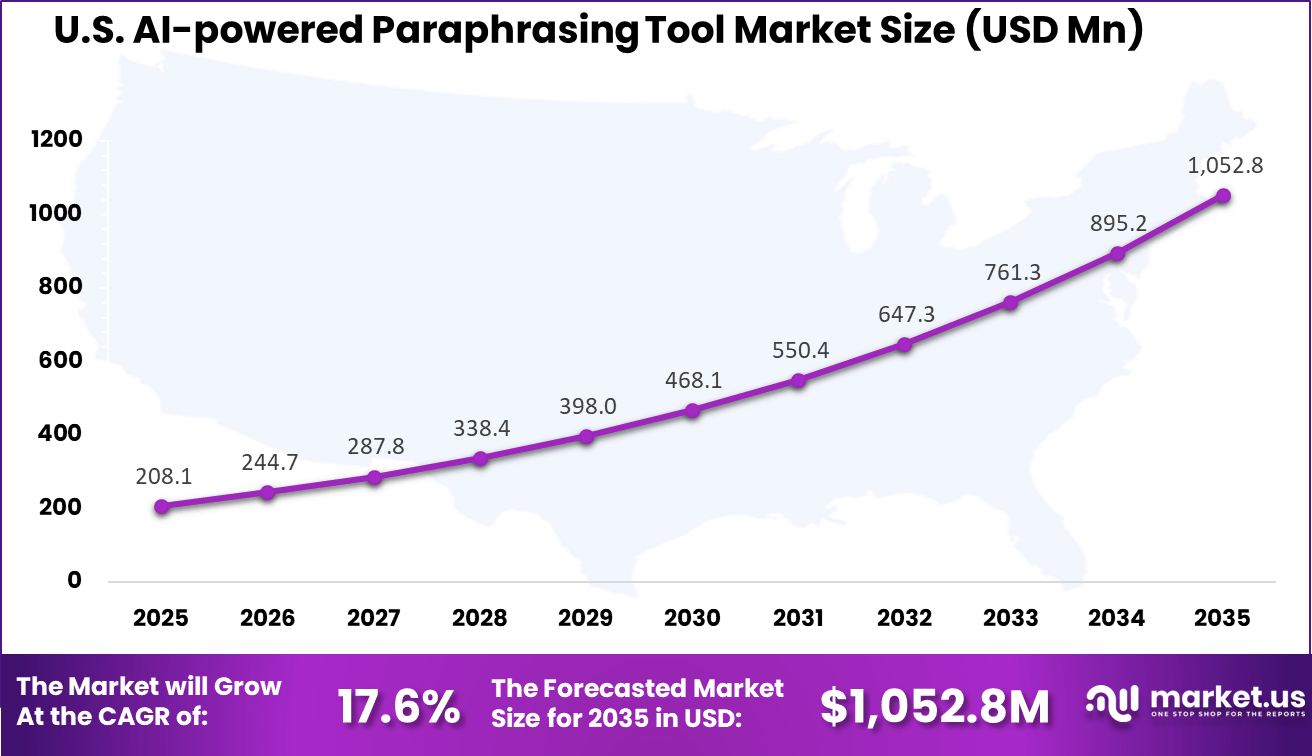
- The U.S. market reached USD 208.1 million, expanding at a robust 17.6% growth rate, driven by rising reliance on AI assisted writing tools across education, marketing, and professional communication.
Key Insights Summary
User Adoption and Demographic Insights
- Overall AI adoption accelerated sharply, as AI tool usage among researchers increased from 57% in 2024 to 84% in 2025. Within content marketing, adoption reached 90%, indicating deep integration into everyday workflows.
- Productivity gains were widely reported. Professionals expected to save an average of 5 hours per week within one year of adoption, while content marketers saved about 3 hours per content asset, supporting faster turnaround and higher output.
Key User Groups
- Students and academics represented a core user base, with 86% of students and 85% of teachers using AI during the 2024–25 academic year. Paraphrasing tools were heavily used for assignments, research summaries, and literature reviews.
- Professionals and marketers relied on AI paraphrasing for emails, advertising copy, and SEO focused content. These users reported improved writing efficiency and more consistent tone and clarity across outputs.
User Sentiment and Risk Awareness
- Accuracy expectations increased alongside adoption, as 91% of professionals believed AI tools should meet higher accuracy standards than human writers, reflecting rising dependence on AI generated outputs.
- Data security concerns remained prominent, prompting more cautious use in sensitive or regulated content workflows despite high overall adoption levels.
Drivers Impact Analysis
| Driver Category | Key Driver Description | Estimated Impact on CAGR (%) | Geographic Relevance | Impact Timeline |
|---|---|---|---|---|
| Growth of digital content creation | Rising demand for fast content rewriting | ~4.6% | Global | Short Term |
| Expansion of creator economy | Freelancers and influencers adopting AI tools | ~3.9% | North America, Europe | Short Term |
| Subscription software adoption | Predictable pricing and continuous updates | ~3.4% | Global | Mid Term |
| Academic and professional writing demand | Plagiarism avoidance and clarity improvement | ~3.1% | Global | Mid Term |
| Cloud platform scalability | Easy access across devices | ~2.8% | Global | Long Term |
Risk Impact Analysis
| Risk Category | Risk Description | Estimated Negative Impact on CAGR (%) | Geographic Exposure | Risk Timeline |
|---|---|---|---|---|
| Ethical and misuse concerns | Over-reliance in academic settings | ~4.2% | North America, Europe | Short Term |
| Content quality inconsistency | Semantic accuracy limitations | ~3.5% | Global | Short Term |
| Data privacy issues | Handling of user text data | ~3.0% | Europe, North America | Mid Term |
| Regulatory uncertainty | AI usage guidelines in education | ~2.4% | Europe | Mid Term |
| High market competition | Tool commoditization pressure | ~1.9% | Global | Long Term |
Restraint Impact Analysis
| Restraint Factor | Restraint Description | Impact on Market Expansion (%) | Most Affected Regions | Duration of Impact |
|---|---|---|---|---|
| Free tool availability | Limited conversion to paid plans | ~4.5% | Global | Short Term |
| Language performance gaps | Lower accuracy beyond English | ~3.6% | Emerging Markets | Mid Term |
| Trust and originality concerns | Perceived loss of human voice | ~2.9% | Global | Mid Term |
| Integration limitations | Limited workflow compatibility | ~2.2% | Global | Long Term |
| Subscription fatigue | Rising SaaS spending pressure | ~1.8% | Global | Long Term |
U.S. Market Size
The market for AI-powered Paraphrasing Tool within the U.S. is growing tremendously and is currently valued at USD 208.1 million, the market has a projected CAGR of 17.6%. The growth stems from rising needs for quick content creation in digital marketing and e-learning.
Businesses use these tools to make original copy for SEO and ads at a low cost. Advances in natural language processing bring more accurate results. The e-commerce boom and remote work push demand higher. Students and freelancers add to the user base by avoiding plagiarism easily.
For instance, in August 2025, Grammarly, headquartered in San Francisco, USA, launched a redesigned document interface with enhanced AI paraphrasing capabilities, including a dedicated Paraphraser agent that modifies text tone and style. This innovation, built on acquired Coda technology, integrates seamlessly with an AI assistant, grader, citation finder, and plagiarism checker, reinforcing U.S. leadership in AI-powered writing tools.
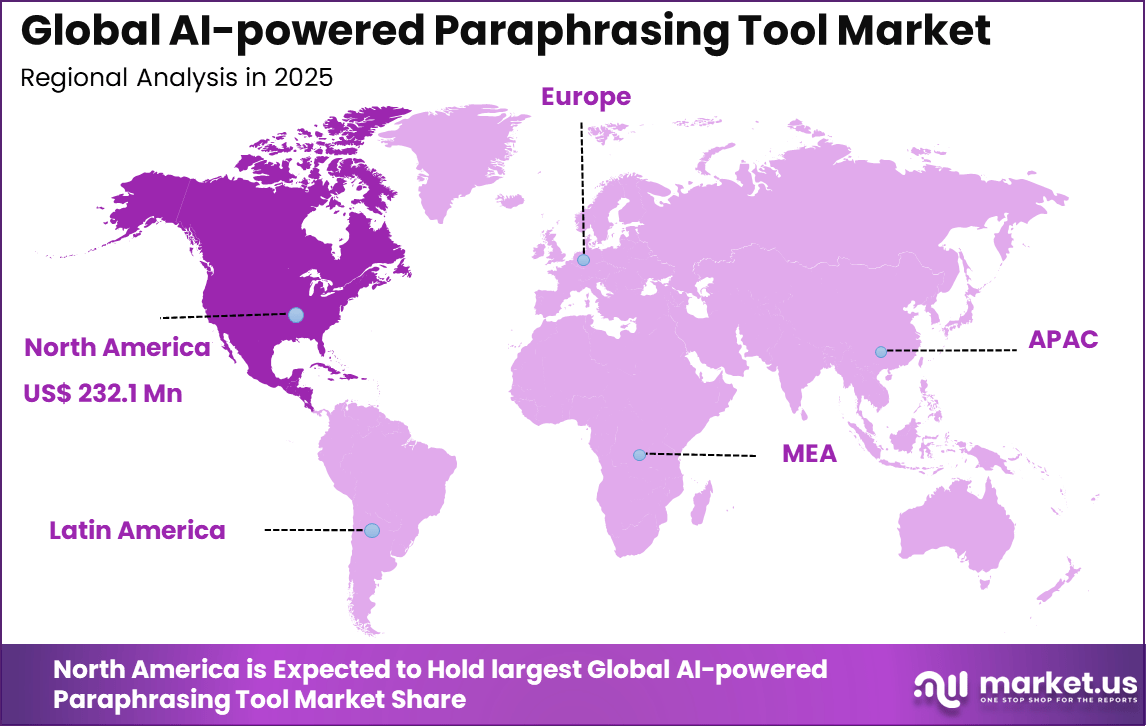
In 2025, North America held a dominant market position in the Global AI-powered Paraphrasing Tool Market, capturing more than a 42.4% share, holding USD 232.1 million in revenue. This lead comes from a strong tech ecosystem and early adoption of AI innovations.
High demand for content in marketing and e-learning drives use. Tech giants and startups pour funds into natural language tools. Digital businesses seek SEO-optimized originals fast. Academic needs for plagiarism-free work add a push. Robust infrastructure supports cloud-based growth.
| Region | Primary Growth Driver | Regional Share (%) | Regional Value (USD Mn) | Adoption Maturity |
|---|---|---|---|---|
| North America | Mature content marketing ecosystem | 42.4% | USD 232.2 Mn | Advanced |
| Europe | Academic and professional writing demand | 26.8% | USD 146.8 Mn | Advanced |
| Asia Pacific | Rapid growth of digital creators | 22.1% | USD 121.0 Mn | Developing |
| Latin America | Social media content expansion | 5.2% | USD 28.5 Mn | Developing |
| Middle East and Africa | Early adoption of AI writing tools | 3.5% | USD 19.1 Mn | Early |
For instance, in October 2025, Quillbot, based in Chicago, USA, enhanced its AI paraphrasing tool with real-time feedback, seven rewriting modes, and grammar checks. Premium features like word freezing and synonym expansion solidify its market dominance. This update underscores North American innovation in accessible, customizable AI rephrasing solutions for writers.
Offering Analysis
In 2025, The Integrated Writing Suites segment held a dominant market position, capturing a 58.4% share of the Global AI-powered Paraphrasing Tool Market. These platforms bundle paraphrasing with tools like grammar checks and summarizers. Writers prefer them for handling full editing needs in one spot. This setup cuts down on switching apps and boosts workflow speed. Demand grows as users seek complete solutions for content tasks.
The lead comes from real-world use in daily writing. Professionals handle reports or posts without extra software. Suites offer templates and style guides. This makes them ideal for teams or solo creators. Ease of use drives adoption over basic paraphrasers. Future updates will add more AI features to keep the edge.
For Instance, in December 2025, Grammarly launched enhanced integrated suites with advanced paraphrasing in their premium plans. The update blends grammar checks, tone adjustments, and rephrasing into one dashboard. Users now rewrite entire documents while getting style suggestions in real time. This move strengthens their hold on all-in-one writing tools.
Pricing Model Analysis
In 2025, the Subscription segment held a dominant market position, capturing a 65.2% share of the Global AI-powered Paraphrasing Tool Market. Users pay monthly or yearly for full access to features. Plans include unlimited words and priority support. This fits regular users like bloggers who need steady tools. Providers update models often to match new language patterns.
Subscriptions beat one-time buys by offering flexibility. Cancel anytime if needs change. Extra perks like mobile apps add value. Businesses pick them for team accounts with usage tracking. Costs stay low compared to hiring editors. This model supports ongoing improvements and user loyalty over time.
For instance, in November 2025, Quillbot rolled out flexible subscription tiers with unlimited paraphrasing access. New plans start low for individuals and scale for teams, adding features like history tracking. Subscribers get priority AI model updates for better accuracy. This caters to ongoing users seeking value over free limits.
Application Analysis
In 2025, The Content Creation & Marketing segment held a dominant market position, capturing a 34.5% share of the Global AI-powered Paraphrasing Tool Market. Teams rewrite headlines, emails, and web copy fast. Tools ensure unique phrasing to avoid duplicates online. Marketers gain from quick turns on campaigns. SEO benefits come from varied keyword use without repetition.
This segment thrives on digital demands. Social posts need fresh spins daily. Tools help scale output for growing audiences. Agencies use them to meet client deadlines. Accuracy keeps the brand voice intact. As platforms evolve, integration with analytics will sharpen targeting even more.
For Instance, in October 2025, Wordtune introduced marketing-focused modes for content repurposing. The tool now suggests SEO-optimized rewrites and social snippets from long-form posts. Marketers use it to refresh campaigns quickly while keeping the brand voice. Integration with platforms like Slack boosts team workflows.
Deployment Analysis
In 2025, The Cloud-based segment held a dominant market position, capturing a 97.1% share of the Global AI-powered Paraphrasing Tool Market. Access works from any browser or phone. No downloads mean instant start. Teams share links for collaborative edits. Servers handle heavy AI loads without user hardware strain.
The shift to cloud stems from remote work trends. Updates roll out server-side for all users. Data stays secure with backups. Scalability suits peak usage times. On-premise fades as cloud costs drop. This dominance will hold as 5G speeds up mobile access further.
For Instance, in January 2026, Rephrase.ai upgraded its cloud platform with faster processing speeds. Users access paraphrasing from any device without installation, supporting bulk uploads. Real-time collaboration features let teams edit shared content. This aligns with remote work needs in cloud-dominant setups.
Language Support Analysis
In 2025, The English segment held a dominant market position, capturing a 73.9% share of the Global AI-powered Paraphrasing Tool Market. Global business and web content rely on it most. Tools excel here with vast training data. Users get precise rephrasing for essays or articles. Non-native speakers improve clarity fast.
Focus on English matches online traffic patterns. Most searches and sales happen in it. Tools handle idioms and tones well. Multilingual growth lags due to data gaps. English keeps the top spot for commercial viability. Expansion to others will pick up with better datasets.
For Instance, in September 2025, Scribbr enhanced English paraphrasing accuracy for academic texts. The tool preserves citations during rewrites and flags complex structures. Students and researchers benefit from natural-sounding outputs. It remains focused on English to match high demand in education.
End-User Analysis
In 2025, The Individual Consumers (B2C) segment held a dominant market position, capturing a 54.8% share of the Global AI-powered Paraphrasing Tool Market. Students rewrite papers to fit the guidelines. Freelancers refresh client drafts quickly. Apps offer free tiers to hook users. Simple interfaces suit non-tech folks. Personal use drives volume over enterprise buys.
B2C grows from the self-publishing boom. Bloggers avoid plagiarism flags easily. Hobby writers polish ideas without cost. Mobile versions fit on-the-go needs. Feedback loops refine tools for solo habits. This group pushes innovation in user-friendly designs ahead.
For Instance, in July 2025, Spinbot improved its free web-based tool for solo users. Now handles longer texts with better readability to avoid a robotic feel. Freelancers and bloggers spin content daily without costs. Simple interface draws casual B2C crowds seeking quick fixes.
Investor Type Impact Matrix
| Investor Type | Adoption Level | Contribution to Market Growth (%) | Key Motivation | Investment Behavior |
|---|---|---|---|---|
| Individual consumers (B2C) | Very High | ~54.8% | Writing efficiency and ease | Subscription based |
| Content creators | High | ~21% | Productivity and scale | Tool bundling |
| Educational users | Moderate | ~13% | Academic writing support | Selective usage |
| Marketing agencies | Moderate | ~8% | Content volume optimization | Team licenses |
| Enterprises | Low | ~3% | Internal communication tools | Limited adoption |
Technology Enablement Analysis
| Technology Layer | Enablement Role | Impact on Market Growth (%) | Adoption Status |
|---|---|---|---|
| Transformer language models | Semantic rewriting accuracy | ~4.9% | Mature |
| Contextual embeddings | Meaning preservation | ~4.1% | Mature |
| Cloud inference platforms | High availability and speed | ~3.5% | Mature |
| Style and tone controls | Custom paraphrasing outputs | ~2.8% | Growing |
| Multilingual model tuning | Language expansion | ~1.9% | Developing |
Emerging Trends
Emerging trends in the AI-powered paraphrasing tool market include the evolution toward more contextually intelligent and adaptive text rewriters that leverage deeper natural language understanding to improve relevance and stylistic coherence. Tools are increasingly incorporating features that support semantic awareness, tone adjustment, and nuanced rewriting to match professional or creative demands.
Additionally, there is a trend toward integrating paraphrasing capabilities with broader content ecosystems, including writing platforms and collaborative tools, enabling seamless workflows for users. Demand for multilingual paraphrasing support is also rising as global content creation expands, pushing developers to build solutions with broader language coverage and contextual sensitivity.
Growth Factors
Growth in the AI-powered paraphrasing tool market is driven by the accelerating pace of digital content generation and the need for efficient writing assistance across business, education, and media sectors. Organisations are prioritising tools that can expedite content refinement, support consistent messaging, and facilitate localisation for diverse audiences.
Advancements in artificial intelligence, particularly in natural language processing and deep learning, enhance the accuracy and adaptability of paraphrasing systems, making them more valuable to a wider range of users. The continuous expansion of online communication and the demand for high-quality text variations further reinforce investment in and adoption of AI-driven paraphrasing solutions.
Opportunity Analysis
Emerging opportunities within the AI-powered paraphrasing tool market are connected to its expanding role in enhancing communication effectiveness and supporting multilingual and contextual language needs. As digital content creation proliferates globally, these tools can assist in localisation, translation support, and tailored messaging that aligns with diverse audience profiles.
They also offer value in enhancing internal business communications by improving clarity and reducing ambiguity, particularly in cross-cultural or distributed work environments. Integration with broader content creation ecosystems, such as writing assistants and workflow platforms, can further elevate their utility and drive adoption in both consumer and enterprise applications.
Challenge Analysis
A central challenge facing the AI-powered paraphrasing tool market is maintaining semantic integrity while delivering high-quality, context-aware rewrites. Advanced AI models must interpret nuanced language structures and preserve original meaning, which is technically complex, especially for domain-specific or highly specialised text.
Achieving this level of performance requires continuous refinement of algorithms and extensive datasets that represent varied linguistic use cases. Balancing automation with the need for human oversight to validate accuracy and appropriateness remains a persistent operational challenge for adopters aiming to leverage these tools reliably.
Key Market Segments
By Offering
- Standalone Paraphrasing Tools
- Integrated Writing Suites
By Pricing Model
- Freemium
- Subscription
- Others
By Application
- Plagiarism Avoidance & Academic Integrity
- Content Creation & Marketing
- Business & Professional Communication
- Localization & Translation Support
- Accessibility & Simplification
- Others
By Deployment
- Cloud-based
- On-Premises
By Language Support
- English
- Spanish
- French
- German
- Others
By End-User
- Individual Consumers (B2C)
- Enterprises & Organizations (B2B)
Key Players Analysis
One of the leading players in January 2026, Grammarly solidified its dominance in AI-powered paraphrasing by completing integration with Superhuman, its June acquisition. The move bolsters rewriting capabilities across email and docs, with 40 million daily users now accessing unified AI productivity tools. This enhances context-aware paraphrasing for enterprises, driving $700 million annual revenue while expanding multilingual support.
Top Key Players in the Market
- Prepostseo
- Scribbr
- Spinbot
- Rephrase.ai
- Cite This For Me
- Grammarly
- Quillbot
- Paraphraser.io
- Paraphraser
- Paraphrase Online
- Duplichecker
- Wordtune
- Essay Rewriter
- ProWritingAid
- Sentence Checker
- Others
Recent Developments
- In September 2025, Quillbot rolled out its AI Co-Writing Companion with real-time citation and tone-shifting for paraphrasing. Acquired by Learneo earlier, it now integrates with Google Docs and Notion, serving academic and enterprise users with expanded multilingual modes for seamless rewriting.
- In July 2025, Wordtune enhanced its rewriting engine with voice-to-text paraphrasing and 10 new languages, including Korean and Hindi. The update focuses on personalized style learning, making it ideal for global teams and boosting adoption in marketing workflows.









