


Report Overview
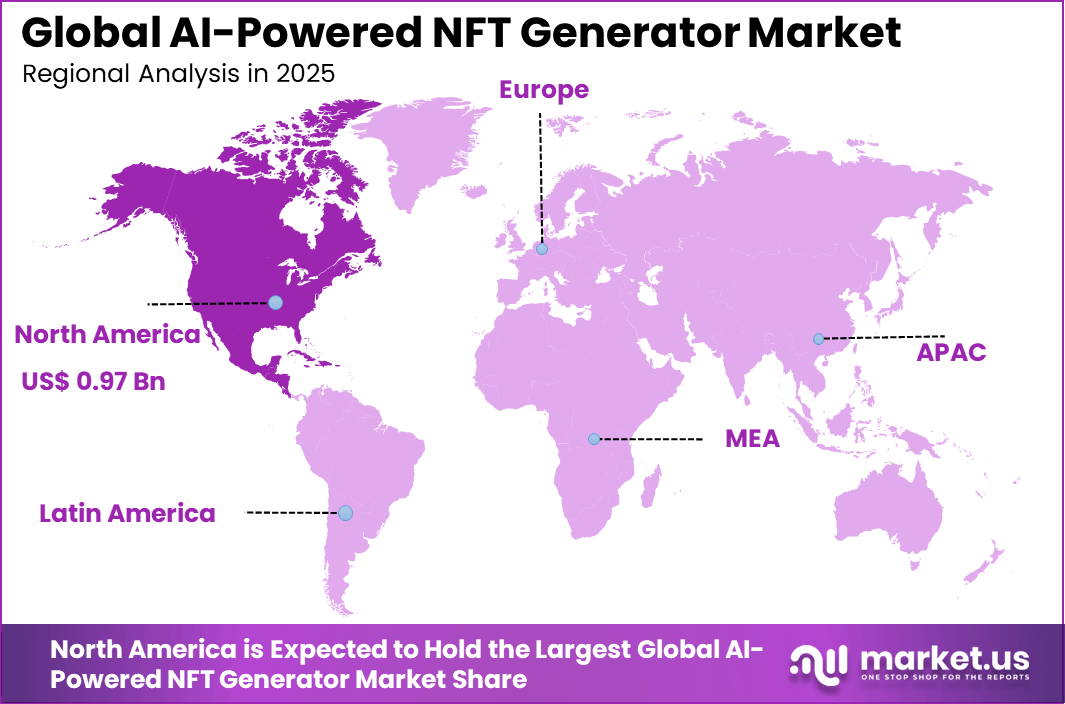
The Global AI-Powered NFT Generator Market size is expected to be worth around USD 46.38 billion by 2035, from USD 2.56 billion in 2025, growing at a CAGR of 33.6% during the forecast period from 2025 to 2035. North America held a dominant market position, capturing more than a38.1% share, holding USD 0.97 billion in revenue.
The AI powered NFT generator market refers to platforms and tools that use artificial intelligence to create digital assets that can be minted as non-fungible tokens. These tools generate visual art, music, animations, and other digital content based on predefined inputs, styles, or datasets. AI powered NFT generators are used by artists, designers, game developers, brands, and content creators. Adoption supports faster creation of unique digital assets.
One major driving factor of the AI powered NFT generator market is the demand for scalable digital content creation. NFT platforms and marketplaces require large volumes of unique assets. AI generators enable rapid production without proportional increases in creative effort. This scalability supports wider participation. Another key driver is the growing interest in creator economy platforms. Independent creators seek tools that reduce technical and artistic barriers.
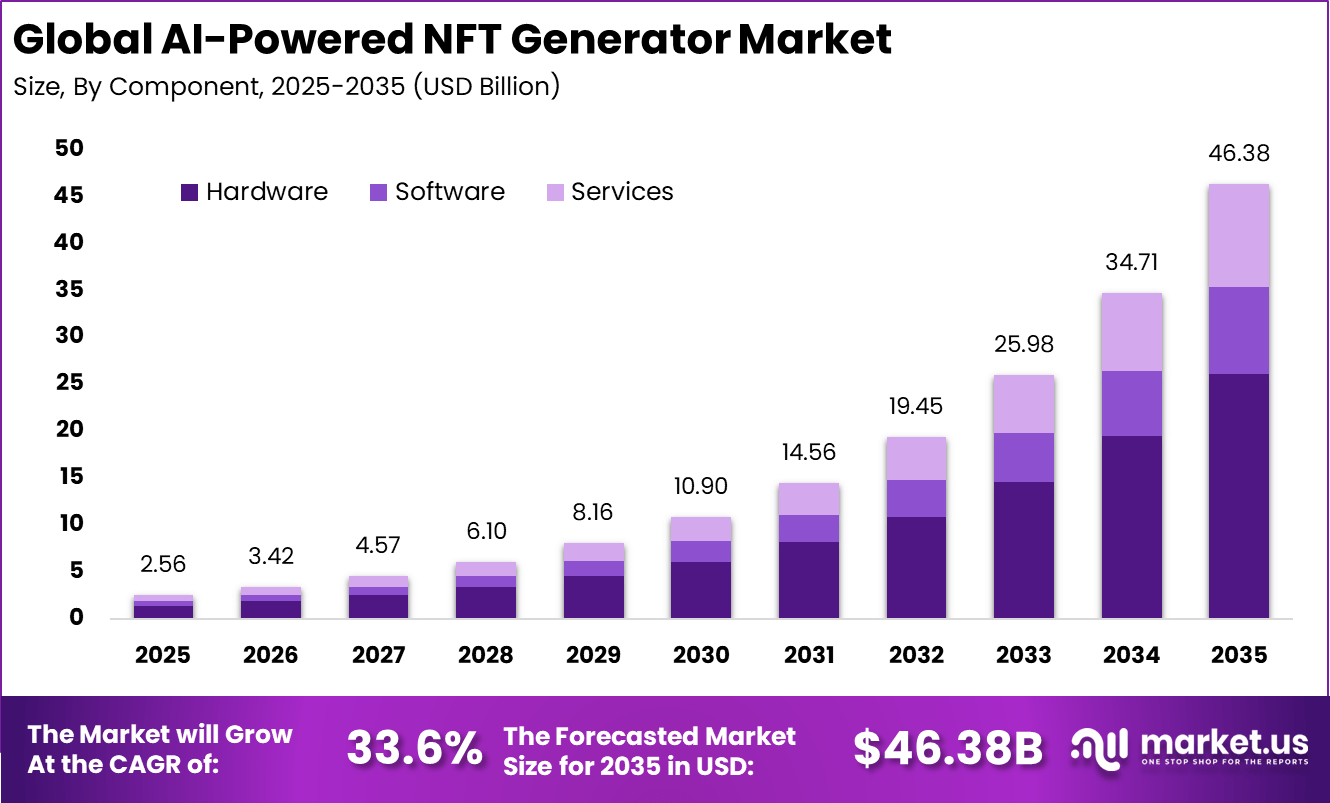
Demand for AI powered NFT generators is influenced by growth in blockchain-based digital marketplaces. As NFT platforms expand, content supply requirements increase. Creators and brands require tools that generate differentiated assets quickly. This fuels consistent demand. Demand is also shaped by the rise of virtual environments and digital experiences. Gaming, metaverse platforms, and virtual events rely on unique digital items.
For instance, in September 2025, SuperRare acquired an AI art verification startup, enhancing authenticity checks for generative works. Sales of AI-curated pieces jumped 35%, solidifying San Diego’s role in premium AI-NFT spaces.
Investment opportunities in the AI powered NFT generator market exist in platforms that combine creation and minting workflows. Integrated solutions simplify asset production and blockchain interaction. These platforms attract both novice and professional users. End-to-end functionality improves adoption. Another opportunity lies in industry-specific NFT generators. Tools designed for gaming assets, music NFTs, or brand collectibles offer focused value.
Key Takeaway
- In 2025, the hardware segment led the market with a 56.2% share, reflecting strong reliance on high performance computing systems and dedicated infrastructure to support AI driven content generation and rendering.
- The art segment captured a 30.5% share, highlighting the continued dominance of digital art creation as the primary use case for AI powered NFT generation.
- On premises deployment remained the preferred model with a 57.4% share in 2025, indicating that control over data, intellectual property protection, and processing performance remained critical for creators and enterprises.
- Large enterprises accounted for a dominant 70.2% share, driven by their ability to invest in advanced AI tools, manage large scale NFT projects, and integrate generation platforms into broader digital asset strategies.
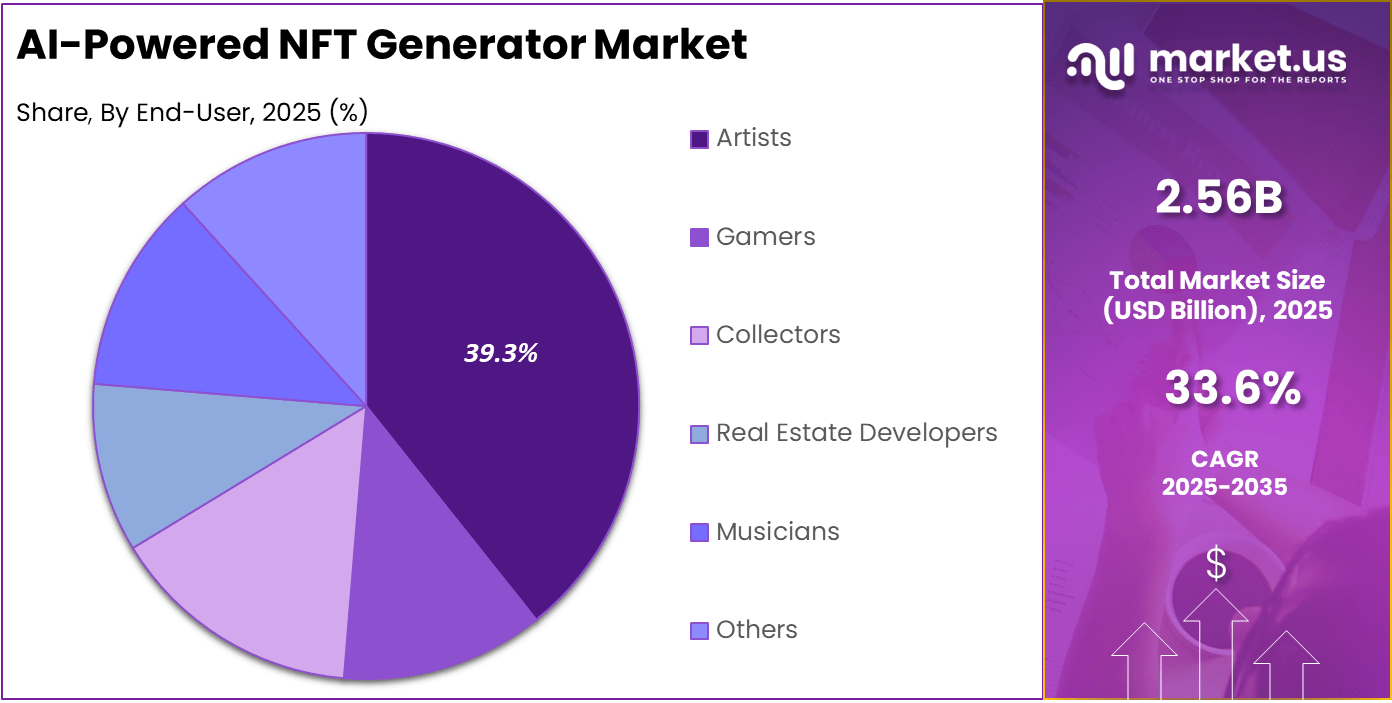
- The artists segment held a 39.3% share, showing strong adoption among professional creators seeking faster production cycles, creative experimentation, and monetization through AI assisted NFT creation.
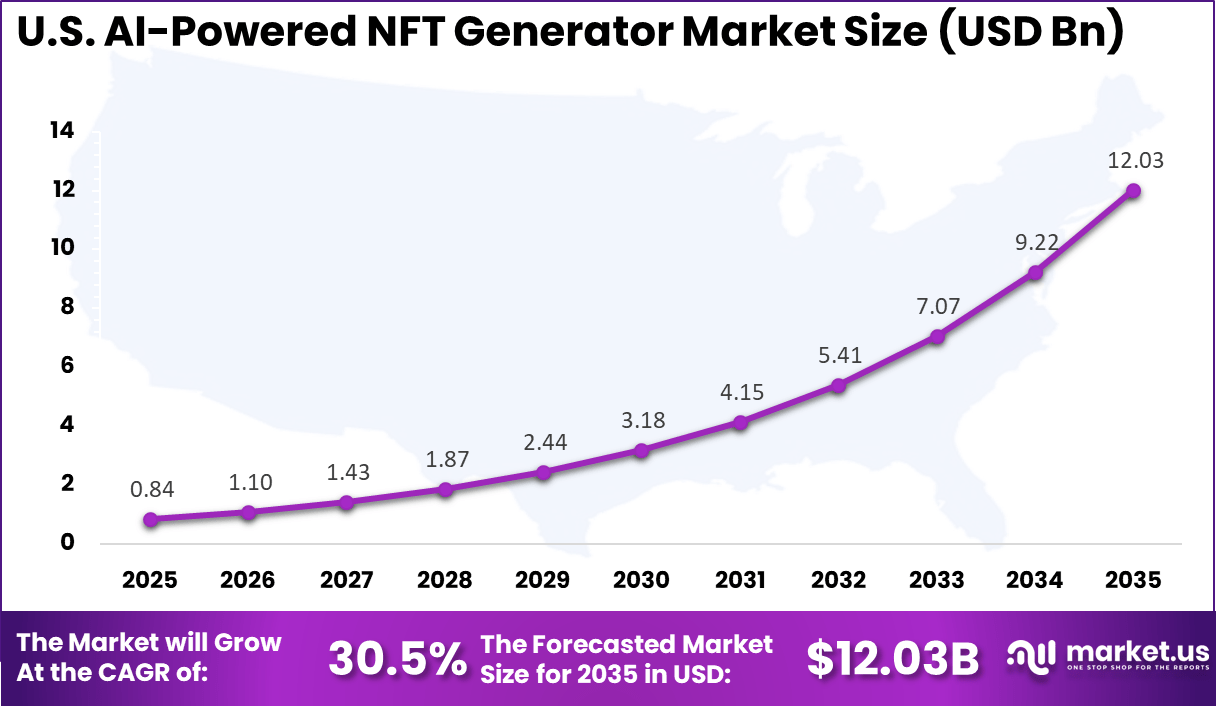
- The U.S. market reached USD 0.84 billion in 2025, expanding at a strong 30.5% growth rate, supported by high creator activity, mature blockchain ecosystems, and rapid adoption of AI based creative tools.
- North America maintained regional leadership with more than a 38.1% share in 2025, backed by advanced AI infrastructure, strong digital art communities, and early adoption of NFT and generative technologies.
Drivers Impact Analysis
| Driver Category | Key Driver Description | Estimated Impact on CAGR (%) | Geographic Relevance | Impact Timeline |
|---|---|---|---|---|
| Growth of digital ownership | Expansion of blockchain based asset creation | ~7.4% | North America, Europe | Short Term |
| Rising adoption of generative AI | Automated creation of unique digital assets | ~6.6% | Global | Short Term |
| Expansion of creator economy | Monetization opportunities for digital artists | ~6.1% | Global | Mid Term |
| Enterprise investment in digital assets | Branded and licensed NFT projects | ~5.2% | North America, Asia Pacific | Mid Term |
| Advancements in AI hardware | Faster model training and rendering | ~4.3% | Global | Long Term |
Risk Impact Analysis
| Risk Category | Risk Description | Estimated Negative Impact on CAGR (%) | Geographic Exposure | Risk Timeline |
|---|---|---|---|---|
| Market volatility | Fluctuating NFT demand cycles | ~6.2% | Global | Short Term |
| Regulatory uncertainty | Digital asset compliance and taxation | ~5.1% | North America, Europe | Mid Term |
| IP and copyright disputes | Ownership of AI generated assets | ~4.4% | Global | Mid Term |
| High infrastructure cost | Hardware intensive AI systems | ~3.6% | Emerging Markets | Mid Term |
| Environmental concerns | Energy consumption of blockchain | ~2.7% | Global | Long Term |
Restraint Impact Analysis
| Restraint Factor | Restraint Description | Impact on Market Expansion (%) | Most Affected Regions | Duration of Impact |
|---|---|---|---|---|
| High entry barriers | Cost of AI and blockchain infrastructure | ~5.8% | Emerging Markets | Short to Mid Term |
| Skills gap | Limited expertise in AI and NFTs | ~4.6% | Global | Mid Term |
| Platform interoperability issues | Fragmented NFT ecosystems | ~3.9% | Global | Mid Term |
| Security vulnerabilities | Risks of digital asset theft | ~3.1% | Global | Long Term |
| Limited mainstream adoption | Niche user base concentration | ~2.4% | Global | Long Term |
By Component
Hardware accounts for 56.2%, indicating its important role in AI-powered NFT generation. High-performance processors and graphics units support intensive image and asset creation tasks. Hardware ensures stable performance during model execution and rendering. Reliable infrastructure is essential for consistent output quality. Professional users prioritize dependable systems.
The dominance of hardware is driven by compute-heavy workloads. NFT generation requires fast processing for design and validation. Dedicated hardware reduces latency and errors. On-premises setups benefit from controlled environments. This sustains steady demand for hardware components.
For Instance, in December 2025, OpenSea launched a hardware-optimized toolkit for AI NFT generation, using GPU clusters to speed up image rendering. Creators now batch-produce layered art with less wait time, boosting output on powerful local rigs. This ties into hardware’s lead by making high-compute tasks seamless for pros. Early users report double the speed on dedicated setups.
By Application
Art represents 30.5%, making it the leading application segment. AI tools help artists generate unique digital assets. Automated creation supports rapid experimentation. Visual diversity improves creative output. Artists value efficiency and originality. Growth in this application is driven by digital art adoption. Creators seek new ways to express ideas.
AI tools reduce manual effort. Artistic NFTs attract collector interest. This keeps art as a central application. For instance, in October 2025, SuperRare rolled out an AI art generator feature, letting artists input prompts for unique digital canvases. It focuses on fine art styles, minting directly as NFTs with editable traits. This highlights art’s dominance as users flood in for creative tools. Feedback shows quick adoption among digital painters.
By Deployment Mode
On-premises deployment accounts for 57.4%, reflecting preference for local control. Users manage sensitive creative assets internally. Local systems provide predictable performance. On-premises setups reduce reliance on external networks. Security remains a key factor.
Adoption of on-premises deployment is driven by ownership concerns. Artists and enterprises protect intellectual property. Custom configurations improve workflow alignment. Offline capability supports uninterrupted creation. This sustains strong on-premises usage.
For Instance, in November 2025, Rarible introduced on-premises deployment kits for their AI NFT tools, allowing full local control over generation servers. Enterprises set up private hardware to handle sensitive designs without cloud risks. It matches the mode’s top share by prioritizing security and customization for heavy users.
By Enterprise Size
Large enterprises represent 70.2%, highlighting their dominant role. These organizations invest in digital asset creation at scale. AI tools support brand and content strategies. Centralized systems ensure consistency. Reliability is critical for enterprise operations.
Adoption among large enterprises is driven by commercialization goals. Enterprises use NFTs for marketing and engagement. AI automation improves production speed. Integration with existing systems supports efficiency. This sustains strong enterprise participation.
For Instance, in January 2026, Nifty Gateway partnered with big firms for enterprise-grade AI generators, deploying custom hardware for bulk NFT creation. Large teams use it for branded collectibles in campaigns. This reinforces their lead, as scale demands robust backends that only they can run smoothly.
By End-User
Artists account for 39.3%, making them the largest end-user group. Independent creators use AI tools to expand creativity. NFT generators lower technical barriers. Artists gain control over production. Accessibility supports wider participation. Adoption among artists is driven by monetization opportunities. Digital marketplaces reward unique content.
AI tools help scale output. Reduced costs improve sustainability. This keeps artists at the forefront. For Instance, in September 2025, Zora updated its minting page with AI prompts for artists, simplifying custom font and color ties to generated art. Independent creators mint fragments and sketches easily now. It cements artists’ top spot by lowering barriers to full creative control.
By Region
North America accounts for 38.1%, supported by strong digital creative ecosystems. The region shows high adoption of blockchain-based assets. Technology awareness supports market growth. Creative communities drive demand. The region remains influential.
| Region | Primary Growth Driver | Regional Share (%) | Regional Value (USD Bn) | Adoption Maturity |
|---|---|---|---|---|
| North America | Strong creator economy and AI adoption | 38.1% | USD 0.98 Bn | Advanced |
| Europe | Digital art and cultural NFT initiatives | 27.6% | USD 0.71 Bn | Advanced |
| Asia Pacific | Rapid blockchain and AI innovation | 24.3% | USD 0.62 Bn | Developing to Advanced |
| Latin America | Emerging digital creator platforms | 5.7% | USD 0.15 Bn | Developing |
| Middle East and Africa | Early digital asset experimentation | 4.3% | USD 0.11 Bn | Early |
For instance, in January 2026, Zora launched AI minting capabilities, allowing users to generate and mint NFTs instantly using text prompts powered by advanced AI models. This innovation, enabling model creators to earn passive income from AI outputs, solidifies North American leadership in AI-NFT integration.
The United States reached USD 0.84 Billion with a CAGR of 30.5%, reflecting rapid expansion. Growth is driven by creator economy development. AI adoption accelerates asset creation. Demand for digital ownership continues to rise. Market momentum remains strong.
For instance, in October 2025, OpenSea pivoted to a crypto trading aggregator with AI-driven minting tools, facilitating $1.6 billion in crypto trades and $230 million in NFT transactions in early October. This development reinforces U.S. dominance in AI-powered NFT generation by leveraging its massive user base for seamless AI-enhanced NFT creation and multi-chain trading.
Investor Type Impact Matrix
| Investor Type | Adoption Level | Contribution to Market Growth (%) | Key Motivation | Investment Behavior |
|---|---|---|---|---|
| Artists and creators | Very High | ~39.3% | Monetization of digital art | Tool subscription and usage |
| Large enterprises | High | ~70.2% | Brand driven NFT initiatives | Project based investment |
| Blockchain platforms | High | ~18% | Ecosystem expansion | Infrastructure investment |
| Digital agencies | Moderate | ~12% | Client NFT campaigns | Selective adoption |
| Individual collectors | Low | ~6% | Asset creation and resale | Opportunistic usage |
Technology Enablement Analysis
| Technology Layer | Enablement Role | Impact on Market Growth (%) | Adoption Status |
|---|---|---|---|
| AI image generation models | Automated artwork creation | ~7.2% | Growing |
| High performance AI hardware | Fast rendering and training | ~6.1% | Growing |
| Blockchain minting engines | Secure asset creation | ~5.0% | Mature |
| Smart contract automation | Ownership and royalty management | ~4.2% | Mature |
| Decentralized storage | Long term asset preservation | ~3.3% | Developing |
Key Market Segments
By Component
- Software
- Hardware
- Services
By Application
- Art
- Gaming
- Collectibles
- Real Estate
- Music
- Others
By Deployment Mode
- On-Premises
- Cloud
By Enterprise Size
- Small and Medium Enterprises
- Large Enterprises
By End-User
- Artists
- Gamers
- Collectors
- Real Estate Developers
- Musicians
- Others
Key Players Analysis
OpenSea, Rarible, and Mintable lead the AI powered NFT generator market by enabling creators to generate, mint, and trade AI generated digital assets at scale. Their platforms support generative art tools, smart contract automation, and creator friendly minting workflows. These companies focus on ease of use, marketplace liquidity, and multi chain support. Rising interest in AI driven digital art continues to strengthen their leadership.
SuperRare, Foundation, Zora, Nifty Gateway, and MakersPlace strengthen the market by focusing on curated and premium AI generated NFTs. Their platforms emphasize artist authenticity, limited editions, and high value digital collectibles. These providers integrate AI tools with strong community engagement and brand positioning. Growing demand for exclusive and high quality generative NFTs supports wider adoption.
Art Blocks, Async Art, Enjin, Mintbase, and BakerySwap expand the landscape with programmable art, gaming focused NFTs, and decentralized minting models. Their offerings target niche creator communities and experimental AI art formats. These companies focus on innovation, interoperability, and creator control. Continued convergence of AI, blockchain, and digital ownership is driving steady growth in the AI powered NFT generator market.
Top Key Players in the Market
- OpenSea
- Rarible
- SuperRare
- Mintable
- Foundation
- Zora
- KnownOrigin
- Async Art
- Nifty Gateway
- MakersPlace
- Art Blocks
- BakerySwap
- Enjin
- Mintbase
- Portion
- Cargo
- NFT Showroom
- GhostMarket
- Hic et Nunc
- Treum
- Others
Recent Developments
- In October 2025, Rarible rolled out an AI-enhanced NFT marketplace with buyback rewards, directing transaction fees into RARI token redemptions for traders. This sustainable model supports AI-generated art minting across multiple chains, attracting creators with zero-code launchpads.
- In October 2025, SuperRare rolled out AI artist curation tools for exclusive digital drops, maintaining its premium positioning. The U.S.-operated marketplace focused on blockchain authenticity, driving high-end AI-NFT sales among serious collectors.









