


Report Overview
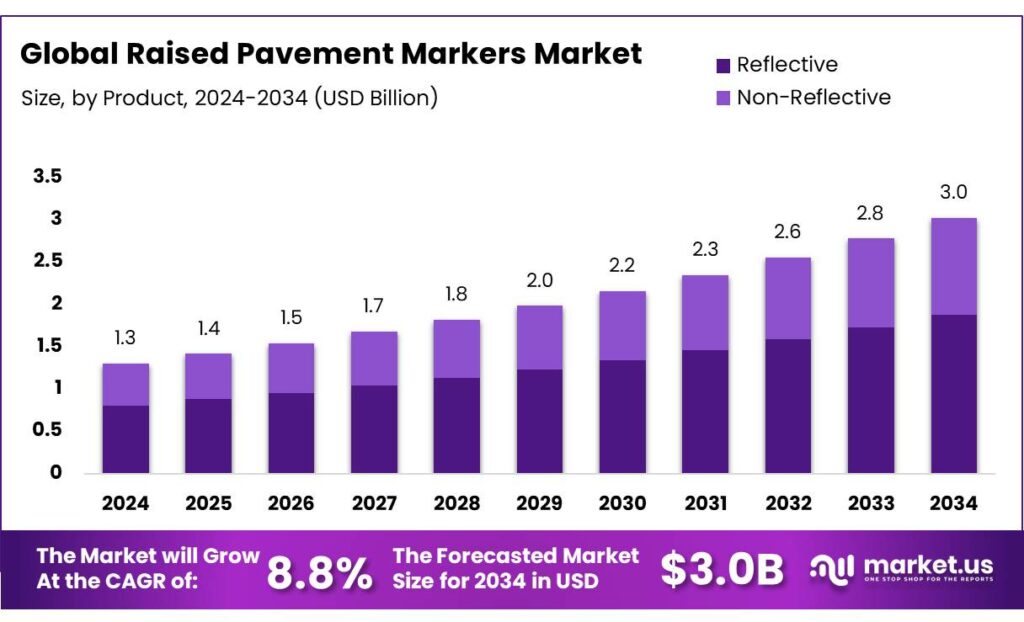
Global Raised Pavement Markers Market size is expected to be worth around USD 3.0 Billion by 2034, from USD 1.3 Billion in 2024, growing at a CAGR of 8.8% during the forecast period from 2025 to 2034. In 2024 North America held a dominant market position, capturing more than a 44.7%share, holding USD 13.2 Million in revenue.
Raised Pavement Markers (RPMs), also known as road studs or reflectors, are small, durable devices attached to road surfaces that enhance visibility and safety by reflecting vehicle headlights and providing tactile feedback, defining lane lines, centerlines, and road edges, particularly at night or in adverse weather conditions. Its market is primarily driven by the demand for improved road safety and visibility, particularly on highways and high-traffic roads.
Reflective RPMs are favored due to their ability to enhance nighttime visibility, reduce accidents, and guide drivers in low-light and adverse weather conditions. With increasing investments in road infrastructure, especially in North America, the demand for RPMs has grown significantly. Innovations, such as smart RPMs integrated with IoT sensors, further enhance the market appeal by offering real-time data on road conditions. However, competition from alternatives such as centerline and edge-line rumble stripes (CLRSs and ELRSs) and regional disruptions caused by geopolitical tensions can affect the growth of the market. Furthermore, the plastic RPMs dominate the market due to their cost-effectiveness, durability, and ease of installation. Despite the popularity of white markers, other colors such as yellow, blue, and red are used for specific safety purposes.
Key Takeaways
- The global raised pavement markers market was valued at USD 1.3 billion in 2024.
- The global raised pavement markers market is projected to grow at a CAGR of 8.8% and is estimated to reach USD 3.0 billion by 2034.
- Based on the type, reflective raised pavement markers dominated the market, with a substantial market share of around 62.1%.
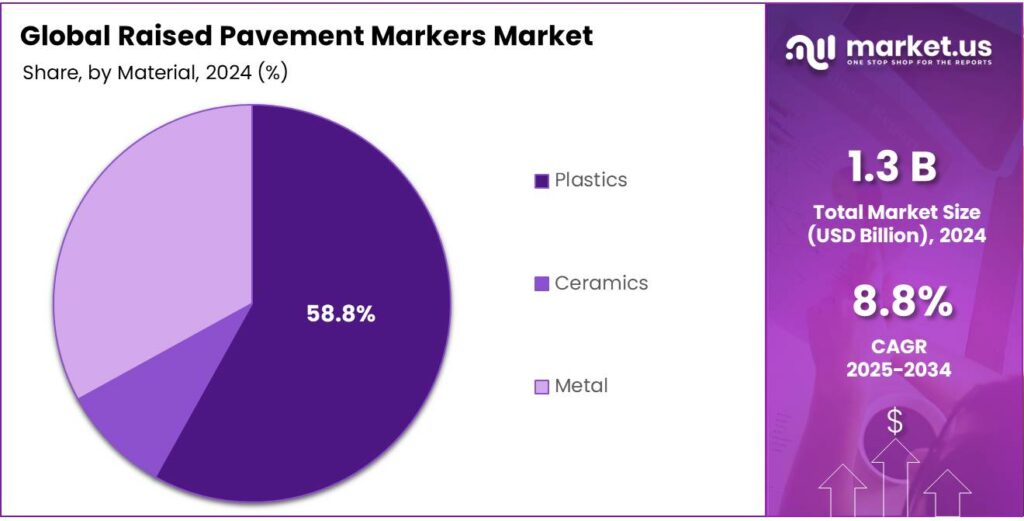
- On the basis of material, the market is dominated by plastic raised pavement markers, comprising 58.8% share of the total market.
- Based on the colors of raised pavement markers, white markers held a major share in the market, 42.6% of the market share.
- Based on the directionality, one-way raised pavement markers dominated the market, with a substantial market share of around 53.4%.
- Based on surface type, the market is dominated by asphalt surface, comprising 61.3% share of the total market.
- Among the applications of the raised pavement markers, the newly built ones led the market, with around 52.5% market share.
- Among the end-uses of raised pavement markers, roads and highways held a major share in the market, 48.1% of the market share.
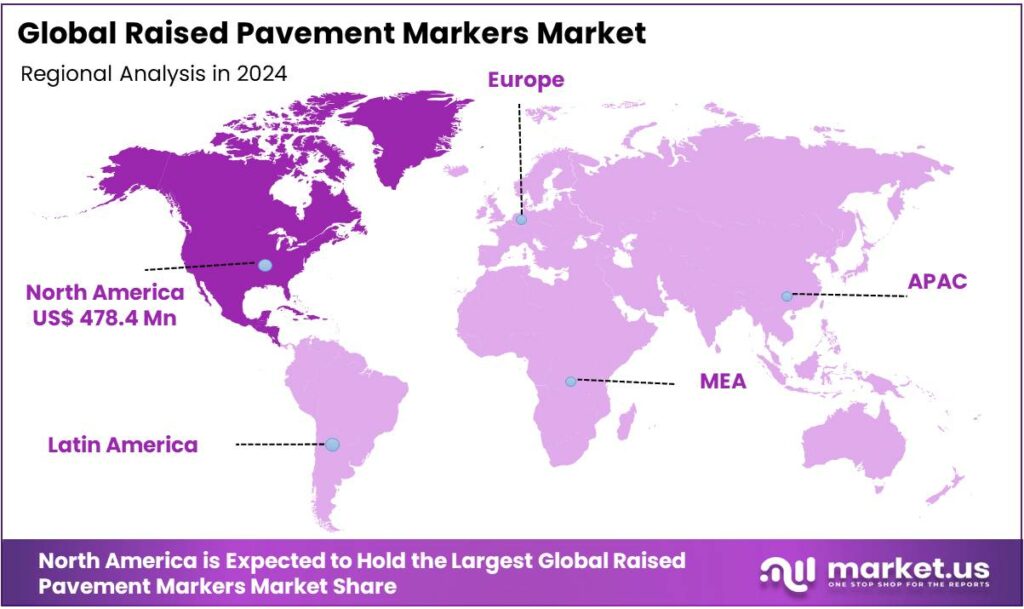
- In 2024, North America was the most dominant region in the raised pavement markers market, accounting for around 36.8% of the total global consumption.
Type Analysis
Reflective Raised Pavement Markers are a Prominent Segment in the Market.
The raised pavement markers market is segmented based on type as reflective and non-reflective. The reflective raised pavement markers dominated the market, comprising around 62.1% of the market share, as they significantly enhance road safety, especially in low-light conditions. The reflective surface of these markers allows them to be clearly visible at night or during adverse weather, such as rain, fog, or snow, by reflecting vehicle headlights.
This increased visibility helps drivers navigate safely, reducing the likelihood of accidents. Reflective RPMs are particularly effective on highways and rural roads, where road lighting may be sparse. Consequently, transportation authorities prioritize their installation to improve overall road safety and decrease nighttime crash rates.
Material Analysis
Plastic Raised Pavement Markers Dominated the Market.
On the basis of materials for raised pavement markers, the market is segmented into plastics, ceramics, and metal. The plastic raised pavement markers dominated the market, comprising around 58.8% of the market share, due to their cost-effectiveness, durability, and ease of installation. Plastic markers are lightweight and less prone to cracking or breaking compared to ceramics, making them ideal for handling heavy traffic and harsh weather conditions.
Additionally, they offer better resistance to wear and tear, ensuring a longer lifespan. Similarly, plastic RPMs are easier to install and replace, reducing maintenance costs. The flexibility of plastic allows for various designs and colors, further increasing its versatility and appeal for road safety projects.
Colors Analysis
White Raised Pavement Markers are Utilized Most Widely for Clear Visibility.
Based on the colors of raised pavement markers, the market is divided into white, yellow, blue, red, and green. The white raised pavement markers dominated the market, with a market share of 42.6%, due to their high visibility and standardization in road safety. White markers are primarily used to delineate lane boundaries and road edges, making them essential for guiding drivers, especially on highways and urban roads.
The contrast between white markers and the road surface, coupled with their reflective properties, ensures they are easily seen at night and in low-visibility conditions. In contrast, colors such as yellow, blue, or red are often used for specific purposes, such as marking cautionary zones or emergency vehicle lanes, and are therefore less common for general road marking.
Directionality Analysis
One-Way Raised Pavement Markers are a Major Fragment in the Market.
The raised pavement markers market is segmented based on directionality as one-way and two-way. The one-way raised pavement markers dominated the market, comprising around 53.4% of the market share, as they are specifically designed to improve safety on roads with one-directional traffic flow, such as highways and one-way streets. These markers clearly define lane boundaries and reduce the risk of head-on collisions by directing drivers in a single direction.
Their primary function is to enhance visibility and guide vehicles along the correct path, especially at night or in poor weather conditions. In contrast, two-way RPMs are often used in areas where traffic flows in both directions, making them less common and more specific to certain road layouts.
Surface Type Analysis
Raised Pavement Markers on Asphalt Surface Dominated the Market.
On the basis of surface type, the market is segmented into asphalt surface and concrete surface. The raised pavement markers on the asphalt surface dominated the market, comprising around 61.3% of the market share, due to better adhesion and ease of installation. Asphalt provides a smoother, more uniform surface, which allows RPMs to bond more effectively with adhesives or other fastening methods.
In contrast, concrete surfaces are often more porous and rough, making it challenging for RPMs to stay securely in place. Additionally, asphalt is more flexible, which helps reduce the risk of marker damage from road wear or temperature fluctuations. This durability, along with ease of installation, makes asphalt the preferred surface for RPM placement.
End-Use Analysis
Raised Pavement Markers Were Mostly Utilized for Roads and Highways.
Based on the end-use of raised pavement markers, the market is divided into roads and highways, parking lots, factories and warehouses, airports, fields, and others. The roads and highways dominated the market, with a market share of 48.1%, due to their primary function of enhancing road safety in high-speed, high-traffic environments. On roads and highways, these markers improve visibility at night and during adverse weather conditions, helping drivers stay on course and avoid accidents.
In contrast, areas such as parking lots and warehouses often have slower traffic and better lighting, reducing the demand for such markers. Similarly, the airports and fields have different safety and navigation needs that are better met by other types of markings or systems tailored to those specific environments.
Key Market Segments
By Type
- Reflective
- Non-Reflective
By Material
- Plastics
- Ceramics
- Metal
By Colors
- White
- Yellow
- Blue
- Red
- Green
By Directionality
- One-Way
- Two-way
By Surface Type
- Asphalt Surface
- Concrete Surface
By Application
- New Built
- Retrofit
By End-Use
- Roads and Highways
- Parking Lot
- Factory and Warehouse
- Airport
- Field
- Others
Drivers
Safety Regulations Drive the Raised Pavement Markers Market.
The raised pavement markers market has witnessed a significant boost due to increasing safety regulations globally. These markers play a crucial role in enhancing road safety by improving visibility in low-light conditions and adverse weather. Governments and transportation authorities worldwide are mandating the use of RPMs for highway construction, urban road networks, and pedestrian zones.
- According to a study, the roads with RPMs show up to a 40% reduction in nighttime crashes, highlighting their effectiveness in reducing accidents.
For instance, countries such as the United States and the United Kingdom have implemented regulations that require RPMs on all major roads and bridges to prevent accidents, especially at night or in foggy conditions. In addition, the adoption of reflective and thermoplastic markers has become standard practice, given their ability to reflect vehicle headlights more effectively. Such regulatory initiatives continue to shape the demand for RPMs, ensuring their adoption across various transportation infrastructure projects.
Restraints
Effective Alternatives Might Delay the Growth of the Raised Pavement Markers Market.
The raised pavement markers often face ongoing maintenance challenges. Additionally, a dislodged RPM opens an ingress point for water to reach the sub-pavement, potentially reducing the design life of the pavement.
Alternatives such as centerline rumble stripes (CLRSs) and edge-line rumble stripes (ELRS) may slow the growth of the raised pavement markers market due to their cost-effectiveness and additional safety benefits. CLRSs and ELRSs are designed to alert drivers when they unintentionally drift out of their lanes by producing a tactile vibration and an audible sound when vehicles pass over them.
- CLRS are observed to reduce target crashes by 45%, and ELRS can reduce target crashes by 35%, in large part by effectively alerting drivers and providing them an opportunity to correct their course before crossing the centerline or leaving the roadway.
The implementation of rumble stripes in various U.S. states has led to a notable decline in accidents, particularly on highways and rural roads. Furthermore, the installation of rumble stripes is often more economical compared to RPMs, as they do not require the same materials or labor-intensive processes. With transportation authorities prioritizing budget efficiency and proven safety enhancements, these alternatives could limit the widespread adoption of RPMs.
Opportunity
Increased Road Infrastructure Spending Creates Opportunities in the Raised Pavement Markers Market.
Increased spending on road infrastructure presents significant opportunities for the raised pavement markers market. Governments across the globe are investing heavily in the modernization and expansion of transportation networks, which include upgrading highways, bridges, and urban road systems. This surge in infrastructure spending is largely driven by the need to improve road safety and accommodate growing traffic volumes.
For instance, the U.S. Department of Transportation approximately allocates US$5 billion to road marking projects, including the installation of RPMs, under various federal initiatives. Such investments are aimed at reducing accidents, particularly in areas with high accident rates due to poor visibility. As road networks expand and safety regulations tighten, the demand for RPMs is set to rise, offering robust opportunities for manufacturers and suppliers in the sector.
Trends
Shift Towards Smart Raised Pavement Marker with IoT Sensors.
The shift towards smart raised pavement markers integrated with Internet of Things (IoT) sensors is a key trend reshaping the raised pavement markers market. These advanced markers are equipped with sensors that can provide real-time data on road conditions, traffic patterns, and vehicle movement.
For instance, smart RPMs can detect temperature changes, traffic congestion, or accidents and transmit this information to central monitoring systems or even to vehicles directly. This technology enhances road safety by alerting drivers to potential hazards, such as slippery conditions or accidents ahead. Early trials of smart RPMs in countries such as Japan and the U.S. have demonstrated a significant reduction in crash rates, with some areas reporting a 25% decrease in accidents due to the real-time alerts. As cities and governments increasingly focus on creating smart cities with connected infrastructure, the demand for IoT-enabled RPMs is expected to rise, driving innovation and expanding market opportunities.
Geopolitical Impact Analysis
Geopolitical Tensions Are Impacting the Raised Pavement Markers Market by Disrupting the Essential Supply Chains in the Market.
The geopolitical tensions have had a notable impact on the raised pavement markers market, particularly due to disruptions in global supply chains and shifts in government spending priorities. As conflicts escalated in various regions, supply chains for key materials used in RPM manufacturing, such as thermoplastics and reflective beads, were severely affected.
For instance, the ongoing trade tensions and sanctions between major economies led to delays and cost increases in the procurement of raw materials. Countries reliant on imports for these materials faced challenges in meeting their road infrastructure demands, causing delays in projects involving RPM installation. Furthermore, the diversion of government funds towards military and defense spending has led to a slowdown in infrastructure investments in certain regions.
In contrast, some countries have accelerated their road safety initiatives, particularly those bordering conflict zones, to ensure the protection of civilians and improve critical transport networks. The road safety budgets in these areas increased by as much as 15%, with a higher proportion allocated to immediate safety measures such as RPMs.
Regional Analysis
North America Held the Largest Share of the Global Raised Pavement Markers Market.
In 2024, North America dominated the global raised pavement markers market, holding about 36.8% of the total global consumption, driven by significant investments in road safety and infrastructure upgrades. The United States, in particular, has been at the forefront, with federal and state governments consistently allocating substantial funds for highway safety improvements.
- Approximately 40% of the U.S. highway system is equipped with some form of RPMs, reflecting the region’s commitment to reducing road accidents and enhancing visibility.
In addition, stricter road safety regulations, such as the Federal Highway Administration’s policies, have further spurred the adoption of RPMs. Similarly, the commitment of Canada to improving road safety, particularly in rural and remote areas, contributes significantly to the dominance of the region in this market, where rural road infrastructure often requires enhanced visibility features such as RPMs.
Key Regions and Countries
- North America
- The US
- Canada
- Europe
- Germany
- France
- The UK
- Spain
- Italy
- Russia & CIS
- Rest of Europe
- APAC
- China
- Japan
- South Korea
- India
- ASEAN
- Rest of APAC
- Latin America
- Brazil
- Mexico
- Rest of Latin America
- Middle East & Africa
- GCC
- South Africa
- Rest of MEA
Key Players Analysis
The companies in this market focus on product innovation, such as developing smart RPMs integrated with IoT sensors for real-time data collection and improved safety. Additionally, companies invest in expanding their geographic presence by targeting emerging markets with growing infrastructure needs, particularly in developing regions where road safety initiatives are gaining momentum. Furthermore, they emphasize strategic partnerships with government bodies and road safety organizations to secure large-scale contracts.
The following are some of the major players in the industry
- 3M Company
- PPG Industries, Inc.
- Pexco LLC.
- JACKWIN
- Rayolite
- Alcolite India Road Safety Pvt. Ltd
- Valtir, LLC
- HIVIS Group
- The Universal Group
- Lubao Smart Traffic
- Other Key Players
Key Development
- In October 2023, PPG announced the sale of its entire Traffic Solutions business, including paints, thermoplastics, and RPMs, in Australia and New Zealand to Geveko Markings, a Swedish-based specialist in pavement markings.
- In October 2024, Lubao launched the LS-08A Solar LED Pavement Marker, emphasizing its solar rechargeability and high-intensity LEDs.









