


Report Overview
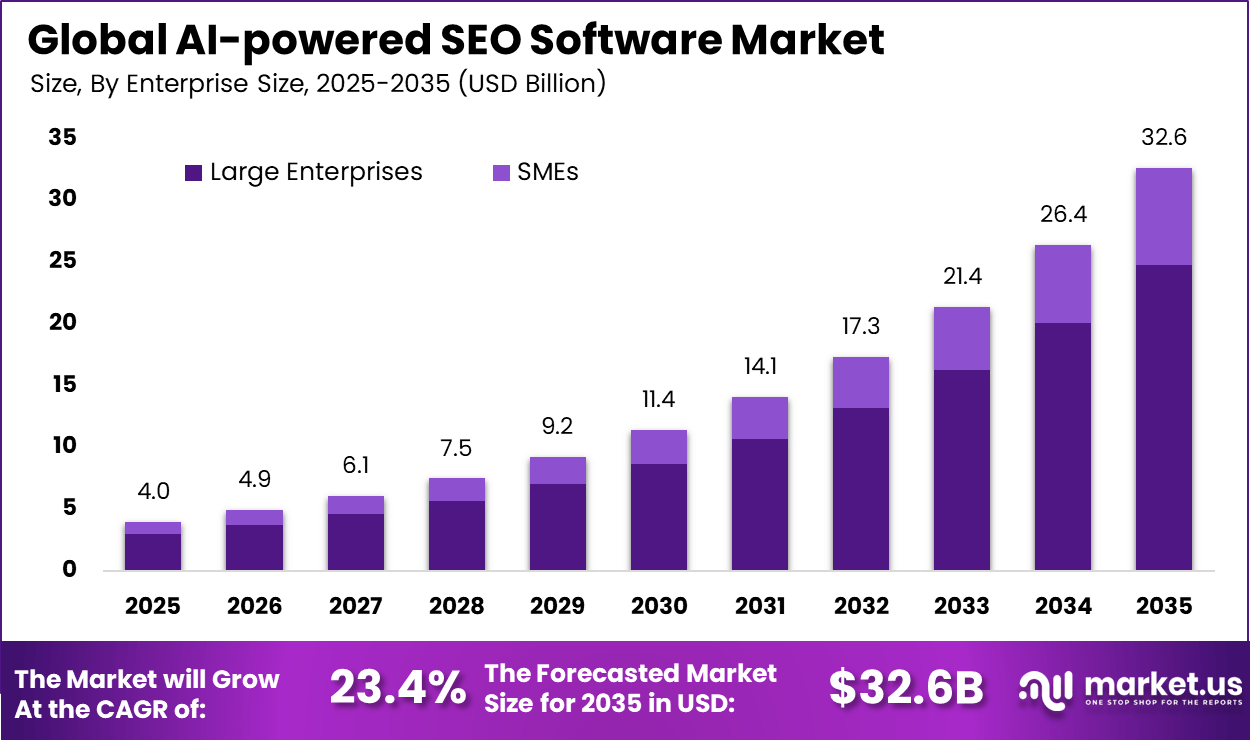
The Global AI-powered SEO Software Market size is expected to be worth around USD 32.6 billion by 2035, from USD 3.98 billion in 2025, growing at a CAGR of 23.4% during the forecast period from 2025 to 2035. North America held a dominant market position, capturing more than a38.4% share, holding USD 1.52 billion in revenue.
The AI powered SEO software market refers to tools and platforms that use artificial intelligence to automate, optimize, and enhance search engine optimization activities. These solutions apply machine learning, natural language processing, and predictive analytics to functions such as keyword research, content optimization, competitive analysis, link building insights, and performance forecasting. AI SEO software supports digital marketers, content strategists, and SEO specialists seeking greater efficiency and more accurate decision making.
One major driving factor of the AI powered SEO software market is the need for data driven insights in competitive digital environments. Marketers must understand user intent, search trends, and ranking signals to maintain or improve search performance. AI models can process vast datasets and extract actionable recommendations. This analytical advantage supports smarter and more timely SEO decisions.
AI adoption has become widespread across the SEO industry, reflecting a clear shift toward automation and efficiency. According to seoprofy, 86% of SEO professionals have already integrated AI into their strategies. A majority of experts, around 67%, identify automation of repetitive tasks as the primary benefit of generative AI. In addition, 65% of businesses report improved SEO outcomes after adopting AI driven tools.
Productivity gains are a major factor behind this adoption. Around 75% of marketers use AI to reduce time spent on manual activities such as keyword research and meta tag optimization. About 35% of companies rely on AI to build SEO focused content strategies, indicating growing trust in data driven planning. Furthermore, 52% of SEO professionals have observed measurable performance improvements from using AI for on page optimization.
Investment momentum remains strong, particularly among large organizations. Nearly 82% of enterprise SEO specialists plan to increase spending on AI based solutions. This trend highlights long term confidence in AI as a core component of SEO operations. As adoption deepens, AI is expected to play a central role in improving scalability, accuracy, and strategic decision making in search optimization.
Key Takeaway
- In 2025, large enterprises dominated adoption with a 75.9% share, reflecting higher investment capacity, complex SEO requirements, and strong demand for advanced automation and analytics capabilities.
- The on premises deployment model held a leading 67.4% share in 2025, indicating continued preference for greater data control, customization, and integration with internal digital infrastructure.
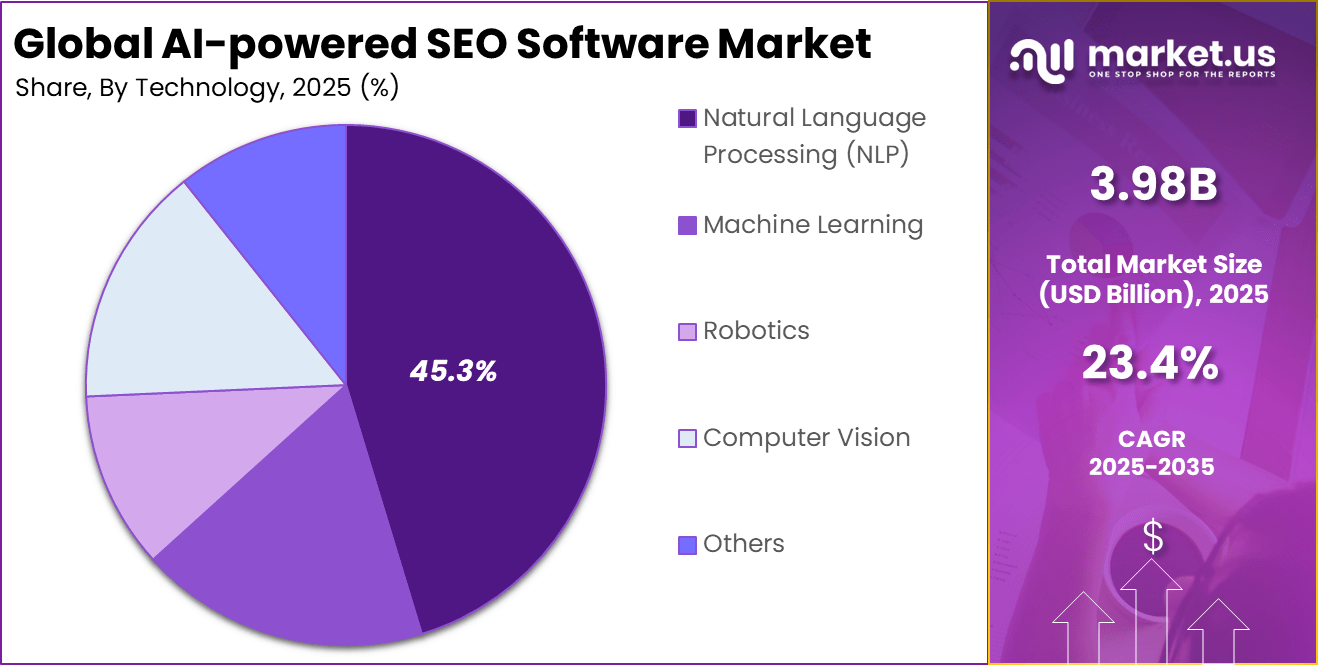
- Natural language processing emerged as the most influential technology, capturing a 45.3% share. This leadership was driven by its role in search intent analysis, content optimization, and semantic keyword modeling.
- The social media marketing application segment accounted for a 27.5% share, showing that AI driven SEO tools are increasingly used to align search visibility with social engagement and content distribution strategies.
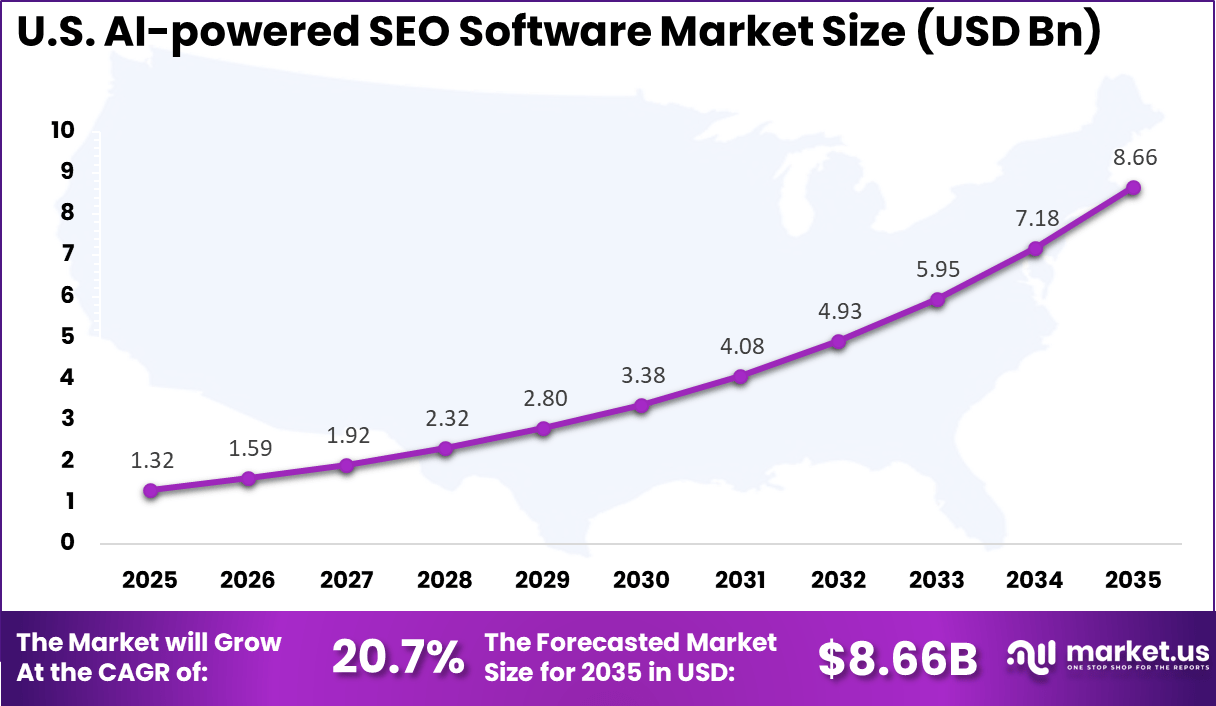
- The U.S. market was valued at USD 1.32 billion in 2025, expanding at a strong 20.7% growth rate, supported by high digital marketing spend and early adoption of AI based optimization tools.
- North America maintained regional leadership with more than a 38.4% share in 2025, backed by mature SEO practices, strong enterprise demand, and rapid integration of AI across digital marketing workflows.
Role of Generative AI
Generative AI plays a key role in AI-powered SEO software by automating content creation and optimization. It generates high-quality, keyword-rich content at scale, which helps websites rank higher in search results. Companies using these tools see search rankings improve by 30% within six months. Additionally, 68% of digital marketers adopt AI-based SEO tools to refine content strategy and keyword targeting.
This technology also enhances personalization and efficiency in SEO workflows. Generative AI analyzes user intent to produce tailored content that matches search queries better. It cuts manual effort by over 70% in some cases, allowing focus on strategy. Google search results now include 19% AI-generated content as of January 2025.
Drivers Impact Analysis
| Driver Category | Key Driver Description | Estimated Impact on CAGR (%) | Geographic Relevance | Impact Timeline |
|---|---|---|---|---|
| Shift to data driven marketing | Demand for automated SEO decision making | ~6.2% | Global | Short Term |
| Growth of enterprise digital presence | Large organizations managing multi channel SEO | ~5.1% | North America, Europe | Short to Mid Term |
| Advances in natural language processing | Improved content relevance and intent matching | ~4.4% | Global | Mid Term |
| Social media search convergence | SEO optimization across social platforms | ~3.9% | Global | Mid Term |
| Rising competition for organic traffic | Need for continuous optimization and insights | ~3.8% | Global | Long Term |
Risk Impact Analysis
| Risk Category | Risk Description | Estimated Negative Impact on CAGR (%) | Geographic Exposure | Risk Timeline |
|---|---|---|---|---|
| Search algorithm volatility | Frequent changes affecting tool accuracy | ~4.6% | Global | Short Term |
| Data privacy regulations | Restrictions on user level data usage | ~3.7% | Europe, North America | Mid Term |
| Over automation risk | Reduced human oversight impacting strategy | ~3.1% | Global | Mid Term |
| Integration challenges | Compatibility with existing marketing stacks | ~2.5% | Global | Mid Term |
| High enterprise switching costs | Vendor lock in concerns | ~2.0% | Global | Long Term |
Restraint Impact Analysis
| Restraint Factor | Restraint Description | Impact on Market Expansion (%) | Most Affected Regions | Duration of Impact |
|---|---|---|---|---|
| High licensing costs | Premium pricing for advanced AI features | ~4.8% | Emerging Markets | Short to Mid Term |
| Skills dependency | Need for SEO and AI expertise | ~3.9% | Global | Mid Term |
| Limited SME adoption | Smaller firms relying on manual SEO | ~3.2% | Emerging Markets | Short Term |
| Tool complexity | Steep learning curve for advanced platforms | ~2.6% | Global | Mid Term |
| Unclear ROI measurement | Difficulty attributing revenue impact | ~2.1% | Global | Long Term |
By Enterprise Size
Large enterprises account for 75.9%, showing their dominant role in the adoption of AI-powered SEO software. These organizations manage extensive digital properties and large volumes of content. AI-driven SEO tools help optimize performance across multiple websites and regions. Centralized platforms support consistent strategy execution. Scale increases the need for automation and analytics.
The dominance of large enterprises is driven by complex marketing operations. These organizations invest heavily in data-driven decision-making. AI-powered SEO software supports keyword analysis and performance tracking. Integration with enterprise marketing systems improves efficiency. This sustains strong adoption among large enterprises.
For Instance, in January 2025, Ahrefs raised USD 100 million in Series D funding to boost features for large-scale site audits and enterprise keyword tracking. This move targets big firms needing deep data analysis across massive domains. The funds support expanded server capacity for handling enterprise-level crawls without slowdowns.
By Deployment
On-premise deployment holds 67.4%, reflecting preference for local control over SEO systems. Organizations use on-premise solutions to manage sensitive data internally. This deployment model supports customization and integration with internal tools. Performance stability is a key advantage. Data ownership remains important.
Adoption of on-premise deployment is driven by security and compliance requirements. Enterprises prefer to control data access and processing. On-premise systems reduce dependency on external infrastructure. They also support tailored configurations. This keeps on-premise deployment widely used.
For instance, in May 2024, SEMrush teamed with Google Cloud but kept strong on-premise options via API integrations for self-hosted setups. Businesses deploy tools internally for private data handling in compliance-heavy environments. Supports heavy audits without cloud dependency.
By Technology
Natural language processing accounts for 45.3%, making it the leading technology in AI-powered SEO software. NLP enables analysis of search intent and content relevance. These tools improve keyword optimization and content structuring. Language understanding enhances ranking strategies. NLP supports semantic search alignment.
Growth in NLP adoption is driven by evolving search engine algorithms. Search platforms prioritize context and meaning over keywords alone. NLP helps SEO tools adapt to these changes. Improved content recommendations support better visibility. This keeps NLP central to SEO innovation.
| Technology Layer | Enablement Role | Impact on Market Growth (%) | Adoption Status |
|---|---|---|---|
| Natural language processing | Semantic content optimization | ~6.4% | Mature |
| Machine learning models | Keyword forecasting and ranking insights | ~5.2% | Growing |
| Predictive analytics | Traffic and conversion forecasting | ~4.1% | Growing |
| Automation engines | SEO task orchestration | ~3.6% | Developing |
| AI driven competitor analysis | Market positioning insights | ~2.9% | Developing |
For Instance, in September 2025, Conductor shared the 2025 AI search trends report, highlighting NLP for content intent matching. Their platform uses advanced NLP to optimize for AI overviews and semantic search. Helps align content with evolving query understanding.
By Type
Social media marketing represents 27.5%, highlighting its role within AI-powered SEO tools. SEO platforms increasingly analyze social signals and engagement. Social media content impacts brand visibility and traffic. AI tools help optimize posts and hashtags. Cross-channel alignment improves reach.
Adoption in this type is driven by integrated digital marketing strategies. Brands seek consistency across search and social platforms. AI-powered insights support content timing and targeting. Social engagement data informs SEO decisions. This supports steady growth in this segment.
For Instance, in February 2025, HubSpot Inc. launched the 2025 Social Trends Report with AI tools for social-SEO integration. Features track social signals to enhance search visibility and content distribution. Boosts campaigns by blending social engagement with organic rankings.
By Region
North America accounts for 38.4%, supported by advanced digital marketing adoption. Organizations in the region actively invest in AI-based SEO solutions. High competition drives demand for optimization tools. Digital infrastructure supports deployment. The region remains a key contributor.
| Region | Primary Growth Driver | Regional Share (%) | Regional Value (USD Bn) | Adoption Maturity |
|---|---|---|---|---|
| North America | Enterprise digital marketing maturity | 38.4% | USD 1.53 Bn | Advanced |
| Europe | Data driven content optimization | 27.6% | USD 1.10 Bn | Advanced |
| Asia Pacific | Rapid digital business expansion | 25.1% | USD 1.00 Bn | Developing to Advanced |
| Latin America | Growing online brand competition | 5.4% | USD 0.21 Bn | Developing |
| Middle East and Africa | Early stage SEO automation adoption | 3.5% | USD 0.14 Bn | Early |
For instance, in June 2025, Conductor launched its revolutionary AI platform, unifying proprietary data with AI for enterprise website optimization and Answer Engine Optimization (AEO). The platform accelerates content generation and visibility across Google and AI engines like ChatGPT, demonstrating North American innovation in AI SEO workflows.
The United States reached USD 1.32 Billion with a CAGR of 20.7%, reflecting strong market growth. Expansion is driven by enterprise digital transformation. Businesses prioritize search visibility and analytics. AI-powered SEO tools support marketing efficiency. Market momentum remains strong.
For instance, in September 2025, at Inbound 2025, HubSpot unveiled AI agents, including Breeze Customer Agent and Marketing Studio for AI-powered SEO content and personalization. These tools enhance visibility in AI search, reinforcing U.S. dominance in integrated CRM-SEO platforms for marketing automation.
Investor Type Impact Matrix
| Investor Type | Adoption Level | Contribution to Market Growth (%) | Key Motivation | Investment Behavior |
|---|---|---|---|---|
| Large enterprises | Very High | ~75.9% | Scalable and automated SEO operations | Platform wide deployment |
| Digital marketing agencies | High | ~12% | Client performance optimization | Tool bundling |
| SaaS companies | Moderate | ~7% | User acquisition efficiency | Selective adoption |
| Mid sized enterprises | Moderate | ~4% | Competitive positioning | Phased rollout |
| Startups | Low | ~1% | Cost sensitive experimentation | Limited usage |
Key Market Segments
By Enterprise Size
- SMEs
- Large Enterprises
By Deployment
- On-premise
- Cloud
By Technology
- Natural Language Processing (NLP)
- Machine Learning
- Robotics
- Computer Vision
- Others
By Type
- Social Media Marketing
- Email Marketing
- SEO Marketing
- Pay Per Click Marketing
- Display Marketing
- Video Marketing
- Content Marketing
- Others
Regional Analysis and Coverage
- North America
- US
- Canada
- Europe
- Germany
- France
- The UK
- Spain
- Italy
- Russia
- Netherlands
- Rest of Europe
- Asia Pacific
- China
- Japan
- South Korea
- India
- Australia
- Singapore
- Thailand
- Vietnam
- Rest of Latin America
- Latin America
- Brazil
- Mexico
- Rest of Latin America
- Middle East & Africa
- South Africa
- Saudi Arabia
- UAE
- Rest of MEA
Key Players Analysis
Ahrefs, Semrush, and SEOMoz, Inc. lead the AI powered SEO software market by offering advanced keyword intelligence, backlink analysis, and AI driven content optimization. Their platforms support competitive analysis, search intent mapping, and performance tracking across channels. These companies focus on data depth, accuracy, and actionable insights. Growing reliance on organic search for digital growth continues to reinforce their leadership.
BrightEdge Technologies, Inc., Conductor, and HubSpot, Inc. strengthen the market with enterprise focused SEO automation and content performance platforms. Their solutions integrate AI recommendations with marketing workflows and analytics dashboards. These providers emphasize ROI measurement, scalability, and collaboration across teams. Rising adoption among large enterprises and content led businesses supports wider usage.
Screaming Frog Ltd., WebFX, OuterBox, and other players expand the landscape with technical SEO auditing, site crawling, and AI assisted optimization services. Their offerings support mid sized businesses and agencies seeking efficiency and visibility. These companies focus on usability and rapid insights. Increasing algorithm complexity continues to drive steady growth in the AI powered SEO software market.
Top Key Players in the Market
- Ahrefs
- BrightEdge Technologies, Inc.
- Conductor
- HubSpot, Inc.
- Next Net Media
- Semrush
- Screaming Frog Ltd.
- SEOMoz, Inc.
- WebFX
- OuterBox
- Others
Recent Developments
- In September 2025, Ahrefs made a strategic acquisition of Detailed.com and its popular SEO browser extension, bringing Glen Allsopp on board full-time to bolster marketing strategy and product development. This move strengthens Ahrefs’ position in on-page auditing and data-driven SEO research, helping teams tackle AI search complexities more effectively.
- In September 2025, HubSpot rolled out Breeze AI agents at Inbound, including tools for SEO content creation and AI Search Grader to measure visibility in generative search. These integrate seamlessly with their CMS, making AI SEO accessible for marketers.









