


Report Overview
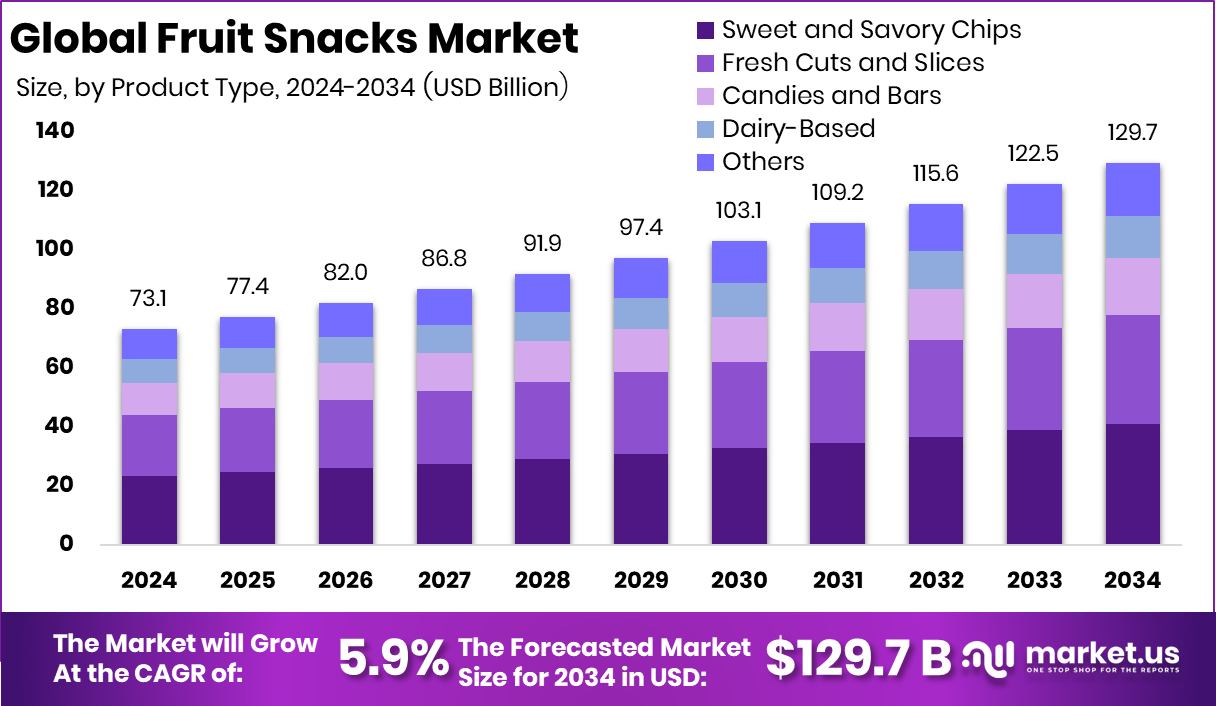
The Global Fruit Snacks Market is expected to be worth around USD 129.7 billion by 2034, up from USD 73.1 billion in 2024, and is projected to grow at a CAGR of 5.9% from 2025 to 2034. North America accounted for 44.90% of the fruit snacks market, totaling USD 32.8 Bn.
Fruit snacks are packaged food products made mainly from fruit or fruit-based ingredients, designed for easy, on-the-go consumption. They include dried fruit pieces, leathers, chews, bars, and baked or dehydrated snacks. These products are popular because they are convenient, portable, and often seen as a better alternative to traditional sugary snacks, especially for children and busy adults.
The Fruit Snacks Market refers to the global trade and consumption of these fruit-based snack products across retail and foodservice channels. The market covers multiple formats, fruit types, and distribution routes, serving households, schools, and workplaces. It sits between indulgent snacking and everyday nutrition, benefiting from demand for simple, familiar ingredients and easy portion control.
One major growth factor is the rising focus on fresh and natural food systems. However, challenges remain, as highlighted when Alabama schools lost USD 16 million in funding for fresh produce after USDA cuts, showing how public food programs strongly influence fruit demand and processing volumes. At the same time, infrastructure investment continues, such as a West Michigan fruit processor receiving incentives for a USD 32 million expansion, supporting long-term supply growth.
From a demand perspective, consumers increasingly prefer whole and recognizable ingredients. This is reflected in PlantBaby reaching a USD 20 million valuation, signaling strong interest in real, whole-food formulations over heavily processed alternatives. Similar demand patterns support fruit-based snack innovation across everyday diets.
Looking at opportunities, investment momentum is shaping future growth. Arummi secured USD 2 million to expand cashew milk operations, while Kern Tec raised €12 million to scale products made from upcycled fruit pits. These developments highlight opportunities for waste reduction, value addition, and new fruit-derived snack formats within the evolving market.
Key Takeaways
- The Global Fruit Snacks Market is expected to be worth around USD 129.7 billion by 2034, up from USD 73.1 billion in 2024, and is projected to grow at a CAGR of 5.9% from 2025 to 2034.
- Within the Fruit Snacks Market, sweet and savory chips led product types, capturing 31.7% share.
- By fruit type, apple dominated the Fruit Snacks Market, accounting for 28.5% consumption share.
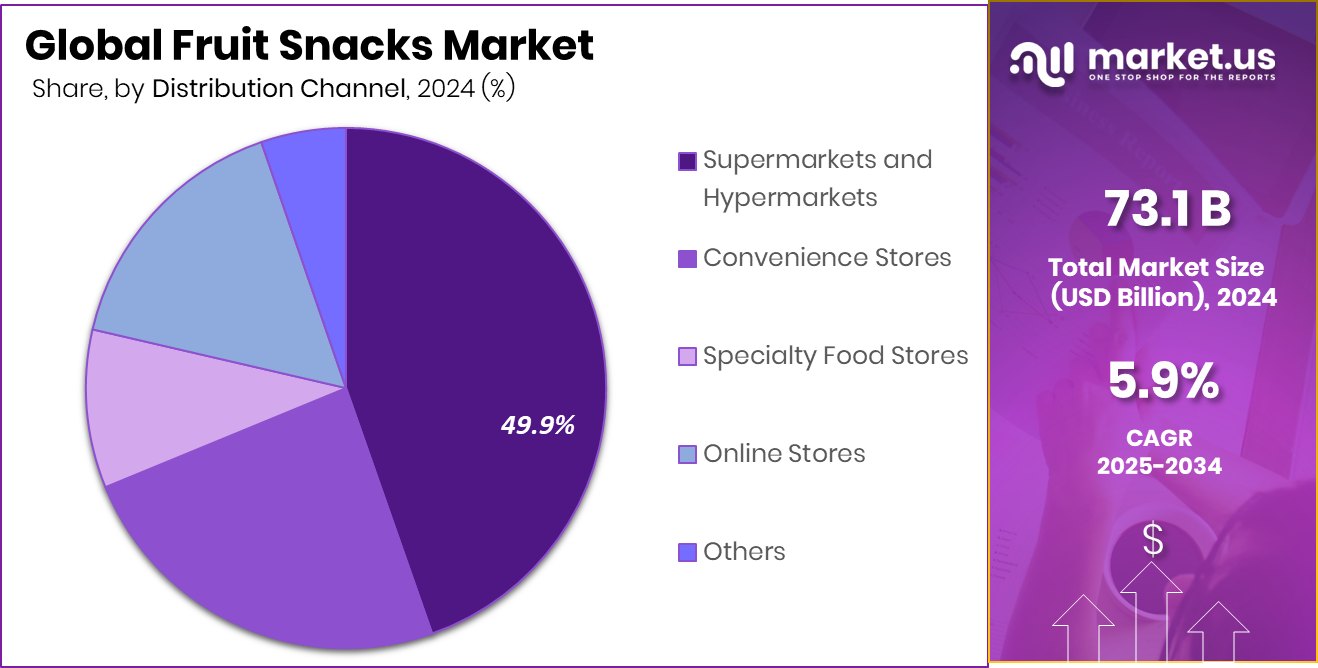
- Supermarkets and hypermarkets remained primary channels in the Fruit Snacks Market, representing 49.9% sales share.
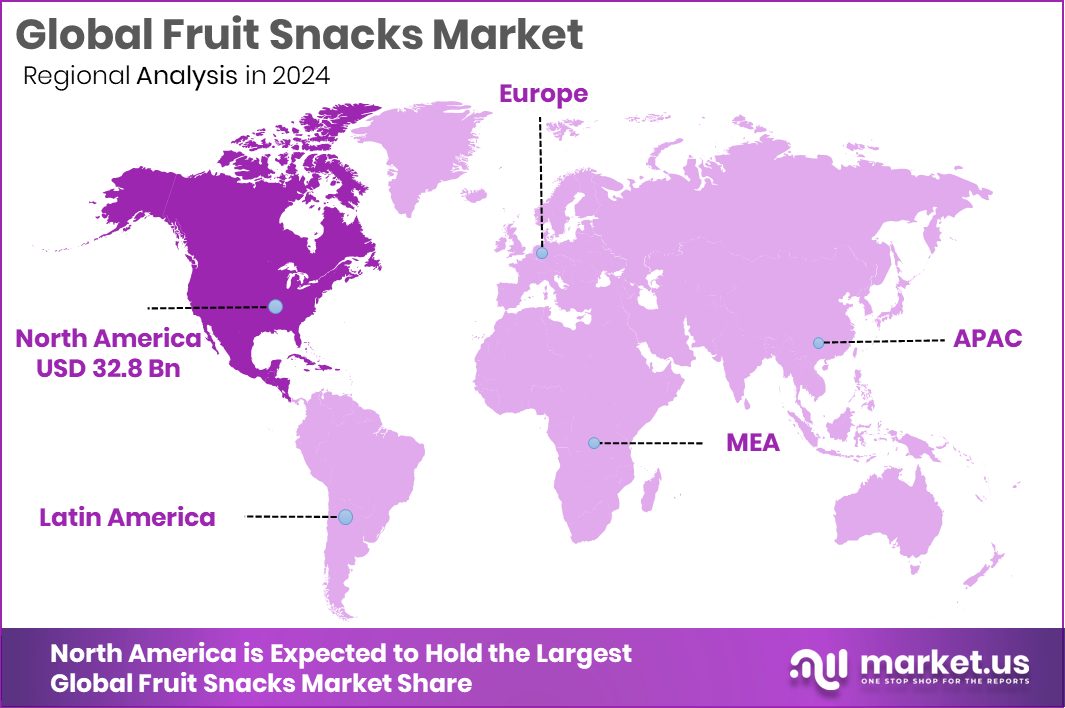
- The fruit snacks market in North America reached 44.90%, generating USD 32.8 Bn in value.
By Product Type Analysis
Sweet and savory chips lead the fruit snacks market with a 31.7% share.
In 2024, the Fruit Snacks Market by product type was led by Sweet and Savory Chips, holding a notable 31.7% share. This segment benefited from strong consumer interest in crunchy, flavorful snack formats that balance indulgence with perceived natural ingredients. Sweet variants appealed to younger consumers and families seeking convenient snack options, while savory fruit chips gained traction among health-conscious adults looking for alternatives to traditional fried snacks.
Advances in dehydration and baking technologies helped preserve taste and texture without heavy oil use. Brands also focused on clean labels, limited additives, and fruit-forward positioning, which strengthened consumer trust. As snacking occasions expanded beyond traditional meal gaps, sweet and savory fruit chips became a preferred everyday option.
By Fruit Type Analysis
Apple dominates the fruit snacks market by fruit type, holding a 28.5% share.
In 2024, segmentation by fruit type showed Apple dominating the Fruit Snacks Market with a 28.5% share. Apples remained the most widely used fruit due to their year-round availability, cost stability, and natural sweetness that suits multiple snack formats. Apple-based fruit snacks were easy to process into chips, leathers, and bite-sized pieces while maintaining appealing color and flavor.
Consumers associated apples with familiarity and nutrition, supporting repeat purchases across age groups. Manufacturers also leveraged apples as a base ingredient, blending them with other fruits to enhance taste profiles and manage raw-material costs. This versatility positioned apple fruit snacks as a cornerstone product across both mass-market and premium offerings.
By Distribution Channel Analysis
Supermarkets and hypermarkets dominate the fruit snacks market distribution, accounting for 49.9% of sales.
In 2024, Supermarkets and Hypermarkets emerged as the leading distribution channel in the Fruit Snacks Market, accounting for 49.9% of total sales. These large retail formats offered strong visibility, wide product assortments, and convenient access for family shoppers. Strategic shelf placement near healthy snacks and children’s food sections helped drive impulse purchases.
Retail promotions, private-label offerings, and bulk packaging further strengthened sales volumes. Consumers preferred supermarkets for comparing brands, checking ingredient labels, and benefiting from price discounts. As urbanization and organized retail penetration increased, supermarkets and hypermarkets continued to play a central role in shaping purchasing behavior and supporting the large-scale distribution of fruit snack products.
Key Market Segments
By Product Type
- Sweet and Savory Chips
- Fresh Cuts and Slices
- Candies and Bars
- Dairy-Based
- Others
By Fruit Type
- Apple
- Mango
- Banana
- Pineapple
- Berries
- Mixed
- Others
By Distribution Channel
- Supermarkets and Hypermarkets
- Convenience Stores
- Specialty Food Stores
- Online Stores
- Others
Driving Factors
Rising Investment Fuels Fruit Snack Innovation
The Fruit Snacks Market is strongly driven by rising investment in natural, whole-fruit snack brands. New funding is helping companies improve sourcing, processing, and distribution of fruit-based snacks that appeal to health-focused consumers. This trend is clearly visible as The Ugly Company raised USD 9 million in Series A funding, supporting products made from imperfect but edible fruits, reducing waste while keeping nutrition intact.
Similarly, ReelFruit, a Nigerian whole-fruit snack brand, secured USD 3 million in funding to expand production and reach more regional and international consumers. These investments show growing confidence in fruit snacks as scalable, everyday food options. Capital support allows brands to improve shelf life, packaging, and affordability, making fruit snacks more accessible across urban and semi-urban markets while supporting sustainable food systems.
Restraining Factors
Pricing Pressure Limits Consumer Accessibility
Despite growing interest, pricing remains a key restraining factor in the Fruit Snacks Market. Many fruit snacks cost more than conventional snacks due to raw fruit prices, processing needs, and shorter shelf lives. New brands are working to overcome this challenge, but cost sensitivity remains high. Final Boss Sour raised USD 4 million in Seed 2 funding, aiming to create healthier sour snacks while balancing taste and price, showing how innovation still requires heavy capital.
Likewise, TABP Snacks and Beverages raised USD 3 million, focusing on expanding operations and improving efficiency. These funding rounds highlight that while demand exists, significant financial support is needed to control costs, maintain quality, and keep fruit snacks affordable for price-conscious consumers.
Growth Opportunity
Untapped Regional Markets Create Expansion Potential
The Fruit Snacks Market presents strong growth opportunities through expansion into new regions and retail formats. Smaller brands are using funding to enter untapped local and international markets where packaged fruit snacks are still emerging. Oddball raised USD 2 million in seed funding to expand its footprint, focusing on wider retail reach and supply chain improvements.
In India, healthy snacking startup Natch secured Rs 3 crore in seed funding, supporting product development and regional expansion. These investments point to growing demand beyond major cities, especially among younger consumers and working families. Expansion into schools, offices, and convenience stores offers long-term volume growth, making regional penetration a key opportunity driver.
Latest Trends
Traditional Fruit Formats Meet Modern Branding Trends
A major trend in the Fruit Snacks Market is the modernization of traditional fruit snacks through branding and organized production. Banana chips, once largely unbranded, are now gaining premium positioning. This shift is highlighted by Beyond Snack raising USD 8.3 million in a Series A round, supporting large-scale production, improved packaging, and wider distribution. The funding reflects growing demand for consistent quality and hygienically produced fruit snacks.
By combining familiar fruit formats with modern branding and supply chains, companies are attracting both domestic and global consumers. This trend shows how traditional fruit-based snacks are evolving into structured, scalable products suited for modern retail and export markets.
Regional Analysis
North America led the fruit snacks market at 44.90% share, valued at USD 32.8 Bn.
The Fruit Snacks Market shows clear regional differentiation, led strongly by North America, which stands as the dominating region with a 44.90% market share, valued at USD 32.8 Bn. This leadership reflects high consumer preference for convenient, packaged snack formats and strong penetration of organized retail channels supporting consistent product availability.
North America benefits from established consumption habits, broad flavor acceptance, and steady demand across children and adult demographics. Europe represents a mature and structured market, characterized by steady consumption patterns and emphasis on quality, ingredient transparency, and balanced snacking choices. In the Asia Pacific, the market continues to evolve, driven by urbanization, changing lifestyles, and growing acceptance of packaged snack products within daily routines.
The Middle East & Africa region reflects selective demand, where fruit snacks are gradually integrated into modern retail and convenience-driven consumption patterns. Latin America shows developing market characteristics, with demand shaped by expanding retail access and increasing exposure to packaged snack categories. Overall, regional performance highlights North America’s clear dominance while other regions contribute through gradual, structurally driven market expansion.
Key Regions and Countries
- North America
- US
- Canada
- Europe
- Germany
- France
- The UK
- Spain
- Italy
- Rest of Europe
- Asia Pacific
- China
- Japan
- South Korea
- India
- Australia
- Rest of APAC
- Latin America
- Brazil
- Mexico
- Rest of Latin America
- Middle East & Africa
- GCC
- South Africa
- Rest of MEA
Key Players Analysis
PepsiCo Inc remains a structurally strong player in the global Fruit Snacks Market in 2024 due to its deep expertise in packaged foods, brand management, and large-scale distribution. The company benefits from its ability to integrate fruit snack offerings within broader snack portfolios, allowing efficient shelf placement and cross-category visibility. PepsiCo’s operational scale supports consistent quality, wide geographic reach, and steady product innovation aligned with evolving consumer snacking habits, reinforcing its long-term competitive positioning in fruit-based snacks.
Brothers International Food Corporation is viewed as a focused specialist with strong alignment to fruit-forward snacking trends. The company’s emphasis on fruit-only ingredients and processing expertise strengthens its credibility among consumers seeking simple and recognizable snack options. In 2024, Brothers International Food Corporation benefits from its agility in product development and its ability to scale niche fruit snack formats across multiple retail channels, positioning it well within premium and clean-label fruit snack segments.
Pilgrim Food Group PLC holds a strategic role in the Fruit Snacks Market through its manufacturing capabilities and private-label expertise. The company supports retailers with consistent supply, flexible product specifications, and cost-efficient production. In 2024, Pilgrim Food Group PLC’s strength lies in serving value-driven and mainstream fruit snack demand, helping retailers expand fruit snack availability while maintaining competitive pricing and dependable quality standards.
Top Key Players in the Market
- PepsiCo Inc
- Brothers International Food Corporation
- Pilgrim Food Group PLC
- Crispy Green Inc.
- General Mills Inc.
- Kellogg Company
- Sunkist Growers Incorporated
- SunOpta Inc
- The Hershey Company
- Welch Foods Inc.
Recent Developments
- In March 2025, PepsiCo Inc., a global food and drink company, announced it would acquire Poppi, a U.S. prebiotic soda brand, for about $1.95 billion (net ~$1.65 billion). This deal closed in May 2025 and expands PepsiCo’s portfolio into healthier, fruit-juice-based functional beverages with low sugar and prebiotic ingredients. The acquisition aims to tap into the growing demand for better-for-you drinks and broaden PepsiCo’s product range beyond traditional sodas.
- In March 2025, The Hershey Company introduced Jolly Rancher Freeze Dried Candy, a new version of its fruity Jolly Rancher line with an airy, crunchy texture while keeping the bold fruit flavors fans love. The product extends Hershey’s fruit-flavored candy offerings beyond traditional gummies and chews to meet consumer demand for novel fruity snack formats.
- In October 2024, Welch’s Fruit Snacks introduced Welch’s Absolute Fruitfuls Fruit Strips made from whole fruit. These soft, individually wrapped fruit strips come in strawberry, mango-peach, and berry medley flavors and are gluten-free, vegan, non-GMO, and a good source of vitamin C, offering a fresh snack choice beyond traditional gummies.









