


Report Overview
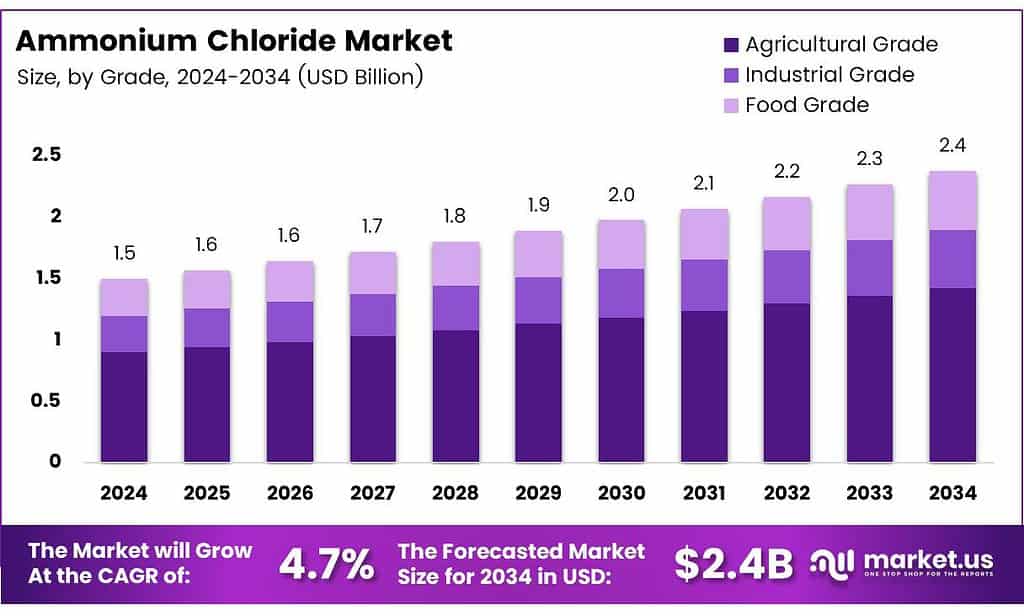
The Global Ammonium Chloride Market size is expected to be worth around USD 2.4 billion by 2034, from USD 1.5 billion in 2024, growing at a CAGR of 4.7% during the forecast period from 2025 to 2034.
The Ammonium Chloride Market represents the commercial ecosystem surrounding the production, distribution, and application of ammonium chloride across agriculture and industry. Broadly, it serves fertilizer demand, metal processing, pharmaceuticals, batteries, and chemical synthesis. Importantly, steady downstream usage continues to support consistent market relevance across emerging and mature economies.
Ammonium Chloride, as a compound, functions primarily as a nitrogen source and process chemical. It supports soil nutrition, metal surface treatment, and buffering applications. Consequently, its predictable chemical behavior and ease of storage make it suitable for large-scale supply chains, especially where operational stability and consistent quality are essential.
- Ammonium chloride powder is a high-purity fertilizer-grade material supplied in powder form for ease of handling. According to fertilizer technical manuals published by FAO and national agriculture departments, typical commercial grades reach 99.5% purity, remain stable at room temperature, and exhibit a melting point of 340°C, ensuring thermal reliability. Ammonium chloride contains 25% nitrogen entirely in ammoniacal form, supporting gradual nitrogen uptake.
Demand expansion is driven by fertilizer consumption and industrial recovery cycles. Rising food security programs, soil productivity improvement initiatives, and moderate industrialization in developing regions continue to reinforce consumption. Meanwhile, controlled nutrient release characteristics improve acceptance among farmers seeking yield reliability and cost efficiency.
Key Takeaways
- The Global Ammonium Chloride Market is projected to grow from USD 1.5 billion in 2024 to USD 2.4 billion by 2034, registering a 4.7% CAGR during 2025–2034.
- Agricultural Grade leads the By Grade segment with a dominant share of 43.7%, driven by its widespread use in crop nutrition.
- Powder Form dominates the By Form segment, accounting for 54.1% of total market demand due to ease of handling and application.
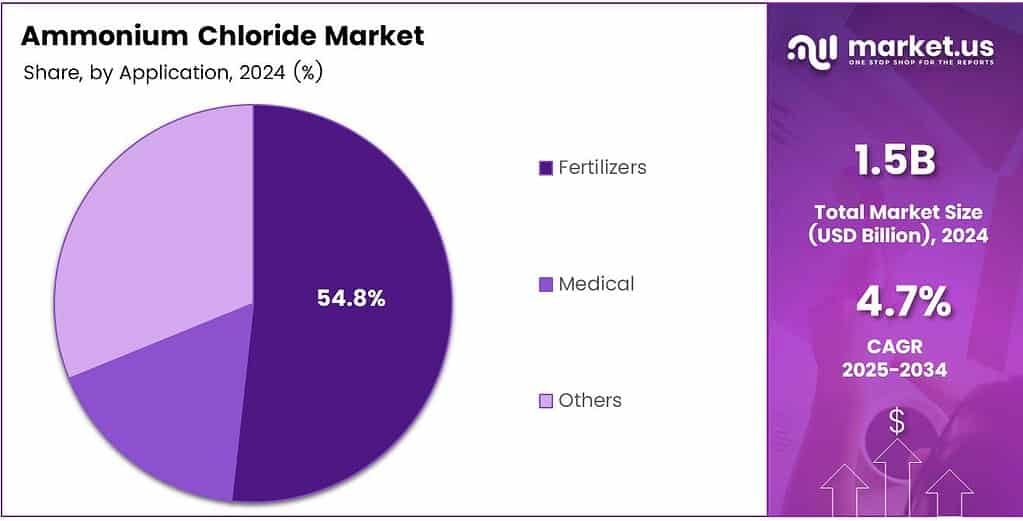
- Fertilizers remain the largest application area, holding a market share of 54.8% in 2024.
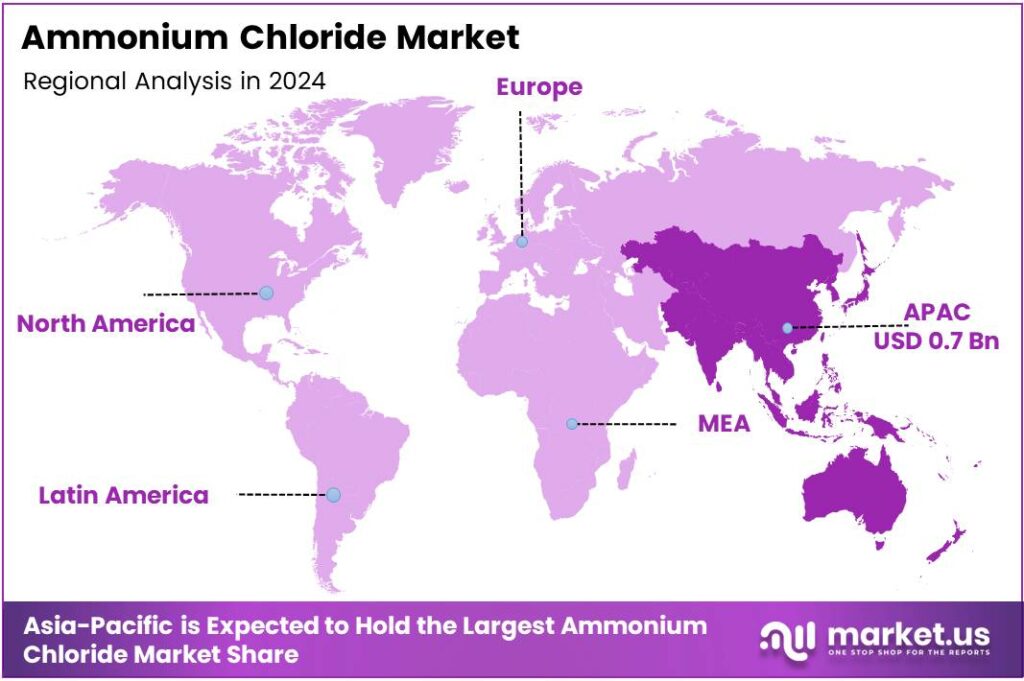
- Asia Pacific is the leading region, capturing 47.3% of global demand and valued at USD 0.7 billion.
By Grade Analysis
Agricultural Grade dominates with 43.7% due to its extensive use in crop nutrition and soil conditioning.
In 2024, Agricultural Grade held a dominant market position in the By Grade Analysis segment of the Ammonium Chloride Market, with a 43.7% share. This leadership is driven by consistent demand from fertilizer blending, rice cultivation, and wheat farming. Moreover, its role in improving nitrogen availability supports large-scale agricultural productivity.
Industrial Grade ammonium chloride followed as an important sub-segment, supported by its usage in metal processing, dry cell batteries, and textile applications. Gradually, industries prefer this grade for controlled chemical reactions and surface treatment processes. As industrial output expands, this segment continues to show steady and reliable demand patterns.
Food-grade ammonium chloride represents a smaller yet specialized segment, mainly used as a food additive and flavoring agent. Although limited in volume, it plays a critical role in bakery products and yeast processing. Increasing food safety compliance further shapes its controlled but stable consumption.
By Form Analysis
Powder Form dominates with 54.1% owing to its ease of handling, storage, and application flexibility.
In 2024, Powder Form held a dominant market position in the By Form Analysis segment of the Ammonium Chloride Market, with a 54.1% share. This form is widely preferred due to its high solubility and compatibility with agricultural and industrial processes. Additionally, transportation efficiency supports its broader adoption.
Granular Form is gradually gaining attention, especially in fertilizer applications requiring slow and uniform nutrient release. This form reduces dust generation and improves field application efficiency. As mechanized farming expands, granular ammonium chloride continues to gain gradual acceptance across farming regions.
Liquid Form remains a niche segment, mainly used in specialized industrial and laboratory applications. While its usage volume is limited, it offers advantages in precise dosing and rapid mixing. Consequently, this form supports selective applications rather than large-scale consumption.
By Application Analysis
Fertilizers dominate with 54.8% driven by strong dependence on nitrogen-based crop inputs.
In 2024, Fertilizers held a dominant market position in the By Application Analysis segment of the Ammonium Chloride Market, with a 54.8% share. This dominance reflects its essential role in enhancing crop yield and soil fertility. Continuous agricultural demand strongly sustains this application segment.
Medical applications account for a smaller yet vital share, where ammonium chloride is used in expectorants and acidifying agents. Gradually, pharmaceutical formulations rely on their precise chemical properties. Strict quality standards limit volume but ensure consistent demand within healthcare systems.
Others include applications in batteries, textiles, and laboratory chemicals. Although fragmented, this segment supports diverse end uses. Over time, incremental industrial innovation and specialty chemical needs contribute to steady utilization across these miscellaneous applications.
Key Market Segments
By Grade
- Agricultural Grade
- Industrial Grade
- Food Grade
By Form
- Powder Form
- Granular Form
- Liquid Form
By Application
- Fertilizers
- Medical
- Others
Emerging Trends
Shift Toward Controlled and Efficient Fertilizer Use Shapes Market Trends
One key trend in the ammonium chloride market is the move toward controlled fertilizer application. Farmers are adopting better nutrient management practices to reduce waste and environmental harm. This changes how ammonium chloride is formulated and applied.
- International Fertilizer Association, more than 70% of industrial ammonium chloride output in Asia now comes from integrated chemical operations where it is produced as a secondary product, lowering energy intensity and emissions per tonne.
The market is becoming more mature, with a focus on quality, purity, and consistent supply. Industrial buyers prefer reliable suppliers with strong compliance records. Local manufacturing helps ensure steady availability and lower transportation costs. This trend supports long-term market stability rather than short-term expansion.
Drivers
Rising Use of Ammonium Chloride in Agriculture Drives Market Growth
The ammonium chloride market is mainly driven by its steady demand in agriculture. Farmers use ammonium chloride as a nitrogen-based fertilizer, especially for crops grown in alkaline soils. It helps improve soil quality and supports healthy crop growth. As food demand increases due to population growth, fertilizer consumption continues to rise, supporting market expansion.
Ammonium chloride is used in metalworking, galvanizing, and soldering as a fluxing agent. These processes depend on ammonium chloride to clean metal surfaces and improve bonding. Growth in construction, automotive, and manufacturing activities increases the need for such materials.
The pharmaceutical and medical sectors also support market growth. Ammonium chloride is used in expectorants and cough medicines. Rising healthcare spending and demand for basic medicines in developing regions add to stable consumption. Its low cost and proven effectiveness make it a preferred ingredient.
Restraints
Environmental and Handling Concerns Limit Market Expansion
One major restraint for the ammonium chloride market is environmental regulation. Excessive use in agriculture can lead to soil salinity and water contamination. Governments are becoming stricter about fertilizer usage, which can limit demand growth in some regions.
- In agriculture, ammonium chloride is valued as a nitrogen source for chloride-tolerant crops such as rice and wheat. The Food and Agriculture Organization reports that global nitrogen fertilizer consumption exceeded 113 million tonnes, with Asia accounting for nearly 60% of use.
Health and safety concerns also act as restraints. Ammonium chloride dust can irritate if inhaled or handled without protection. This increases compliance costs for manufacturers and users, especially in industrial settings. Smaller companies may struggle to meet safety standards.
Growth Factors
Expanding Industrial Manufacturing Creates New Growth Opportunities
Growth opportunities for the ammonium chloride market are linked to industrial expansion in emerging economies. Rapid growth in metal fabrication, electronics, and battery production increases demand for ammonium chloride as a processing aid. These industries value their reliability and cost-effectiveness.
There is also an opportunity in water treatment and specialty chemical applications. Ammonium chloride is used in laboratory reagents and niche chemical processes. As research activities and specialty manufacturing increase, demand from these segments may rise steadily.
Additionally, improving production technologies can lower costs and reduce environmental impact. This allows manufacturers to meet regulations while improving margins. Companies investing in cleaner production methods may gain long-term growth advantages.
Regional Analysis
Asia Pacific Dominates the Ammonium Chloride Market with a Market Share of 47.3%, Valued at USD 0.7 billion
Asia Pacific leads the global Ammonium Chloride market due to strong consumption across agriculture, fertilizers, and industrial processing sectors. In this region, the market accounted for 47.3% of global demand and reached a value of USD 0.7 billion, supported by large-scale farming activity and expanding chemical manufacturing capacity. Rapid industrialization and consistent fertilizer usage continue to reinforce regional dominance.
North America represents a stable and mature market for Ammonium Chloride, driven by steady demand from agriculture, pharmaceuticals, and metalworking applications. The region benefits from well-established production infrastructure and regulated usage across end-use industries. Demand growth remains moderate, supported by technological improvements and consistent downstream consumption.
Europe shows measured demand for Ammonium Chloride, largely influenced by regulatory oversight and controlled fertilizer usage. Industrial-grade consumption remains important across chemical processing and specialty applications. Sustainability policies and efficiency-driven practices shape market development rather than volume expansion.
The U.S. market is characterized by consistent demand from industrial processing, pharmaceuticals, and specialty agriculture uses. Regulatory compliance and quality standards strongly influence product usage. Market activity remains steady, supported by diversified applications rather than rapid volume growth.
Key Regions and Countries
North America
- US
- Canada
Europe
- Germany
- France
- The UK
- Spain
- Italy
- Rest of Europe
Asia Pacific
- China
- Japan
- South Korea
- India
- Australia
- Rest of APAC
Latin America
- Brazil
- Mexico
- Rest of Latin America
Middle East & Africa
- GCC
- South Africa
- Rest of MEA
Key Players Analysis
Apollo Fertilizer typically aligns ammonium chloride output with fertilizer demand cycles, so its 2024 playbook is usually about steady availability and cost discipline. For buyers, the value is a predictable supply for blending and N-source applications, especially when logistics and seasonal ordering matter. The key watchpoint is how well it manages raw-material swings without disrupting contract terms.
Arkema Group. It is better viewed through the lens of downstream performance chemicals and customer specifications, where ammonium chloride can sit inside tightly controlled production windows. In 2024, its market impact is often felt in quality consistency, documentation, and compliance readiness for industrial customers. The company’s strength is servicing applications that prioritize purity, traceability, and stable technical support.
BASF SE brings scale, integrated operations, and process discipline that can stabilize deliveries when demand shifts across regions. In 2024, BASF’s influence is less about aggressive pricing and more about reliability, standardized product quality, and long-term customer programs. For large industrial users, that operational depth can reduce supply risk and simplify procurement planning.
Central Glass Co. Ltd. tends to compete on specialty-chemicals know-how and controlled manufacturing, which supports customers needing consistent performance in niche or sensitive uses. In 2024, its advantage is often responsiveness for specification-driven orders and the ability to support tailored requirements. The main differentiator is dependable quality for applications where variability can disrupt downstream yields.
Top Key Players in the Market
- Apollo Fertilizer
- Arkema Group
- BASF SE
- Central Glass Co. Ltd.
- Chemcon Speciality Chemicals Ltd.
- FUJI KASEI Co., Ltd.
- GFS Chemicals Inc.
- HELM AG
- Jiangsu Debang Chemical Industry Group Co., Ltd
- Nanoshel LLC
Recent Developments
- In 2025, Apollo Fertilizer Limited’s recent developments were found to be specifically related to ammonium chloride from official or government sources. The company, an American fertilizer producer with manufacturing ties in China, includes ammonium chloride among its product offerings, which encompass various nitrogen-based fertilizers.
- In 2025, BASF became the first producer of renewable ammonia in Central Europe, introducing two new sustainable grades—renewable ammonia and renewable ammonia solution, which could support downstream production of ammonium-based compounds like ammonium chloride.









