


Report Overview
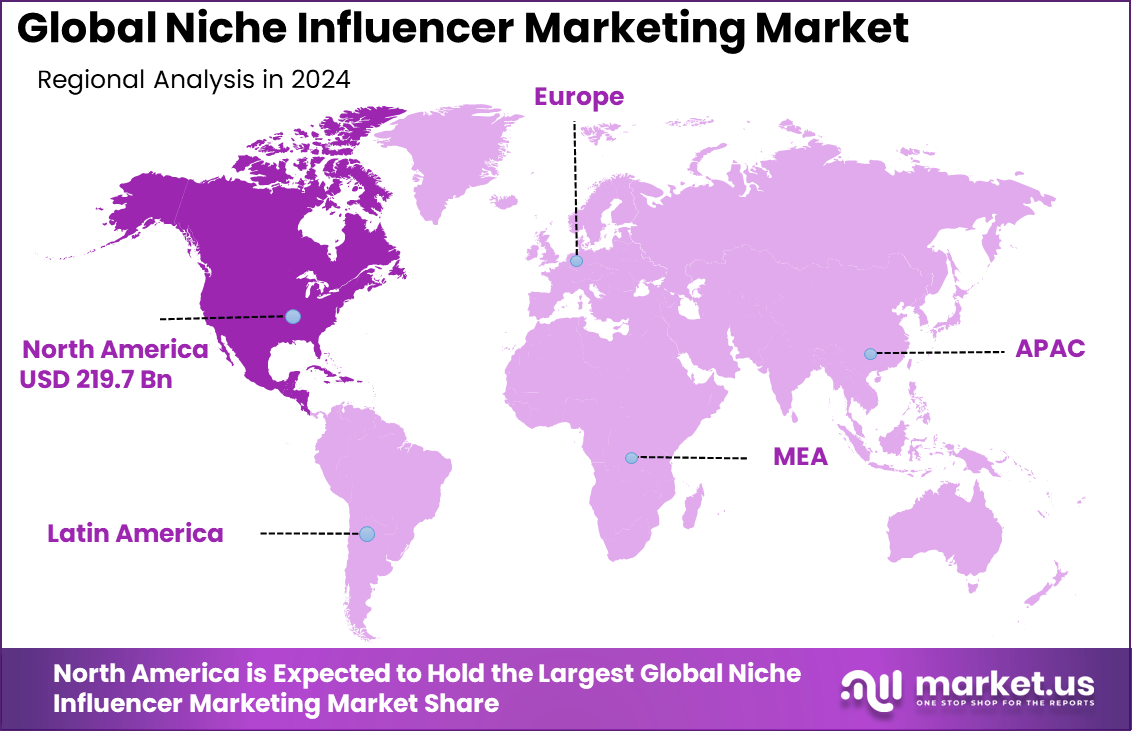
The Global Niche Influencer Marketing Market size is expected to be worth around USD 8,547.9 million by 2034, from USD 486.2 million in 2024, growing at a CAGR of 33.2% during the forecast period from 2025 to 2034. North America held a dominant market position, capturing more than a45.2% share, holding USD 219.7 million in revenue.
The niche influencer marketing market refers to the ecosystem of digital platforms, services, and strategies that connect specialized content creators with brands targeting specific audience segments. These influencers operate within defined verticals such as fitness, beauty, gaming, parenting, sustainable living, and technology, where they maintain high levels of authenticity and engagement. Brands leverage niche influencers to reach highly relevant communities with tailored messaging that aligns with consumer interests and preferences.
The market includes influencer discovery tools, campaign management platforms, performance analytics, and content collaboration services designed for targeted marketing initiatives. Growth in this market has been supported by the increasing importance of authentic engagement and relevance in brand communications. As consumers become more selective in media consumption, general mass reach campaigns have given way to targeted influencer partnerships that resonate on a personal level.
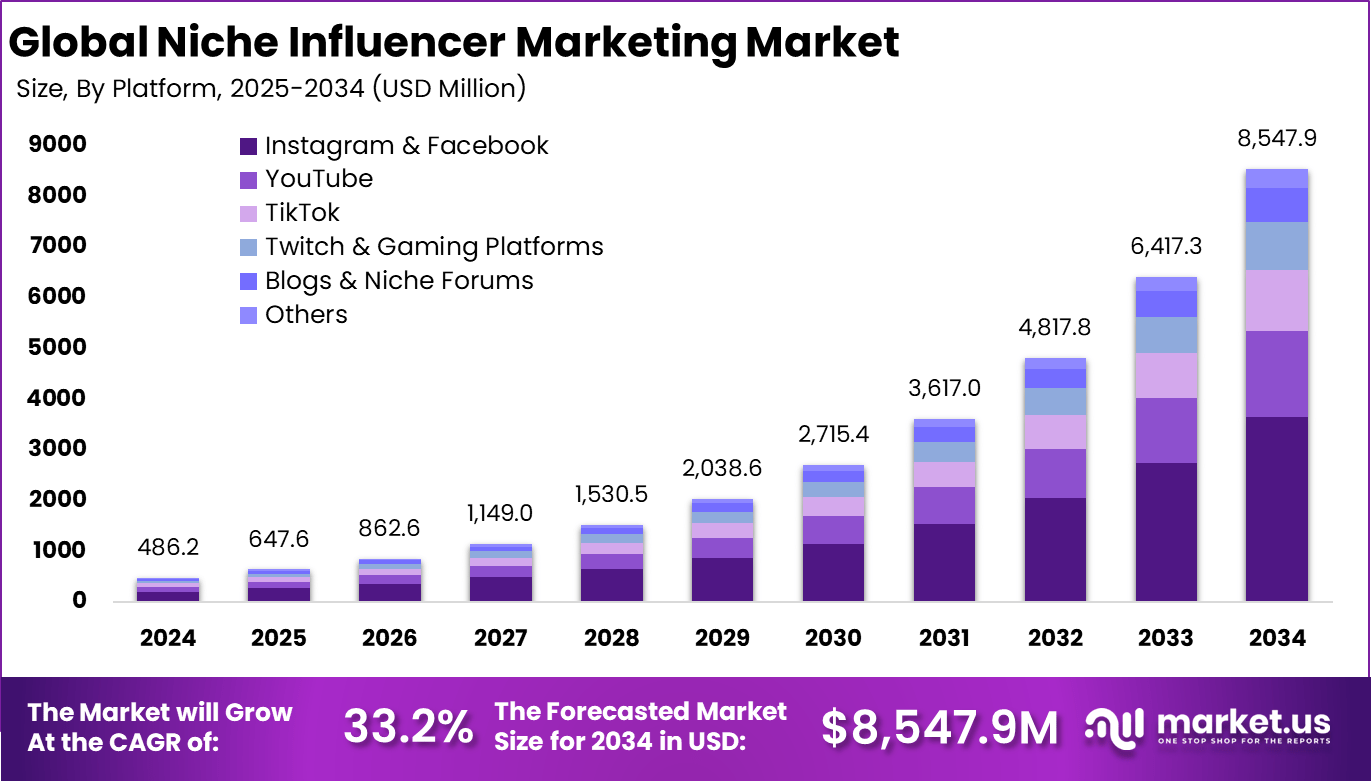
Demand for niche influencer marketing is shaped by the need for personalized brand engagement across digital channels. Consumers are more likely to respond to content that reflects their unique interests and lifestyles, which niche influencers are positioned to deliver. Brands targeting segmented audiences, whether by interest niche or demographic subgroup, view influencer collaborations as a pathway to authentic interaction. This dynamic reinforces sustained demand for niche marketing approaches.
For instance, in October 2025, Aspire teamed up with Meta for AI-driven Instagram discovery, letting brands snag niche creators whose fans match buyer profiles spot-on. Campaigns kicked off faster with real-time chats, cutting hunt time while boosting authentic fits. This edge keeps North American tools ahead in smart, targeted outreach.
According to sproutsocial, influencer marketing continued to show strong growth and adoption across global brands. About 86% of U.S. marketers planned to partner with influencers in 2025, highlighting its importance within modern marketing strategies. Globally, 26% of marketing agencies and brands allocated more than 40% of their total marketing budgets to influencer marketing. The influencer marketing industry was valued at approximately USD 24 billion in 2024, reflecting its expanding commercial scale.
Platform preference remained concentrated among leading social networks and creative collaboration gained importance. Around 57% of brands selected Instagram as their preferred platform for influencer campaigns, followed closely by TikTok at 52%. YouTube was chosen by 37% of brands, while 28% preferred Facebook and 12% opted for LinkedIn. Additionally, 65% of influencers indicated a strong interest in being involved in the creative process, supporting a shift toward more collaborative campaign models.
Key Niche Influencer Marketing Insights
- In 2024, Instagram and Facebook emerged as the leading platforms, capturing a 42.7% share. Their dominance was supported by mature creator ecosystems, advanced targeting tools, and strong engagement within niche communities.
- The Beauty and Skincare segment held a dominant 28.9% share in 2024. This leadership reflected high consumer trust in creator recommendations and the visual, tutorial-driven nature of the category.
- Brand awareness and content creation represented the primary campaign objective, accounting for a 52.6% share. This indicates that niche influencer strategies were mainly used to build authenticity, recall, and long-term brand perception.
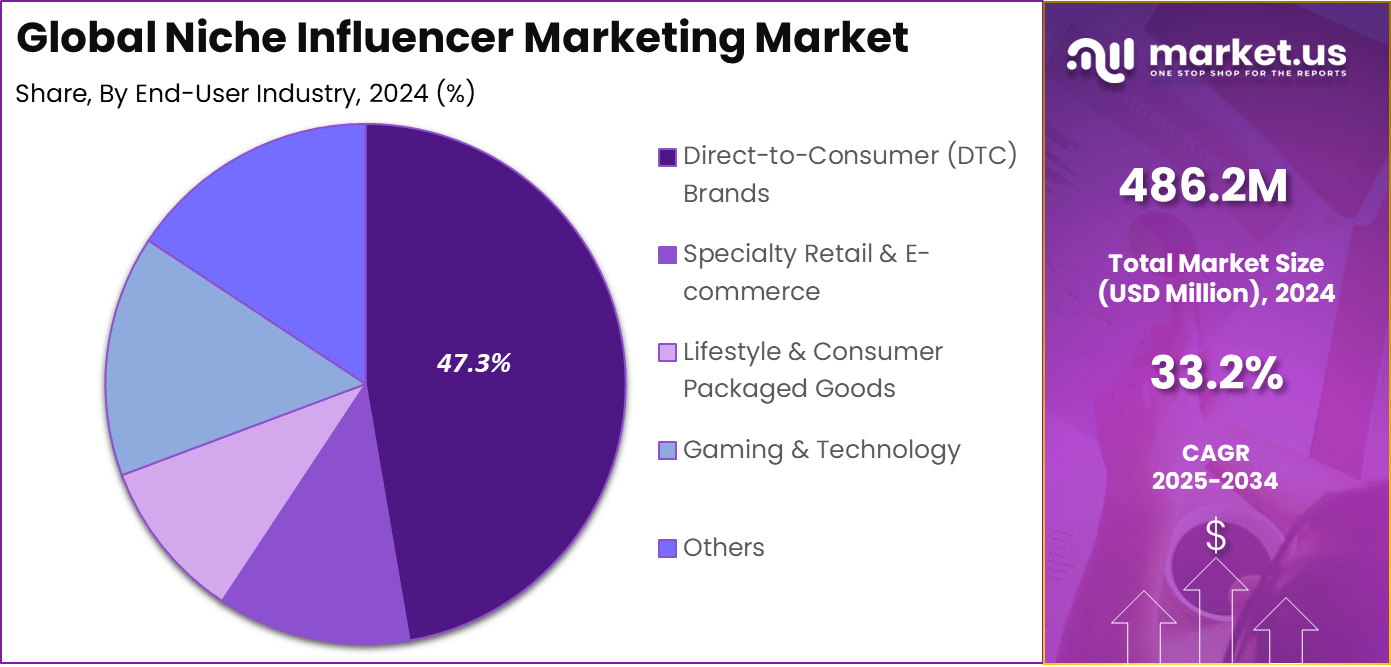
- Direct-to-consumer brands led adoption with a 47.3% share in 2024. Their dominance was driven by the need for cost-efficient customer acquisition and direct engagement with highly targeted audiences.
- The United States remained a key growth engine in 2024, supported by high social media penetration and early adoption of creator-led marketing strategies.
- North America held regional leadership with more than a 45.2% share in 2024, reflecting strong brand spending on niche creators and advanced digital marketing infrastructure.
Key Statistics and Trends
- Niche-focused creators continued to deliver stronger audience interaction, as 18% engagement was recorded for TikTok nano influencers, compared with about 5% on Instagram. In parallel, micro influencer campaigns generated nearly 60% higher engagement, reinforcing the value of smaller, trust-based communities.
- Influencer activity showed a direct impact on purchasing behavior, with 86% of consumers making at least one influencer driven purchase each year. Short form video proved especially effective, as 79% of Instagram Reels viewers reported buying products after exposure.
- Platform preferences shifted in 2024, with TikTok becoming the most widely used channel for influencer campaigns at 69% brand adoption, ahead of Instagram at 47%. This change reflects growing brand focus on video-first discovery and rapid audience reach.
- Category performance varied by niche, as 81.4% adoption was observed in fashion-focused influencer activity, making it the most developed segment. At the same time, sports and fitness content showed consistently high engagement levels on Instagram.
- Trust remained a central factor in campaign effectiveness, with 36% of marketers reporting that influencer content outperformed their own branded material. Consumer confidence was also strong, as 69% of audiences stated they rely on influencer recommendations when evaluating products.
Drivers Impact Analysis
| Driver Category | Key Driver Description | Estimated Impact on CAGR (%) | Geographic Relevance | Impact Timeline |
|---|---|---|---|---|
| Shift toward micro and niche creators | Higher engagement and trust compared with mass influencers | ~9.1% | North America, Europe | Short Term |
| Growth of DTC brands | DTC companies rely on targeted influencer reach | ~7.4% | North America, Asia Pacific | Short to Mid Term |
| Performance driven marketing demand | Focus on measurable ROI and conversions | ~6.6% | Global | Short Term |
| Social commerce expansion | Influencer led purchase journeys | ~5.4% | Global | Mid Term |
| Declining effectiveness of traditional ads | Brands shifting budgets to creator marketing | ~4.7% | Global | Long Term |
Risk Impact Analysis
| Risk Category | Risk Description | Estimated Negative Impact on CAGR (%) | Geographic Exposure | Risk Timeline |
|---|---|---|---|---|
| Influencer credibility risk | Fake followers and engagement inflation | ~5.8% | Global | Short Term |
| Platform algorithm dependency | Changes affecting content reach | ~4.9% | Global | Short Term |
| Regulatory disclosure requirements | Compliance with ad transparency rules | ~3.7% | North America, Europe | Mid Term |
| Brand safety concerns | Misalignment between brand and creator values | ~3.1% | Global | Mid Term |
| Measurement inconsistencies | Difficulty standardizing performance metrics | ~2.4% | Global | Long Term |
Restraint Impact Analysis
| Key Factors | Restraint Description | Impact on Market Expansion (%) | Most Affected Regions | Duration of Impact |
|---|---|---|---|---|
| Budget constraints among SMEs | Limited marketing spend capacity | ~5.6% | Emerging Markets | Short Term |
| Talent discovery challenges | Identifying authentic niche influencers | ~4.3% | Global | Short to Mid Term |
| Contract management complexity | Managing large volumes of creators | ~3.5% | Global | Mid Term |
| Content saturation | Reduced visibility due to high creator density | ~2.8% | Global | Long Term |
| Short campaign lifecycles | Continuous creator sourcing needed | ~2.1% | Global | Long Term |
Investor Type Impact Matrix
| Investor Type | Adoption Level | Contribution to Market Growth (%) | Key Motivation | Investment Behavior |
|---|---|---|---|---|
| DTC brands | Very High | ~47.3% | Customer acquisition and trust | Always on influencer spend |
| E commerce companies | High | ~22% | Conversion focused campaigns | Performance led allocation |
| Marketing agencies | Moderate to High | ~15% | Client demand and scalability | Retainer based models |
| Consumer brands | Moderate | ~10% | Brand awareness in niche segments | Campaign based spend |
| Startups | Low to Moderate | ~6% | Cost effective marketing | Experiment driven |
Technology Enablement Analysis
| Technology Layer | Enablement Role | Impact on Market Growth (%) | Adoption Status |
|---|---|---|---|
| Influencer discovery platforms | Identification of niche creators | ~7.8% | Growing |
| Campaign analytics tools | ROI and performance tracking | ~6.2% | Growing |
| Social commerce integrations | Direct checkout from content | ~5.4% | Developing |
| AI based audience matching | Brand creator alignment | ~4.2% | Developing |
| Automated contract systems | Creator onboarding and payments | ~2.6% | Developing |
By Platform
Instagram and Facebook account for 42.7%, making them the leading platforms for niche influencer marketing. These platforms support visual content formats that suit targeted storytelling. Influencers use posts, reels, and stories to engage niche audiences. High user engagement improves brand visibility. Platform familiarity supports consistent campaign execution.
The dominance of these platforms is driven by mature advertising tools. Brands can target specific audience segments effectively. Influencers benefit from built-in analytics and content features. Integration with shopping tools improves conversion potential. This sustains strong platform preference.
For Instance, in September 2025, Traackr shared insights on holiday strategies using Instagram data. Brands planned months on these platforms to seed products with influencers, boosting awareness through authentic shares. The approach shows how Facebook and Instagram remain go-to spots for timely, visual-driven niche promotions.
By Niche Category
Beauty and skincare represent 28.9%, making it the most prominent niche category. This segment benefits from product-focused visual demonstrations. Influencers share routines, reviews, and results with followers. Authentic content builds trust among audiences. Personal recommendations influence purchase behavior.
Growth in this niche is driven by consumer interest in personal care. Social media users actively seek beauty advice online. Influencer-led content feels relatable and credible. Brands collaborate with niche creators for targeted reach. This supports steady category demand.
For instance, in November 2025, Traackr analyzed holiday beauty campaigns on Instagram. Leading skincare brands partnered early with niche creators for tutorials and routines, driving engagement through genuine product demos. This tactic underscores beauty’s top spot in influencer niches for trusted, everyday advice.
By Campaign Type
Brand awareness and content creation account for 52.6%, making them the leading campaign type. Brands use influencers to introduce products to niche audiences. Content creation supports storytelling and engagement. Influencer-generated content feels organic. This improves brand recall.
The preference for this campaign type is driven by audience trust. Brands focus on long-term visibility rather than direct sales. Influencers produce reusable digital content. This content supports multiple marketing channels. The approach remains widely adopted.
For Instance, in November 2025, Traackr revealed early planning wins for awareness drives. Beauty creators produced ongoing content series that kept brands top-of-mind, turning single posts into sustained buzz. The data proves content creation’s lead in fostering organic community growth.
By End-User Industry
Direct-to-consumer brands account for 47.3%, highlighting their strong reliance on influencer marketing. These brands depend on digital channels for customer acquisition. Influencers help build direct relationships with consumers. Content-driven promotion supports brand identity. Cost efficiency remains a key advantage.
Adoption among DTC brands is driven by competition and differentiation. Influencer marketing supports rapid market entry. Brands use niche creators to reach specific audiences. Engagement metrics guide campaign optimization. This sustains strong demand from DTC brands.
Use Case Adoption
| Industry Vertical | Primary Use Case | Adoption Share (%) | Adoption Maturity |
|---|---|---|---|
| Direct to consumer brands | Product launches and conversions | 47.3% | Advanced |
| Beauty and personal care | Reviews and tutorials | 18.9% | Advanced |
| Fashion and apparel | Lifestyle promotion | 14.7% | Developing |
| Fitness and wellness | Trust based recommendations | 11.2% | Developing |
| Food and beverage | Local and niche campaigns | 7.9% | Developing |
For Instance, in January 2025, Upfluence enhanced e-commerce tools for DTC campaigns. New integrations let brands run affiliate links directly through influencer content, streamlining sales from niche partnerships. This update supports DTC’s heavy reliance on authentic endorsements for direct buyer reach.
By Region
North America accounts for 45.2%, supported by advanced social media adoption. Brands actively invest in influencer-driven campaigns. High digital spending supports market growth. Influencer ecosystems are well developed. The region remains a major contributor.
For instance, in December 2025, CreatorIQ released its annual CreatorIQ Wrapped report showing customers activated 70% more campaigns, increased creator payments 79% YoY, and boosted affiliate revenue 84%, demonstrating scalable creator-led growth and North America’s leadership in performance-driven niche influencer marketing.
Regional Driver Comparison
| Region | Primary Growth Driver | Regional Share (%) | Regional Value (USD Mn) | Adoption Maturity |
|---|---|---|---|---|
| North America | Mature influencer economy and DTC adoption | 45.2% | USD 219.8 Mn | Advanced |
| Europe | Performance marketing shift | 27.6% | USD 134.2 Mn | Advanced |
| Asia Pacific | Rapid social commerce growth | 20.1% | USD 97.8 Mn | Developing |
| Latin America | Rising creator participation | 4.1% | USD 19.9 Mn | Developing |
| Middle East and Africa | Early stage influencer ecosystems | 3.0% | USD 14.6 Mn | Early |
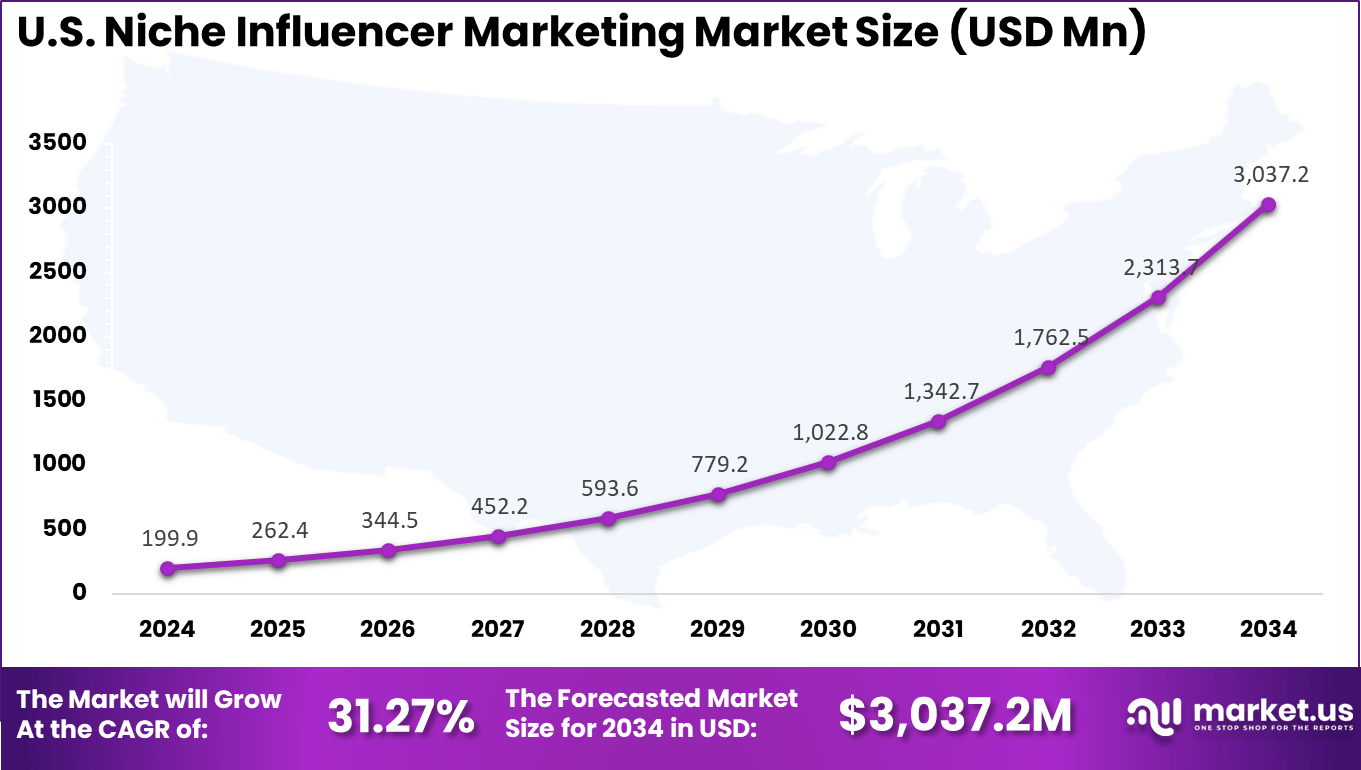
The United States reached USD 199.9 Million with a CAGR of 31.27%, reflecting rapid expansion. Growth is driven by DTC brand adoption. Influencer marketing aligns with digital-first strategies. Content personalization continues to rise. Market momentum remains strong.
For instance, in December 2025, GRIN introduced the Gia AI assistant to automate influencer campaigns, alongside earlier Social Listening and Affiliate Hub launches, enabling brands to scale niche partnerships with real-time insights and operational efficiency that solidify U.S. dominance.
Emerging Trends
In the niche influencer marketing market, one trend is the focus on micro and specialised content creators who serve tightly defined audience segments. Brands are increasingly partnering with creators whose followers share specific interests, values, or professional affiliations. These targeted collaborations allow messages to resonate more deeply with audiences that prioritise relevance over scale.
Another emerging trend is the integration of performance analytics into campaign planning. Rather than relying only on follower counts or engagement rates, marketers are using detailed data on conversion behaviour, time-on-content, and audience retention to shape partnerships and content strategies. This analytical approach supports more precise alignment between influencer contributions and business outcomes.
Growth Factors
A primary growth factor in the niche influencer marketing market is the demand for authentic and trusted endorsements. Audiences that follow niche creators often do so because of shared interests or expertise. Influencers with credibility in specific areas – such as fitness, sustainability, or specialised technology – can shape perceptions more effectively than broad-reach campaigns, prompting brands to invest more in these targeted collaborations.
Another growth factor is the expansion of digital platforms that support niche communities. Social channels, specialised forums, and curated content hubs enable influencers to build engaged followings around specific topics. These communities create fertile ground for influencer outreach, helping brands find precise audience match points for their products or services.
Opportunity
An important opportunity exists in the development of specialised matchmaking and analytics tools that help brands discover niche influencers based on topic relevance, audience behaviour, and performance potential. Tools that streamline this discovery and evaluation process can reduce friction in campaign planning and improve targeting accuracy.
Another opportunity lies in expanding long-term collaborations and ambassador programmes that build deeper relationships between brands and niche creators. Sustained partnerships can foster authentic storytelling over time, reinforce brand values within communities, and create cumulative impact that goes beyond one-off campaigns.
Challenge
One of the main challenges for the niche influencer marketing market is ensuring alignment between brand values and influencer authenticity. Influencers with very specific audience relationships must maintain credibility, and misaligned partnerships can erode trust on both sides. Brands and creators must collaborate closely to craft messages that feel natural and genuinely relevant to followers.
Another challenge is measuring the impact of niche influencer content on business outcomes. Standard metrics such as likes and views provide surface-level engagement signals, but tying influencer activity to conversions, sales lift, or long-term brand perception requires more sophisticated tracking and attribution frameworks.
Key Market Segments
By Platform
- Instagram & Facebook
- YouTube
- TikTok
- Twitch & Gaming Platforms
- Blogs & Niche Forums
- Others
By Niche Category
- Gaming & Esports
- Beauty & Skincare
- Health, Fitness & Wellness
- Sustainable Living & Eco-products
- DIY, Crafts & Specific Hobbies
- Others
By Campaign Type
- Brand Awareness & Content Creation
- Affiliate Marketing & Performance
- Product Launches & Reviews
- Community Building & Engagement
- Others
By End-User Industry
- Direct-to-Consumer (DTC) Brands
- Specialty Retail & E-commerce
- Lifestyle & Consumer Packaged Goods
- Gaming & Technology
- Others
By Region
- North America
- Europe
- Asia Pacific
- Latin America
- Middle East & Africa
Key Players Analysis
AspireIQ, Upfluence, Traackr, and Klear play a key role in the niche influencer marketing market. Their platforms focus on creator discovery, campaign tracking, and performance measurement. Emphasis is placed on data accuracy and audience authenticity. These tools support brands targeting specific communities. Strong analytics improve decision-making.
Patreon and Ko-fi enable direct monetization for niche creators. Platforms such as Obviously and The Influencer Marketing Factory focus on managed campaign execution. These companies support long-term creator partnerships. Focus is placed on community engagement and content authenticity. Their models appeal to creators and brands seeking sustainable income and trust-based promotion. Adoption is supported by flexible pricing and creator-friendly policies.
TikTok Creator Marketplace and YouTube BrandConnect connect brands with niche content creators at scale. Analytics firms such as HypeAuditor, Influencity, Heepsy, CreatorIQ, and GRIN improve transparency. These tools help reduce fraud risks. Other players address emerging niches and micro-communities.
Top Key Players in the Market
- AspireIQ
- Upfluence
- Traackr
- Klear
- Patreon
- Ko-fi
- Obviously (by Mavrck)
- The Influencer Marketing Factory
- TikTok Creator Marketplace
- YouTube BrandConnect
- HypeAuditor
- Influencity
- Heepsy
- CreatorIQ
- GRIN
- Others
Recent Developments
- In June 2025, HypeAuditor updated its platform with better YouTube discovery, streamlined campaign setups, and auto-personalized promo codes with usernames. Drafts now flow like live campaigns, saving hours on niche outreach. These tweaks make spotting authentic micro-influencers way easier.
- In March 2025, GRIN rolled out Social Listening and Affiliate Hub, integrating real-time insights and affiliate tracking right into its creator platform. Brands get a full-funnel view without juggling tools, cutting data silos, and boosting scalability for niche partnerships. It’s a game-changer for tracking organic convos alongside paid collabs.









