


Report Overview
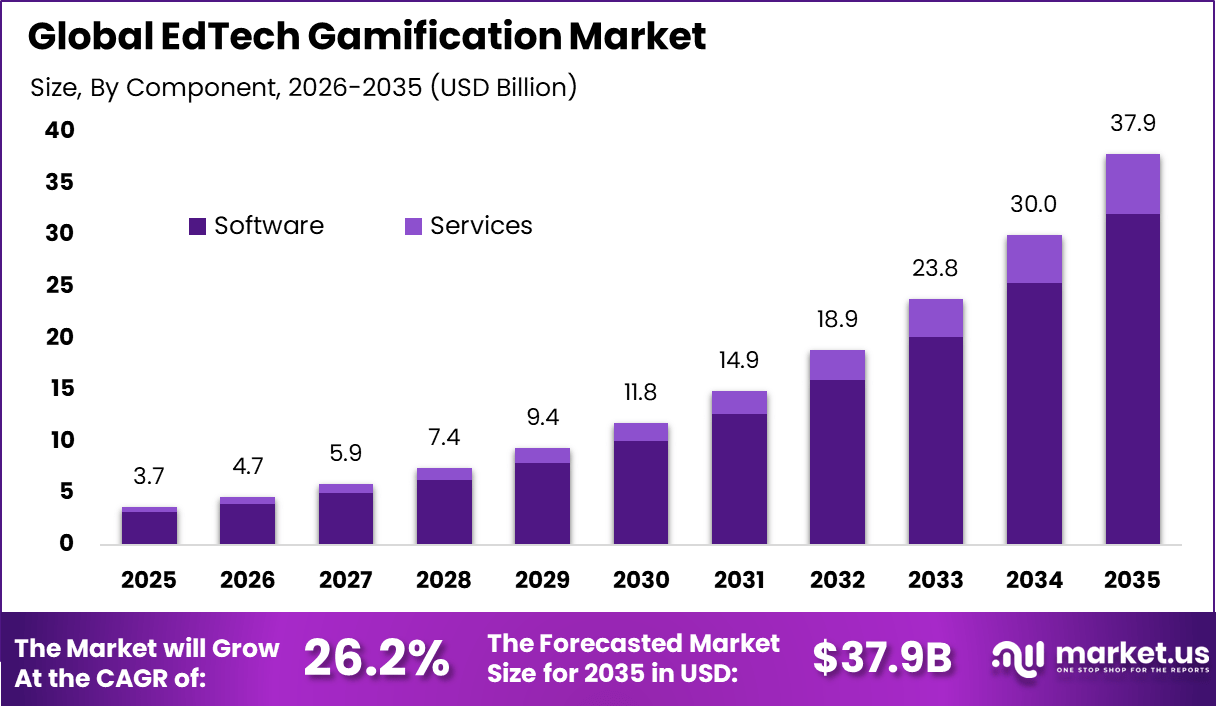
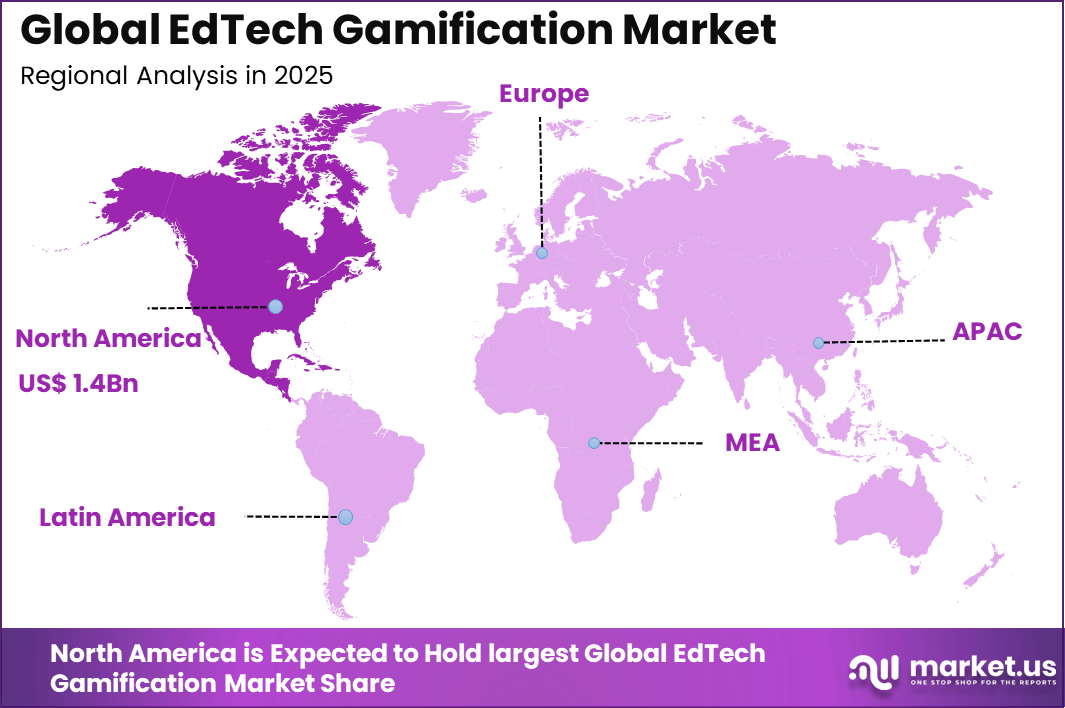
The Global EdTech Gamification Market size is expected to be worth around USD 37.9 Billion By 2035, from USD 3.7 billion in 2025, growing at a CAGR of 26.2% during the forecast period from 2026 to 2035. North America held a dominan Market position, capturing more than a 38.6% share, holding USD 1.4 Billion revenue.
The EdTech Gamification Market refers to the segment of educational technology where game design elements are incorporated into learning platforms and tools to enhance engagement and learning outcomes. This market includes software and applications that use points, badges, leaderboards, challenges, and interactive storytelling to motivate learners. Growth in this market has been influenced by digital transformation in education and the need to improve learner engagement and retention.
The market spans K12 education, higher education, corporate training, and lifelong learning sectors. The integration of gamification in educational content aims to make learning more interactive and enjoyable. Providers of gamification solutions partner with educational institutions, training centers, and corporate clients to implement game-based features into curricula and learning modules. The market is shaped by advancements in technology, including mobile learning and cloud computing, which facilitate scalable deployment. F
Top Market Takeaways
- Software dominated the EdTech gamification market with an 84.6% share, as learning platforms increasingly embed gamification engines, analytics, and content tools directly into digital systems.
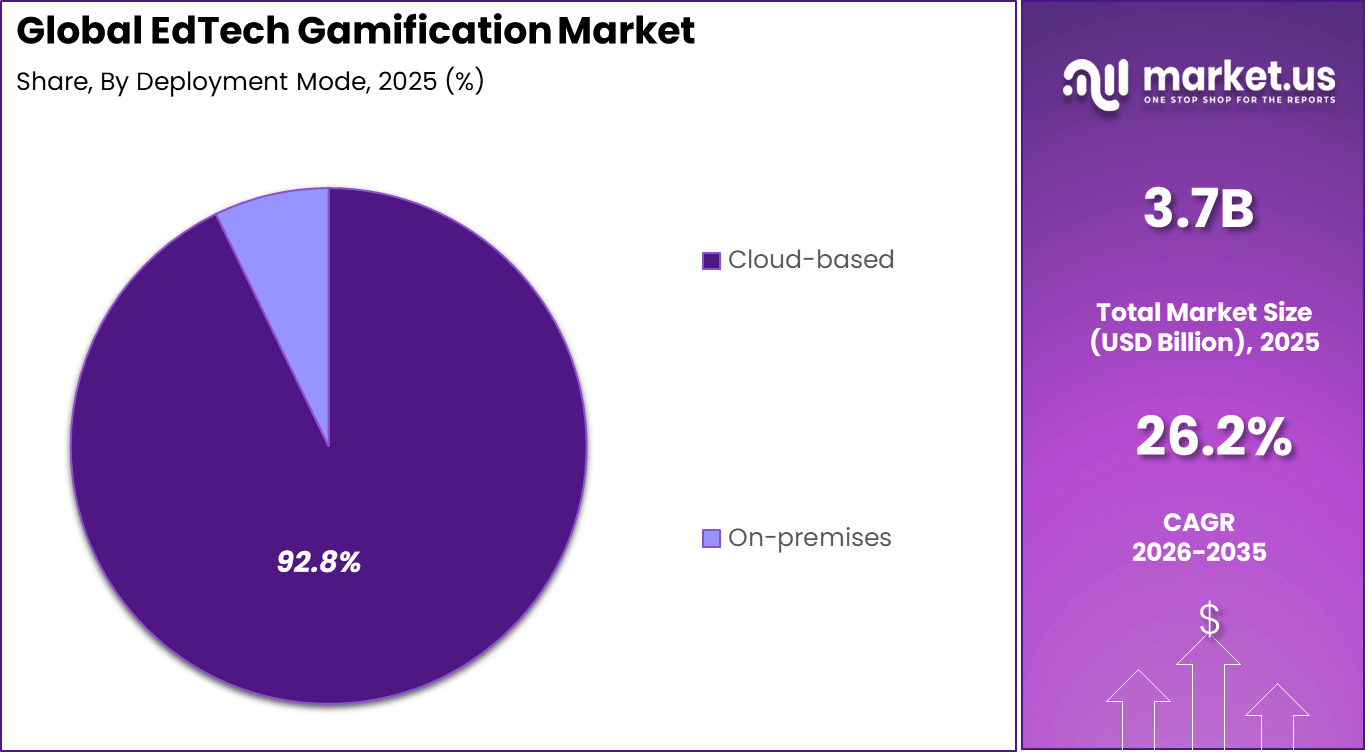
- Cloud-based deployment led with 92.8%, reflecting strong preference for scalable access, remote learning support, and continuous feature updates.
- K–12 education accounted for 47.3% of end-user adoption, driven by early digital learning exposure and strong demand for engagement-focused teaching methods.
- Points, badges, and leaderboards captured 58.4%, highlighting their effectiveness as simple and widely accepted motivation mechanisms.
- Courseware and subject learning represented 52.7%, as gamification is increasingly applied to core curriculum delivery rather than supplementary activities.
- North America held 38.6% share, supported by high EdTech investment, digital classroom penetration, and innovation in learning platforms.
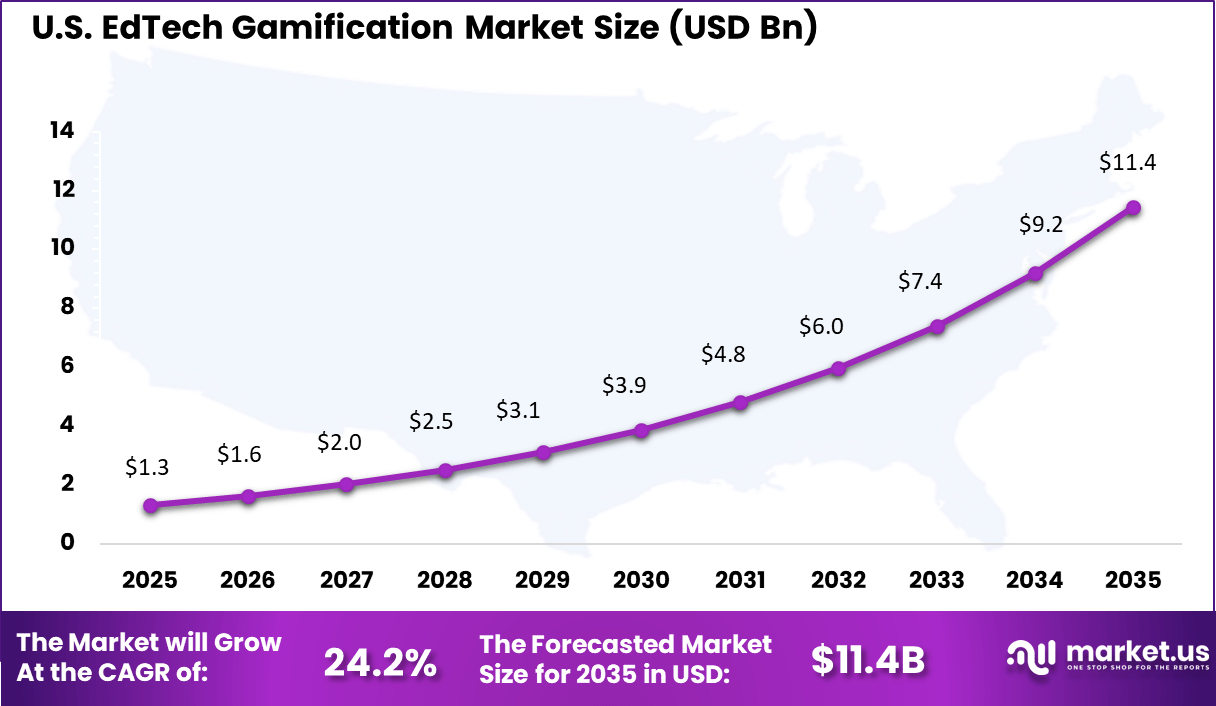
- The U.S. market reached USD 1.31 billion in 2024 and is expanding at a 24.22% CAGR, driven by rapid adoption of gamified learning across schools and digital education providers.
Quick Market Facts
Adoption Rates by Sector (2025)
- K–12 education: More than 500 million students globally use gamified learning tools. In North America, over 60% of classrooms have adopted digital rewards or game-based elements.
- Higher education: Around 200 million college and university students access gamified platforms, with an 88.9% utilization rate in e-learning environments.
- Corporate training: Over 100 million employees worldwide use gamified modules each year, and about 70% of Fortune 500 companies have integrated gamification into training programs.
Usage and Classroom Integration
- Educator sentiment: About 60% of teachers view gamification as the most effective approach for improving student engagement.
- Frequency of use: In markets such as Nigeria, 84.1% of teachers apply gamification at least weekly, while 37.8% use it on a daily basis.
- Preferred elements: Badges are used by 80.5% of educators, followed by points (57.3%) and leaderboards (43.9%).
- Subject adoption: Gamification is most prevalent in mathematics (91.5%) and English (57.3%), where interactive methods support skill development and participation.
Student Engagement and Motivation
- 89% of educators report higher student engagement when gamified tools are used in learning environments.
- More than 70% of students feel increased motivation through game-based and interactive learning formats.
- About 67% of students in the U.S. prefer game-based learning compared with traditional instructional methods.
Performance and Learning Outcomes
- Students in gamified learning environments perform about 14% better in skill-based assessments.
- Average test score improvements reach 34%, with some programs recording gains as high as 89.45%.
- Gamification improves knowledge retention by up to 40%, supporting longer-term learning outcomes.
- Engineering students exposed to gamified learning methods achieved performance improvements of up to 89.45%, highlighting strong impact in technical disciplines.
By Component
Software accounts for 84.6%, showing that gamification in education is mainly delivered through digital platforms. These software tools integrate game mechanics into learning content and assessments. Schools and institutions use software to improve student engagement and participation. Digital platforms allow easy updates and customization. Software-based delivery supports wide adoption across education levels.
The dominance of software is driven by the growing use of digital learning tools. Educational institutions prefer flexible platforms that work across devices. Software solutions support analytics to track student progress. They also integrate with existing learning management systems. This makes software the backbone of gamified education.
By Deployment Mode
Cloud-based deployment holds 92.8%, reflecting strong reliance on online learning environments. Cloud platforms allow students and teachers to access gamified content from any location. They support real-time interaction and data synchronization. Cloud delivery reduces the need for local infrastructure. This improves scalability and accessibility.
Adoption of cloud-based deployment is driven by remote and hybrid learning models. Institutions benefit from lower maintenance and faster deployment. Cloud platforms support frequent content updates. They also enable collaboration across classrooms and regions. These advantages sustain high adoption.
By End User
K-12 education accounts for 47.3%, making it the leading end-user segment. Gamification is widely used to increase student motivation and focus. Interactive learning methods help improve understanding of core subjects. Younger learners respond well to game-based elements. This improves classroom engagement.
Demand in K-12 education is driven by the need for effective learning tools. Teachers use gamification to simplify complex topics. Digital rewards encourage participation and consistency. Schools adopt these tools to improve learning outcomes. This supports steady growth.
By Element
Points, badges, and leaderboards hold 58.4%, making them the most widely used gamification elements. These elements reward students for progress and achievement. They create a sense of competition and motivation. Simple reward systems are easy to implement. Students respond positively to visible progress indicators.
The popularity of these elements is driven by their effectiveness in engagement. Educators prefer straightforward gamification methods. Points and badges encourage consistent participation. Leaderboards promote healthy competition. These elements remain central to gamified learning design.
By Application
Courseware and subject learning represent 52.7%, highlighting their central role in gamification adoption. Gamified courseware helps make lessons more interactive and enjoyable. Students engage better with structured and visual learning content. Subject-focused games support skill development. This improves retention and understanding.
Growth in this application is driven by curriculum digitization. Institutions invest in interactive course materials. Gamification helps standardize learning experiences. It also supports self-paced learning models. This drives sustained adoption.
By Region
North America accounts for 38.6%, supported by advanced digital education infrastructure. Schools and institutions actively adopt innovative learning technologies. High internet access supports cloud-based platforms. Digital learning acceptance remains strong. The region shows steady expansion.
The United States reached USD 1.31 Billion with a CAGR of 24.22%, reflecting rapid market growth. Expansion is driven by EdTech investment and digital curriculum adoption. Gamified learning tools gain popularity among educators. Institutions focus on student engagement. Market momentum remains strong.
Emerging Trend Analysis
The EdTech Gamification Market is being shaped by the increasing incorporation of adaptive learning systems that tailor game-like experiences to individual student proficiency. These systems assess learner performance in real time, adjusting difficulty levels and rewards to sustain engagement and support mastery. This adaptive approach enhances motivation and encourages sustained participation in digital educational environments.
Another emerging trend is the integration of immersive technologies, such as augmented reality and virtual reality, within gamified learning modules. These technologies create interactive and experiential learning scenarios that can bring abstract concepts to life. Students are able to explore virtual environments, complete challenges, and receive instant feedback in engaging formats. The combination of immersive technologies with gamification expands opportunities for experiential education across subject areas.
Driver Analysis
A primary driver of market growth is the increasing adoption of digital learning tools by educational institutions seeking to improve student engagement and performance. Traditional instructional methods often struggle to capture learner attention, whereas gamified solutions introduce challenge, feedback loops, and reward mechanisms that enhance motivation. Schools, colleges, and corporate training programs are investing in gamification to make learning more interactive and enjoyable.
Another driver is the growing expectation among learners for interactive and technology-enabled experiences. Students and adult learners alike have become accustomed to digital interfaces and interactive content in entertainment and social applications. This familiarity drives demand for similar engagement models in educational contexts. Providers that incorporate game mechanics into instructional content can better meet learner preferences and support positive learning experiences.
Restraint Analysis
One restraint on market growth is the challenge of aligning gamified content with rigorous educational standards and curricula. Designing game elements that are both engaging and academically meaningful requires careful instructional design expertise. Without alignment to learning objectives, gamified activities risk being perceived as entertaining rather than educational. This challenge can slow adoption among institutions committed to academic integrity and measurable outcomes.
Another restraint arises from limited access to technological infrastructure in under-resourced educational settings. Gamified learning platforms often depend on reliable internet connectivity, modern devices, and technical support. Schools and training centers in regions with constrained budgets or limited digital readiness may struggle to implement these solutions effectively. This disparity in access restricts the reach of gamification initiatives.
Opportunity Analysis
Significant opportunity exists in expanding adaptive gamification solutions that support lifelong learning and professional development. As the workforce evolves, adults increasingly seek engaging digital tools for skills acquisition and upskilling. Gamified platforms that provide personalized challenges, progress tracking, and certification pathways can attract learners beyond traditional classrooms. This expansion into corporate and adult education sectors is anticipated to broaden market demand.
Another opportunity lies in partnerships between gamification providers and content creators to develop subject-specific game-based modules. Collaborations can produce rich learning experiences that address niche educational needs, such as language acquisition, STEM skills, and vocational training. These tailored gaming experiences can differentiate offerings and drive adoption among educators seeking specialized solutions.
Challenge Analysis
A major challenge for the market is demonstrating measurable learning outcomes attributable to gamified experiences. Institutions and decision-makers require evidence that gamification improves retention, comprehension, and skill mastery compared to conventional methods. Collecting valid data and conducting rigorous evaluations can be resource intensive. Without clear metrics, investment decisions may be deferred or conservative.
Another challenge lies in designing game mechanics that appeal to diverse learner populations across ages, cultures, and proficiency levels. Gamification elements that are effective for one group may not resonate with another, leading to inconsistent engagement. Providers must continuously refine mechanics, aesthetics, and reward systems to ensure broad appeal. Balancing universal design with personalized experiences remains an ongoing challenge.
Key Market Segments
By Component
- Software
- Services
By Deployment Mode
- Cloud-based
- On-premises
By End-User
- K-12 Education
- Higher Education
- Corporate Training
- Language Learning
- Others
By Element
- Points, Badges & Leaderboards (PBLs)
- Storytelling & Narrative
- Challenges & Quests
- Social & Collaborative Features
- Others
By Application
- Courseware & Subject Learning
- Assessment & Testing
- Student Engagement & Behavior Management
- Professional Skill Development
- Others
Regional Analysis and Coverage
- North America
- US
- Canada
- Europe
- Germany
- France
- The UK
- Spain
- Italy
- Russia
- Netherlands
- Rest of Europe
- Asia Pacific
- China
- Japan
- South Korea
- India
- Australia
- Singapore
- Thailand
- Vietnam
- Rest of Latin America
- Latin America
- Brazil
- Mexico
- Rest of Latin America
- Middle East & Africa
- South Africa
- Saudi Arabia
- UAE
- Rest of MEA
Competitive Analysis
Kahoot! ASA, Duolingo, Inc., and Microsoft through Minecraft Education Edition lead the EdTech gamification market by embedding game mechanics into structured learning experiences. Their platforms use quizzes, rewards, levels, and interactive challenges to improve student engagement and retention. These companies focus on ease of use, scalability, and alignment with curriculum standards. Rising demand for engaging digital learning tools continues to reinforce their leadership.
Classcraft Studios, Inc., Quizlet, Inc., Nearpod, Inc., Blooket, LLC, and Gimkit, Inc. strengthen the market with classroom focused gamification tools. Their solutions support real time participation, formative assessment, and collaborative learning. These providers emphasize teacher control, student motivation, and data driven insights. Growing adoption in K 12 education supports wider use.
Breakout EDU, Legends of Learning, SplashLearn, Prodigy Education, Inc., Mango, LLC, and EdApp, Ltd. expand the landscape with subject specific and mobile friendly gamified learning platforms. Their offerings target math, science, language, and professional training use cases. These companies focus on accessibility, personalization, and measurable learning outcomes. Increasing digital learning adoption continues to drive steady growth in the EdTech gamification market.
Top Key Players in the Market
- Kahoot! ASA
- Duolingo, Inc.
- Classcraft Studios, Inc.
- Minecraft: Education Edition (Microsoft)
- Quizlet, Inc.
- Nearpod, Inc.
- GoGuardian
- Blooket, LLC
- Gimkit, Inc.
- Breakout EDU
- Legends of Learning
- SplashLearn
- Prodigy Education, Inc.
- Mango, LLC
- EdApp, Ltd.
- Others
Recent Developments
- GoGuardian launched DNS Precision Filtering, Image Filtering, and Smart Alerts Allowlist enhancements to its Admin platform in November 2025. These features provide K-12 IT admins with better network protection and content visibility for student safety. The updates help schools manage digital risks while supporting educational access.
- Duolingo, Inc. acquired the team from NextBeat, a London-based music gaming startup, in August 2025 to enhance its gamified Music course. This move adds expertise in music licensing and interactive design to make learning more engaging. The acquisition also establishes Duolingo’s first official presence in the UK.









