


Report Overview
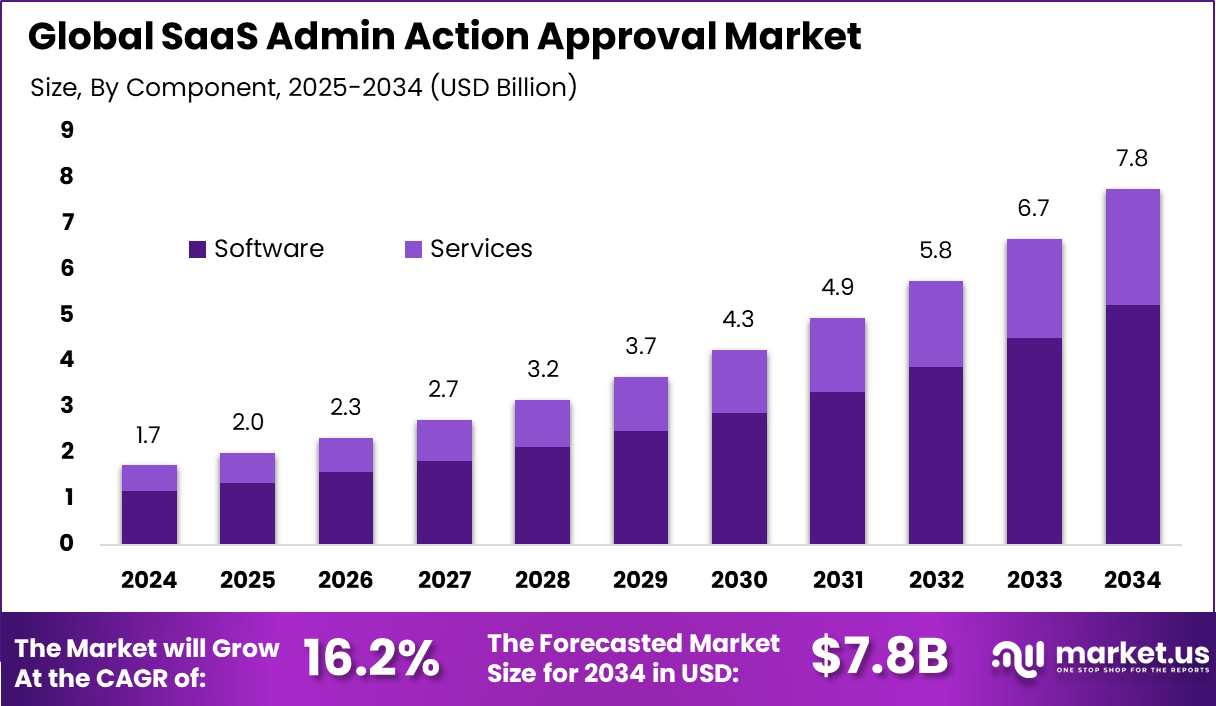
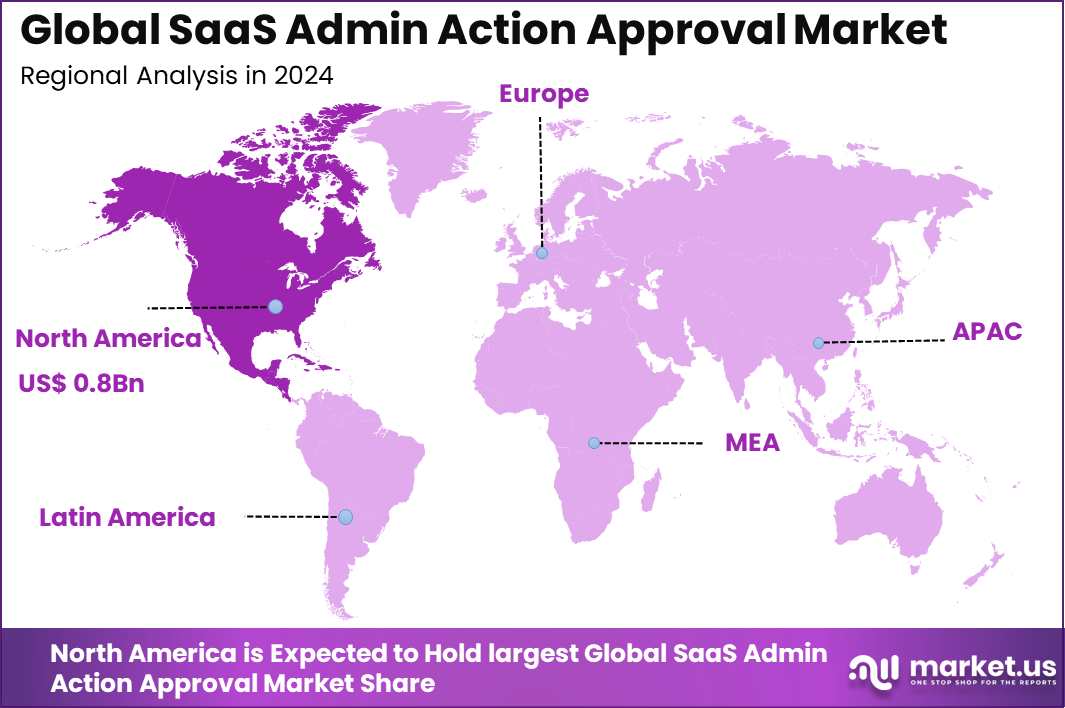
The Global SaaS Admin Action Approval Market size is expected to be worth around USD 7.8 Billion By 2034, from USD 1.7 billion in 2024, growing at a CAGR of 16.2% during the forecast period from 2025 to 2034. In 2024, North America held a dominan Market position, capturing more than a 51.4% share, holding USD 0.8 Billion revenue.
The SaaS admin action approval market refers to software platforms and tools that enable structured review and authorization of administrative actions within cloud-based services. These systems enforce multi-level approval workflows for critical changes such as user provisioning, permission adjustments, configuration updates, security policy changes, and integration deployments.
The market has grown alongside the widespread adoption of SaaS solutions across enterprises, with organizations recognising the need to govern administrative privileges, enforce compliance, and mitigate access-related risks in multi-tenant cloud environments. This market plays a crucial role in supporting secure and compliant management of cloud applications. SaaS applications often contain sensitive corporate data, and administrative actions can have wide-ranging effects on security and operations.
Admin action approval platforms help ensure that critical changes are reviewed by authorised stakeholders before execution, reducing the likelihood of human error, privilege misuse, or configuration drift. They also support audit trails and visibility into who approved which actions and when, strengthening accountability and governance. Growth in this market is driven by increasing reliance on SaaS applications for core business operations, rising regulatory compliance requirements, and greater emphasis on cloud security controls.
Enterprises are adopting multiple SaaS solutions for collaboration, workflow management, customer relationship management, and finance functions. As a result, the number of administrative actions requiring oversight has grown significantly. Security teams and compliance leaders are prioritising structured approval processes to reduce risks associated with privilege escalation, misconfiguration, and insider threats.
According to bettercloud, the average organization used 106 SaaS applications in 2024, down from 112 in 2023, showing early signs of application rationalization. However, consolidation activity has slowed sharply, with the consolidation rate dropping from 14% to just 5% year over year, indicating that many firms are still adding tools faster than they retire them. SaaS continues to dominate enterprise software usage, with nearly 75% of applications delivered through SaaS models, while only about 25% remain on premises.
Mid sized organizations with 1,500 to 4,999 employees have taken more decisive action, cutting their SaaS portfolios by 29%, reflecting tighter cost control and stronger governance. Overall SaaS end user spending continued to expand at 19.1% year over year, largely influenced by the integration of AI driven capabilities across business applications.
Top Market Takeaways
- The market is largely driven by software-based solutions, which account for 67.5% of adoption. This reflects a strong preference for centralized tools that control, review, and approve sensitive admin-level actions across SaaS environments. Demand is being shaped by the need for visibility, audit readiness, and consistent policy enforcement.
- Security and monitoring applications represent 32.1% of overall usage. This highlights how approval workflows are increasingly treated as a security control, not just an IT process. Organizations are prioritizing prevention of misconfigurations, insider risk, and unauthorized privilege changes.
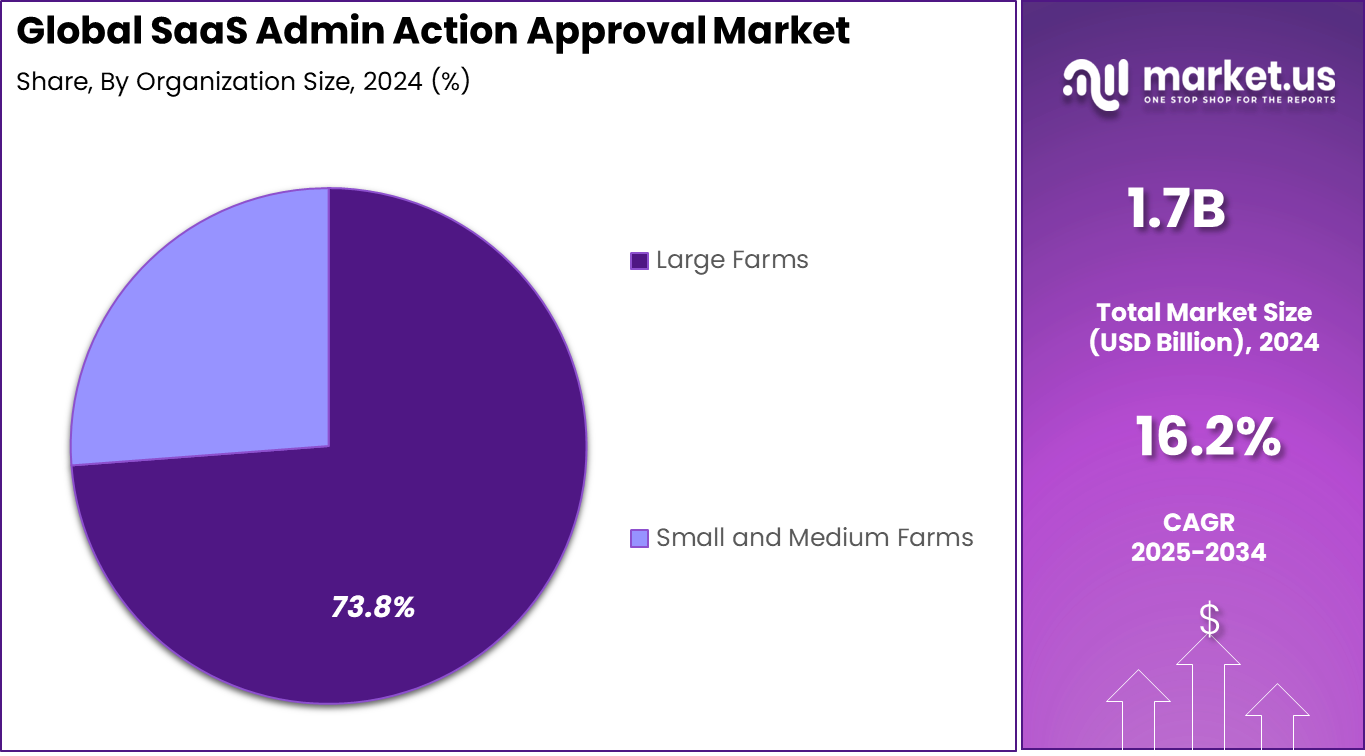
- Large enterprises dominate adoption with a 73.8% share. Complex SaaS stacks, multiple administrators, and strict compliance requirements are making structured approval mechanisms essential in large-scale environments. Standardization and risk reduction remain the primary drivers in this segment.
- The BFSI sector contributes 30.4% of end-user demand. High regulatory pressure, data sensitivity, and audit obligations are accelerating adoption of admin action approval systems to strengthen governance and internal controls.
- North America leads regional adoption with a 51.4% share. Early SaaS maturity, strong security awareness, and strict compliance practices are supporting higher uptake of approval-based admin management tools.
Key Statistics and Trends
- Shadow IT usage is expanding across enterprises. By 75% of employees are expected to use unapproved SaaS tools. Around 85% of applications within organizations remain unmanaged, which creates visibility and governance gaps. Approval workflows are increasingly used to restore central oversight.
- SaaS security incidents remain highly frequent. About 75% of organizations reported at least one SaaS-related security incident within a twelve-month period. Many incidents are linked to unauthorized access or incorrect configuration. This trend is pushing firms to enforce approval checks before sensitive admin actions occur.
- Misconfigurations and excessive access are major risk factors. Nearly 63% of SaaS security issues are caused by misconfigurations. Users and non-human identities often hold more access rights than required, increasing exposure. Approval workflows help limit privilege escalation and reduce accidental changes.
- Automation adoption remains uneven. While automation is viewed as critical, 54% of organizations still lack automated user lifecycle management. Many enterprises aim to automate approvals for routine and low-risk actions, while keeping manual review for high-impact or sensitive changes.
By Component
Software accounts for 67.5%, showing that SaaS admin action approval relies mainly on dedicated software platforms. These platforms control and monitor privileged actions such as configuration changes, user access updates, and policy enforcement within SaaS environments.
The dominance of software is supported by growing use of cloud applications across enterprises. Organizations prefer software solutions because they provide centralized visibility, audit logs, and real-time approval workflows. This helps reduce internal security risks and unauthorized actions.
By Application
Security and monitoring represent 32.1%, making them the leading application area. Enterprises use admin approval tools to track sensitive actions and detect unusual behavior within SaaS systems. This supports stronger internal control and accountability.
Growth in this segment is driven by rising concerns around insider threats and misconfigurations. Continuous monitoring and approval mechanisms help organizations maintain system integrity. These tools also support compliance with internal security policies.
By Organization Size
Large enterprises account for 73.8%, highlighting their strong adoption of admin action approval solutions. These organizations manage multiple SaaS applications and large user bases, which increases the risk of unauthorized changes.
Adoption is supported by complex IT environments and strict governance requirements. Large enterprises rely on approval workflows to standardize access control and reduce operational errors. This ensures consistent security practices across departments.
By End User
The BFSI sector holds 30.4%, reflecting its strong focus on access control and audit readiness. Financial institutions manage sensitive customer and transaction data, which requires strict approval of administrative actions.
SaaS admin approval tools help BFSI organizations reduce fraud risk and meet regulatory expectations. These platforms provide traceability and approval records that support internal and external audits. Security remains a top priority in this sector.
By Region
North America holds 51.4%, supported by high SaaS adoption and mature cybersecurity practices. Organizations in the region invest heavily in governance tools to manage growing cloud application usage. Strong regulatory focus also supports market growth.
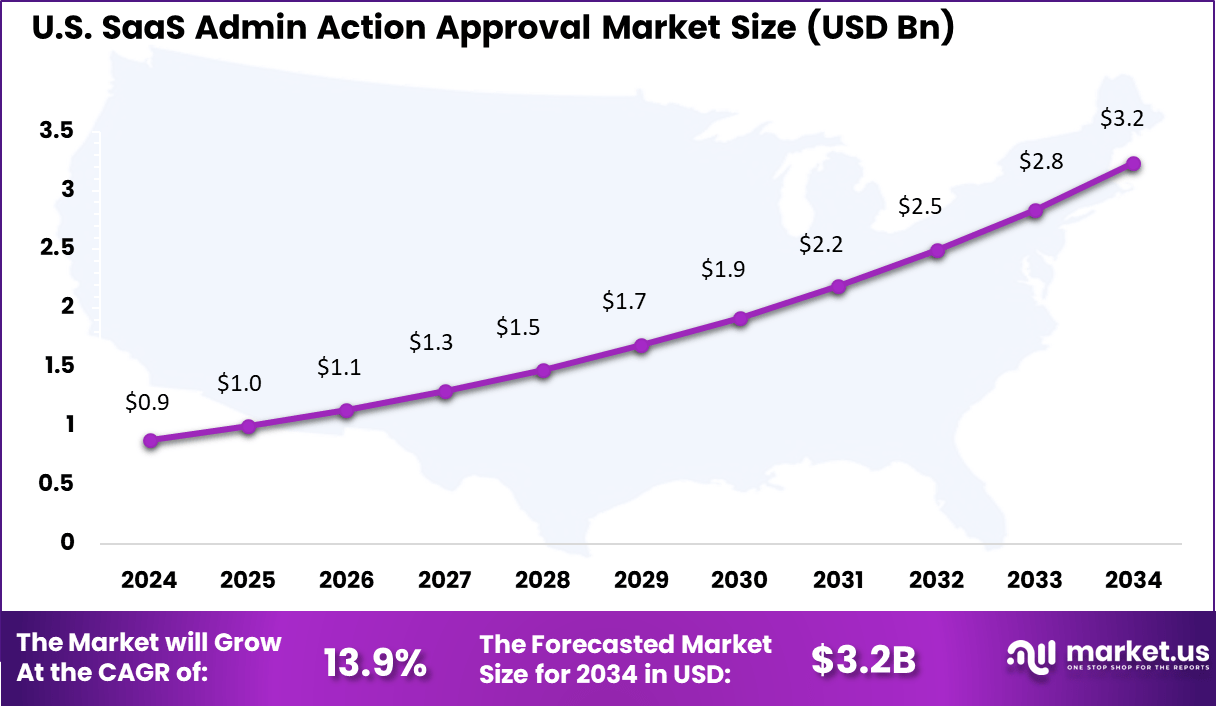
The United States reached USD 0.88 Billion with a CAGR of 13.9%, reflecting steady demand for SaaS security and approval platforms. Growth is driven by expansion of cloud-first strategies and stricter access control needs. Enterprises continue to prioritize secure SaaS operations.
Increasing Adoption Technologies
Key technologies supporting adoption include identity and access management (IAM) platforms, privileged access management (PAM) systems, workflow automation engines, and cloud-native governance tools. Integration with single sign-on (SSO) and multi-factor authentication (MFA) enhances control over administrative sessions.
Cloud orchestration and API-based connectors allow approval systems to interface with multiple SaaS applications, creating unified governance across a heterogeneous SaaS portfolio. AI-assisted risk scoring is also increasingly used to prioritise high-risk actions for additional review. Organizations adopt admin action approval platforms to improve oversight of cloud operations, mitigate security and compliance risks, and streamline governance processes.
Approval workflows help organisations enforce consistent policies for critical actions and maintain clear records for audit requirements. Reducing the burden on security and IT teams while retaining control over sensitive changes is a central motivator. Business stakeholders often require approval visibility to ensure operational transparency.
Investment and Business Benefits
Investment opportunities exist in integrated governance platforms that combine approval workflows with analytics, identity management, and compliance reporting. Solutions that support policy-based automation and risk-aware approvals can reduce administrative overhead and improve control. Opportunities also exist in managed services that support implementation, optimisation, and training for enterprises adopting these tools.
As SaaS portfolios expand, demand for centralised governance solutions that unify approval processes across multiple applications will grow. SaaS admin action approval platforms deliver measurable business benefits including reduced security incidents, improved compliance posture, and stronger oversight of cloud operations.
Approval workflows reduce the likelihood of inadvertent misconfigurations that can lead to downtime or data exposure. Clear audit trails and approval records support regulatory reporting and internal governance processes. Teams using these solutions often report improved alignment between IT, security, and business units.
Emerging Trends
In the SaaS admin action approval space, a clear trend is the increasing formalization of approval workflows within everyday cloud operations. Administrative actions such as permission changes, configuration updates, and access grants are being routed through predefined approval paths instead of being executed directly. This approach reduces the risk of misconfigurations and strengthens internal accountability.
Approval logic is increasingly aligned with internal governance policies so that sensitive changes follow a consistent review process across teams and business units. As SaaS environments grow more interconnected, admin approval workflows are being positioned as a core control layer rather than an optional safeguard. Another emerging trend is the deeper integration of admin approval processes with security monitoring and audit practices.
Approval actions are now commonly recorded automatically, creating clear activity trails for compliance and internal reviews. This improves visibility into administrative behavior and supports faster investigation when anomalies occur. There is also a growing emphasis on defining approval authority based on role and responsibility, which limits excessive privileges and clarifies decision ownership. These practices contribute to stronger trust in cloud administration, particularly in large enterprises with distributed IT teams.
Growth Factors
The expansion of SaaS admin action approval practices is largely driven by the rising complexity of cloud based operations. Organizations now manage dozens of SaaS platforms, each with its own administrative controls. As the number of configuration changes and access requests increases, informal approval methods become difficult to manage.
Structured approval workflows help maintain control while allowing operations to continue without disruption. This balance between speed and governance is supporting broader adoption across both mid sized and large organizations. Another important growth factor is the heightened focus on internal risk management and accountability. Enterprises are under increasing pressure to demonstrate clear oversight of administrative decisions, especially those affecting data access, integrations, or security settings.
Admin approval mechanisms provide documented evidence of review and authorization, reducing operational and compliance risk. This need is further amplified by remote and hybrid work models, where administrators operate across locations and time zones. As governance expectations evolve, admin action approval is increasingly viewed as a foundational requirement for secure SaaS management.
Key Market Segments
By Component
- Software
- Services
- Implementation & Configuration
- Advisory & Compliance Consulting
- Managed Services
By Application
- User Access Management
- Workflow Automation
- Compliance Management
- Security and Monitoring
- Others
By Organization Size
- Small and Medium Enterprises
- Large Enterprises
By End-User
- BFSI
- Healthcare
- IT and Telecommunications
- Retail
- Government
- Others
Regional Analysis and Coverage
- North America
- US
- Canada
- Europe
- Germany
- France
- The UK
- Spain
- Italy
- Russia
- Netherlands
- Rest of Europe
- Asia Pacific
- China
- Japan
- South Korea
- India
- Australia
- Singapore
- Thailand
- Vietnam
- Rest of Latin America
- Latin America
- Brazil
- Mexico
- Rest of Latin America
- Middle East & Africa
- South Africa
- Saudi Arabia
- UAE
- Rest of MEA
Driver
The primary driver for SaaS admin action approval adoption is the growing need for stronger internal control over cloud based administrative activities. As SaaS platforms handle sensitive data and critical business workflows, uncontrolled admin actions can lead to misconfigurations, data exposure, or service disruption. Approval mechanisms ensure that high risk actions are reviewed before execution, which improves accountability and reduces operational risk. This structured oversight supports consistent enforcement of internal policies across teams and applications.
Another important driver is the increasing alignment between IT governance and security management. Admin approval workflows make it easier to document who approved a change and why it was required. This clarity strengthens trust between IT, security, and compliance teams. As organizations mature in their cloud governance practices, admin action approval is increasingly treated as a necessary control to support secure and reliable SaaS operations.
Restraint
A key restraint in this market is the perception that approval workflows can slow down operations. In fast paced digital environments, teams often prioritize speed and flexibility. When approval processes are not designed carefully, they can introduce delays in resolving issues or deploying updates. This can lead to resistance from technical teams who view approvals as an obstacle rather than a safeguard.
Another restraint relates to integration complexity across multiple SaaS platforms. Each application may have different administrative models and permission structures. Aligning approval workflows across these systems requires planning and coordination. Smaller organizations with limited IT resources may find it challenging to implement consistent approval controls without increasing administrative overhead.
Opportunity
A major opportunity lies in embedding admin action approval directly into broader governance and identity management frameworks. When approval logic is connected with access control and authentication systems, administrative actions can be evaluated in context rather than in isolation. This creates smarter decision making and reduces unnecessary approvals for low risk actions. Such alignment supports both efficiency and security.
There is also strong opportunity in supporting distributed and remote work environments. As administrative teams operate across locations and time zones, centralized approval mechanisms provide a consistent decision making structure. This improves collaboration and reduces dependency on informal communication channels. Organizations seeking to scale their SaaS usage securely are increasingly open to adopting these structured approval practices.
Challenge
One of the main challenges is maintaining the right balance between control and usability. Overly strict approval requirements can frustrate users and lead to workarounds that weaken governance. Designing approval flows that are proportionate to risk requires deep understanding of operational needs and system dependencies. This balance can be difficult to achieve, especially in complex SaaS ecosystems.
Another challenge is ensuring ongoing relevance of approval rules as environments evolve. SaaS platforms are frequently updated, and business processes change over time. Approval policies that are not reviewed regularly may become outdated or misaligned with current risks. Continuous refinement and governance oversight are required to keep admin approval mechanisms effective and trusted.
Competitive Analysis
Adaptive Shield, AppOmni, DoControl, and Nudge Security lead the SaaS admin action approval market with platforms that monitor, control, and approve privileged actions across SaaS applications. Their solutions help organizations prevent misconfigurations, limit excessive permissions, and reduce insider risk. These companies focus on real time policy enforcement, visibility into admin behavior, and automated approval workflows. Rising SaaS sprawl and security governance needs continue to reinforce their leadership.
Okta, BetterCloud, SailPoint, OneLogin, JumpCloud, Zluri, Torii, and CoreView strengthen the market by embedding admin action controls within identity, access management, and SaaS management platforms. Their tools enable role based approvals, audit trails, and compliance reporting. These providers emphasize centralized control, integration with major SaaS apps, and ease of deployment. Growing adoption of zero trust and identity first security supports wider use.
Productiv, ManageEngine, Saviynt, Microsoft Azure AD, Google Workspace Admin, IBM Security, Oracle Identity Cloud Service, and other players expand the landscape with broader governance, analytics, and automation capabilities. Their offerings support enterprise wide oversight of SaaS usage and admin privileges. These companies focus on scalability, policy standardization, and regulatory readiness. Increasing complexity of SaaS environments continues to drive demand for admin action approval solutions.
Top Key Players in the Market
- Adaptive Shield
- AppOmni
- DoControl
- Nudge Security
- Okta
- BetterCloud
- SailPoint
- OneLogin
- JumpCloud
- Zluri
- Torii
- CoreView
- Productiv
- ManageEngine
- Saviynt
- Microsoft (Azure AD)
- Google (Workspace Admin)
- IBM Security
- Oracle Identity Cloud Service
- Others
Recent Developments
- November, 2024, CrowdStrike agreed to acquire Adaptive Shield to boost SaaS protection across identities and apps on its Falcon platform. The deal, eyed to close in late fiscal 2025, mixes cash and stock for around $300 million. This strengthens admin oversight in hybrid environments.
- November, 2025, DoControl teamed up with Japan’s Marubeni I-DIGIO for SaaS data security rollout, starting in retail and healthcare. The partnership targets deep visibility and automated controls for sensitive data. Later that month, DoControl earned a top spot as a 2025 Spark Matrix Leader in SaaS Security Posture Management.









