


Report Overview
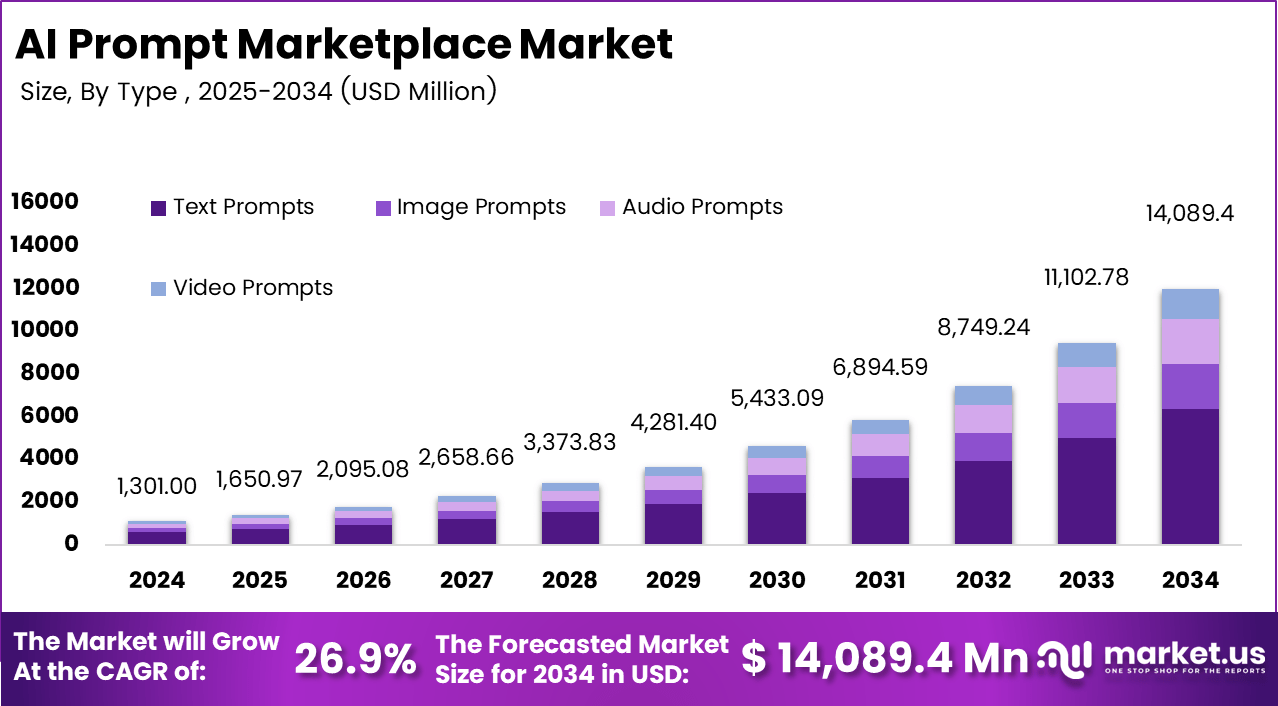
The global AI prompt marketplace market was valued at USD 1,301.0 million in 2024 and is expected to expand to approximately USD 14,089.4 million by 2034, registering a CAGR of 26.9% during the 2025 to 2034 period. Growth is being supported by rapid adoption of generative AI tools across marketing, education, software development, and creative workflows, where reusable and optimized prompts improve productivity and output quality.
The AI prompt marketplace market refers to digital platforms where users can discover, buy, sell, and share pre-designed prompts for artificial intelligence models. These prompts are structured instructions created to generate specific outputs such as marketing copy, code snippets, images, research summaries, or creative content. As AI tools become widely adopted across business and creative workflows, prompt marketplaces help users save time and achieve more consistent results without deep technical knowledge.
This market plays a crucial role in improving accessibility and usability of AI systems. Prompt marketplaces act as a bridge between raw AI capability and real world use cases by standardizing effective instructions. They reduce trial and error for users and improve output quality across tasks such as content creation, customer support, design, and software development. In enterprise settings, curated prompts support consistency, governance, and knowledge sharing across teams using AI tools at scale.
Growth is driven by rapid adoption of generative AI across industries and the growing need for productivity gains. Many users lack prompt engineering expertise, creating demand for ready to use prompts. Increased use of AI in marketing, education, software development, and research has expanded the range of prompt use cases. The rise of independent creators and digital professionals has also supported marketplace activity, as prompts are viewed as reusable digital assets.
Key Takeaways
- The global AI Prompt Marketplace Market was valued at USD 1,301.0 million in 2024 and is projected to reach USD 14,089.4 million by 2034, expanding at a CAGR of 26.9%.
- Text Prompts dominated the market with a 45% share in 2024, driven by strong usage across AI writing assistants, chatbots, and content automation platforms.
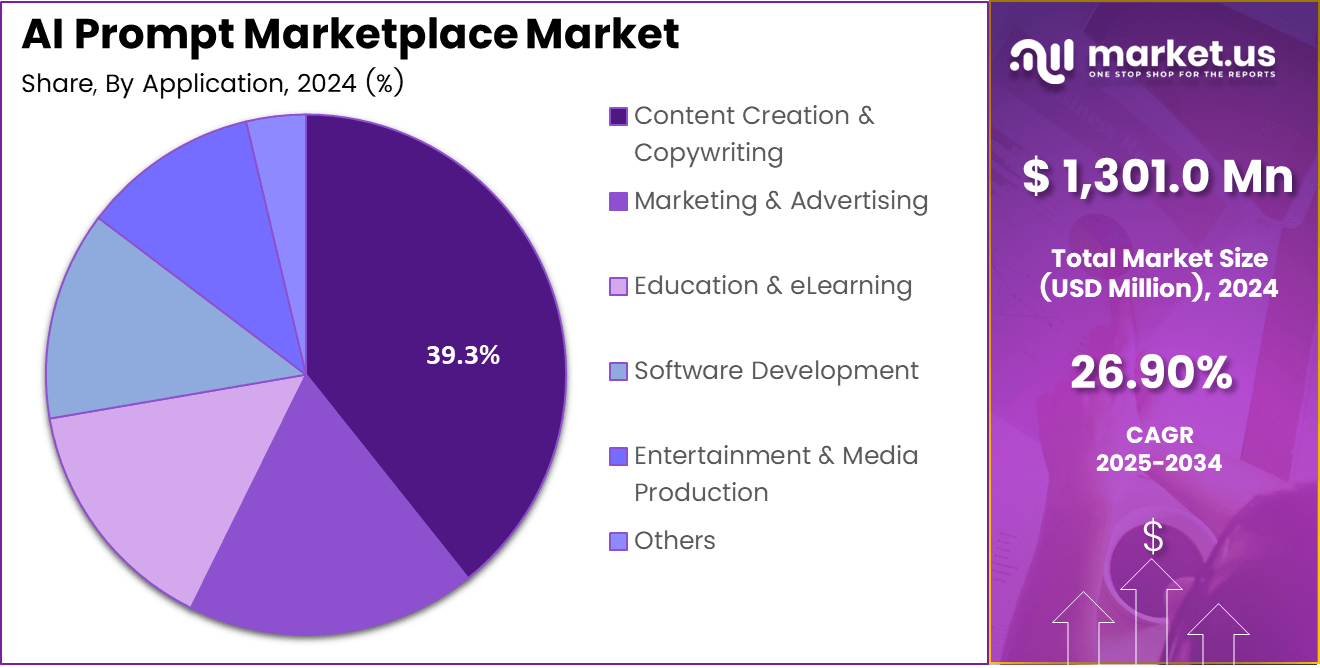
- Content Creation & Copywriting was the leading application segment, accounting for 39.3% of total revenue, owing to the rising integration of generative AI tools for marketing and publishing.
- North America led the global market with a valuation of USD 365.5 million in 2024, supported by the presence of major AI platform developers and high enterprise adoption.
- Asia-Pacific (APAC) is expected to record the fastest growth rate during 2025–2034, driven by rapid digitalization, expanding AI infrastructure, and government-backed innovation programs.
- The increasing use of AI prompts in education, design, and entertainment sectors is anticipated to create new monetization opportunities for developers and marketplace providers.
By Type
Text prompts account for 45%, showing that written prompts remain the most widely used format in AI prompt marketplaces. These prompts are used to guide AI systems in generating articles, summaries, scripts, emails, and other text-based outputs. Their simplicity and broad usability support strong adoption.
The dominance of text prompts is driven by growing use of generative AI tools across professional and creative tasks. Users prefer text prompts because they are easy to create, modify, and reuse. This flexibility supports repeated use across different AI models and applications.
By Application
Content creation and copywriting represent 39.3%, making them the leading application area. Businesses and individuals use AI prompts to generate marketing content, blog posts, product descriptions, and social media copy. This helps reduce writing time and improve productivity.
Growth in this segment is supported by rising demand for frequent and personalized content. AI prompts allow users to maintain tone consistency and speed up content workflows. This makes prompt marketplaces valuable tools for marketers, writers, and digital teams.
North America Market Size
North America dominated the AI Prompt Marketplace Market in 2024 with an estimated value of USD 365.5 million, reflecting strong adoption of AI-driven content and marketing tools. The region’s leadership is supported by a robust ecosystem of AI developers, prompt engineering platforms, and enterprise users integrating generative AI into content creation and automation workflows. Europe followed as a major contributor, with increased investment in AI ethics, regulation, and creative industries fostering marketplace expansion.
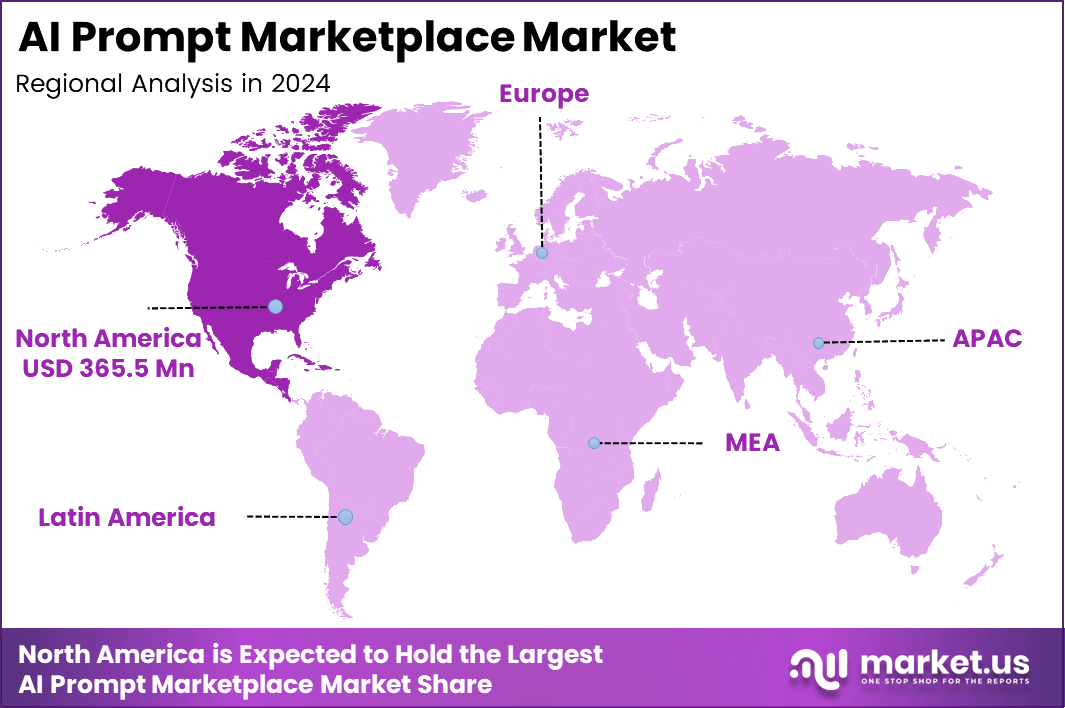
The Asia-Pacific (APAC) region is projected to register the fastest growth over the forecast period, driven by the rapid digital transformation of economies like China, Japan, India, and South Korea, alongside government-led AI innovation programs. Meanwhile, Latin America and the Middle East & Africa (MEA) are emerging markets where rising interest in generative AI applications for education, e-commerce, and marketing is gradually expanding regional participation in the global AI prompt economy.
Increasing Adoption Technologies
Key technologies supporting adoption include large language models, image generation models, API based AI services, and cloud platforms. Version control and prompt testing tools help refine and validate prompts before listing. Integration with productivity tools and AI applications allows seamless prompt deployment. Some platforms use analytics and feedback systems to rank prompt performance and improve discovery.
Users adopt AI prompt marketplaces to save time, improve output quality, and reduce learning curves. Pre built prompts help achieve predictable results and lower the risk of poor AI responses. For teams, shared prompt libraries support standardization and faster onboarding. Creators adopt marketplaces as a new monetization channel for their expertise and domain knowledge.
Investment and Business Benefits
Investment opportunities exist in prompt marketplace platforms, enterprise focused prompt management tools, and creator monetization systems. There is growing interest in niche marketplaces focused on specific domains such as legal, healthcare, education, or software development. Tools that support prompt security, versioning, and compliance also present opportunities as enterprise adoption increases.
AI prompt marketplaces deliver clear business benefits including faster task completion, reduced experimentation costs, and improved consistency in AI outputs. Organizations gain productivity gains by reusing proven prompts across teams. Creators benefit from new income streams, while businesses reduce dependency on specialized AI talent. Overall efficiency and quality of AI assisted work improve significantly.
Emerging Trends
In the AI prompt marketplace market, a clear trend is the increasing move toward use case focused and task specific prompts. Users are no longer satisfied with generic instructions. Prompts are being designed for specific outcomes such as marketing copy creation, software development support, research summarization, and visual content generation. This shift improves consistency of AI outputs and reduces the need for repeated trial and error.
Another emerging trend is the growing emphasis on usability for non technical users. Prompt marketplaces are being shaped to support professionals who do not have deep knowledge of prompt engineering. Simple descriptions, examples of expected outputs, and guided prompt structures are improving accessibility. This trend reflects the broader adoption of AI across business functions where ease of use is essential for scale and long term engagement.
Growth Factors
One of the main growth factors is the rapid integration of generative AI tools into everyday business and creative activities. As more users rely on AI systems for writing, analysis, design, and problem solving, the need for well structured prompts increases. Prompt marketplaces help users save time by providing ready to use instructions that improve output quality. This practical value supports steady adoption across individuals, teams, and organizations.
Another important growth factor is the widening skill gap in effective AI usage. While AI tools are becoming widely available, many users struggle to communicate their intent clearly to these systems. Prompt marketplaces address this challenge by capturing best practices and reusable knowledge in prompt form. This enables broader participation in AI driven workflows and encourages repeat usage, supporting sustained market expansion.
Key Market Segment
By Type
- Text Prompts
- Image Prompts
- Audio Prompts
- Video Prompts
By Application
- Content Creation & Copywriting
- Marketing & Advertising
- Education & eLearning
- Software Development
- Entertainment & Media Production
- Others
Key Regions and Countries
- North America
- US
- Canada
- Europe
- Germany
- France
- The UK
- Spain
- Italy
- Rest of Europe
- Asia Pacific
- China
- Japan
- South Korea
- India
- Australia
- Singapore
- Rest of Asia Pacific
- Latin America
- Brazil
- Mexico
- Rest of Latin America
- Middle East & Africa
- South Africa
- Saudi Arabia
- UAE
- Rest of MEA
Top 5 Use Cases
- Automated Content Generation: Enables businesses to produce blogs, ads, and product descriptions instantly using optimized text prompts.
- Creative Design Assistance: Supports designers in generating images, branding visuals, and layouts through AI-driven image prompts.
- AI-Powered Marketing Campaigns: Helps marketers create targeted ad copies and personalized campaigns with data-trained prompts.
- Educational Content Creation: Assists educators in building customized learning modules and assessments using generative AI tools.
- Software Code Generation: Developers use structured prompts to generate, debug, and optimize code efficiently.
Driver
A key driver for the AI prompt marketplace market is the increasing reliance on generative AI tools across business, creative, and technical functions. As AI systems are used more frequently for writing, coding, analysis, and design, the quality of prompts directly affects output accuracy and usefulness. Structured and reusable prompts help users achieve consistent results without repeated experimentation. This practical efficiency makes prompt marketplaces valuable for improving productivity and reducing learning time.
Another important driver is the recognition of prompt design as a skill that improves AI performance. Users and teams are actively seeking proven prompt structures that work reliably for specific tasks. Marketplaces enable the sharing and reuse of this expertise, which supports faster adoption of AI tools across organizations. This growing awareness of prompt value continues to push demand for organized prompt ecosystems.
Restraint
One major restraint is the lack of standardized quality control across prompt offerings. Prompts can perform differently depending on context, model behavior, and user input. Without clear validation or testing frameworks, users may experience inconsistent outcomes. This uncertainty can reduce trust, especially for professional or enterprise users who require predictable results.
Another restraint involves intellectual property and content ownership concerns. Users may hesitate to buy or share prompts when the boundaries of ownership and reuse are unclear. Questions around originality, reuse rights, and responsibility for generated outputs can slow participation. These concerns are particularly relevant in regulated or commercial environments.
Opportunity
A strong opportunity exists in developing structured evaluation and feedback systems for prompts. Marketplaces that help users understand how and when a prompt performs well can build confidence and long term engagement. Context based recommendations and performance feedback can improve prompt selection and usability. This approach supports higher quality interactions between users and AI systems.
Another opportunity lies in expanding prompt marketplaces into professional workflows such as education, marketing, research, and software development. As AI adoption deepens, teams will look for trusted prompt resources aligned with specific roles and tasks. Curated prompt collections designed around real work scenarios can increase adoption and repeat usage. This creates room for sustained growth through specialization.
Challenge
One of the main challenges is keeping pace with rapid changes in AI model behavior. As models are updated, prompts that previously worked well may lose effectiveness. Maintaining prompt relevance requires continuous testing and refinement, which can be difficult at scale. This dynamic environment demands ongoing attention from both creators and platforms.
Another challenge is addressing security and misuse risks linked to prompt based interactions. Poorly designed prompts can expose systems to manipulation or unintended behavior. Ensuring responsible use while preserving creative freedom is complex. Balancing openness with safeguards remains a critical challenge for prompt marketplaces as adoption increases.
SWOT Analysis
Strengths
- Strong adoption of generative AI across industries, enhancing efficiency and creativity.
- High scalability due to low entry barriers for creators and developers.
- Rapid integration with enterprise tools and APIs increases accessibility.
- Monetization potential through subscription models, licensing, and royalty-based systems.
Weaknesses
- Data quality and bias issues may affect prompt reliability and trust.
- Lack of clear IP rights and ownership standards for AI-generated outputs.
- Limited domain-specific prompt databases in certain industries.
- Dependence on a few dominant platforms is restricting fair competition.
Opportunities
- Rising demand for multimodal prompts.
- Expansion into emerging economies with growing AI adoption.
- Strategic partnerships with creative, marketing, and education sectors.
- Development of specialized industry-focused prompt repositories.
Threats
- Regulatory uncertainties surrounding AI-generated content.
- Ethical and copyright disputes impacting platform credibility.
- Intensifying competition among major AI developers.
- Potential misuse of generative AI leading to reputational risks.
Key Players Analysis
OpenAI, Anthropic, Google, Microsoft, IBM, and Meta Platforms play a central role in the AI prompt marketplace market by providing large language models and generative AI platforms that enable prompt creation, sharing, and reuse. Their ecosystems support enterprise and developer access to advanced AI capabilities. These companies focus on model performance, safety, and scalable access. Growing adoption of generative AI across industries continues to reinforce their influence.
AIPRM, FlowGPT, ChatX, and Perplexity AI strengthen the market by offering dedicated marketplaces and communities for curated prompts. Their platforms allow users to discover, rate, customize, and monetize prompts for different use cases. These providers emphasize usability, prompt quality, and community engagement. Rising demand for productivity focused AI workflows supports their expansion.
Other participants continue to emerge with niche prompt libraries and vertical specific marketplaces. Their offerings target marketing, coding, design, and data analysis use cases. These players focus on specialization, ease of integration, and prompt optimization. Increasing enterprise and creator interest in reusable AI workflows continues to drive growth in the AI prompt marketplace market.
Top Key Players
- OpenAI
- AIPRM
- ChatX
- FlowGPT
- Anthropic
- IBM
- Microsoft
- Perplexity AI
- Meta Platforms
Recent Developments
- In April 2025, Meta launched the Meta AI app powered by Llama 4, delivering a more conversational AI experience through voice and text interactions. The app integrates image generation, editing, and seamless voice based multitasking, while personalizing responses using data from Meta profiles and activities. Available initially in select countries, it extends across Meta platforms and Ray Ban Meta glasses, offering consistent AI features through both web and mobile access.









