


Report Overview
The Global Agarose for Gel Electrophoresis Market size is expected to be worth around USD 177.6 Million by 2034, from USD 98.2 Million in 2024, growing at a CAGR of 6.1% during the forecast period from 2025 to 2034. In 2024, North America held a dominan market position, capturing more than a 36.5% share, holding USD 2.3 Billion revenue.
Agarose for gel electrophoresis is a natural linear polymer from seaweed, sold as a white powder, that forms a porous gel matrix when dissolved in a buffer and heated. This gel acts as a sieve to separate nucleic acid fragments (DNA or RNA) based on size when an electric current is applied. The concentration of the agarose determines the pore size of the gel; the higher concentrations create smaller pores for separating smaller molecules, while lower concentrations create larger pores for separating larger molecules. Its market is driven by its critical role in biotechnology, molecular diagnostics, forensic science, and pharmaceutical research.
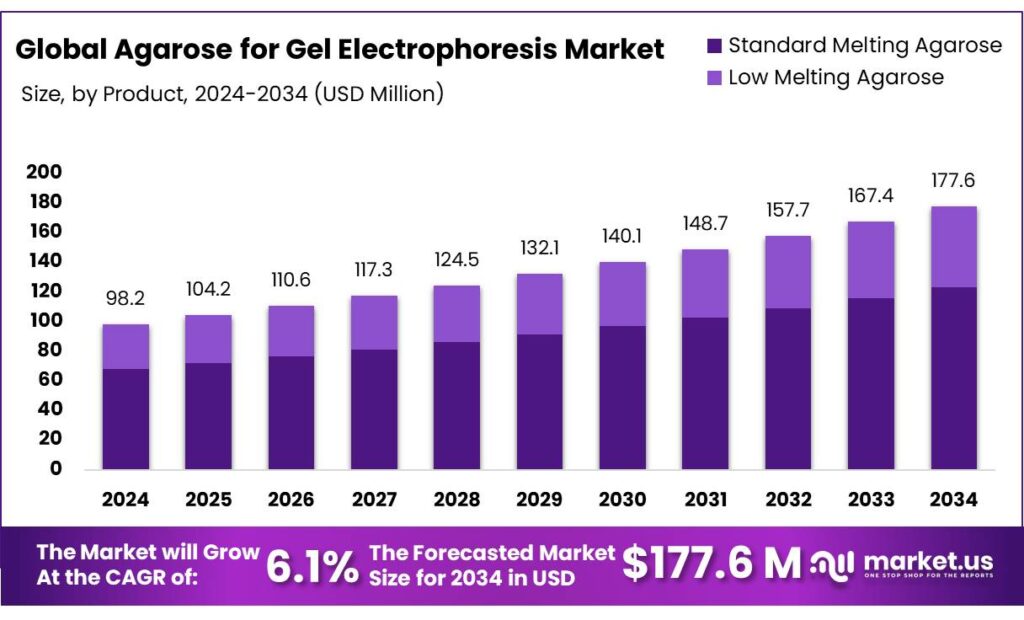
In North America, the market is particularly strong, fueled by high demand from academic institutions, diagnostic centers, and forensic laboratories. The increasing need for genetic testing in paternity testing, criminal investigations, and vaccine development further supports market growth. However, challenges such as technical complexity in gel preparation and disruptions caused by geopolitical tensions, such as trade restrictions and raw material shortages, have affected supply chains. As applications in DNA analysis, diagnostics, and genetic research continue to expand, the demand for high-quality agarose gels remains robust, particularly in regions with well-established research infrastructure.
Key Takeaways
- The global agarose for gel electrophoresis market was valued at USD 98.2 million in 2024.
- The global agarose for gel electrophoresis market is projected to grow at a CAGR of 6.1% and is estimated to reach USD 177.6 million by 2034.
- Based on the type of agarose, standard melting agarose dominated the agarose for gel electrophoresis market, with a market share of around 69.2%.
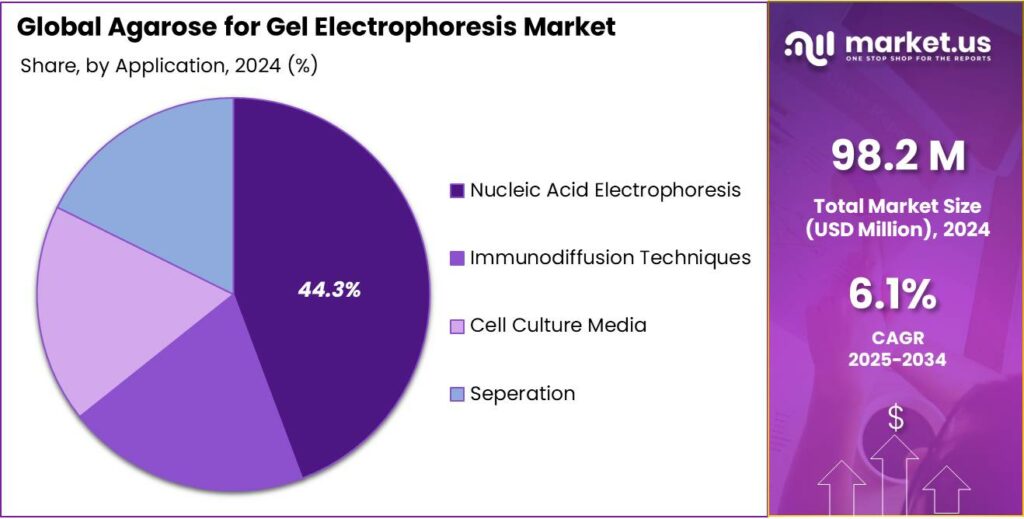
- Among the applications of agarose for gel electrophoresis, nucleic acid electrophoresis held a major share in the market, 44.3% of the market share.
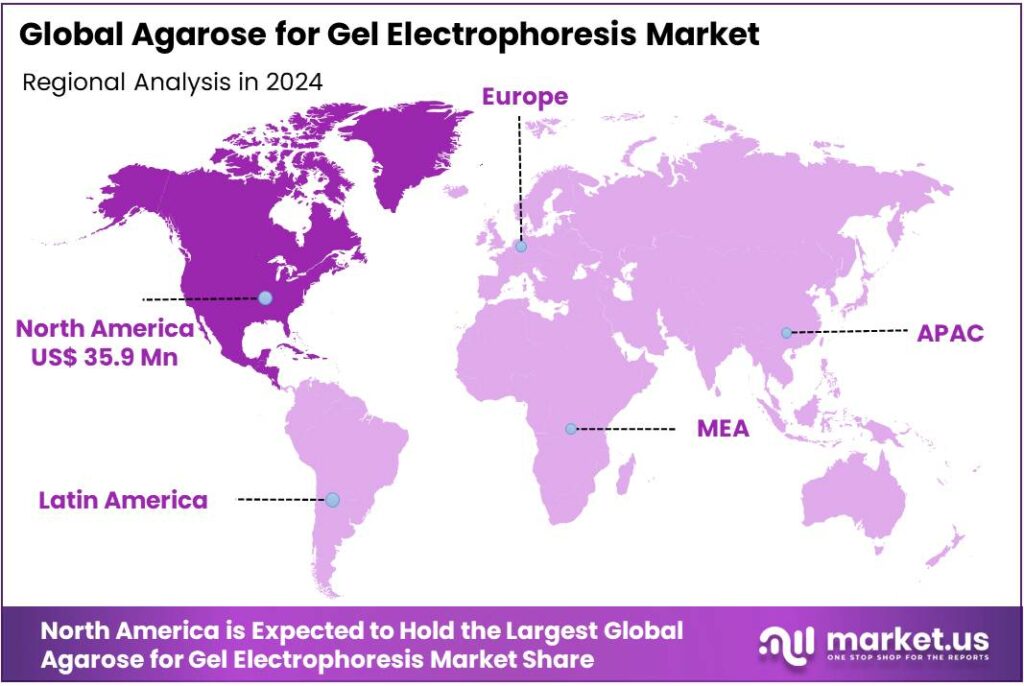
- In 2024, North America was the most dominant region in the agarose for gel electrophoresis market, accounting for around 36.5% of the total global consumption.
Product Type Analysis
Standard Melting Agarose for Gel Electrophoresis Held the Largest Share in the Market.
The agarose for gel electrophoresis market is segmented based on types of agarose into standard melting agarose and low melting agarose. The standard melting agarose for gel electrophoresis dominated the market, comprising around 69.2% of the market share. It is more widely utilized than low-melting agarose for gel electrophoresis as it offers higher gel strength, better mechanical stability, and improved resolution for routine DNA and RNA separation.
Standard agarose typically has a gelling temperature around 35-40°C and a melting temperature near 90-95°C, allowing it to maintain structural integrity during electrophoresis, even under varying voltage and buffer conditions. This makes it ideal for analytical applications such as checking PCR products or plasmid DNA.
In contrast, low-melting agarose, which melts at about 65°C, is softer and primarily used for DNA recovery or cloning applications. Since most laboratories perform electrophoresis for visualization rather than DNA extraction, standard melting agarose remains the preferred and more cost-effective choice for general molecular biology workflows.
Application Analysis
The Agarose Were Mostly Utilized for Nucleic Acid Electrophoresis.
Based on the applications of agarose for gel electrophoresis, the market is divided into nucleic acid electrophoresis, immunodiffusion techniques, cell culture media, and separation. The nucleic acid electrophoresis dominated the market, with a market share of 44.3%. Gel electrophoresis is most commonly used for nucleic acid analysis as it offers high resolution and precision in separating DNA, RNA, and their fragments based on size and charge.
The technique is particularly effective for visualizing genetic material after PCR amplification, restriction digestion, or cloning, making it essential in molecular biology and diagnostics. Nucleic acids, with their distinct molecular weights and charge-to-mass ratios, migrate through agarose gels in a way that is easy to track and interpret.
In contrast, techniques like immunodiffusion or cell culture media separation are more suited for protein analysis or cellular studies, which involve different principles of separation, such as antigen-antibody interactions or cell growth conditions. Gel electrophoresis, with its straightforward methodology and ability to handle nucleic acids, remains the preferred tool for studying genetic material rather than proteins or cells.
Key Market Segments
By Product Type
- Standard Melting Agarose
- Multipurpose Agarose (Low EEO)
- Specialty Agarose (High & Medium EEO)
- Specialty Agarose Low EEO
- Low Melting Agarose
By Application
- Nucleic Acid Electrophoresis
- Immunodiffusion Techniques
- Cell Culture Media
- Separation
Drivers
Antibiotics and Vaccines Testing Drive the Agarose for Gel Electrophoresis Market.
The demand for agarose used in gel electrophoresis is being driven by the growing focus on antibiotics and vaccine testing in both clinical and research settings. Agarose gels play a critical role in the separation and analysis of DNA, RNA, and proteins, essential for identifying microbial resistance genes and verifying vaccine purity.
For instance, electrophoresis is routinely used to confirm the molecular weight of vaccine antigens and assess plasmid integrity during mRNA vaccine production.
- According to the World Health Organization, it is estimated that bacterial antimicrobial resistance (AMR) is directly responsible for over 1.2 million global deaths annually. With the global rise in antimicrobial resistance, laboratories increasingly rely on agarose gels for genetic screening of resistant bacterial strains.
In addition, during vaccine development against diseases such as influenza and COVID-19, electrophoretic assays help ensure genetic stability and quality control. This growing use in molecular diagnostics and vaccine validation continues to strengthen the demand for agarose across biotechnology and pharmaceutical laboratories worldwide.
Restraints
Technical Complexity is a Significant Challenge in the Agarose for Gel Electrophoresis Market.
Technical complexity remains a significant challenge in the agarose for gel electrophoresis market, as the process demands precision, skill, and optimal laboratory conditions to achieve accurate results. Errors in gel concentration, buffer preparation, or voltage settings can lead to distorted bands or incomplete separations, affecting the reliability of DNA, RNA, or protein analyses.
- For instance, even a minor variation in agarose concentration, from 0.8% to 2%, can alter the resolution of nucleic acid fragments, making reproducibility difficult for inexperienced users. According to laboratory training data, nearly 20-30% of electrophoresis errors in academic and diagnostic labs stem from improper sample loading or gel casting.
Moreover, maintaining contamination-free conditions and interpreting faint or smeared bands requires advanced technical expertise. These challenges make electrophoresis labor-intensive, particularly in smaller or under-equipped facilities, where a lack of automation or skilled personnel can limit the efficiency and accuracy of molecular diagnostics and research applications.
Opportunity
Application of Agarose for Gel Electrophoresis in Criminal Investigations Creates Opportunities in the Market.
The use of agarose for gel electrophoresis in criminal investigations is creating significant opportunities in forensic science applications. Agarose gels are vital for DNA fingerprinting, a technique that enables the comparison of genetic material collected from crime scenes with that of suspects or victims.
- According to INTERPOL, DNA profiling has helped solve thousands of cases globally, with accuracy rates exceeding 99.9% when high-quality samples are available. INTERPOL’s DNA Gateway, accessible via its I-24/7 communications system, allows member countries to link cases that would have gone unsolved because the evidence was in different countries.
Electrophoresis allows forensic experts to separate and visualize DNA fragments, helping identify individuals even from trace biological evidence such as blood, hair, or saliva. For instance, in the United States, the FBI’s Combined DNA Index System (CODIS) has aided in over 600,000 criminal investigations by utilizing DNA analysis methods that rely heavily on electrophoretic separation. As criminal justice systems increasingly depend on molecular evidence for case resolution, the demand for agarose gels in forensic laboratories continues to expand, enhancing precision and reliability in modern investigations.
Trends
Application of Agarose for Gel Electrophoresis in Paternity Testing.
The application of agarose for gel electrophoresis in paternity testing has become an ongoing trend, driven by the growing accessibility and reliability of DNA-based identification methods. Agarose gels are essential for separating and visualizing DNA fragments obtained from the genetic samples of parents and children to determine biological relationships.
Using electrophoresis, laboratories can compare specific genetic markers, such as short tandem repeats (STRs), to establish paternity with over 99.9% accuracy when high-quality samples are used. For instance, DNA-based paternity testing has become increasingly common in legal disputes, immigration cases, and personal verification worldwide.
- The American Association of Blood Banks (AABB) reported that in 2023, approximately 347,043 paternity tests were conducted in the United States alone, with electrophoretic analysis being a crucial step in these procedures. This growing use of agarose gels in genetic verification continues to enhance the precision, affordability, and accessibility of paternity testing across clinical and legal domains.
Geopolitical Impact Analysis
Geopolitical Tensions Are Impacting the Agarose for Gel Electrophoresis Market by Shifting Trade Flows.
The geopolitical tensions have had a noticeable impact on the agarose for gel electrophoresis market, disrupting supply chains and affecting the availability of key raw materials. Many manufacturers of agarose, which is primarily produced in countries such as China, Spain, and Indonesia, have faced production delays and shipping bottlenecks due to trade restrictions, tariffs, and geopolitical conflicts.
For instance, the trade war between the U.S. and China, along with the ongoing Ukraine-Russia conflict, has led to shortages in agarose raw materials and higher transportation costs, which in turn impact the pricing and accessibility of the product. These disruptions have affected research timelines, particularly in time-sensitive fields such as drug development and diagnostics, where agarose gel electrophoresis is a critical technique for genetic testing.
Moreover, the tensions made it more difficult for smaller biotech companies and academic labs with limited budgets to source the necessary reagents for the studies. The geopolitical instability has prompted some countries to invest in local manufacturing capabilities, reducing dependency on international suppliers.
However, the long-term effect of these geopolitical factors continues to create uncertainties in the supply and demand dynamics of agarose for gel electrophoresis, especially in regions reliant on imports for research purposes.
Regional Analysis
North America Held the Largest Share of the Global Agarose for Gel Electrophoresis Market.
In 2024, North America dominated the global agarose for gel electrophoresis market, holding about 36.5% of the total global consumption. The region holds the largest share of the global agarose for gel electrophoresis market, largely due to its strong presence in biotechnology, pharmaceutical research, and academic institutions.
In particular, the United States is home to a high concentration of research laboratories and universities conducting advanced studies in genomics, molecular biology, and biotechnology, which rely heavily on agarose gel electrophoresis for DNA, RNA, and protein analysis. The National Institutes of Health (NIH) and other funding agencies invest significantly in research projects that require electrophoresis techniques, further fueling demand.
Additionally, North American forensic labs and clinical diagnostic centers frequently use agarose gels in applications such as paternity testing and criminal investigations, which contribute to the market share. The region’s well-established infrastructure, along with a focus on technological innovations in molecular biology, solidifies North America as a dominant player in the agarose gel electrophoresis market.
Key Regions and Countries
- North America
- The US
- Canada
- Europe
- Germany
- France
- The UK
- Spain
- Italy
- Russia & CIS
- Rest of Europe
- APAC
- China
- Japan
- South Korea
- India
- ASEAN
- Rest of APAC
- Latin America
- Brazil
- Mexico
- Rest of Latin America
- Middle East & Africa
- GCC
- South Africa
- Rest of MEA
Key Players Analysis
The major market players in the agarose for gel electrophoresis market are Thermo Fisher Scientific, Merck KGaA, Avantor, Lonza Group AG, Bio-Rad Laboratories, Bioneer Corporation, Hispanagar S. A., Condalab, Geno Technology, Cleaver Scientific, Nippon Gene, Promega, and GoldBio.
Companies in the agarose for gel electrophoresis market employ several strategies to boost their sales, focusing on product innovation, strategic partnerships, and expanding distribution networks. By offering agarose with enhanced purity, improved resolution, or faster gel formation times, companies differentiate themselves in a competitive market.
In addition, collaboration with academic institutions and research organizations plays a key role, as these partnerships help ensure products meet evolving research needs. Similarly, expanding distribution networks, particularly in emerging markets, helps companies tap into new customer bases, driving further sales growth.
The major players in the industry
- Thermo Fisher Scientific Inc.
- Merck KGaA
- Avantor Inc.
- Lonza Group AG
- Bio-Rad Laboratories Inc.
- BIONEER CORPORATION
- Hispanagar S A
- Condalab
- Geno Technology, Inc.
- Cleaver Scientific Ltd.
- NIPPON GENE
- Promega
- GoldBio
- Other Key Players
Key Development
- In January 2025, Biotium announced the launch of EMBER Ultra Gel Kits for RNA and DNA gel electrophoresis. These kits use a gel system of EMBER ultra pre-coated agarose with EMBER loading dye to achieve the highest sensitivity available for agarose gel-based detection and analysis.









