


Report Overview
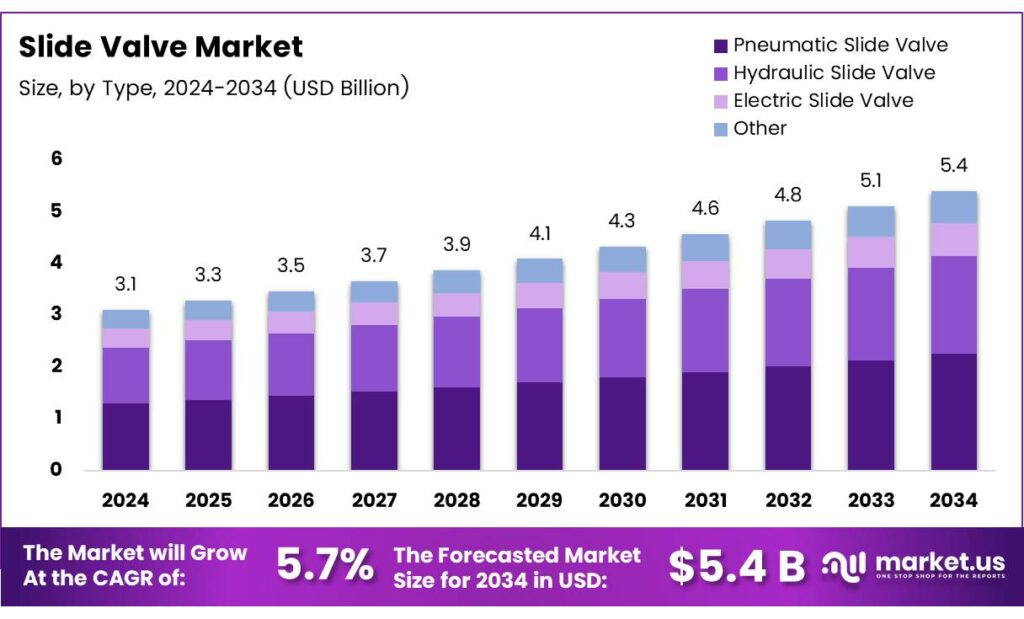
The Global Slide Valve Market size is expected to be worth around USD 5.4 billion by 2034, from USD 3.1 billion in 2024, growing at a CAGR of 5.7% during the forecast period from 2025 to 2034.
The Slide Valve Market represents a crucial segment within industrial flow control systems, supporting applications in chemical processing, food handling, water treatment, and power plants. It includes manual, hydraulic, pneumatic, and electric slide valve systems that regulate material flow with precision. The market continues to evolve with automation, digital monitoring, and improved material durability.
The market outlook appears positive as industries adopt smart manufacturing and optimise operational efficiency. Demand rises due to expanding infrastructure, stricter emission regulations, and growth in industrial automation. Additionally, slide valves are becoming more reliable due to advancements in sealing technology, corrosion-resistant alloys, and integration with PLC-based control systems.
From a technical standpoint, slide valves often integrate with pneumatic or solenoid control units. Solenoid valves used in industrial systems are offered in 2/2-way normally closed and 3/2-way configurations with 0.4 mm and 1.0 mm orifice options. Threading varies, where 0.4 mm uses 10-32UNF, and 1.0 mm supports M6 or 1/4-28UNF connections.
- Furthermore, these solenoid-based controls typically operate at 12 VDC or 24 VDC, supporting automation-ready deployment. Pressure range capability influences industrial suitability, where 0.4 mm orifice handles -0.9 to +5,000 mbar, and 1.0 mm supports -900 mbar to +3,000 mbar. These technical improvements strengthen performance reliability and reinforce market adoption.
Environmental regulations encourage industries to use high-efficiency valve systems to reduce leakage and prevent material loss. Public investments in wastewater treatment, bulk chemical storage networks, and industrial safety standards contribute to long-term demand. These market drivers position slide valves as strategic infrastructure components, especially in fast-growing industrial markets.
Key Takeaways
- The Global Slide Valve Market is projected to reach USD 5.4 billion by 2034, expanding from USD 3.1 billion in 2024 at a steady 5.7% CAGR.
- Pneumatic slide valves lead the market with a significant 48.2% share due to their high responsiveness, low maintenance, and strong suitability for automated process environments across manufacturing.
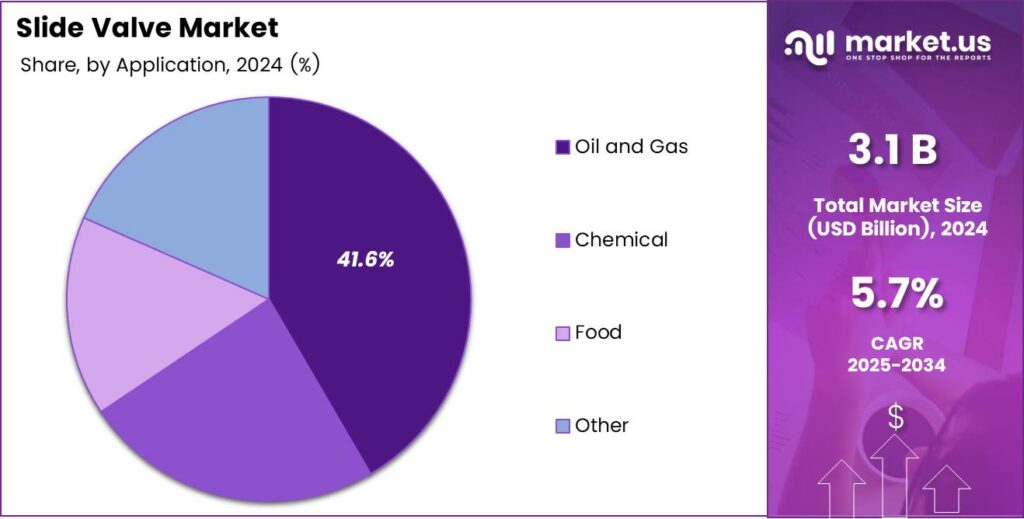
- The Oil and Gas sector accounts for the highest share at 41.6%, reflecting strong usage in high-pressure applications, pipeline systems.
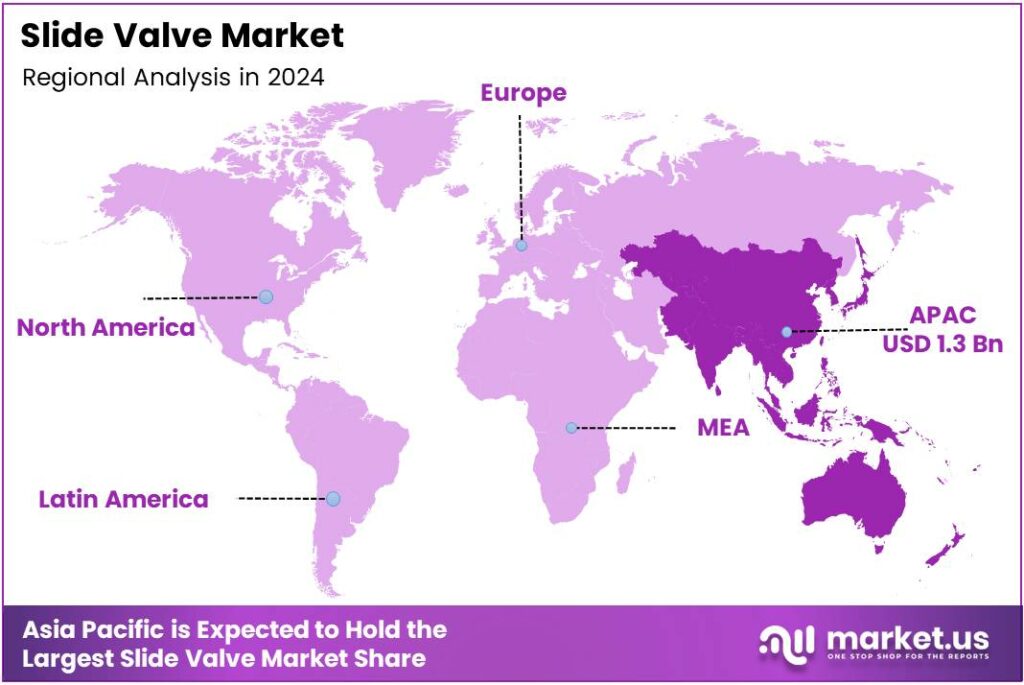
- The Asia Pacific region dominates the global market with a 43.9% share valued at USD 1.3 billion, fueled by rapid industrial expansion, increasing adoption of automated valve systems.
By Types Analysis
Pneumatic Slide Valve dominates with a 48.2% share due to its efficiency and adaptability.
In 2024, Pneumatic Slide Valve held a dominant market position in the By Types Analysis segment of the Slide Valve Market, with a 48.2% share. This category continues to expand as industries demand faster response control, reduced manual intervention, and compatibility with automated systems used in manufacturing, processing, and waste handling.
The Hydraulic Slide Valve remained an essential option for heavy-duty industrial use. It supports high-pressure applications and ensures consistent flow control in systems requiring stability and minimal leakage. Industries adopt this type when reliability and long-term durability outweigh speed and automation benefits. Therefore, it remains relevant across processing and infrastructure projects.
The Electric Slide Valve segment gained traction as industries shift toward energy efficiency and centralised automation. Its integration with IoT and smart systems allows predictive maintenance and remote monitoring. Companies exploring automation for safety improvements and operational cost reduction continue to adopt electric valves across sensitive and controlled environments.
The Other category includes customised and speciality slide valves used in unique production flows. These solutions cater to niche sectors requiring tailored mechanical control beyond standard valve formats. Although smaller in adoption, the segment contributes value through innovation, specialised engineering, and adaptability to rare or emerging industrial functions.
By Applications Analysis
Oil and Gas leads the segment with a 41.6% share, driven by operational safety and demand stability.
In 2024, the Oil and Gas segment held a dominant market position in the By Applications Analysis of the Slide Valve Market, with a 41.6% share. High-pressure environments, safety standards, and continuous flow monitoring supported their adoption. These valves remain key components in refinery operations, extraction units, and pipeline systems.
The Chemical application category relied on slide valves for handling reactive materials and managing hazardous flow transitions. They are used to prevent contamination and maintain operational safety. Their corrosion resistance and suitability for controlled material handling make them important across chemical production, refining processes, and handling speciality compounds.
The Food segment adopted slide valves for hygienic material control in production lines. These valves help manage the flow of powders, liquids, and semi-solid ingredients. Their durability and compliance with safety standards support food-grade processing, packaging, and automated batching environments that require minimal contamination and high operational consistency.
Key Market Segments
By Types
- Pneumatic Slide Valve
- Hydraulic Slide Valve
- Electric Slide Valve
- Other
By Applications
- Oil and Gas
- Chemical
- Food
- Other
Emerging Trends
Increasing Preference for Automated and Durable Valve Solutions Shapes Market Trends
A key trend in the slide valve market is the growing shift toward automation-ready valve solutions. Many industries seek valves that support programmable control systems, making slide valves more attractive for modern processing lines. The move toward durability and sustainability.
- Manufacturers are focusing on high-performance materials that reduce wear, energy loss, and downtime. This helps industries lower operating costs while improving safety and reliability. The programme known as National Infrastructure Pipeline (NIP) also highlights capital outlay of USD 1.4 trillion over the ensuing years.
There is also a rising trend of customisation based on end-use applications. Customers now request industry-specific designs for food processing, hazardous materials, or extreme temperatures, reflecting a shift toward specialised product solutions rather than one-size-fits-all equipment.
Restraints
High Maintenance Cost Limits Rapid Market Expansion
Despite strong demand, high installation and maintenance costs remain a key challenge for the slide valve market. Many end users must spend on periodic servicing to keep slide valves running smoothly, especially in applications handling corrosive or abrasive materials. Some industries also hesitate to shift from traditional valve types because slide valves can require specialised fittings and skilled technicians.
This adds additional cost and slows adoption in smaller manufacturing facilities with limited budgets. Another restraint is the availability of alternative valve technologies that may offer lower costs or simpler maintenance. This creates competition and reduces the immediate shift toward slide valves, especially in price-sensitive markets. Until cost-related concerns are addressed through better materials or smarter designs, this restraint will continue to affect market speed.
Drivers
Rising Industrial Automation Boosts Slide Valve Market Demand
Growing industrial automation is one of the major factors driving demand for slide valves. Many industries, such as oil and gas, chemicals, water treatment, and manufacturing, are now using automated equipment to improve efficiency and reduce manual handling. Slide valves support this demand because they are reliable, easy to control, and suitable for automated flow systems.
- The need for safety and accuracy in industrial processing is increasing, supporting the adoption of slide valves in pipelines and material transfer systems. As industries focus on reducing production downtime, slide valves provide longer service life and better performance under harsh operating conditions. The rise in core‐industry output, such as cement up 11.6% in March 2025 and steel up 7.1% in March 2025.
The rise of process industries in developing countries is also pushing market growth. Investments in new manufacturing facilities, infrastructure upgrades, and energy projects continue to create steady demand for industrial valves, including slide valves. With ongoing modernisation across sectors, this driver is expected to remain strong in the coming years.
Growth Factors
Technological Innovation Creates New Growth Pathways
There is a strong opportunity for growth through smarter, more efficient valve designs. New materials that offer corrosion resistance, longer lifespan, and less maintenance are gaining attention and could help expand the market. Digital and smart valve technologies are also expected to create new opportunities.
As industries adopt predictive maintenance and remote monitoring, integrating sensors with slide valves may increase demand in automated sectors. Expanding industrial projects in emerging economies also offer growth potential. Countries investing in chemical plants, food processing, and waste management are likely to drive higher purchasing volumes for slide valves. This trend positions the market well for long-term expansion.
Regional Analysis
Asia Pacific Leads the Slide Valve Market with 43.9% Share, Valued at USD 1.3 Billion
Asia Pacific holds the dominant position in the Slide Valve Market, securing a strong 43.9% share, valued at approximately USD 1.3 billion. The region benefits from rapid industrial expansion, particularly across chemicals, oil & gas, cement, and food processing sectors. Rising investments in manufacturing facilities and automation are further boosting the adoption of slide valves in both process and discrete industries.
North America remains a key market due to advanced industrial automation adoption, strict safety standards, and the growth of refining and petrochemical capacity. Additionally, the region benefits from widespread modernisation of legacy infrastructure and strong demand for reliable control equipment in harsh operating environments.
Europe demonstrates steady growth, driven by its well-established industrial sector and focus on energy-efficient technologies. Environmental regulations encourage industries to upgrade to optimised valve systems, supporting demand across water treatment, chemical processing, and renewable energy segments.
The United States remains one of the most mature markets, driven by high technology adoption, refinery throughput, and modernisation of water and wastewater facilities. Strong focus on safety compliance and efficiency standards ensures continued investment in advanced slide valve solutions.
Key Regions and Countries
North America
- US
- Canada
Europe
- Germany
- France
- The UK
- Spain
- Italy
- Rest of Europe
Asia Pacific
- China
- Japan
- South Korea
- India
- Australia
- Rest of APAC
Latin America
- Brazil
- Mexico
- Rest of Latin America
Middle East & Africa
- GCC
- South Africa
- Rest of MEA
Key Players Analysis
ARGO-HYTOS plays a strong role in the slide valve market due to its specialisation in hydraulic control components. The company focuses on precision, durability, and reliability, making its slide valves suitable for demanding industrial environments, including construction equipment, heavy machinery, and agricultural systems. Its ongoing product innovation and modular hydraulic platforms support automation trends and strengthen long-term positioning.
Beswick Engineering brings a niche strength with miniature slide valve designs tailored for compact and precision applications. Its solutions support sectors such as medical devices, laboratory automation, instrumentation, and robotics. With a focus on clean flow control and tight tolerances, the company benefits from growing adoption of micro-pneumatics and lightweight system architectures.
Bosch Rexroth – Mobile Hydraulics remains one of the most influential players through its extensive hydraulic valve systems integrated across mobile and industrial platforms. Its slide valve offerings benefit from a larger ecosystem of sensors, electronics, and control software, allowing the company to support digital hydraulics and electronically controlled flow systems, gaining traction in smart manufacturing and heavy mobile equipment.
Boston Gear adds value through its broad motion-control and power-transmission portfolio, where slide valves complement mechanical and pneumatic control products. The company’s ability to pair valve technology with drives, actuators, and control components makes it relevant in sectors like packaging, energy, material handling, and industrial automation, where integrated solutions are preferred over standalone components.
Top Key Players in the Market
- ARGO-HYTOS
- Beswick Engineering
- Bosch Rexroth – Mobile Hydraulics
- Boston Gear
- C.matic
- Clippard
- DAV TECH Srl
- Festo
- HANSA FLEX Hydraulik
- KOSMEK
- PONAR S.A
Recent Developments
- In 2025, ARGO-HYTOS highlighted advancements in proportional directional control valves, enabling stepless and sensitive regulation of pressure and flow rates. These valves adapt flow precisely to operating conditions, improving energy efficiency in industrial and mobile hydraulic systems.
- In 2024, Beswick Engineering, highlighting pinch valves complementary to slide valves for fluid isolation that avoid direct contact with mechanical seals, will reduce contamination risks. This ties into broader 2024 trends toward miniaturised fluid power for UAVs and medical devices.









