


Report Overview
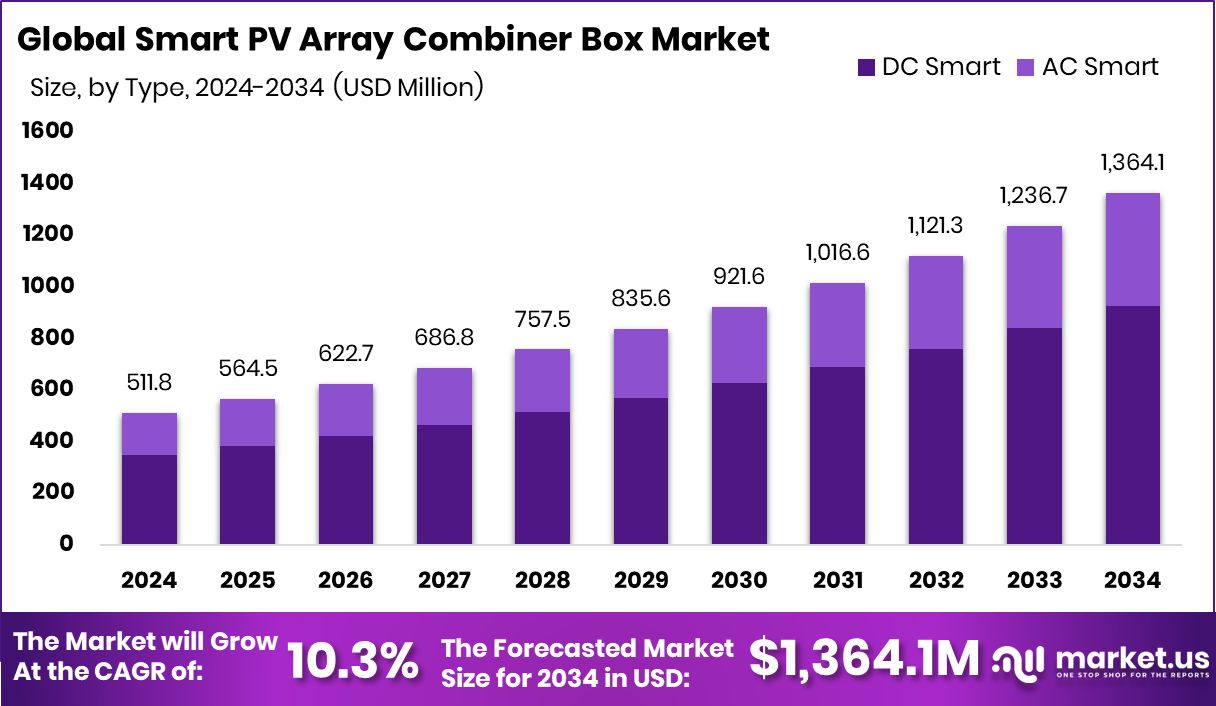
The Global Smart PV Array Combiner Box Market is expected to be worth around USD 1,364.1 million by 2034, up from USD 511.8 million in 2024, and is projected to grow at a CAGR of 10.3% from 2025 to 2034. North America maintains market leadership with a 45.80% share and strong investments.
A Smart PV Array Combiner Box is an intelligent electrical unit used in solar power systems to group multiple photovoltaic strings into a single output while offering monitoring, surge protection, fault diagnosis, and communication functions. Unlike traditional boxes, smart versions include sensors, IoT connectivity, and real-time data reporting for voltage, current, and insulation levels, helping improve uptime, safety, and energy yield in solar installations.
The Smart PV Array Combiner Box Market represents the demand for these advanced power management components across utility-scale, commercial, and residential solar deployments. Growth is driven by rising solar installations, grid modernisation, and the need for predictive maintenance and safety compliance. The transition toward smart grids and remote asset monitoring further supports adoption.
Demand continues to accelerate as solar capacity expands worldwide and digital energy infrastructure becomes a standard. With India’s solar sector attracting $17.3 billion in corporate funding, utilities and EPC firms are increasingly prioritising intelligent balance-of-system components that reduce energy losses and improve asset lifecycle efficiency.
Growth opportunities are also rising as financing supports large renewable portfolios. Recently, Mirova raised $1.4 billion for an energy transition fund, while Soltage secured $525 million for storage and solar projects. These developments signal confidence in smart monitoring technologies.
Improving revenue models in regional energy markets is also encouraging investment. For example, Sikkim’s power department reported Rs 3,400 crore revenue but remitted only Rs 1,488 crore, highlighting inefficiencies that smart monitoring and asset traceability tools can help reduce, creating long-term modernisation opportunities.
Key Takeaways
- The Global Smart PV Array Combiner Box Market is expected to be worth around USD 1,364.1 million by 2034, up from USD 511.8 million in 2024, and is projected to grow at a CAGR of 10.3% from 2025 to 2034.
- In the Smart PV Array Combiner Box Market, DC Smart dominates with 67.9% global share.
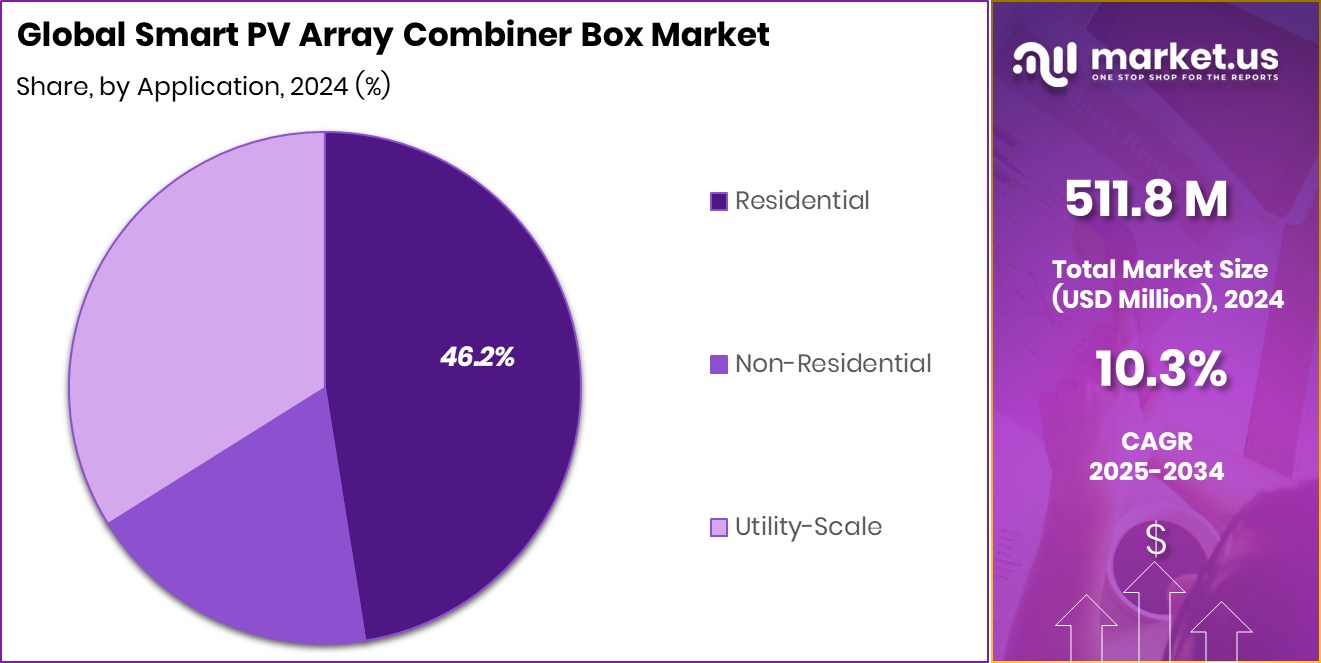
- Smart PV Array Combiner Box Market sees Non-Residential applications leading at 46.2% deployment demand growth.
- Within the Smart PV Array Combiner Box Market, Independent Power Producers hold 49.4% primary adoption share.
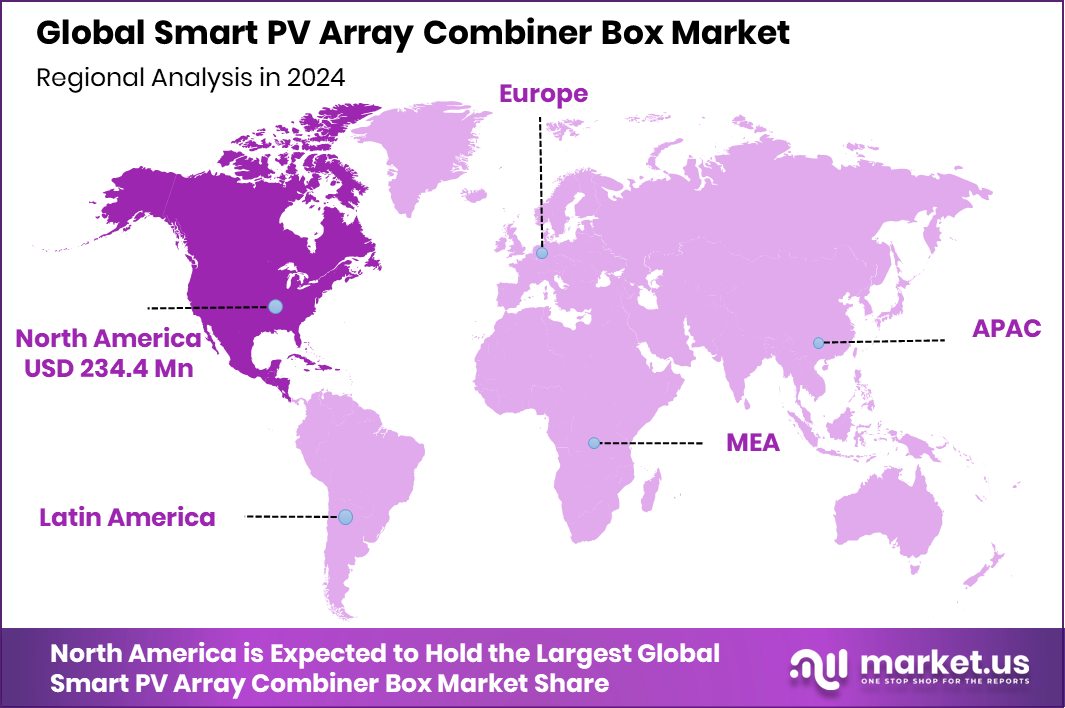
- North America reaches USD 234.4 Mn, driven by growing digital solar adoption.
By Type Analysis
Smart PV Array Combiner Box Market sees DC Smart dominating with 67.9%.
In 2024, DC Smart held a dominant market position in the By Type segment of the Smart PV Array Combiner Box Market, with a 67.9% share. This strong position reflects the increasing use of DC architecture in solar installations where efficiency, monitoring, and fault detection are essential.
The segment benefits from growing utility-scale and commercial solar deployments where real-time remote monitoring and digital diagnostics help reduce downtime and operational risk.
As solar infrastructure expands, DC Smart solutions continue to gain preference due to their compatibility with advanced inverters, IoT-based system oversight, and predictive maintenance needs. This dominance also shows how reliability and automation are becoming key decision factors in next-generation energy systems.
By Application Analysis
Smart PV Array Combiner Box Market shows non-residential applications reaching 46.2%.
In 2024, Non-Residential held a dominant market position in the By Application segment of the Smart PV Array Combiner Box Market, with a 46.2% share. This position aligns with the rising adoption of large-scale commercial and institutional solar projects, where monitoring, safety, and performance optimisation are critical. Non-residential users prioritise operational continuity and energy cost reduction, making smart monitoring and automated fault detection essential features.
The segment benefits from increasing investment in rooftop and ground-mounted solar systems across warehouses, manufacturing units, business parks, and public infrastructure. The focus on long-term energy savings and system reliability continues to strengthen the importance of smart electrical balance-of-system components within this application category.
By End User Analysis
Smart PV Array Combiner Box Market sees Independent Power Producers holding 49.4%.
In 2024, Independent Power Producers (IPPs) held a dominant market position in the By End User segment of the Smart PV Array Combiner Box Market, with a 49.4% share. This reflects the increasing role of privately financed solar assets, where efficiency, uptime, and remote system intelligence are crucial for profitability.
IPPs typically manage large, distributed, and utility-scale projects, making smart monitoring, real-time diagnostics, and automated safety controls essential in operational strategy. The segment’s strong position indicates a preference for intelligent components that support performance tracking, reduce maintenance costs, and optimise long-term generation output.
Key Market Segments
By Type
- DC Smart
- AC Smart
By Application
- Residential
- Non-Residential
- Utility-Scale
By End User
- Independent Power Producers (IPPs)
- Commercial and Industrial (C&I) Entities
- Utility Companies
Driving Factors
Rising Solar Installations Drive Smart Adoption
A major driving factor for the Smart PV Array Combiner Box Market is the rapid increase in global solar installations. As more homes, industries, and large utility projects adopt solar power, the need for better system monitoring, safety, and efficiency grows. Smart combiner boxes help track performance, detect faults early, and reduce power loss, making them essential for modern solar systems.
They support remote monitoring, which helps operators reduce downtime and maintenance costs. With solar projects expanding across both urban and rural areas, developers are choosing smarter and automated power management solutions. This rising demand for reliable, connected, and intelligent energy systems strongly supports the growth of smart combiner box adoption.
Restraining Factors
High upfront cost limits wider deployment
A key restraint for the Smart PV Array Combiner Box Market is the higher upfront cost compared to traditional non-smart units. Even though smart systems offer better monitoring, protection, and long-term savings, many small and mid-sized solar developers hesitate due to initial investment pressure. These systems also require additional components such as communication modules, sensors, and digital safety features, which can increase installation and integration expenses.
In some regions, limited awareness and a lack of skilled technicians make adoption even slower. For cost-sensitive solar projects, especially in emerging markets, budget priorities often focus on panels and inverters rather than smart balance-of-system upgrades, delaying wider use of intelligent combiner technology.
Growth Opportunity
Growing demand for digital solar monitoring systems
A major growth opportunity for the Smart PV Array Combiner Box Market comes from the shift toward digital and data-driven solar operations. As solar plants expand in size, operators need smarter ways to track power output, detect failures early, and manage assets remotely. Smart combiner boxes offer real-time insights, making them useful for predictive maintenance and better energy planning.
With more solar farms connecting to smart grids, the need for automation, IoT integration, and cloud-based analytics continues to rise. This creates a clear pathway for wider adoption of intelligent system components. As digital energy platforms and remote operating centers become standard practice, smart combiner solutions are expected to see increased global acceptance.
Latest Trends
Increasing integration with IoT and cloud platforms
A key emerging trend in the Smart PV Array Combiner Box Market is the growing use of IoT connectivity and cloud-based monitoring systems. Smart combiner boxes are now being designed to transmit real-time performance data, temperature, fault alerts, and string-level current readings directly to centralized dashboards or remote operations centers. This shift allows plant operators to track the health of solar systems from anywhere, helping reduce on-site inspection needs and improving response time during equipment failures.
With solar deployments becoming larger and more distributed, centralized digital monitoring helps improve overall efficiency, reduce operational costs, and support predictive maintenance. This trend reflects the transition toward smarter, automated, and data-driven solar power infrastructure.
Regional Analysis
North America holds a 45.80% share, showing strong Smart PV Array Combiner Box demand.
North America dominated the Smart PV Array Combiner Box Market with a 45.80% share valued at USD 234.4 Mn, supported by large-scale solar deployment across utility and commercial sites. The region’s focus on digital monitoring and advanced grid integration continues to strengthen smart system adoption.
Europe follows with steady growth driven by increasing rooftop solar systems and the modernization of energy infrastructure. Asia Pacific shows rising interest as solar installations expand across industrial and non-residential sectors, particularly in faster-growing economies adopting digital energy management.
The Middle East & Africa region demonstrates gradual traction as solar farms grow in desert and utility environments requiring reliable monitoring. Latin America continues to emerge with policy support and increasing energy diversification, encouraging investment in smart balance-of-system solutions across distributed and centralized solar projects.
Key Regions and Countries
- North America
- US
- Canada
- Europe
- Germany
- France
- The UK
- Spain
- Italy
- Rest of Europe
- Asia Pacific
- China
- Japan
- South Korea
- India
- Australia
- Rest of APAC
- Latin America
- Brazil
- Mexico
- Rest of Latin America
- Middle East & Africa
- GCC
- South Africa
- Rest of MEA
Key Players Analysis
CFAT continues strengthening its position in the Smart PV Array Combiner Box Market by focusing on technology that supports efficiency, safety, and digital monitoring. The company appears aligned with the shift toward smart solar systems, where real-time performance tracking and automated fault detection are becoming standard. Its ability to adapt solutions for utility-scale and commercial installations supports demand as the market evolves toward intelligent power management.
XJ Group maintains relevance by offering solutions designed around reliable power distribution, surge protection, and structured monitoring capabilities. Its role in supporting smart electrical systems allows it to serve growing modern energy projects where remote supervision and operational safety are essential. The company benefits from increasing attention on smarter and connected solar infrastructure.
Wuxi Longmax demonstrates steady participation in the market by offering solutions aligned with smart grid expectations, string-level monitoring, and operational intelligence. The company’s focus remains on supporting scalable and efficient solar installations where reducing system losses and improving maintenance response time matter. As global solar deployment expands and more installations shift toward digital management, the company’s offerings remain positioned to support adoption within both large solar fields and structured commercial systems.
Top Key Players in the Market
- CFAT
- XJ Group
- Wuxi Longmax
- Noark
- Weidmuller
- Schneider Electric
- TOPBAND
- Eaton
Recent Developments
- In June 2025, NOARK introduced two new offerings for photovoltaic and energy-storage systems — an 800 V moulded-case circuit-breaker (MCCB) family and a 1500 Vdc MCCB family intended for use at combiner boxes and inverter inputs, aligning with higher-voltage smart PV systems.
- In April 2024, Longmax showcased a new generation of energy-solutions products — including advanced combiner-box systems — at the World Future Energy Summit (WFES). The company emphasised its smart combiner-box capabilities tailored for large-scale solar plants.









