


Report Overview
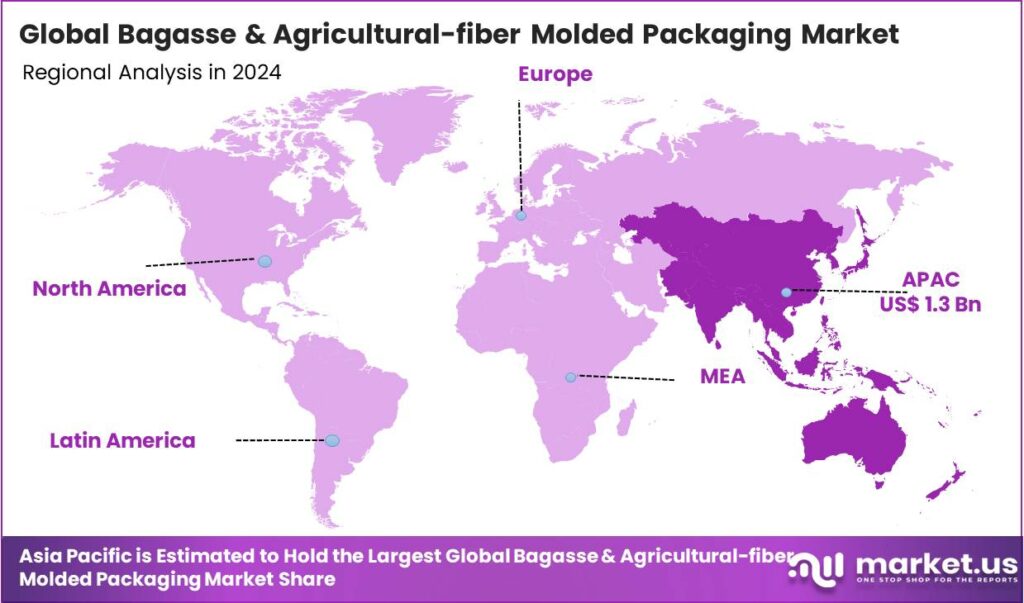
The Global Bagasse and Agricultural-fiber Molded Packaging Market size is expected to be worth around USD 8.34 Billion by 2034, from USD 3.46 Billion in 2024, growing at a CAGR of 9.2% during the forecast period from 2025 to 2034. In 2024, Asia Pacific held a dominan market position, capturing more than a 38.4% share, holding USD 1.3 Billion revenue.
Agricultural-fiber molded packaging is a protective and eco-friendly material made from natural fibers, such as sugarcane bagasse or wheat straw, that are pulped with water and then molded into specific shapes using pressure and heat. Its market is driven by the growing demand for sustainable alternatives to traditional plastic packaging, particularly in the food service sector. Bagasse, a byproduct of sugarcane processing, along with other agricultural fibers such as wheat straw and rice straw, provides an eco-friendly, biodegradable solution for single-use packaging.
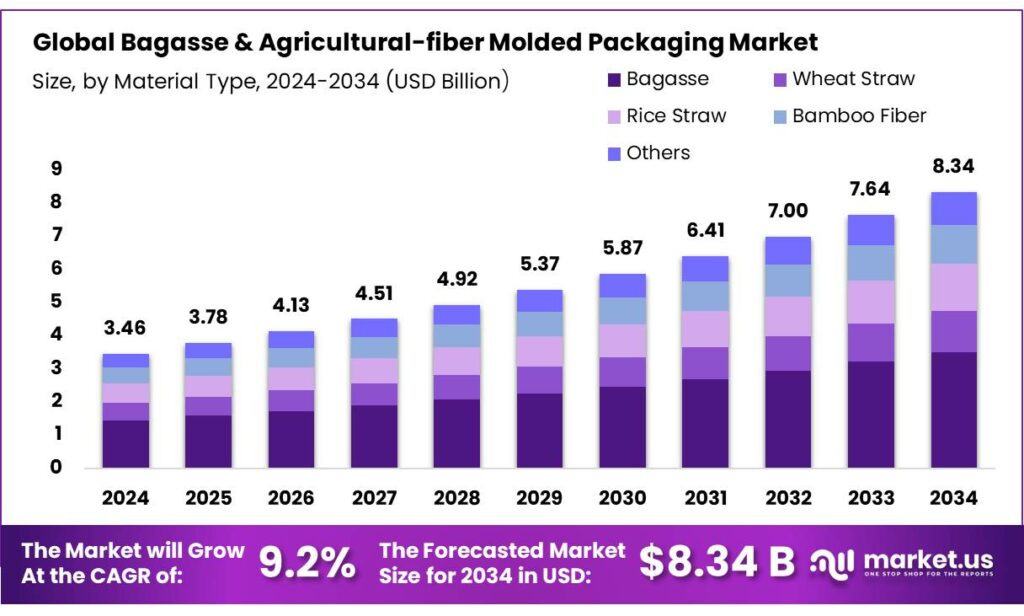
Its most common applications are in plates, bowls, trays, and food containers, which align with the material’s strength, heat resistance, and ease of molding. The market is fueled by increasing consumer awareness of environmental concerns, along with regulatory pressures to reduce plastic waste.
Geopolitical factors, such as trade restrictions and supply chain disruptions, have led companies to explore local sourcing of raw materials, further boosting the adoption of bagasse-based packaging. While the food service sector is the largest consumer, the material is used in other industries, such as consumer goods. The shift towards sustainability, combined with the growing focus on eco-conscious packaging solutions, continues to drive innovation and demand in the market.
- The United States alone disposes of nearly 100 million plastic utensils daily, and around 9,200 metric tons of plastic are produced every year globally. Out of which, single-use plastic utensils take up a significant portion and take approximately 300 to 450 years to decompose.
Key Takeaways
- The global bagasse and agricultural-fiber molded packaging market was valued at USD 3.46 billion in 2024.
- The global bagasse and agricultural-fiber molded packaging market is projected to grow at a CAGR of 9.2% and is estimated to reach USD 8.34 billion by 2034.
- Based on the type of material, the bagasse and agricultural-fiber molded packaging market is dominated by bagasse, with 41.6% of the total global market.
- On the basis of application, plates and bowls held a major share of the bagasse and agricultural-fiber molded packaging market with 39.7%.
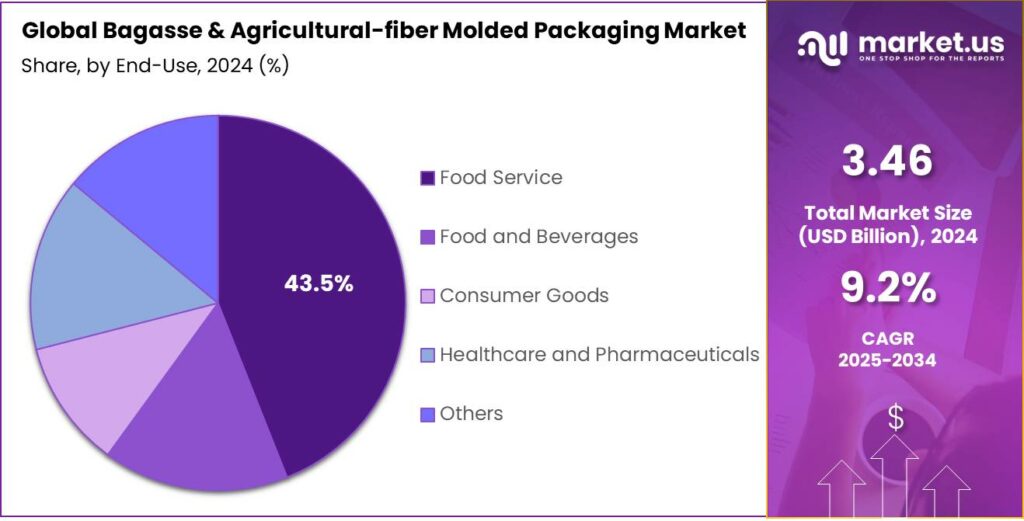
- Among the end-uses, the food service sector emerged as a major segment in the bagasse and agricultural-fiber molded packaging market, with 43.5% of the market share.
- In 2024, the Asia Pacific was the most dominant region in the bagasse and agricultural-fiber molded packaging market, accounting for around 38.4% of the total global consumption.
Material Type Analysis
Bagasse Dominated the Bagasse and Agricultural-fiber Molded Packaging Market in 2024.
The bagasse and agricultural-fiber molded packaging market is segmented based on the material type into bagasse, wheat straw, rice straw, bamboo fiber, and others. Bagasse dominated the bagasse and agricultural-fiber molded packaging market, comprising around 41.6% of the market share, primarily due to its availability, cost-effectiveness, and ideal properties for molding. As a byproduct of sugarcane processing, bagasse is abundant and inexpensive, making it a readily available raw material for large-scale production.
In addition, it has a high fiber content and a relatively soft, fibrous texture, which makes it easier to mold into various shapes without the need for additional processing. Unlike wheat or rice straw, which can sometimes be more difficult to handle or less durable in certain applications. The bagasse is strong, lightweight, and naturally resistant to water and oil, making it suitable for many hot, cold, and greasy foods.
Application Analysis
Plates and Bowls are a Prominent Segment in the Bagasse and Agricultural-fiber Molded Packaging Market.
The bagasse and agricultural-fiber molded packaging market is segmented on the basis of application into plates and bowls, trays and clamshells, cups and lids, containers, and others. The plates and bowls led the bagasse and agricultural-fiber molded packaging market, constituting about 39.7% of the market share. Bagasse and agricultural-fiber molded packaging are most commonly used for plates and bowls as these products align well with the material’s properties, such as its strength, flexibility, and ability to handle heat and moisture.
Plates and bowls made from bagasse offer a sturdy, lightweight solution for food service, particularly in takeout or catering situations. The smooth, durable surface is ideal for holding a variety of hot and cold foods without leaking or losing integrity. While bagasse is also used for trays, clamshells, and containers, plates and bowls are simpler to mold and require less intricate design compared to the complex shapes needed for cups, lids, or multi-compartment containers. This makes the manufacturing process for plates and bowls more cost-effective and efficient, contributing to their popularity in the food service industry.
End-Use Analysis
The Food Service Sector Emerged as a Leading Segment in the Bagasse and Agricultural-fiber Molded Packaging Market.
On the basis of end-uses, the bagasse and agricultural-fiber molded packaging market is segmented into food and beverages, consumer goods, food service, healthcare and pharmaceuticals, and others. Approximately 43.5% of the bagasse and agricultural-fiber molded packaging market revenue is generated from the food service sector due to their direct applicability in food handling, convenience, and sustainability. The food service industry, including takeout restaurants, fast food chains, and catering services, demands packaging that is lightweight, heat-resistant, and capable of handling a variety of food types, which are offered by bagasse and agricultural fibers.
These materials are biodegradable and compostable, which aligns with increasing consumer demand for environmentally-friendly solutions. In contrast, other sectors such as food and beverages, consumer goods, and healthcare require packaging with more specialized properties, such as longer shelf-life, airtight sealing, or sterility, which bagasse may not always provide. While bagasse is suitable for single-use, disposable food containers, it’s less appropriate for packaging products in other industries that require more complex, protective, or durable characteristics.
Key Market Segments
By Material Type
- Bagasse
- Wheat Straw
- Rice Straw
- Bamboo Fiber
- Others
By Application
- Plates and Bowls
- Trays and Clamshells
- Cups and Lids
- Containers
- Others
By End-Use
- Food and Beverages
- Consumer Goods
- Food Service
- Healthcare and Pharmaceuticals
- Others
Drivers
Food Service Sector Drives the Bagasse and Agricultural-fiber Molded Packaging Market.
The food service sector plays a pivotal role in driving the demand for bagasse and agricultural-fiber molded packaging due to the growing preference for sustainable and eco-friendly alternatives to traditional plastic packaging. As consumer awareness of environmental issues rises, many restaurants, cafes, and food delivery services are opting for biodegradable and compostable packaging materials. Bagasse, a byproduct of sugarcane, and other agricultural fibers are ideal as they are renewable, compostable, and reduce the dependency on petroleum-based plastics.
For instance, many fast-food chains and quick-service restaurants have shifted to using molded pulp containers made from bagasse for items such as take-out boxes, clamshells, and food trays. In addition, the global rise of food delivery services has further spurred demand for these materials, as they provide a practical solution to reduce single-use plastic waste. This shift reflects both regulatory pressures and consumer preferences for greener packaging options, helping minimize the environmental impact of food packaging.
Restraints
Availability of Efficient Alternatives Poses a Significant Challenge in the Bagasse and Agricultural-fiber Molded Packaging Market.
The availability of efficient alternatives to bagasse and agricultural-fiber molded packaging presents a significant challenge in the market, as competition from other sustainable packaging materials intensifies. While bagasse and agricultural fibers are increasingly popular due to their compostability and renewable nature, materials such as polylactic acid (PLA), recycled paper, and plant-based plastics are gaining traction as viable alternatives. These alternatives can offer similar benefits in terms of biodegradability and environmental impact while being more consistent and safer to use.
For instance, PLA packaging is often known for its versatility in food packaging, while recycled paper provides a lower-cost solution in certain applications. Similarly, the cost of molded packaging made from recycled paper is often between US$50-US$150 per ton, while the price of bagasse itself costs around US$50 per ton, making the latter costlier. Several companies in the bagasse and agricultural-fiber molded packaging space must contend with the challenge of differentiating their products while addressing potential concerns related to production costs, availability of raw materials, and scalability.
Opportunity
Restriction on Single-Use Plastics Creates Opportunities in the Bagasse and Agricultural-fiber Molded Packaging Market.
The increasing global restrictions on single-use plastics have created significant opportunities for the bagasse and agricultural-fiber molded packaging market, as governments and consumers seek sustainable alternatives. As countries implement stricter regulations to combat plastic pollution, many industries, particularly food service, retail, and e-commerce, are turning to eco-friendly options such as bagasse, which is derived from sugarcane, and other agricultural fibers. For instance, the European Union’s plastic directive outright bans certain single-use plastic items, such as cutlery, plates, straws, cotton bud sticks, and expanded polystyrene food containers.
Similarly, single-use plastic bans in countries such as Canada and India have prompted businesses to adopt molded pulp packaging, which offers biodegradability and compostability. Fast-food chains and takeaway restaurants are leading the charge, replacing plastic containers with fiber-based clamshells, trays, and cups. Additionally, large-scale events and festivals are increasingly using agricultural-fiber packaging for food and beverages to comply with local laws and meet consumer expectations for sustainability. This growing regulatory landscape has accelerated the adoption of biodegradable materials, positioning them as a key solution to the plastic waste crisis.
Trends
Shift Towards Sustainability.
The shift towards sustainability is a major driving force in the bagasse and agricultural-fiber molded packaging market, with increasing consumer demand for eco-conscious alternatives to traditional plastic packaging. Consumers are more aware of the environmental impacts of plastic waste, prompting brands to adopt sustainable packaging solutions. Bagasse and agricultural fibers offer an ideal solution as they are compostable, biodegradable, and made from renewable resources. Several food and beverage companies are embracing these materials, with major fast-food chains such as McDonald’s and Starbucks leading the charge by replacing plastic straws and containers with fiber-based options.
For instance, in August 2024, Starbucks announced a partnership with Huhtamaki for fibre-based compostable cold cup lids. Additionally, the rise of environmentally-focused consumer goods brands has further accelerated this trend, with businesses across sectors, such as cosmetics and e-commerce, turning to molded packaging made from agricultural waste to reduce their carbon footprint. This shift reflects a broader cultural movement towards sustainability, driven by both regulatory changes and consumer preference for brands that prioritize environmental responsibility.
Geopolitical Impact Analysis
Geopolitical Tensions Are Impacting the Bagasse and Agricultural-fiber Molded Packaging market by Disrupting the Essential Supply Chains in the Market.
The current geopolitical tensions have had a mixed impact on the bagasse and agricultural-fiber molded packaging market, presenting both challenges and opportunities. The disruptions in global supply chains, particularly due to trade restrictions or logistical bottlenecks, have led to increased costs and delays in sourcing raw materials such as bagasse and agricultural fibers.
For instance, trade tensions between major economies such as the U.S. and China have at times led to tariff impositions on agricultural products, which made sourcing fiber materials more expensive and less predictable. Similarly, disruptions in international shipping due to geopolitical events such as conflicts in the South China Sea and the Strait of Hormuz have affected the timely delivery of finished packaging products to global markets, adding to operational costs.
In contrast, these tensions have accelerated the drive toward localizing production, which benefits the bagasse and agricultural-fiber packaging market. Various countries are now prioritizing the development of domestic sustainable packaging industries to reduce dependence on foreign suppliers and enhance environmental sustainability.
This is particularly evident in regions such as Southeast Asia and India, where governments are increasingly focusing on the circular economy and the reduction of plastic waste. Additionally, the growing environmental consciousness in consumers, partly spurred by geopolitical factors such as climate change discussions, is pushing brands to adopt greener packaging options, further boosting demand for sustainable alternatives such as molded fiber products.
Regional Analysis
Asia Pacific Held the Largest Share of the Global Bagasse and Agricultural-fiber Molded Packaging Market.
In 2024, the Asia Pacific dominated the global bagasse and agricultural-fiber molded packaging market, holding about 38.4% of the total global consumption. The region holds the largest share of the global bagasse and agricultural-fiber molded packaging market due to a combination of strong industrial activity, rising environmental awareness, and supportive government policies. Countries such as India, China, and Japan are leading the way in adopting sustainable packaging solutions, driven by strict environmental regulations and growing concerns over plastic pollution.
For instance, in India, the government has implemented various plastic bans and restrictions, encouraging businesses to switch to biodegradable alternatives such as bagasse-based packaging. Additionally, the region’s abundant agricultural resources, such as sugarcane and rice husks, provide a steady and cost-effective supply of raw materials for producing molded fiber products.
India is one of the largest producers of sugarcane, producing approximately 23% of the world’s sugarcane. With a large population and booming food delivery services, particularly in urban areas, the demand for eco-friendly packaging continues to rise. This trend is further supported by the increasing focus on sustainability among both consumers and businesses in the region, pushing Asia Pacific to the forefront of the market.
Key Regions and Countries
- North America
- The US
- Canada
- Europe
- Germany
- France
- The UK
- Spain
- Italy
- Russia & CIS
- Rest of Europe
- APAC
- China
- Japan
- South Korea
- India
- ASEAN
- Rest of APAC
- Latin America
- Brazil
- Mexico
- Rest of Latin America
- Middle East & Africa
- GCC
- South Africa
- Rest of MEA
Key Players Analysis
Market players in the bagasse and agricultural-fiber molded packaging market maintain a competitive edge by prioritizing innovation, cost efficiency, and sustainability. They invest in advanced molding technologies to improve product strength, precision, and design flexibility, enabling customized solutions for foodservice, consumer goods, and e-commerce applications. In addition, companies focus on optimizing their supply chains by securing reliable agricultural-fiber sources and enhancing processing efficiency to reduce waste and production costs.
Similarly, strategic partnerships with farms, food manufacturers, and eco-conscious brands help expand market reach while reinforcing environmental credentials. Furthermore, several companies focus on mergers and acquisitions for business expansion.
The major market players in the bagasse and agricultural-fiber molded packaging market are Sonoco Products Company, Greif, Mondi, Smurfit WestRock, CPS Paper Products, Ace Paper Tube Corp., Corex Group NV, Allpack Group, Erdie Industries, Multi-Pack Containers, Jain Fibre Drums Containers, Alucan Entec S.A., Huhtamaki Oyj, Wes-Pak, Chicago Mailing Tube, Irwin Packaging Pty, Tuba Packaging GmbH, Hindustan Fibre Drum Mfg. Co., Cesta Development Corporation, and Reyoung Pharmaceutical Co.
The Major Players in The Industry
- Sonoco Products Company
- Greif, Inc.
- Mondi plc
- Smurfit WestRock plc
- CPS Paper Products Ltd.
- Ace Paper Tube Corp.
- Corex Group NV
- Allpack Group Ltd.
- Erdie Industries, Inc.
- Multi-Pack Containers (P) Ltd.
- Jain Fibre Drums Containers Pvt. Ltd.
- Alucan Entec S.A.
- Huhtamaki Oyj
- Wes-Pak, Inc.
- Chicago Mailing Tube Co.
- Irwin Packaging Pty Ltd.
- Tuba Packaging GmbH
- Hindustan Fibre Drum Mfg. Co.
- Cesta Development Corporation
- Reyoung Pharmaceutical Co., Ltd.
- Other Key Players
Key Development
- In December 2024, Toppan Holdings Inc. acquired Sonoco’s thermoformed & flexible packaging (TFP) business for US$1.8 billion with the intent to expand its sustainable packaging business into the Americas.
- In April 2025, Huhtamaki, a global leader in sustainable packaging solutions, completed the acquisition of Zellwin Farms Company, a privately-owned molded fiber packaging business based in Zellwood, Florida, USA. The US$18 million enterprise value transaction strengthens Huhtamaki’s position in the North American molded fiber market, particularly in the egg carton and egg flat segment.









