


Report Overview
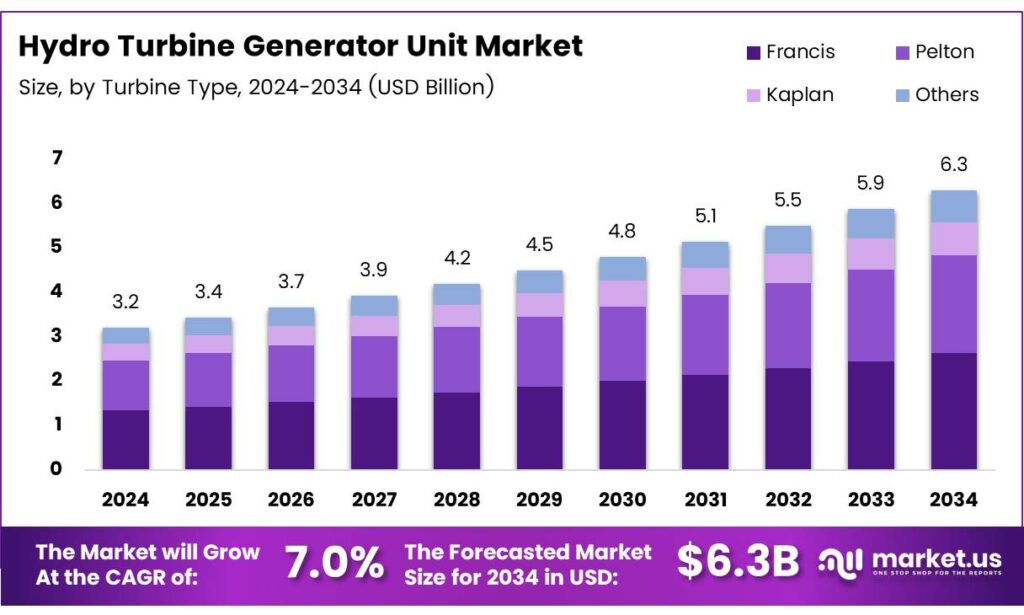
The Global Hydro Turbine Generator Unit Market size is expected to be worth around USD 6.3 billion by 2034, from USD 3.2 billion in 2024, growing at a CAGR of 7.0% during the forecast period from 2025 to 2034.
The Hydro Turbine Generator Unit Market covers integrated turbine and generator systems that convert water flow into reliable electricity. These units form the core of hydropower plants, supporting grid stability, peak load management, and renewable baseload supply. Importantly, the market spans new installations, refurbishment projects, and digital upgrades across utility and industrial applications.
Hydro turbine generator units combine mechanical efficiency with long operating lifetimes and low operating costs. Consequently, power utilities value these systems for predictable generation and minimal fuel risk. In business terms, equipment supply, modernization services, control systems, and long-term maintenance contracts together shape recurring revenue opportunities.
- Hydropower remains the third largest supplier of global electricity generation, behind coal and natural gas. It acts as the backbone of low-carbon electricity, supplying 55% more power than nuclear and exceeding combined solar and wind output, reinforcing its strategic energy security role. However, rising electricity demand has increased fossil fuel dependence, with coal alone contributing 62% of total electricity production.
Hydropower modernization offers a cleaner pathway to offset emissions while maintaining grid reliability without introducing fuel price volatility. International Energy Agency data estimates a projected capacity increase of 230 GW by 2030, reflecting 17% hydropower growth this decade. Critically, nearly 40% of major plants aged 45–60 years require revamping, representing modernization potential of 476 GW, unlocking significant hydro turbine generator unit market expansion.
Key Takeaways
- The Global Hydro Turbine Generator Unit Market is projected to reach USD 6.3 billion by 2034, expanding from USD 3.2 billion in 2024 at a 7.0% CAGR.
- Francis turbines dominate the turbine type segment with a market share of 57.9%, driven by strong demand in medium-head hydropower projects.
- Synchronous generators lead the generator type segment, accounting for a significant 77.8% share due to grid stability and efficiency benefits.
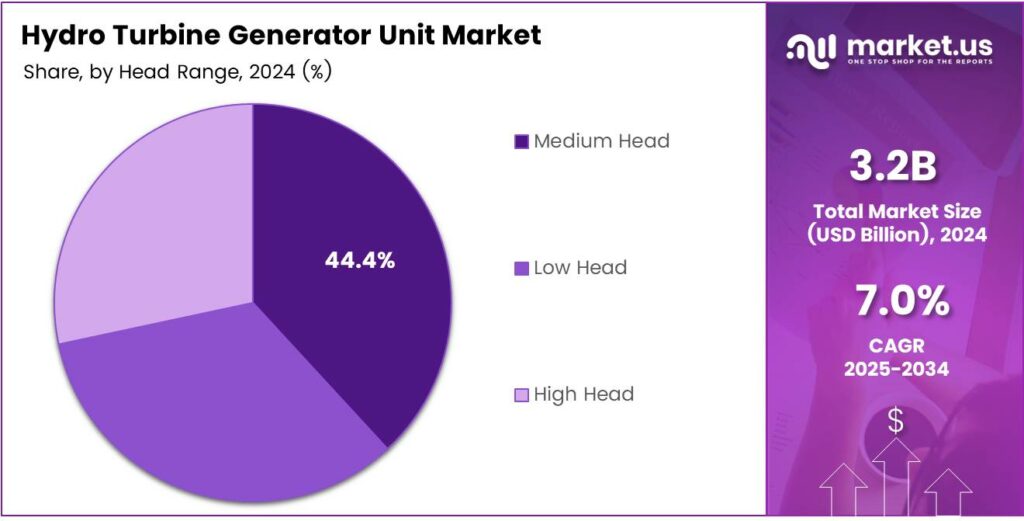
- Medium head installations hold the largest share at 44.4%, supported by balanced performance across diverse terrain conditions.
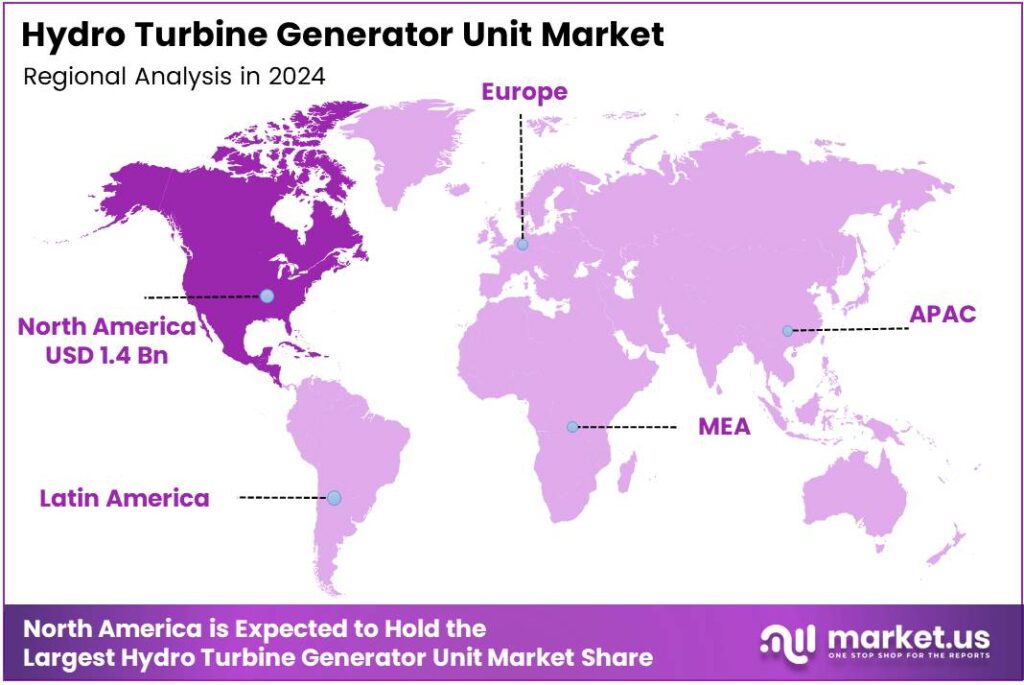
- North America remains the leading region with a market share of 45.8%, valued at approximately USD 1.4 billion in 2024.
By Turbine Type Analysis
Francis dominates with 57.9% due to its wide adaptability across medium-head hydropower projects.
In 2024, Francis held a dominant market position in the By Turbine Type Analysis segment of the Hydro Turbine Generator Unit Market, with a 57.9% share. This dominance is driven by its ability to operate efficiently under varying flow conditions. Moreover, it fits well in medium-head installations, making it widely preferred.
Pelton turbines play an important role in high-head hydropower applications, especially in mountainous regions. They are typically selected where water flow is low, but velocity is high. Consequently, Pelton turbines remain essential for niche projects requiring precise energy conversion.
Kaplan turbines are mainly used in low-head and high-flow environments such as river-based power plants. Their adjustable blades improve operational flexibility. They support stable generation in regions with fluctuating seasonal water levels. Other turbine types address site-specific and customized hydropower needs. These include small-scale and innovative designs developed for unique geographical conditions.
By Generator Type Analysis
Synchronous dominates with 77.8% owing to its high efficiency and grid stability advantages.
In 2024, Synchronous held a dominant market position in the By Generator Type Analysis segment of the Hydro Turbine Generator Unit Market, with a 77.8% share. This leadership is supported by its ability to maintain constant speed. Hence, it ensures stable frequency and smooth grid integration.
Synchronous generators are widely adopted in large hydropower plants due to their superior control over power output. Additionally, they are well-suited for long-duration operations. As a result, utilities prefer them for reliable baseload electricity generation.
Asynchronous generators are mainly used in small and decentralized hydropower systems. They offer simpler construction and lower initial cost. However, they depend more on grid connection for excitation, which limits their use in large installations. Despite a lower share, asynchronous generators support rural and micro-hydro projects.
By Head Range Analysis
Medium Head dominates with 44.4% due to balanced efficiency across varied terrain conditions.
In 2024, Medium Head held a dominant market position in the By Head Range Analysis segment of the Hydro Turbine Generator Unit Market, with a 44.4% share. This range suits many river-based projects. Consequently, it offers an optimal balance between flow and pressure.
Low-head turbines are designed for sites with less than 100 meters of water head. They are commonly installed in canals and run-of-river projects. Therefore, they support power generation in flat and low-elevation regions. Medium Head installations are often combined with Francis turbines, enhancing overall system efficiency.
They enable cost-effective plant construction. Thus, they are widely preferred for regional hydropower development. High Head turbines operate in locations with water heads above 300 meters. These systems are typically found in steep terrains. As a result, they deliver high energy conversion despite limited water flow.
Key Market Segments
By Turbine Type
- Francis
- Pelton
- Kaplan
- Others
By Generator Type
- Synchronous
- Asynchronous
By Head Range
- Low Head (less than 100 meters)
- Medium Head (100 to 300 meters)
- High Head (300 meters)
Emerging Trends
Digital Monitoring and Smart Turbines Shape Market Trends
A key trend in the Hydro Turbine Generator Unit Market is the adoption of digital monitoring systems. Sensors and automation tools help operators track performance, detect faults early, and reduce downtime. This improves plant reliability and lowers maintenance costs.
- Manufacturers are developing units that generate more power with less water, supporting sustainable water use and higher plant productivity. The International Energy Agency (IEA), modern bioenergy already accounts for nearly 55% of all renewable energy globally (excluding traditional biomass) and supplies over 6% of total global energy demand.
These systems are easier to install, require less infrastructure, and suit decentralized energy needs. Lastly, sustainability-focused design is becoming standard. Turbines are now designed to reduce environmental impact by supporting fish-friendly operations and improved water flow control, aligning with stricter environmental standards.
Drivers
Rising Demand for Clean and Renewable Power Drives Market Growth
The Hydro Turbine Generator Unit Market is mainly driven by the global need for clean and reliable electricity. Governments and utilities are focusing on renewable energy to reduce pollution and dependence on fossil fuels. Hydropower offers stable power generation with low operating emissions, making it a preferred long-term solution.
- Many developing regions require constant base-load power, and hydro turbine generator units provide continuous energy, unlike intermittent sources. Global installed hydropower capacity reached approximately 1,443 GW, with about 1,253 GW from conventional hydropower and around 189 GW from pumped-storage schemes.
In addition, existing hydropower plants are being modernized to improve efficiency and lifespan. Aging turbines and generators are replaced with advanced units that deliver higher output using the same water resources. This replacement demand strongly supports market growth.
Restraints
High Initial Investment and Environmental Concerns Limit Market Expansion
One major restraint in the Hydro Turbine Generator Unit Market is the high upfront cost. Building hydropower plants requires large capital for civil construction, equipment installation, and grid connection. This cost can delay or limit projects, especially in developing countries with budget constraints.
- Environmental and social concerns also restrict market growth. Large hydro projects may affect river ecosystems, wildlife habitats, and local communities. Regulatory approvals often take long periods, slowing down project execution. Suitable locations for new large hydropower projects are limited. Global hydropower generation dropped by over 100 TWh (more than 2%), bringing total generation to about 4,250 TWh.
Many ideal river sites are already developed, leaving fewer options for expansion. This restricts rapid market growth in mature regions. Long construction timelines further act as a restraint. From planning to completion, hydro projects can take several years. This discourages private investors who prefer quicker returns compared to other energy sources.
Growth Factors
Modernization of Existing Plants Creates Strong Growth Opportunities
One of the biggest growth opportunities lies in upgrading existing hydropower plants. Many older plants can significantly increase output by installing modern hydro turbine generator units. These upgrades improve efficiency without building new dams, making them cost-effective and environmentally safer.
Small and micro-hydropower projects present another attractive opportunity. Remote and rural areas can use compact turbine generator units for local power supply. These systems support rural electrification and reduce dependence on diesel generators. Technological improvements also open new growth paths.
Advanced turbine designs allow better performance at varying water flows and lower heads. This expands the use of hydropower to new geographical areas. Additionally, hybrid renewable projects combining hydropower with solar or wind systems are creating demand for flexible turbine generator units that support grid balancing and energy storage.
Regional Analysis
North America Dominates the Hydro Turbine Generator Unit Market with a Market Share of 45.8%, Valued at USD 1.4 Billion
North America leads the hydro turbine generator unit market due to its strong base of aging hydropower infrastructure and steady refurbishment activity. In the U.S. and Canada, utilities are focusing on turbine efficiency upgrades to extend plant life and meet grid reliability needs. Supportive clean-energy policies and federal funding for modernization further reinforce demand. The region accounted for a dominant 45.8% share, reaching nearly USD 1.4 billion in market value.
Europe represents a mature and stable market, driven by turbine retrofitting and compliance with strict carbon-reduction targets. Many countries emphasize the life extension of existing hydropower assets rather than greenfield projects. The region benefits from strong regulatory backing for renewable baseload power. Consequently, demand remains resilient despite limited new large-dam construction.
Asia Pacific shows strong momentum due to rising electricity demand and ongoing investments in large and small hydropower projects. Rapid urbanization and cross-border river development support turbine unit installations. Countries prioritize hydropower for energy security and grid balancing with solar and wind. This combination continues to attract long-term infrastructure spending.
The U.S. market centers on the refurbishment of aging dams and the performance optimization of existing plants. Federal incentives encourage efficiency improvements rather than new dam construction. Hydropower remains critical for grid stability and peak-load support. Consequently, turbine generator unit demand remains steady over the medium term.
Key Regions and Countries
North America
- US
- Canada
Europe
- Germany
- France
- The UK
- Spain
- Italy
- Rest of Europe
Asia Pacific
- China
- Japan
- South Korea
- India
- Australia
- Rest of APAC
Latin America
- Brazil
- Mexico
- Rest of Latin America
Middle East & Africa
- GCC
- South Africa
- Rest of MEA
Key Players Analysis
In 2024, General Electric Company continues to lead the global hydro turbine generator unit market owing to its end-to-end capabilities. Its strong balance sheet and global manufacturing footprint allow it to deliver large-scale hydro and pumped-storage projects while offering integrated digital-grid and monitoring services that improve long-term operational efficiency. This makes GE the go-to provider for utilities seeking turnkey hydro solutions with low lifecycle costs.
Siemens Energy AG remains a frontrunner by combining high-efficiency turbine technology with advanced automation and grid integration capabilities. Its modular turbine designs facilitate flexible installation and upgrades, appealing to operators focused on retrofitting aging hydro plants. Siemens’ strong aftermarket service and system-wide electrical experience further bolster its competitive positioning in both emerging and mature hydro markets.
Andritz Hydro GmbH stands out for its breadth in small to medium hydro projects and modernization contracts. Its agile engineering teams enable customized turbine-generator units suited for varied hydrological conditions, which is valuable in emerging markets. Additionally, Andritz’s nimble service and maintenance offering helps hydro plant operators minimize downtime and maximize energy output.
Voith Hydro Holding GmbH & Co. KG retains its strength based on a deep heritage in hydromechanical design and robust global service networks. Its proven track record in supplying durable turbine–generator sets, coupled with growing emphasis on digital retrofit solutions and predictive maintenance, makes Voith a favored partner for long-term hydro infrastructure investments.
Top Key Players in the Market
- General Electric Company
- Siemens Energy AG
- Andritz Hydro GmbH
- Voith Hydro Holding GmbH & Co. KG
- Toshiba Energy Systems & Solutions Corporation
- Mavel, a.s.
- Harbin Electric Corporation
- Dongfang Electric Corporation
- Zhejiang Jinlun Electromechanic Co., Ltd.
- Hitachi Mitsubishi Hydro Corporation
Recent Developments
- In 2024, GE Vernova secured a contract with Dominion Energy South Carolina for the engineering, procurement, construction, and installation of aerating turbines to replace Units 1 and 3 at the Saluda Hydro plant, along with rehabilitating the Unit 3 generator.
- In 2024, Siemens Energy’s hydropower efforts, often in partnership with Voith Hydro, emphasize rehabilitation, efficiency upgrades, and integration with renewables like hydrogen. Delivery of two variable-speed pumped turbines (the largest of their kind) for unnamed projects, enhancing grid stability.









