


Report Overview
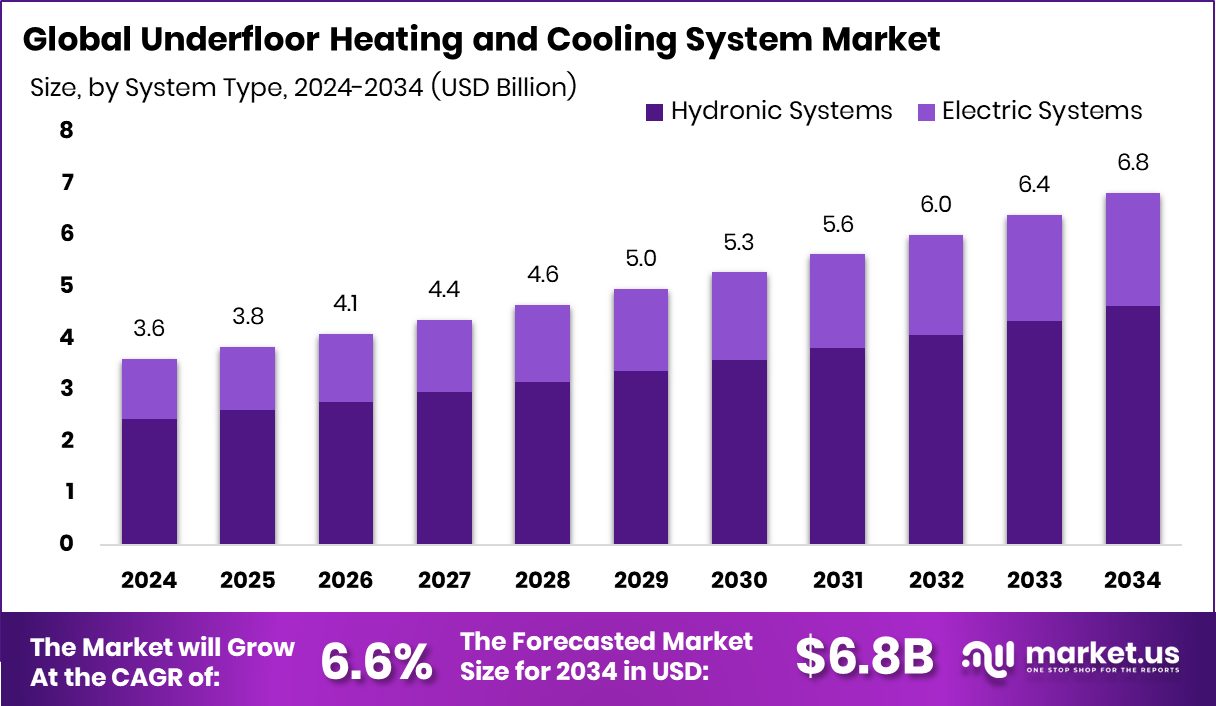
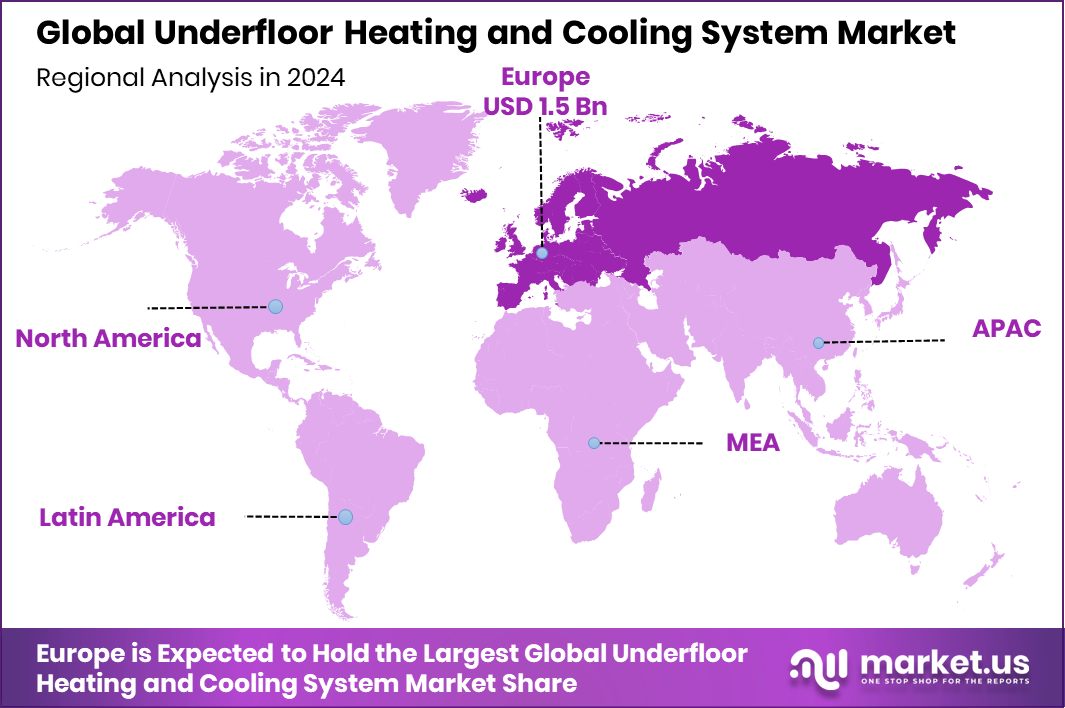
The Global Underfloor Heating and Cooling System Market is expected to be worth around USD 6.8 billion by 2034, up from USD 3.6 billion in 2024, and is projected to grow at a CAGR of 6.6% from 2025 to 2034. In Europe underfloor heating and cooling market reached 43.40% valued at USD 1.5 Bn.
An underfloor heating and cooling system is a building comfort solution where warm or cool water, or electric elements, run beneath the floor surface to control indoor temperature evenly. Heat or cooling rises gently from the floor, reducing cold spots, drafts, and noise while improving overall energy efficiency and comfort in homes, offices, and public buildings.
The underfloor heating and cooling system market refers to the design, installation, and servicing ecosystem around these solutions for residential, commercial, and institutional buildings. It is closely linked to low-carbon construction, energy-efficient retrofits, and modern HVAC upgrades aimed at improving indoor comfort with reduced operating costs.
One key growth factor is strong public and private funding for clean heating infrastructure. Examples include $273M Manhattan Rehab Secures Key Funding, a $169M fund to boost US heat pump production, and Washington state grants $40M to programs installing electric heat and cooling systems, all supporting integrated floor-based systems.
Demand is rising as cities and communities modernize buildings. Projects such as $14.4M awarded in Colorado for geothermal energy, $ a $1.2M grant for Village of Chase arena upgrades, and $3M awarded to Hydronic Shell Technologies in Syracuse highlight real-world adoption.
The main opportunity lies in retrofitting older public buildings and scaling geothermal-linked underfloor systems, combining comfort, lower emissions, and long-term energy savings.
Key Takeaways
- The Global Underfloor Heating and Cooling System Market is expected to be worth around USD 6.8 billion by 2034, up from USD 3.6 billion in 2024, and is projected to grow at a CAGR of 6.6% from 2025 to 2034.
- Hydronic systems lead the Underfloor Heating and Cooling System Market with 67.9% share due to energy-efficient water-based heat transfer.
- Heating and cooling pipes and cables hold a 37.1% share in the Underfloor Heating and Cooling System Market, driven by durable infrastructure demand.
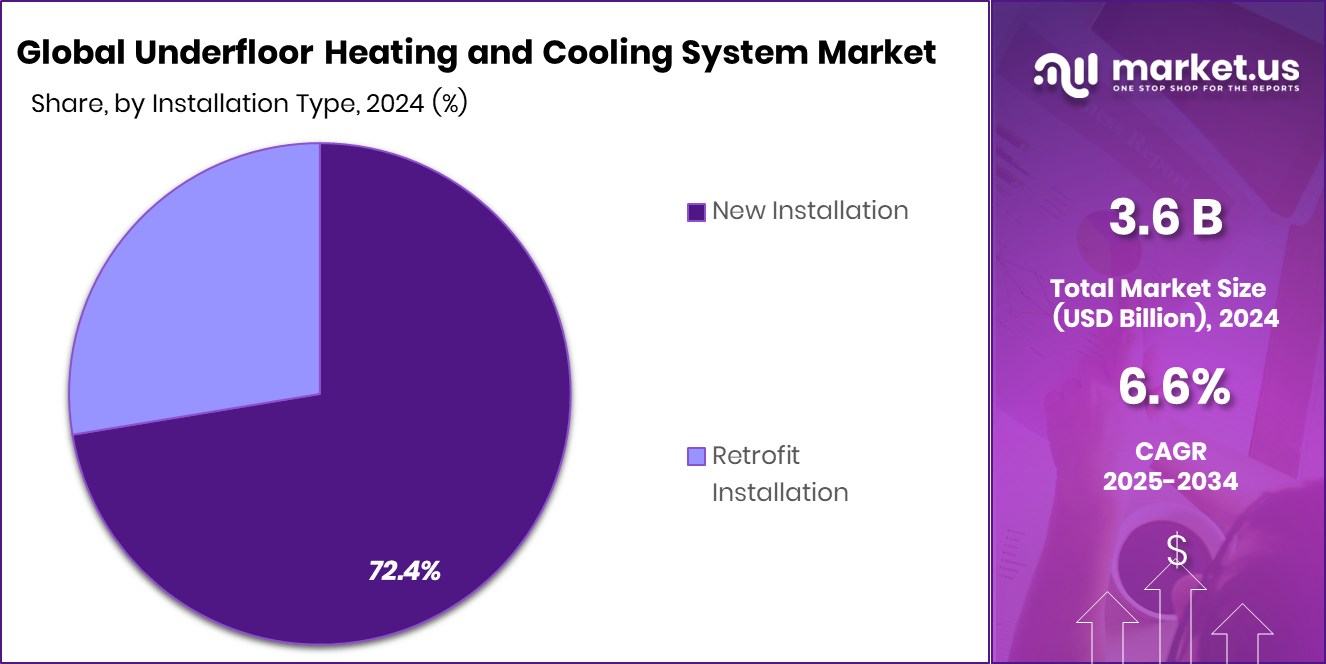
- New installations dominate the Underfloor Heating and Cooling System Market at 72.4%, supported by green building construction growth.
- Residential applications account for 57.6% of the Underfloor Heating and Cooling System Market, reflecting rising home comfort investments.
- Europe represents a strong demand worth USD 1.5 Bn, holding 43.40% market share region.
By System Type Analysis
Hydronic systems dominate the Underfloor Heating and cooling system market with a 67.9% share.
In 2024, Hydronic Systems held a dominant market position in the By System Type segment of the Underfloor Heating and Cooling System Market, with a 67.9% share. This leadership reflects the strong preference for water-based floor heating and cooling layouts that deliver steady indoor comfort with lower energy waste.
Hydronic systems distribute heat and cooling evenly across floor surfaces, reducing temperature fluctuations and improving overall efficiency. Their compatibility with modern low-energy building designs supports wider use across residential and non-residential spaces.
These systems also allow flexibility in operation, making them suitable for both heating during colder months and cooling during warmer periods from the same infrastructure. Long service life, quiet performance, and efficient heat transfer continue to support consistent demand, positioning hydronic systems as the most widely adopted choice within this system type segment.
By Component Analysis
Heating and cooling pipes, cables lead the underfloor heating and cooling system market at 37.1%.
In 2024, Heating/Cooling Pipes and Cables held a dominant market position in the By Component segment of the Underfloor Heating and Cooling System Market, with a 37.1% share. This dominance is driven by their essential role in transferring heat and cooling evenly beneath floor surfaces.
Pipes and cables form the core working layer of underfloor systems, directly influencing performance, durability, and comfort levels. Their ability to support uniform temperature distribution helps reduce energy losses while maintaining stable indoor conditions. These components are widely preferred for both new construction and renovation projects because they integrate smoothly within floor structures.
Long operational life and consistent thermal output further strengthen adoption, making heating and cooling pipes and cables the most critical and widely used component within this segment.
By Installation Type Analysis
New installations drive the underfloor heating and cooling system market, holding 72.4% share.
In 2024, New Installation held a dominant market position in the By Installation Type segment of the Underfloor Heating and Cooling System Market, with a 72.4% share. This strong position reflects the growing integration of underfloor solutions during the construction phase of buildings, where system layout and performance can be optimized from the start.
New installations allow better floor planning, smoother system integration, and improved long-term efficiency compared to later modifications. Builders and property owners increasingly prefer this approach to achieve consistent indoor comfort and reduce future maintenance challenges.
The ability to embed heating and cooling elements seamlessly within floor structures supports reliable performance over the building lifecycle, reinforcing new installation as the leading choice in this segment.
By End-User Analysis
Residential applications lead the underfloor heating and cooling system market demand with 57.6%.
In 2024, Residential held a dominant market position in the end-user segment of the Underfloor Heating and Cooling System Market, with a 57.6% share. This dominance is closely linked to the rising adoption of floor-based comfort systems in homes aimed at achieving even temperature control and improved living comfort.
Residential buildings benefit from underfloor systems because they operate quietly, free up wall space, and support consistent heating and cooling across rooms. Homeowners increasingly value solutions that offer stable indoor conditions without visible equipment.
The ability to integrate these systems during home construction or major renovation further strengthens residential uptake, positioning this end-user segment as the largest contributor within the market landscape.
Key Market Segments
By System Type
- Hydronic Systems
- Electric Systems
By Component
- Heating/Cooling Pipes and Cables
- Manifolds and Control Units
- Insulation and Panels
- Sensors and Thermostats
- Others
By Installation Type
- New Installation
- Retrofit Installation
By End-User
- Residential
- Commercial
- Industrial
Driving Factors
Electrification Push Accelerates Advanced Floor Heating Adoption
The biggest driving factor for the underfloor heating and cooling system market is the growing shift toward all-electric infrastructure. Governments, builders, and designers are moving away from fossil-fuel systems and adopting electric-based solutions that are cleaner and easier to integrate. This transition supports underfloor systems because they work efficiently with electric heat sources and modern energy designs.
The trend is reinforced by targeted research funding, such as Cuzner leading a $1.2 million research grant to ease the design of future all-electric ships, which highlights broader investment in electric thermal management.
Although the marine and building sectors differ, the core focus on efficient electric heating and cooling is shared. As electrification expands across industries, underfloor systems gain momentum as a practical, future-ready solution.
Restraining Factors
Growing Demand for Energy-Efficient Indoor Comfort
The main driving factor for the underfloor heating and cooling system market is the rising demand for energy-efficient indoor comfort. People want homes and buildings that stay warm in winter and cool in summer without high energy bills.
Underfloor systems spread heat and cooling evenly across the floor, so rooms feel comfortable at lower operating temperatures. This reduces energy waste and helps users maintain stable indoor conditions throughout the year.
Another reason behind this demand is the preference for quiet and invisible heating and cooling solutions that do not take up wall or ceiling space. As energy efficiency becomes a key decision factor in building design, underfloor systems continue to gain stronger acceptance.
Growth Opportunity
Research-Led Electrification Unlocks New System Integration Opportunities
One major growth opportunity for the underfloor heating and cooling system market lies in deeper integration with next-generation electric technologies. As buildings move toward electrification, floor-based heating and cooling systems are increasingly designed to work with advanced electric infrastructure. This opportunity is supported by broader research activity, such as NREL receiving $3.4M in federal funding to evaluate the safety of next-generation electric vehicle batteries.
While focused on transport, this funding reflects a wider push to improve electric system safety, efficiency, and performance. These improvements benefit building technologies that rely on reliable electric energy.
As electric systems become safer and more efficient, underfloor heating and cooling can be more widely adopted in residential and commercial buildings, opening new long-term growth paths.
Latest Trends
Smart Sealing and Airflow Efficiency Shape Systems
One of the latest trends in the underfloor heating and cooling system market is the growing focus on improving overall system efficiency through better sealing and controlled airflow.
Modern buildings are being designed to reduce heat loss and air leakage, allowing underfloor systems to perform more effectively with less energy use. This trend is supported by innovation activity, such as Aeroseal raising $67 million in Series B funding to scale advanced sealing solutions.
Better sealing improves temperature stability inside buildings, which directly enhances the performance of floor-based heating and cooling. As buildings become tighter and more efficient, underfloor systems benefit from faster response times, lower operating costs, and consistent comfort, making this trend increasingly important across new and refurbished properties.
Regional Analysis
Europe leads the underfloor heating and cooling market with a 43.40% share of USD 1.5 Bn.
Europe dominates the Underfloor Heating and Cooling System Market, holding a 43.40% share valued at USD 1.5 Bn. The region’s leadership is supported by strong adoption of energy-efficient building practices and a well-established preference for modern indoor comfort solutions. European construction standards emphasize uniform heating, space optimization, and long-term energy savings, which strongly favor underfloor systems. High penetration in residential renovations and new housing projects further reinforces Europe’s dominant position, making it the most mature and value-concentrated regional market.
North America represents a steadily expanding market, driven by growing awareness of indoor comfort, floor-based heating efficiency, and integration with modern building designs. The region shows rising interest across residential and light commercial spaces, particularly in climate-controlled housing and premium construction projects.
Asia Pacific is emerging as a fast-adopting region due to increasing urban development and rising demand for modern building comfort. Large-scale residential construction and infrastructure growth are creating steady opportunities for underfloor heating and cooling adoption across urban centers.
The Middle East & Africa market is developing gradually, supported by demand for efficient cooling solutions in warm climates and growing modern construction projects. Adoption is mainly focused on high-end residential and commercial developments.
Latin America shows growing interest, driven by urban housing projects and the gradual acceptance of advanced indoor temperature control systems.
Key Regions and Countries
- North America
- US
- Canada
- Europe
- Germany
- France
- The UK
- Spain
- Italy
- Rest of Europe
- Asia Pacific
- China
- Japan
- South Korea
- India
- Australia
- Rest of APAC
- Latin America
- Brazil
- Mexico
- Rest of Latin America
- Middle East & Africa
- GCC
- South Africa
- Rest of MEA
Key Players Analysis
Danfoss A/S plays a critical role in the underfloor heating and cooling system landscape through its strong focus on energy-efficient thermal control solutions. In 2024, the company continues to emphasize intelligent heating components that improve temperature accuracy, system responsiveness, and long-term reliability. Danfoss’ engineering strength lies in optimizing heat distribution while reducing energy losses, which aligns well with modern building efficiency goals. Its solutions are well-suited for both heating and cooling integration under floor-based systems.
Uponor Corporation remains closely associated with hydronic underfloor heating and cooling installations, especially where long service life and stable performance are required. In 2024, Uponor’s positioning reflects its deep expertise in piping systems designed for consistent thermal transfer beneath floors. The company’s emphasis on durable materials and system compatibility supports smooth installation and reliable operation, making it a preferred choice for residential and commercial floor-based comfort systems.
Emerson Electric Co. contributes to the market through advanced control technologies and system automation capabilities. In 2024, Emerson’s strengths center on precision control, monitoring, and optimization of heating and cooling operations. Its focus on smart system management enhances efficiency and user comfort, supporting underfloor solutions that require accurate regulation and dependable performance across varying indoor conditions.
Top Key Players in the Market
- Danfoss A/S
- Uponor Corporation
- Emersion Electric Co
- Honeywell International
- Robert Bosch
- Pentair PLC
- Mitsubishi Electric Corporation
- Schneider Electric SE
- Siemens AG
- Nexans S.A
Recent Developments
- In October 2024, Uponor (via its Americas division under GF Building Flow Solutions) launched “ServicePEX”, a new piping product based on the PEX-a standard for water service applications. Though primarily for water supply, enhancements in PEX-a piping technology benefit heating and cooling applications too — by offering reliable, flexible piping that can support water-based underfloor heating installations in diverse building types.
- In October 2024, Siemens acquired a fire-safety business (formerly part of another company) to strengthen its sustainable building solutions portfolio globally. While this relates to fire safety rather than heating/cooling directly, it underscores Siemens’ broader push to provide integrated building-system solutions — which may include HVAC, climate control, safety, and automation under a unified umbrella.









