


Report Overview
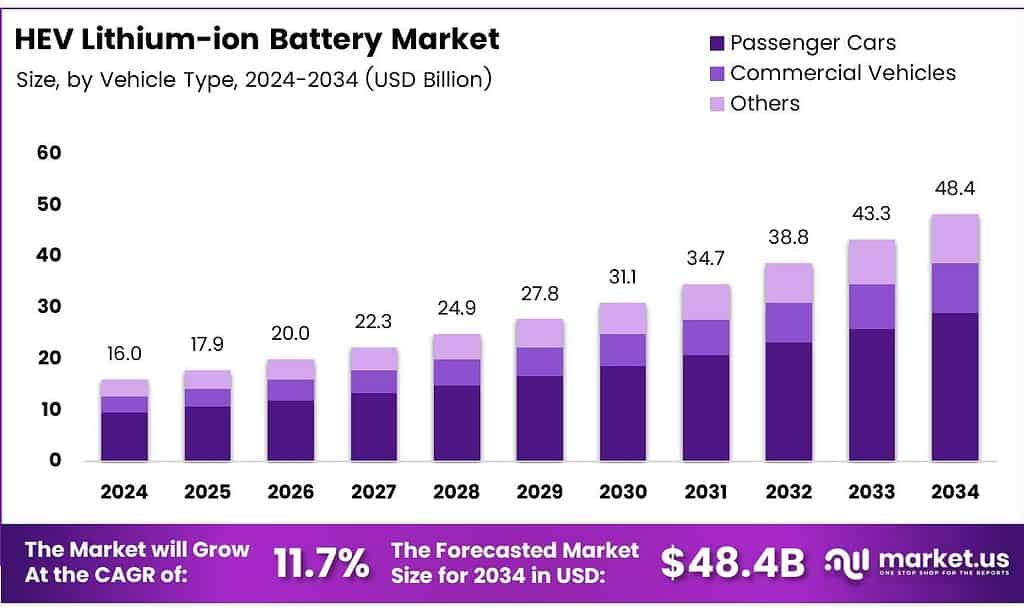
The Global HEV Lithium-ion Battery Market size is expected to be worth around USD 48.4 billion by 2034, from USD 16.0 billion in 2024, growing at a CAGR of 11.7% during the forecast period from 2025 to 2034.
The HEV Lithium-ion Battery Market refers to rechargeable battery systems designed specifically for hybrid electric vehicles, where electric power works alongside internal combustion engines. These batteries support regenerative braking, engine start-stop, and low-speed electric driving. As fuel-efficiency norms tighten, this market becomes a critical bridge toward full electrification.
HEV lithium-ion batteries benefit from balanced cost, durability, and performance. Manufacturers prefer them due to stable power delivery, compact design, and longer cycle life. Meanwhile, automakers rely on these batteries to meet fleet-level emission regulations without shifting fully to battery-electric platforms immediately. Battery producers investing in recycling-ready designs and energy-efficient manufacturing processes gain regulatory and cost advantages over time.
- Energy intensity during battery production remains a critical discussion point. Producing 1 Wh of lithium-ion battery capacity requires about 1.2 MJ of energy. Moreover, lithium extraction itself consumes 0.31–0.67 MJ, depending on recycled versus mined sources, shaping cost and sustainability strategies.
For a typical hybrid car battery of around 30 kWh, the total production energy reaches nearly 56.1 GJ. Environmental pressure is offset by recycling potential. Research on lithium-ion systems shows 90–98% of battery materials can be recovered and reused effectively. The U.S. Energy Policy Act of 2005 introduced hybrid vehicle tax credits ranging from USD 250 to USD 3,400, encouraging large-scale HEV adoption.
HEVs reduce fuel consumption without requiring charging infrastructure, which fits emerging markets well. Demand expands across passenger cars, fleet vehicles, and taxis, creating steady procurement opportunities in the automotive battery supply chain. Opportunities are closely tied to sustainability and circular battery economics. Recycling technologies improve material recovery, while policy frameworks increasingly reward lower lifecycle emissions.
Key Takeaways
- The Global HEV Lithium-ion Battery Market is projected to grow from USD 16.0 billion in 2024 to USD 48.4 billion by 2034, registering a CAGR of 11.7%.
- Lithium Nickel Manganese Cobalt Oxide is the leading battery chemistry, holding a dominant share of 44.2% due to balanced energy density and reliability.
- Passenger cars represent the largest vehicle-type segment, accounting for 72.3% of total HEV lithium-ion battery demand.
- OEM sales channels dominate the market with a significant share of 87.7%, driven by direct integration in vehicle manufacturing.
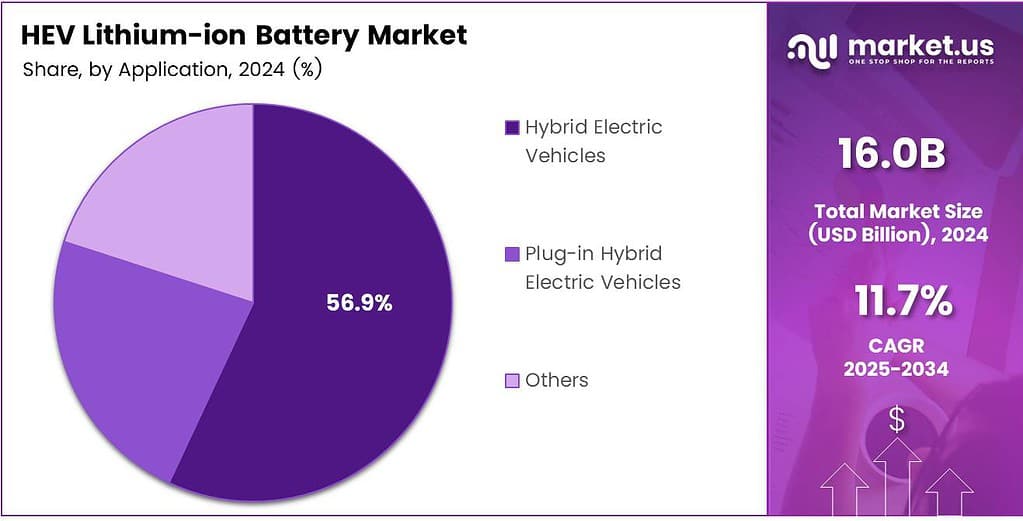
- Hybrid electric vehicles remain the primary application segment, capturing 56.9% of the overall market.
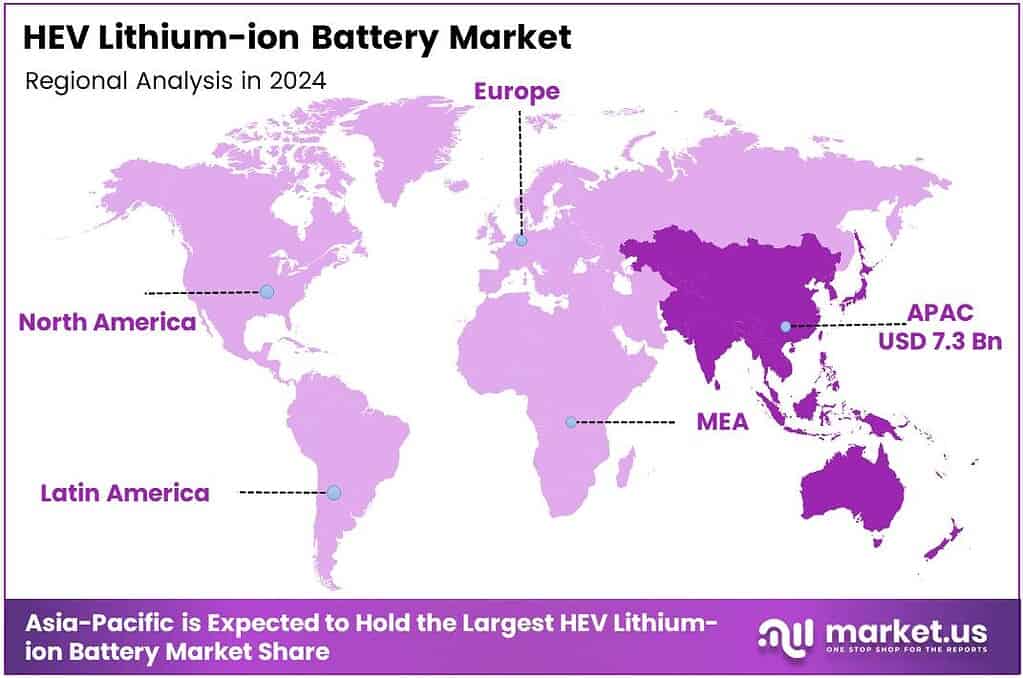
- Asia Pacific leads regional demand with a market share of 45.8%, supported by a market value of USD 7.3 billion in 2024.
By Battery Type Analysis
Lithium Nickel Manganese Cobalt Oxide dominates with 44.2% due to balanced energy density and performance reliability.
In 2024, Lithium Nickel Manganese Cobalt Oxide held a dominant market position in the By Battery Type Analysis segment of the HEV Lithium-ion Battery Market, with a 44.2% share. It is widely preferred because it offers stable energy output, better cycle life, and consistent performance for hybrid vehicle applications.
Lithium Iron Phosphate continues to play a meaningful role as manufacturers prioritize safety and thermal stability. Moreover, this battery type supports longer operating life and reduced fire risk. Therefore, it remains suitable for cost-sensitive HEV platforms and regions emphasizing durability over higher energy density.
Lithium Manganese Oxide supports segments requiring high power output and improved safety margins. While its energy density remains moderate, it is often blended with other chemistries. Consequently, this sub-segment supports niche HEV designs focused on power delivery and operational safety.
Others include emerging and blended lithium chemistries developed to enhance performance and cost balance. These batteries are mainly used in experimental platforms or low-volume HEVs. As innovation continues, this category supports customization, testing, and gradual entry into mass-production hybrid vehicle programs.
By Vehicle Type Analysis
Passenger Cars dominate with 72.3% driven by rising hybrid adoption and fuel-efficiency demand.
In 2024, PassengerCars held a dominant market position in the By Vehicle Type Analysis segment of the HEV Lithium-ion Battery Market, with a 72.3% share. Growing urbanization, fuel efficiency norms, and consumer preference for hybrid sedans and hatchbacks continue to support this strong demand.
Commercial Vehicles represent a growing segment as fleet operators focus on fuel savings and emission control. Although adoption remains slower than passenger cars, buses, and light commercial vehicles increasingly use lithium-ion batteries. Therefore, this segment supports gradual electrification in logistics and public transport.
Others include specialized vehicles such as utility, off-road, and institutional transport hybrids. These vehicles use lithium-ion batteries selectively based on duty cycles. Consequently, this sub-segment remains smaller but supports targeted deployments where hybrid solutions meet specific operational requirements.
By Sales Channel Analysis
OEM dominates with 87.7% due to direct integration in vehicle manufacturing.
In 2024, OEM held a dominant market position in the By Sales Channel Analysis segment of the HEV Lithium-ion Battery Market, with a 87.7% share. Vehicle manufacturers directly source batteries to ensure compatibility, safety compliance, and performance optimization across hybrid powertrain architectures.
The Aftermarket plays a supporting role, mainly addressing battery replacement and limited upgrades. However, replacement cycles remain long due to improved battery lifespan. As a result, aftermarket demand stays comparatively lower but provides essential support for aging hybrid vehicle fleets.
By Application Analysis
Hybrid Electric Vehicles dominate with 56.9% supported by mainstream hybrid adoption.
In 2024, Hybrid Electric Vehicles held a dominant market position in the By Application Analysis segment of the HEV Lithium-ion Battery Market, with a 56.9% share. HEVs remain popular as they do not rely on charging infrastructure while still delivering fuel efficiency and emission reduction benefits.
Plug-in Hybrid Electric Vehicles represent a complementary segment benefiting from dual driving modes. Although adoption varies regionally, PHEVs allow extended electric driving when charging is available. Therefore, this application supports consumers seeking flexibility between electric and fuel-based operation.
Others include experimental hybrid platforms and limited-use applications where lithium-ion batteries support auxiliary power needs. These applications remain niche but enable testing of new hybrid concepts. Consequently, this segment contributes to innovation and gradual expansion within the hybrid battery ecosystem.
Key Market Segments
By Battery Type
- Lithium Iron Phosphate
- Lithium Nickel Manganese Cobalt Oxide
- Lithium Manganese Oxide
- Others
By Vehicle Type
- Passenger Cars
- Commercial Vehicles
- Others
By Sales Channel
- OEM
- Aftermarket
By Application
- Hybrid Electric Vehicles
- Plug-in Hybrid Electric Vehicles
- Others
Emerging Trends
Advancements in Battery Management Systems Shape Market Trends
Improved battery management systems are a key trending factor in the HEV lithium-ion battery market. These systems optimize charging, temperature control, and energy usage. Better control improves battery life and vehicle reliability. Manufacturers are also working toward compact and lightweight battery packs. Reduced size supports vehicle design flexibility and better fuel efficiency.
- There is a growing focus on fast-charging-capable HEV batteries. Although hybrids rely less on external charging, faster energy recovery improves overall efficiency. This trend aligns with consumer demand for smoother driving experiences. The global EV battery demand — which broadly includes batteries used in plug-in hybrid 1 TWh in 2024 to over 3 TWh by 2030 under the stated policies scenario.
Sustainability trends are influencing material selection and battery design. Companies are focusing on reducing cobalt usage and improving recyclability. These developments reflect long-term industry efforts to balance performance with environmental responsibility.
Drivers
Rising Fuel Efficiency Regulations Drive HEV Lithium-ion Battery Market Growth
Stricter fuel efficiency and emission rules are a major driver for the HEV lithium-ion battery market. Governments across major automotive regions are pushing automakers to reduce carbon emissions. As a result, hybrid electric vehicles are becoming a practical solution, increasing demand for reliable lithium-ion batteries.
- Consumers are also showing strong interest in vehicles that offer better mileage without full dependence on charging infrastructure. HEVs meet this need by combining internal combustion engines with lithium-ion batteries. This balance supports steady battery adoption, especially in urban and semi-urban regions. In 2024, battery pack prices dropped by about 20%, marking the largest single-year decline.
Lithium-ion batteries provide high energy density and longer life compared to older battery types. These technical benefits make them suitable for frequent charge–discharge cycles in hybrids. Automakers therefore prefer lithium-ion chemistry for consistent vehicle performance.
Restraints
High Raw Material Costs Restrict HEV Lithium-ion Battery Market Expansion
One key restraint in the HEV lithium-ion battery market is the high cost of critical raw materials. Lithium, nickel, and cobalt prices remain volatile due to supply constraints and geopolitical factors. This directly affects battery production costs. Battery manufacturing also requires advanced equipment and strict quality control.
- Smaller suppliers often face challenges in achieving economies of scale. Production costs remain high for several market participants. According to the most recent IEA battery-supply data, over the past five years, more than 2,000 GWh of lithium-ion battery capacity has been added worldwide, powering around 40 million electric vehicles and many stationary energy-storage projects.
Thermal management and safety concerns further add to development complexity. HEV batteries must perform reliably under varying temperature conditions. Meeting safety standards increases testing expenses and extends development timelines. Recycling infrastructure for lithium-ion batteries is still developing in many regions. Limited recycling systems raise concerns about long-term sustainability and cost recovery.
Growth Factors
Expansion of Hybrid Vehicle Platforms Creates Growth Opportunities
Growing investment in new hybrid vehicle platforms presents strong opportunities for the HEV lithium-ion battery market. Automakers are expanding hybrid models across multiple price ranges. This directly increases battery demand across regions. Emerging economies offer untapped potential due to rising vehicle ownership and fuel cost concerns.
HEVs act as a transitional technology, supporting market expansion without a full electric infrastructure. Battery suppliers can benefit from this shift. Advancements in battery chemistry open opportunities for improved energy density and longer life. These improvements help reduce battery size and weight, enhancing vehicle efficiency.
Innovation, therefore, supports premium and mass-market growth. Public-private partnerships and government incentives for hybrid adoption further strengthen opportunities. Supportive policies can accelerate localization of battery production, improving supply security and reducing costs over time.
Regional Analysis
Asia Pacific Dominates the HEV Lithium-ion Battery Market with a Market Share of 45.8%, Valued at USD 7.3 billion
Asia Pacific leads the HEV lithium-ion battery market due to strong hybrid vehicle production and supportive electrification policies. Countries across this region are actively promoting fuel-efficient mobility to reduce oil dependence. In 2024, the region accounted for 45.8% of global demand, supported by a market value of USD 7.3 billion. Large-scale manufacturing capacity and steady adoption of hybrid vehicles continue to strengthen regional growth.
North America is experiencing stable growth driven by tightening emissions standards and consumer demand for fuel-efficient vehicles. Automakers increasingly integrate HEV platforms to meet regulatory targets without full electrification. Government incentives for low-emission vehicles further support battery demand. Technology upgrades and focus on battery durability are shaping purchasing decisions across the region.
Europe remains a strong market due to stringent carbon-emission norms and sustainability-focused transport policies. Hybrid vehicles serve as a transition technology ahead of full electric adoption. Investments in cleaner mobility and charging infrastructure indirectly support HEV battery consumption. As a result, lithium-ion batteries for hybrids continue to see steady penetration.
The U.S. market benefits from rising consumer preference for hybrid vehicles amid concerns over charging availability. Federal fuel economy regulations push automakers to expand HEV offerings. Lithium-ion batteries gain traction due to their efficiency and long service life. This keeps demand resilient across passenger vehicle categories.
Key Regions and Countries
North America
- US
- Canada
Europe
- Germany
- France
- The UK
- Spain
- Italy
- Rest of Europe
Asia Pacific
- China
- Japan
- South Korea
- India
- Australia
- Rest of APAC
Latin America
- Brazil
- Mexico
- Rest of Latin America
Middle East & Africa
- GCC
- South Africa
- Rest of MEA
Key Players Analysis
In 2024, Panasonic Corporation remains one of the most influential suppliers in the HEV lithium-ion battery landscape, leveraging its long-term partnerships with leading automakers and its strong manufacturing base in Asia. The company continues to focus on enhancing energy density and cycle life, while balancing cost and safety, which keeps it central to hybrid vehicle platform roadmaps globally.
LG Chem (through its energy solutions business) plays a crucial role as a technology-driven player, emphasizing advanced cell chemistries optimized for HEV duty cycles. Its diversified customer portfolio across North America, Europe, and Asia helps reduce dependence on any single OEM. By investing in high-nickel cathode chemistries and localized production, LG strengthens its position in regulatory-driven hybrid adoption markets.
Samsung SDI Co., Ltd. is strategically positioned in the premium HEV and plug-in hybrid segment, where performance, fast-charging, and safety standards are especially strict. The company’s focus on prismatic and cylindrical formats tailored for automotive applications enables it to capture value in long-term supply contracts. With continued R&D around thermal stability and high-voltage operation, Samsung SDI supports OEMs targeting higher efficiency and compact battery packs.
BYD Company Limited stands out with its vertically integrated model, covering cell manufacturing, pack engineering, and vehicle production. This integration allows BYD to control costs and rapidly commercialize new chemistries, especially LFP-based solutions well-suited for hybrids focused on durability and safety. Its strong domestic position in China, combined with accelerated exports, makes BYD an increasingly influential competitor in the global HEV lithium-ion battery market.
Top Key Players in the Market
- Panasonic Corporation
- LG Chem
- Samsung SDI Co., Ltd.
- BYD Company Limited
- A123 Systems LLC
- GS Yuasa Corporation
- Toshiba Corporation
- Johnson Controls International plc
- Hitachi Chemical Co., Ltd.
- SK Innovation Co., Ltd.
Recent Developments
- In 2025, Panasonic announced that its latest-generation cylindrical lithium-ion batteries would power Lucid’s Gravity Grand Touring SUV, which entered production. These batteries enable over energy density and have powered approximately EVs globally with zero recalls due to battery issues.
- In 2025, LG Chem is advancing high-voltage mid-nickel (NCM(A)) cathode materials using single-particle technology, targeting customer delivery. These materials, with nickel content, enhance energy density for HEV batteries while improving output and lifespan.









