


Report Overview
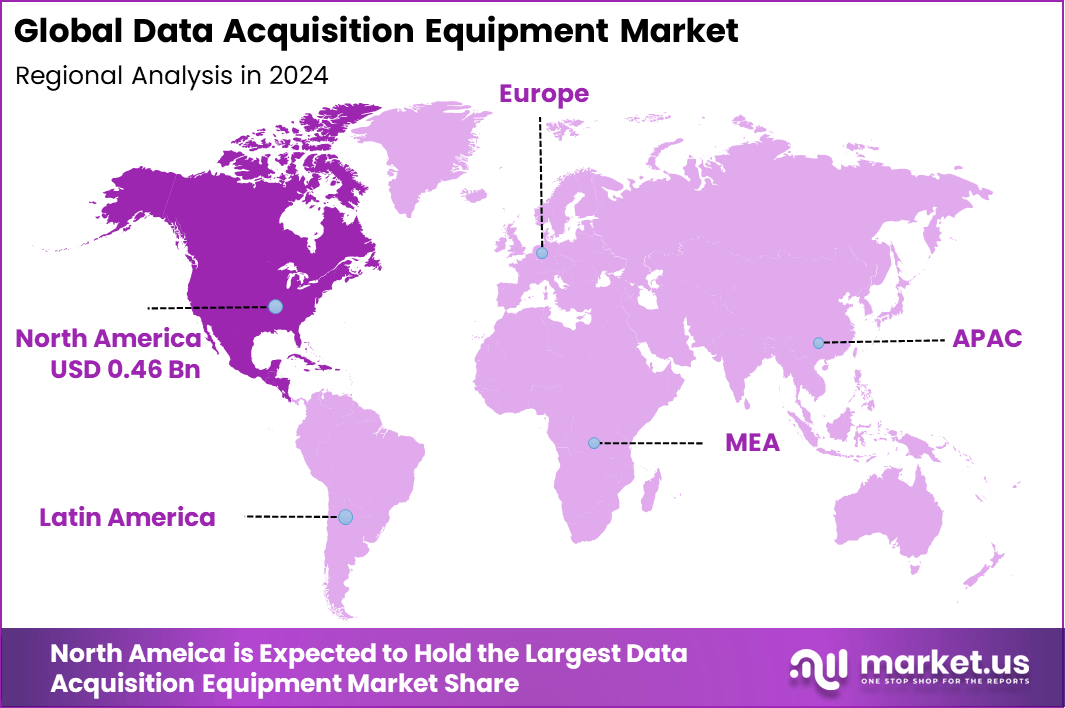
The Global Data Acquisition Equipment Market generated USD 1.4 billion in 2024 and is predicted to register growth from USD 1.5 billion in 2025 to about USD 2.4 billion by 2034, recording a CAGR of 5.50% throughout the forecast span. In 2024, North America held a dominan market position, capturing more than a 32.8% share, holding USD 0.46 Billion revenue.
The Data Acquisition Equipment market is growing steadily as industries demand accurate and real-time data to improve operational efficiency, quality control, and safety. Data acquisition equipment collects and processes signals from sensors and instruments across manufacturing, automotive, aerospace, energy, and healthcare sectors.
These systems are essential for monitoring complex processes, optimizing performance, and enabling predictive maintenance in increasingly automated and digitalized environments. The push for Industry 4.0 and smart manufacturing is a key trend driving investments in advanced data acquisition hardware that can handle higher data volumes with precision and speed.
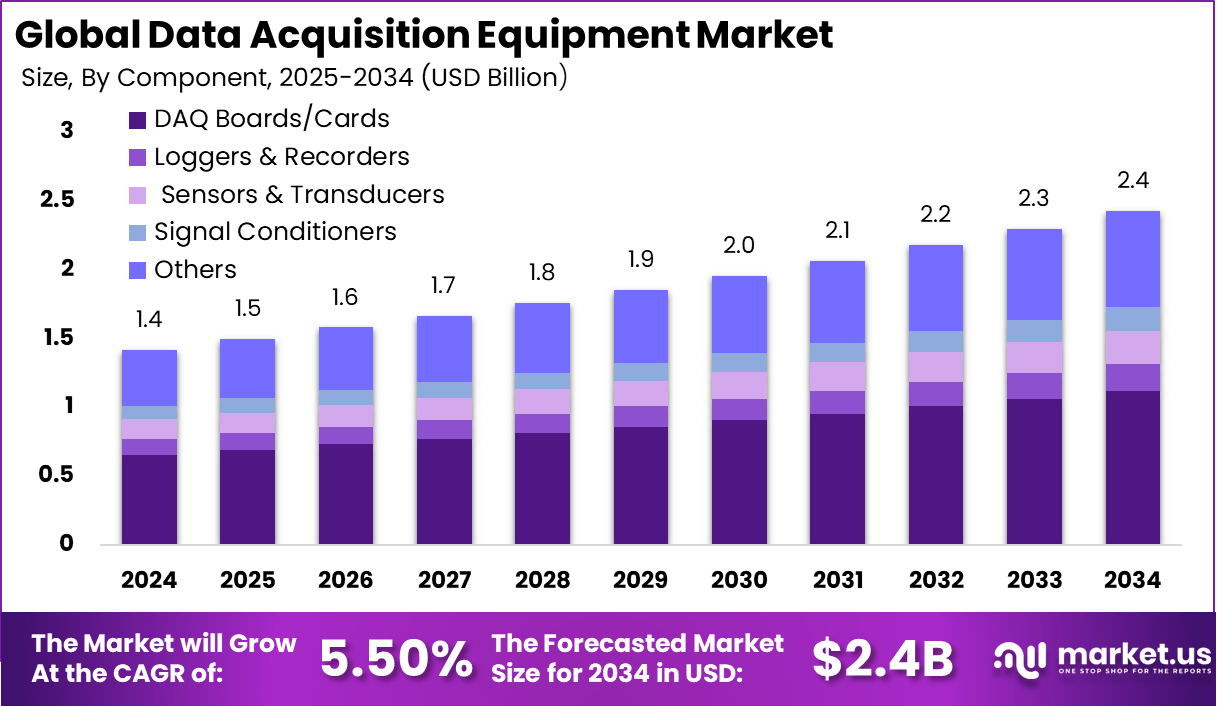
Top driving factors include increasing automation in industrial operations, the need to comply with stringent regulatory and safety standards, and the growth of IoT and connected devices generating vast amounts of data requiring effective capture and analysis. The expansion of renewable energy generation and electric vehicles intensifies the demand for data acquisition to monitor performance and energy consumption.
Digital twins and simulation models increasingly rely on real-time data inputs from acquisition equipment to enhance accuracy and operational insights. Geographic demand is strong in developed regions with established manufacturing bases and emerging rapidly in Asia-Pacific due to industrial expansion.
Demand analysis indicates that manufacturing continues to dominate usage, leveraging data acquisition equipment for process control, quality assurance, and product testing. Automotive and aerospace sectors utilize these systems intensively for performance testing and regulatory compliance.
Healthcare applications include patient monitoring and diagnostic device development, requiring precise data acquisition capabilities. The growth of smart grids and energy management systems also contributes to demand, as data acquisition helps optimize energy usage and detect faults in electrical infrastructure.
Top Market Takeaways
- By component, DAQ boards/cards dominate with 46.2% share, widely used for data collection and signal processing in testing, manufacturing, and quality control environments.
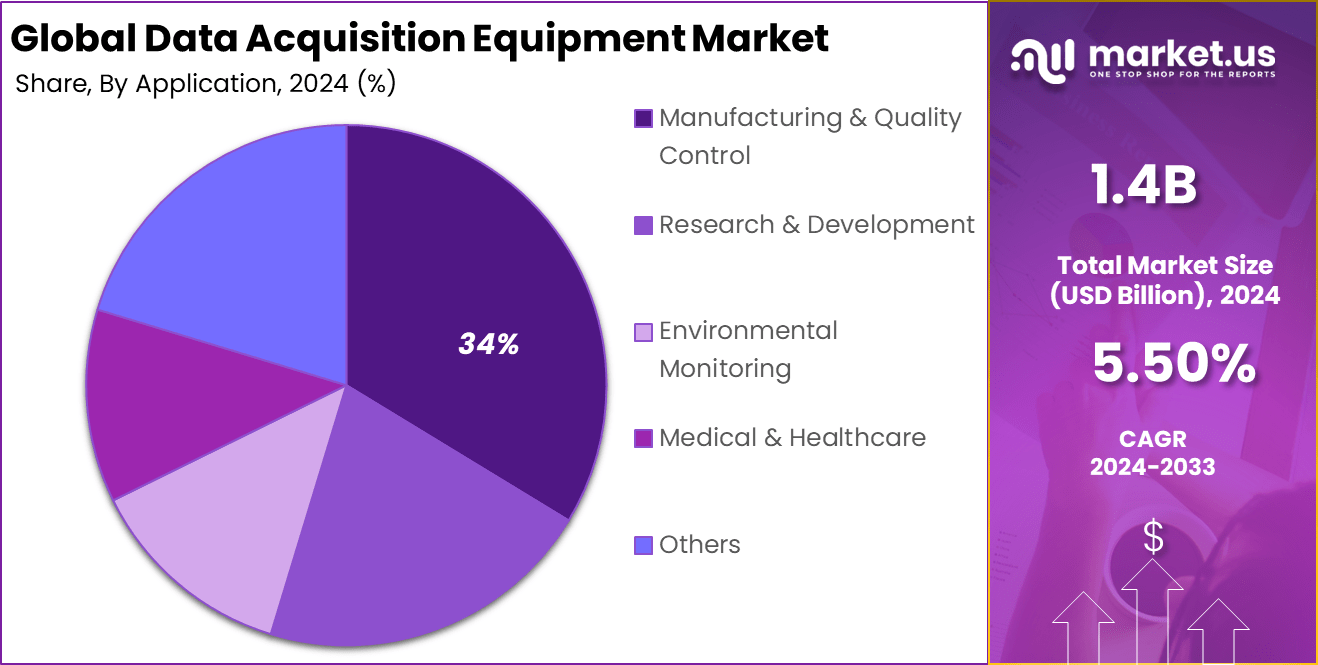
- By application, manufacturing and quality control lead with 33.7% share, reflecting the increasing adoption of automated inspection systems and real-time monitoring to improve product quality and process efficiencies.
- By end-user, automotive represents 26.3% of the market, driven by growing demand for vehicle testing, electric vehicle (EV) validation, and advanced driver assistance systems (ADAS) testing requiring precise and robust DAQ solutions.
- Regionally, North America holds about 32.8% market share, supported by mature industrial automation sectors and heavy R&D investments.
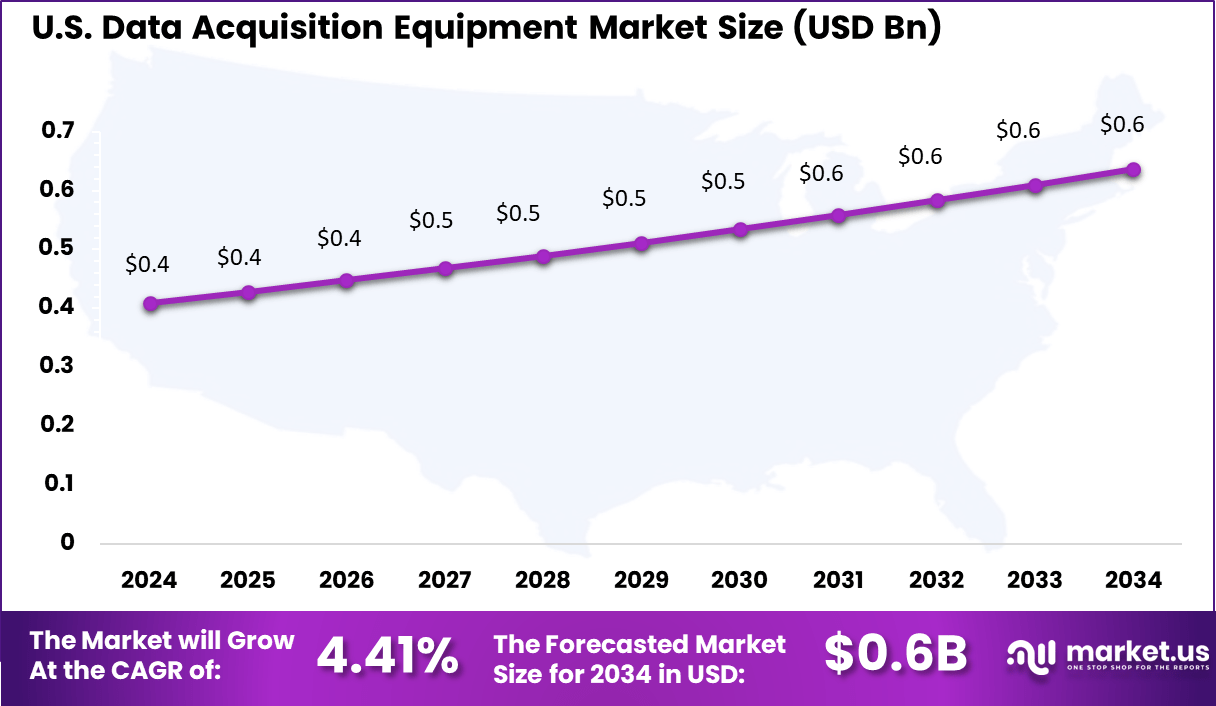
- The U.S. market size is estimated at approximately USD 0.41 billion in 2025.
- The market is expected to grow at a CAGR of around 4.51%, driven by ongoing digitalization, Industry 4.0 adoption, and the increasing complexity of automotive and manufacturing tests necessitating advanced data acquisition hardware.
By Component
DAQ boards and cards hold a leading 46.2% share in the data acquisition equipment market. These components are crucial as they serve as the interface between sensors and data processing systems, converting analog signals into digital data for analysis. Their modular design and versatility enable deployment across diverse applications, allowing engineers to customize configurations for specific testing and monitoring needs.
High channel density, precise timing, and real-time data streaming capabilities make DAQ boards indispensable in modern industrial and scientific infrastructures. The increasing trend towards Industry 4.0 and smart manufacturing underlines the importance of DAQ boards.
Enhanced integration with software analytics platforms amplifies their utility, allowing predictive maintenance and rapid fault diagnosis. As industries automate complex processes, DAQ boards/cards are becoming the backbone of efficient, intelligent data acquisition, ensuring more informed and agile operational decisions.
By Application
Manufacturing and quality control applications dominate the data acquisition market with a 34% share. In these environments, DAQ systems monitor parameters like temperature, pressure, and vibration to maintain product quality and prevent defects.
The demand for seamless, real-time data capture and robust analytics drives manufacturers to integrate DAQ systems throughout the production lifecycle. These systems ensure compliance with stringent industry standards while optimizing operational efficiency. Growing emphasis on automated quality control in automotive, electronics, pharmaceuticals, and consumer goods sectors fuels this segment.
Advanced DAQ solutions enable continuous monitoring, minimizing downtime and waste, while enhancing traceability and process control. Integration with IoT and AI-driven predictive tools transforms manufacturing environments into smarter, more responsive operations, elevating quality outcomes and competitiveness.
By End-User
The automotive sector holds a 26.3% share in data acquisition equipment usage, driven by the growing complexity of vehicle testing and development. Automotive manufacturers rely on accurate data acquisition to validate engine performance, HVAC systems, and advanced driver-assistance systems (ADAS). The shift towards electric vehicles (EVs) and autonomous driving intensifies the need for precise data on battery behavior, sensor outputs, and environmental interactions.
The sector’s push for innovation and regulatory compliance increases demand for durable, high-speed, and high-accuracy DAQ systems. Collaborations between automotive companies and DAQ providers accelerate the development of testing benches and real-time monitoring setups. This ongoing evolution supports safer, more efficient vehicles while reducing time-to-market for automotive innovations.
Key Reasons for Adoption
- Real-time data collection: Enables industries to capture immediate information from machines, sensors, and processes for timely insights and control.
- Process optimization: Helps identify inefficiencies and bottlenecks in workflows, leading to better resource management and higher productivity.
- Predictive maintenance: Detects early signs of equipment wear or failure to prevent costly breakdowns and reduce downtime.
- Compliance and reporting: Supports adherence to industry standards and regulations by providing accurate, logged data for audits and quality control.
- Automation support: Integrates with automated systems to enhance precision, reduce errors, and accelerate operations.
Benefits
- Increased operational efficiency: Real-time monitoring allows quick responses to process deviations, minimizing waste and maximizing output.
- Cost savings: Prevents expensive machine failures through predictive maintenance and reduces manual inspection needs.
- Improved quality control: Continuous data collection ensures products meet quality standards, reducing defects and returns.
- Better decision-making: Reliable data empowers management to make informed, data-driven strategic and operational choices.
- Enhanced safety: Early detection of hazardous conditions protects workers and facilities, lowering liabilities.
Usage
- Monitoring and controlling manufacturing processes in factories
- Environmental monitoring of air and water quality
- Power generation and grid management analysis
- Biomedical research and patient vital signs monitoring
- Structural health monitoring of bridges and infrastructure
Emerging Trends
| Key Trends | Description |
|---|---|
| Miniaturization and Wireless Capability | Development of smaller, wireless data acquisition devices enabling flexible, on-site monitoring. |
| Integration with AI and Machine Learning | AI-powered analytics enhance predictive maintenance and real-time decision-making in diverse industries. |
| Cloud-Based and Edge Computing Solutions | Adoption of cloud and edge platforms for scalable, efficient data processing and remote equipment management. |
| Increasing Automation and Industry 4.0 Adoption | Automation trends in manufacturing and smart factories boosting demand for connected, real-time data acquisition. |
| Enhanced Data Security Features | Growing focus on cybersecurity to protect sensitive industrial data collected by acquisition systems. |
Growth Factors
| Key Factors | Description |
|---|---|
| Expanding Industrial Automation | Rising automation demand in manufacturing, healthcare, energy, and automotive sectors drives market growth. |
| Growing IoT Ecosystem | Proliferation of IoT devices necessitates robust data acquisition for monitoring and analytics. |
| Regulatory Compliance and Quality Standards | Increasing standards require precise monitoring solutions supporting operational safety and compliance. |
| Technological Advancements | Innovations in sensor technology, data processing, and communication enhance equipment capabilities. |
| Rising Investments and Adoption in Emerging Markets | Growth in Asia-Pacific and other developing regions due to industrialization and infrastructure development. |
Key Market Segments
By Component
- DAQ Boards/Cards
- Loggers & Recorders
- Sensors & Transducers
- Signal Conditioners
- Others
By Application
- Research & Development
- Manufacturing & Quality Control
- Environmental Monitoring
- Medical & Healthcare
- Others
By End-User
- Automotive
- Aerospace & Defense
- Electronics & Semiconductors
- Energy & Power
- Healthcare
- Others
Regional Analysis
North America captured a significant 32.8% share of the global data acquisition equipment market, driven by extensive adoption in sectors such as aerospace, automotive, defense, and manufacturing. The region benefits from a highly advanced technological infrastructure and a strong industrial base demanding precise and reliable data collection systems to optimize operations and ensure product quality.
Continuous investments in research and development, coupled with the integration of IoT and AI technologies with data acquisition devices, enhance real-time monitoring and analytics capabilities. Regulatory requirements and quality assurance standards in North America further propel demand for sophisticated data acquisition equipment.
The U.S. dominates the market, valued at approximately USD 0.41 billion in 2024, growing at a CAGR of 4.51%. The country’s industrial and technological landscape fosters innovation and deployment of advanced data acquisition systems, especially in sectors such as aerospace testing, automotive safety, and defense applications.
Leading manufacturers and service providers are focusing on miniaturization, higher accuracy, and automated data processing to address evolving application needs. Government support for technology development and infrastructure modernization also drives market expansion. The U.S. serves as the major growth engine for North America’s data acquisition equipment market, influencing global trends and standards.
Key Regions and Countries
- North America
- US
- Canada
- Europe
- Germany
- France
- The UK
- Spain
- Italy
- Russia
- Netherlands
- Rest of Europe
- Asia Pacific
- China
- Japan
- South Korea
- India
- Australia
- Singapore
- Thailand
- Vietnam
- Rest of APAC
- Latin America
- Brazil
- Mexico
- Rest of Latin America
- Middle East & Africa
- South Africa
- Saudi Arabia
- UAE
- Rest of MEA
Driver
Increasing Adoption of Industry 4.0 and Automation
The data acquisition equipment market is driven by the growing adoption of Industry 4.0 technologies and automation across manufacturing, energy, and healthcare sectors. Precise, real-time data collection provided by these systems enables intelligent decision-making, improved operational efficiency, and predictive maintenance.
With rising digital transformation, companies are investing in sophisticated data acquisition solutions that integrate with IoT and AI platforms. Furthermore, stringent regulatory requirements for monitoring and reporting in various industries boost demand for reliable data acquisition hardware and software. These trends collectively accelerate market growth, especially in technologically advanced regions like North America and Asia Pacific.
Restraint
High Initial Investment and Complexity
The market faces restraints from the high initial costs and complex integration requirements of advanced data acquisition systems. These systems often require expensive hardware, specialized software, and skilled technicians for setup and operation. Small and medium enterprises may find these costs prohibitive, limiting adoption.
In addition, compatibility issues with legacy equipment and infrastructure pose challenges in deployment. Managing the complexity of diverse data sources and ensuring seamless interoperability demands significant technical expertise, which can be a barrier in less developed regions.
Opportunity
Growth in Remote Monitoring and Cloud Integration
Increasing demand for remote monitoring and cloud-based data acquisition solutions offers a significant market opportunity. Cloud integration allows centralized data storage, real-time analytics, and enhanced scalability, supporting multi-site industrial operations. This enables businesses to optimize processes and improve asset management from remote locations.
The surge in environmental monitoring, smart cities, and connected healthcare devices also drives innovation. Emerging technologies like edge computing coupled with data acquisition systems open markets for highly responsive and low-latency data processing, expanding the breadth of applications and fueling market expansion.
Challenge
Regulatory Compliance and Cybersecurity Concerns
Regulatory compliance and cybersecurity represent major challenges for the data acquisition equipment market. Data-driven industries must adhere to strict privacy, safety, and reporting standards, requiring frequent system upgrades and certifications. Non-compliance risks regulatory penalties and operational interruptions.
Cybersecurity threats targeting data acquisition networks can compromise sensitive information and disrupt industrial processes. Ensuring robust data protection, secure communication protocols, and continuous system monitoring are crucial. Balancing regulatory demands with technological advancement and cost control remains a complex challenge for market players.
Competitive Analysis
ABB, National Instruments, Keysight Technologies, and Teledyne Technologies lead the data acquisition equipment market with advanced hardware and software platforms designed for high-speed measurement, real-time monitoring, and multi-sensor integration. Their solutions support industrial automation, energy systems, research labs, and aerospace applications. These companies focus on accuracy, scalability, and seamless connectivity with analytics environments.
AMETEK, Spectris (HBK), ADInstruments, Dewesoft, Campbell Scientific, DATAQ Instruments, and HBM strengthen the competitive landscape with specialized systems for dynamic testing, environmental monitoring, and structural analysis. Their equipment offers flexible channel configurations, robust signal conditioning, and compatibility with diverse sensor technologies.
Siemens, Yokogawa Electric, Schneider Electric, Honeywell, and other participants broaden the market with integrated data acquisition solutions for industrial operations, process automation, and smart infrastructure. Their platforms combine DAQ capabilities with control systems, cloud connectivity, and real-time diagnostics. These companies support large-scale deployments in manufacturing, utilities, and critical infrastructure.
Top Key Players in the Market
- ABB
- National Instruments (NI)
- Keysight Technologies
- Teledyne Technologies
- AMETEK
- Spectris (HBK)
- ADInstruments
- Dewesoft
- Campbell Scientific
- DATAQ Instruments
- HBM
- Siemens
- Yokogawa Electric
- Schneider Electric
- Honeywell
- Others
Future Outlook
The Data Acquisition Equipment Market is expected to grow steadily through 2035, driven by increasing industrial automation, IoT integration, and the demand for precise real-time data for improved decision-making.
Technological advancements such as wireless data acquisition, edge computing, and AI-powered analytics are expanding market applications across manufacturing, healthcare, energy, and automotive sectors. The market’s growth is accelerated by digital transformation efforts, smart factory initiatives, and rising regulatory requirements for data accuracy and monitoring.
Opportunities lie in
- Growing adoption of IoT-enabled data acquisition systems for remote monitoring and predictive analytics.
- Expansion of automation in smart manufacturing, robotics, and connected factory environments.
- Increasing deployment in renewable energy sectors for real-time monitoring and efficiency optimization.
Recent Developments
- November, 2025, ABB Corporation was recognized as a leader in industrial AI analytics by Verdantix for its Genix Industrial IoT and AI Suite that integrates real-time data to improve performance and sustainability.
- April, 2025, Emerson Electric Co. showcased major hardware and software upgrades at NI Connect 2025, including ruggedized FieldDAQ data acquisition modules and enhanced software-defined RF vector signal transceivers suitable for industrial environments









