


Report Overview
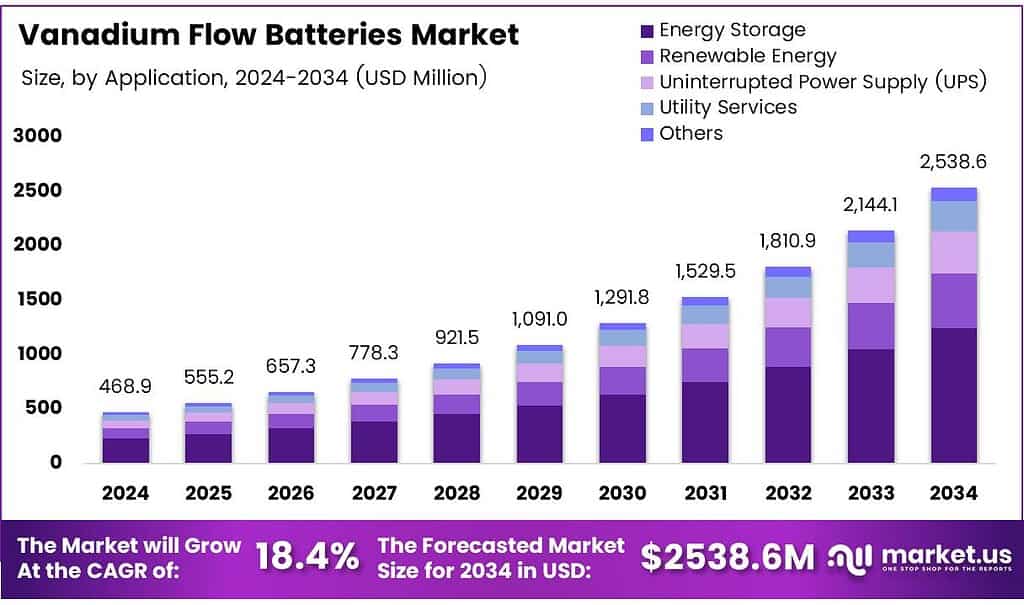
The Global Vanadium Flow Batteries Market size is expected to be worth around USD 2538.6 Million by 2034, from USD 468.9 Million in 2024, growing at a CAGR of 18.4% during the forecast period from 2025 to 2034.
The Vanadium Flow Batteries Market represents a growing segment of long-duration energy storage systems designed for grid stability, renewable integration, and energy security. Vanadium flow batteries use liquid electrolytes stored externally, enabling flexible scaling. As grids decentralize, this market gains attention for durability, safety, and predictable lifecycle economics.
Within the broader energy-storage context, pumped hydroelectric energy storage dominates global capacity. Pumped hydro accounts for more than 90% of installed grid storage worldwide. Although efficient and long-lasting, geographic limitations and ecological impacts limit scalability, creating space for advanced battery-based alternatives.
- Cost and chemistry constraints still shape vanadium battery deployment. Elsevier, commercial vanadium redox systems face voltage limits near 1.229 V due to water’s electrochemical window. Additionally, thermal behavior restricts operating temperatures below 100 °C, affecting system design and balance-of-plant requirements.
Supply-chain dynamics also affect market economics. About 80% of global vanadium electrolyte production currently originates from a single Chinese supplier base. This concentration highlights sourcing risk but also encourages diversification, recycling strategies, and government-backed domestic supply initiatives.
Opportunities strengthen as policymakers focus on energy resilience and climate commitments. Long service lifetimes reduce replacement cycles and support favorable total ownership costs. Additionally, vanadium electrolytes are reusable, opening secondary value streams. Investors increasingly view vanadium flow batteries as strategic infrastructure rather than short-term storage assets.
Key Takeaways
- The Global Vanadium Flow Batteries Market is projected to grow from USD 468.9 million in 2024 to USD 2538.6 million by 2034, registering a CAGR of 18.4%.
- Energy Storage leads the market with a dominant share of 44.7% in 2024, driven by long-duration grid requirements.
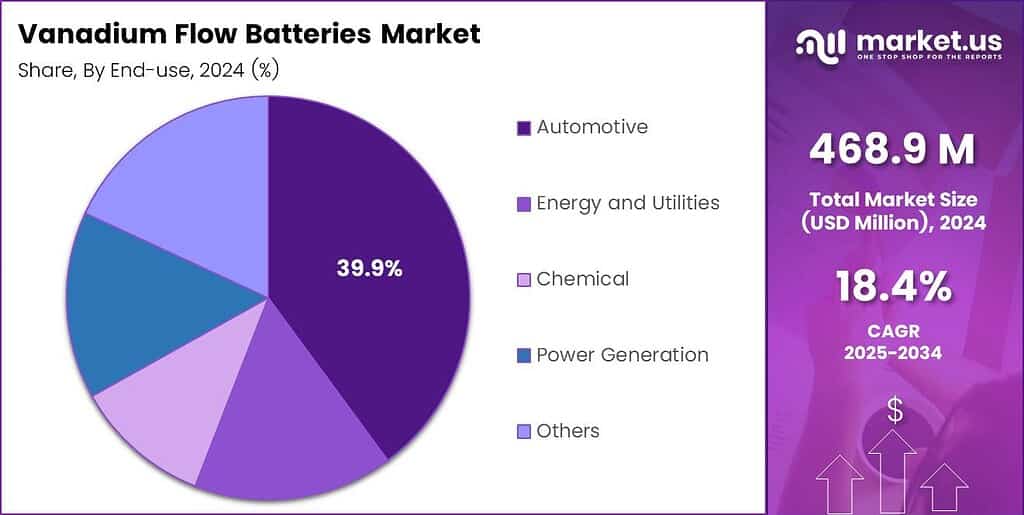
- Energy and Utilities holds the largest share at 39.9%, supported by grid-scale storage adoption.
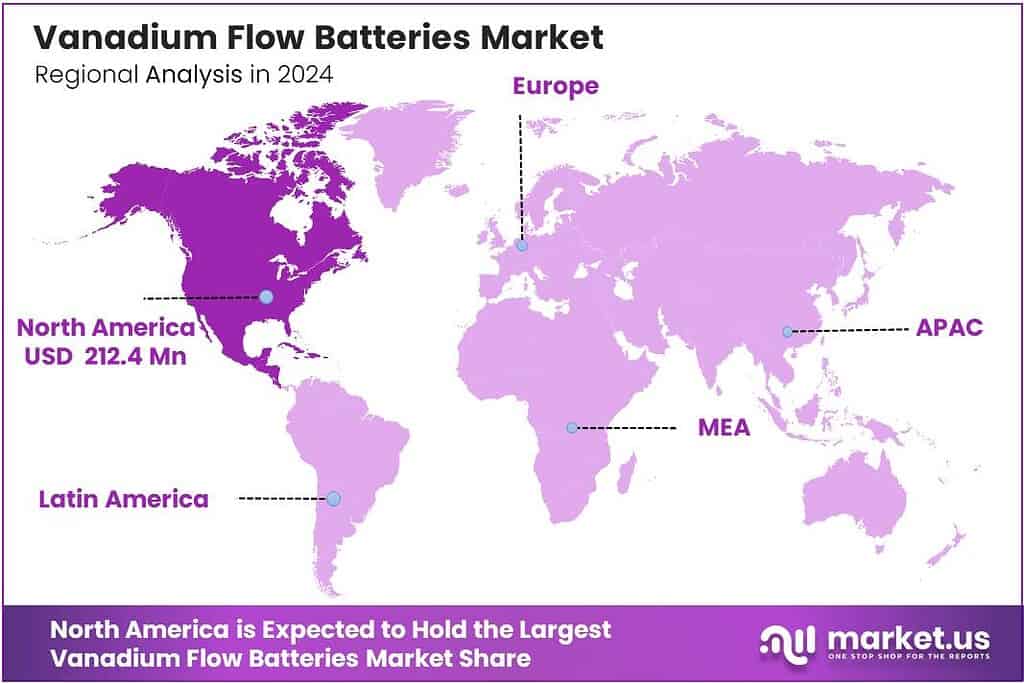
- North America dominates the regional landscape with a market share of 45.3%, valued at USD 212.4 Mn in 2024.
By Application Analysis
Energy Storage dominates with 44.7% due to its strong role in long-duration grid balancing and renewable integration.
In 2024, Energy Storage held a dominant market position in the By Application Analysis segment of the Vanadium Flow Batteries Market, with a 44.7% share. Moreover, utilities prefer this application for long-duration discharge, high cycle life, and improved safety, supporting stable renewable power integration.
Renewable Energy applications follow gradually, as solar and wind projects adopt vanadium flow batteries for smoothing intermittent generation. Additionally, these batteries support time-shifting of clean energy, helping operators improve grid reliability while meeting renewable deployment targets without frequent battery replacement.
Uninterrupted Power Supply (UPS) applications grow steadily, especially in data centers and industrial facilities. Furthermore, vanadium flow batteries offer quick response and deep discharge capability, ensuring backup power during outages while reducing fire risks compared to lithium-based systems.
Utility Services represent another important application, as grid operators deploy flow batteries for peak shaving and load balancing. Consequently, utilities value their long operational life and predictable performance, which lowers lifetime costs and supports grid modernization programs.
By End-Use Analysis
Energy and Utilities dominate with 39.9% supported by grid-scale storage investments and energy transition goals.
In 2024, Energy and Utilities held a dominant market position in the end-use analysis segment of the Vanadium Flow Batteries Market, with a 39.9% share. Additionally, utilities adopt these systems for long-duration storage, grid stabilization, and renewable integration initiatives.
Automotive end-use adoption remains limited but emerging, mainly in charging infrastructure support. Moreover, vanadium flow batteries help manage peak loads at charging stations, improving power availability while reducing strain on local distribution networks.
Chemical industry usage grows steadily as plants seek reliable backup and energy management solutions. Furthermore, vanadium flow batteries align well with continuous-process operations, offering a stable power supply and long service life under demanding industrial conditions.
Power Generation applications expand alongside renewable and hybrid plants. Consequently, generators deploy flow batteries to store excess energy, improve dispatchability, and enhance power plant operational flexibility during variable demand cycles.
Key Market Segments
By Application
- Energy Storage
- Renewable Energy
- Uninterrupted Power Supply (UPS)
- Utility Services
- Others
By End-Use
- Automotive
- Energy and Utilities
- Chemical
- Power Generation
- Others
Emerging Trends
Technological Improvements Shape Market Trends
One major trend in the vanadium flow batteries market is innovation in electrolyte management. Companies are improving energy density, which helps reduce system size and overall cost. Modular system designs are also trending. These allow easy scaling based on energy needs, making deployment simpler for utilities and industrial users.
- Another trend is integration with digital energy management systems. Smart controls improve efficiency, monitoring, and maintenance, increasing overall system value. The government-owned NTPC inaugurated India’s first MWh-scale vanadium flow battery — a 3 MWh system — indicating a real shift from pilot-scale experiments to utility-scale deployment.
Drivers
Rising Need for Long-Duration Energy Storage Drives Market Growth
The vanadium flow batteries market is mainly driven by the rising demand for long-duration energy storage. Power grids are adding more solar and wind energy, which are not available all the time. Vanadium flow batteries help store energy for many hours and release it when needed.
- Utilities need stable systems to manage power fluctuations and avoid outages. Worldwide, too, VRFBs have demonstrated scale: one of the largest flow-battery plants globally (100 MW / 400 MWh) was commissioned in China, showing that the technology can scale far beyond small or pilot setups.
Vanadium flow batteries offer steady performance and are well-suited for large-scale grid applications such as peak shaving and load balancing. Safety is also pushing demand. These batteries use non-flammable electrolytes, making them safer than many lithium-based systems. This feature makes them attractive for use near populated areas and critical infrastructure.
Restraints
High Initial System Cost Limits Short-Term Adoption
The biggest restraint in the vanadium flow batteries market is the high upfront cost. The system requires large volumes of vanadium electrolyte, which increases initial capital investment. This makes buyers cautious, especially in cost-sensitive markets.
- Renewable energy capacities are rising rapidly — creating a parallel surge in demand for reliable storage systems. In India, the push to reach ambitious renewable targets has boosted interest in VRFBs, with commentators projecting an Indian VRFB market size of about USD 70.6 million in 2024.
Large physical size is another limitation. Vanadium flow batteries need more space compared to lithium systems. This restricts use in urban or compact installations where space is limited. Limited manufacturing scale also slows adoption. Compared to lithium batteries, fewer suppliers and factories exist. This keeps production costs high and slows market penetration.
Growth Factors
Growing Renewable Projects Create Strong Future Opportunities
The expansion of renewable energy projects creates major growth opportunities for vanadium flow batteries. Solar and wind farms need storage that can deliver power reliably for long durations. This fits well with vanadium battery capabilities. Utility-scale storage is a key opportunity area.
- Power companies prefer technologies with long lives and low degradation. Vanadium flow batteries meet these requirements and reduce replacement risks. Early large-scale commercialization of flow batteries could raise demand for vanadium by 2.5 times more compared to baseline expectations, and by as much as 50% more by 2040.
Recycling and reuse of vanadium electrolyte also open new opportunities. The electrolyte does not degrade and retains value even after battery life. This can create leasing models and reduce lifetime cost. Emerging markets offer strong potential. Many developing regions are upgrading grids and adding renewables. These regions need robust, low-maintenance storage systems.
Regional Analysis
North America Dominates the Vanadium Flow Batteries Market with a Market Share of 45.3%, Valued at USD 212.4 Mn
North America leads the vanadium flow batteries market due to strong grid modernization efforts and rising deployment of long-duration energy storage solutions. In 2024, the region accounted for a dominant 45.3% share, reaching a value of USD 212.4 Million, supported by large-scale renewable integration. Utilities across the region increasingly prefer vanadium flow batteries for their long cycle life, fire safety, and suitability for stationary energy storage.
Asia Pacific shows fast-growing adoption driven by rapid renewable capacity additions and power reliability needs. Countries in the region focus on energy storage to stabilize grids with high solar and wind penetration. Government-backed demonstration projects and strong industrial manufacturing ecosystems accelerate system deployment. The region continues to benefit from long-term energy transition roadmaps emphasizing non-lithium storage technologies.
Europe remains a key market supported by decarbonization targets and cross-border electricity balancing needs. Utilities and grid operators adopt flow batteries for multi-hour storage and frequency regulation. The region emphasizes lifecycle sustainability, recyclability, and long asset life, aligning well with vanadium flow battery technology. Policy frameworks promoting energy autonomy strengthen demand across member states.
The U.S. plays a central role within North America due to extensive grid-scale energy storage investments. Utilities explore vanadium flow batteries for long-duration storage beyond conventional lithium systems. Federal funding for energy innovation and resilience enhances pilot-to-commercial transitions. The demand is driven by grid reliability, wildfire safety concerns, and renewable energy expansion.
Key Regions and Countries
North America
- US
- Canada
Europe
- Germany
- France
- The UK
- Spain
- Italy
- Rest of Europe
Asia Pacific
- China
- Japan
- South Korea
- India
- Australia
- Rest of APAC
Latin America
- Brazil
- Mexico
- Rest of Latin America
Middle East & Africa
- GCC
- South Africa
- Rest of MEA
Key Players Analysis
Invinity Energy Solutions is positioning itself as a key bridge between renewable developers and utilities. Its modular flow-battery platforms, focused on repeatable project templates and standardized containers, help reduce integration risk and shorten sales cycles — essential as policy support tightens around proven, bankable storage technologies rather than pilots.
CellCube brings a strong engineering heritage and a clear focus on fully integrated vanadium systems for industrial and commercial users. By offering containerized solutions with in-house electrolyte and power electronics, the company aims to capture value across the chain, which could support margins as metal prices fluctuate and customers increasingly demand performance guarantees and long-term service contracts.
Maritime and offshore decarbonization offers a differentiated niche for Conoship International. Leveraging its ship-design capabilities, the firm is exploring vanadium flow solutions for auxiliary power and port-side storage — where safety, long lifetime, and flexible cycling are more critical than energy density. If it can demonstrate reliable operation in harsh marine conditions, it may unlock premium projects and partnerships in emerging green-shipping corridors.
Rongke Power remains one of the most influential players in large-scale vanadium flow deployments. Its experience with multi-hundred-megawatt projects provides valuable cost and performance data that smaller peers lack. As China expands renewable integration and enacts provincial peak-shaving mandates, Rongke’s ability to deliver bankable reference plants and secure electrolyte supply could set the benchmark for system pricing and project economics worldwide.
Top Key Players in the Market
- Invinity Energy Solutions
- CellCube
- Conoship International
- Rongke Power
- Solibra Energy Storage Technologies GmbH
- Sumitomo Electric
- VanadiumCorp Resource Inc.
- VIONX Energy Corp
- VRB Energy
Recent Developments
- In 2025, Invinity reported significant progress on its 12-month corporate priorities, including the rollout of a semi-automated production line at its Bathgate, UK facility, expected to double output. Invinity launched Endurium Enterprise, a VFB platform tailored for C&I customers.
- In 2025, CellCube Energy Storage Systems, an Austrian-Canadian firm specializing in vanadium redox flow batteries (VRFBs) for grid, microgrid, and off-grid applications, had limited publicly reported developments. The company continues to emphasize its mature FB 500-2000 series.









