


Report Overview
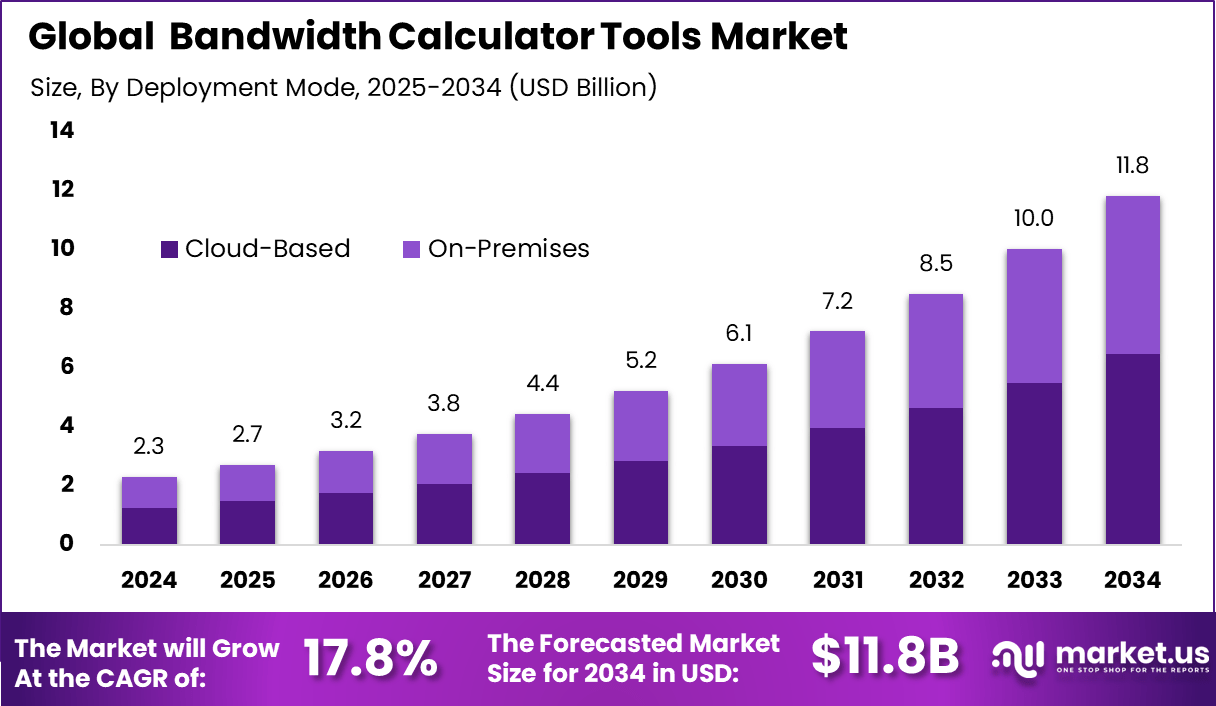
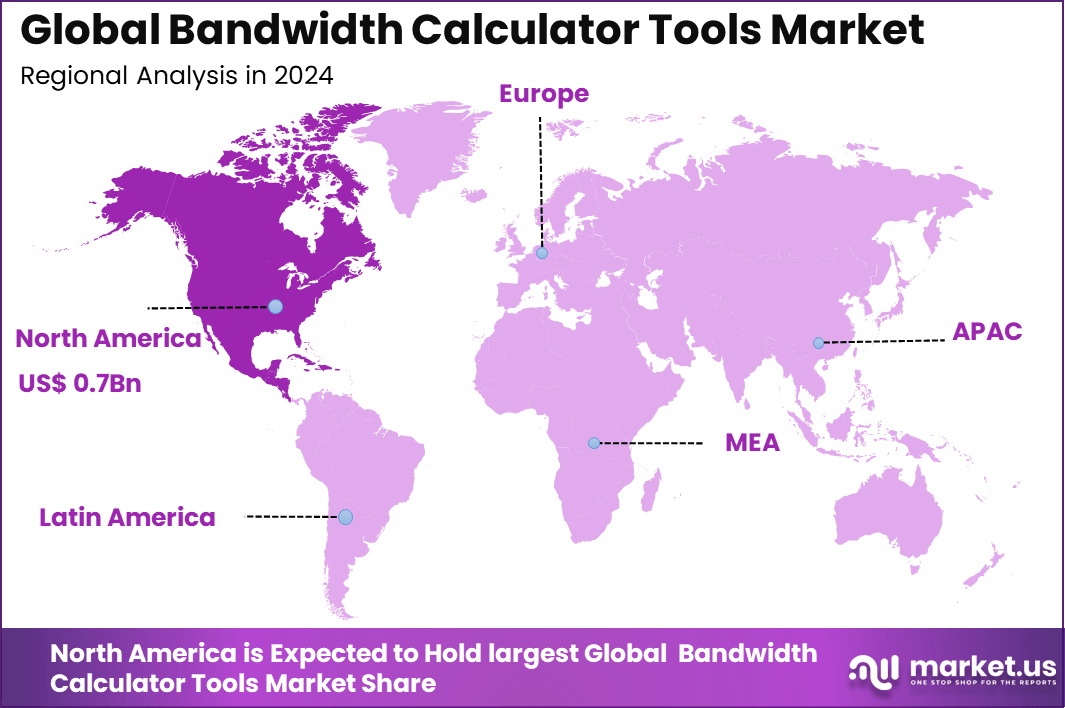
The Global Bandwidth Calculator Tools Market generated USD 2.3 billion in 2024 and is predicted to register growth from USD 2.7 billion in 2025 to about USD 11.8 billion by 2034, recording a CAGR of 17.8% throughout the forecast span. In 2024, North America held a dominan market position, capturing more than a 34.2% share, holding USD 0.7 Billion revenue.
The bandwidth calculator tools market has expanded as businesses and network teams seek accurate methods to estimate data capacity needs across digital infrastructure. Growth reflects rising internet traffic, cloud adoption and the increasing use of high bandwidth applications such as video streaming, remote collaboration and real time analytics. These tools support planning for network upgrades, cloud migrations and service performance optimisation.
The growth of the market can be attributed to increased deployment of cloud services, growth in remote work and rising demand for reliable internet connectivity. Organisations require precise capacity planning to avoid network congestion and service disruption. Expansion of data intensive workloads such as video surveillance, IoT data transfer and edge computing also strengthens the need for reliable bandwidth estimation tools.
Top Market Takeaways
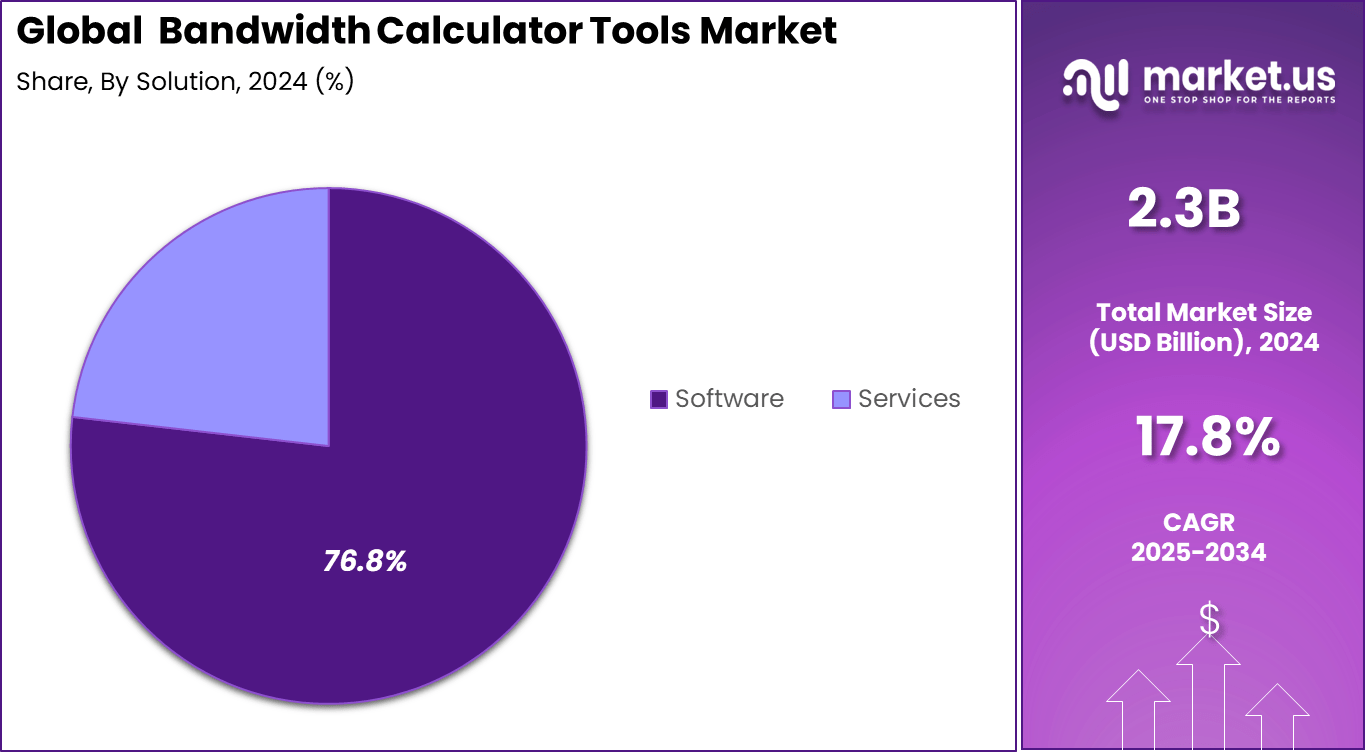
- Software solutions dominated with 76.8%, showing strong demand for automated bandwidth planning and real-time traffic analysis tools.
- Cloud-based deployment captured 54.6%, reflecting the shift toward scalable, remote-ready network monitoring environments.
- Network management applications held 38.3%, highlighting the growing need to optimize traffic flow and prevent congestion.
- The IT and telecom sector accounted for 35.4%, driven by continuous upgrades in communication infrastructure and rising data consumption.
- North America recorded 34.2%, supported by advanced enterprise networks and early adoption of cloud-based monitoring tools.
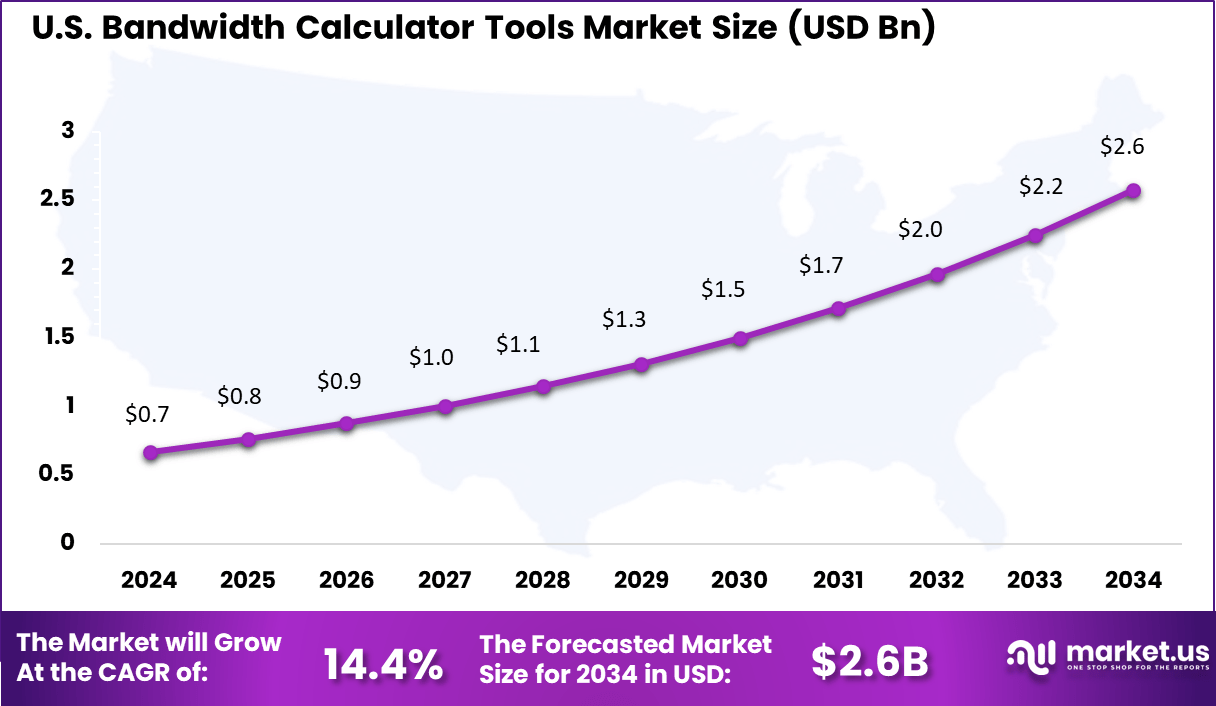
- The U.S. market reached USD 0.67 billion with a 14.4% CAGR, indicating steady investment in network capacity planning and performance optimization.
Quick Market Facts
Key technologies supporting adoption include web based estimation engines, real time traffic modelling, AI assisted traffic prediction, application aware bandwidth planning, API integration with network monitoring systems and cloud usage analytics. Modern tools simulate peak usage scenarios using historical data to forecast network capacity requirements. Some platforms integrate with SD WAN systems to support dynamic bandwidth planning.
Organisations adopt bandwidth calculator tools to prevent network bottlenecks, control infrastructure cost and maintain stable application performance. These tools help teams estimate required capacity before adding new digital services or expanding user bases. Accurate planning reduces over provisioning and avoids under capacity risks that cause service degradation.
Investment opportunities exist in AI based traffic forecasting, cloud migration bandwidth planning, real time network simulation platforms, multi site capacity modelling tools, ISP integrated calculator services and developer focused network planning APIs. Strong potential is seen in digital transformation projects, data center expansion and telecom infrastructure modernisation.
By Solution
The software segment leads the market with a strong 76.8% share, showing that most bandwidth calculation tools are delivered through software platforms. These tools are widely used for estimating network capacity, managing traffic loads, and planning infrastructure upgrades. Software-based solutions offer fast deployment, real-time analysis, and easy integration with existing IT systems.
The high adoption of software tools is driven by the growing need for automated network planning and performance optimization. Enterprises prefer software solutions due to lower installation costs, faster updates, and the ability to scale based on network growth. This supports continuous demand across cloud networks, data centers, and enterprise IT environments.
By Deployment Mode
Cloud-based deployment holds a 54.6% share, indicating a clear shift toward remote and web-based bandwidth calculation platforms. Cloud deployment allows users to access tools from any location, supports automatic updates, and reduces dependency on local hardware infrastructure.
The dominance of cloud-based tools is supported by growing reliance on cloud computing, remote work environments, and multi-site network operations. These tools help organizations monitor bandwidth usage in real time and adjust network resources quickly based on traffic demand. This improves network reliability and operational efficiency.
By Application
Network management represents 38.3% of total application demand, making it the leading use case for bandwidth calculator tools. These tools play an important role in monitoring traffic flow, detecting congestion, and balancing network loads across servers and devices.
The rising complexity of enterprise networks is increasing the need for accurate bandwidth planning. Organizations depend on these tools to avoid downtime, improve data transfer speeds, and support high-volume applications such as cloud computing, video streaming, and remote collaboration platforms.
By End User
The IT and telecom sector accounts for 35.4% of total end-user demand. These industries rely heavily on bandwidth planning tools to manage large communication networks, customer data flows, and service quality performance.
Telecom operators use these tools to estimate network capacity for mobile data, fiber networks, and enterprise connectivity services. IT service providers depend on them to support cloud hosting, managed services, and digital transformation projects across industries.
North America Market Size
In 2024, North America holds a 34.2% share, reflecting its strong adoption of advanced networking and cloud-based infrastructure. The region benefits from high internet traffic volumes, large-scale data center investments, and widespread enterprise cloud usage. These factors create consistent demand for bandwidth planning and network management tools.
The United States alone reached USD 0.67 Bn with a solid CAGR of 14.4%, showing steady expansion of digital networks and cloud services. Growth is supported by rising use of streaming services, enterprise cloud platforms, and remote work tools that require accurate bandwidth allocation.
Strong investment in 5G networks, fiber infrastructure, and edge computing is further strengthening regional demand. Enterprises and service providers continue to upgrade network capacity to handle rising data traffic, which directly supports the need for advanced bandwidth calculator software.
Emerging Trends
One of the key emerging trends in the bandwidth calculator tools market is the rising integration of artificial intelligence and automation in network planning. These tools are now being used to predict traffic patterns, identify peak usage periods, and recommend bandwidth upgrades with higher accuracy. This trend is improving decision-making for IT teams and reducing the risk of network congestion.
Another important trend is the growing use of bandwidth tools in cloud-native and hybrid network environments. As businesses continue to operate across on-premise and cloud platforms, demand is rising for tools that can manage bandwidth across multiple environments from a single dashboard. This is improving cost control and network visibility for enterprises.
Growth Factors
The rapid increase in cloud computing adoption is one of the primary growth factors for this market. As more companies migrate workloads to the cloud, the need for accurate bandwidth estimation becomes critical to maintain system performance and service quality. This is driving continuous demand for bandwidth calculation tools across industries.
The expansion of remote work, video conferencing, data streaming, and digital collaboration platforms is also supporting market growth. These services require stable and high-speed network connections. Organizations depend on bandwidth tools to avoid downtime, optimize network load, and ensure consistent user experience across locations.
Key Market Segments
By Solution
- Software
- Services
By Deployment Mode
- Cloud-Based
- On-Premises
By Application
- Network Management
- Data Centers
- Telecommunications
- Enterprises
- Others
By End-User
- IT & Telecom
- Healthcare
- BFSI
- Education
- Government
- Others
Regional Analysis and Coverage
- North America
- US
- Canada
- Europe
- Germany
- France
- The UK
- Spain
- Italy
- Russia
- Netherlands
- Rest of Europe
- Asia Pacific
- China
- Japan
- South Korea
- India
- Australia
- Singapore
- Thailand
- Vietnam
- Rest of Latin America
- Latin America
- Brazil
- Mexico
- Rest of Latin America
- Middle East & Africa
- South Africa
- Saudi Arabia
- UAE
- Rest of MEA
Driver
The rapid growth of cloud computing across enterprises is one of the strongest drivers for bandwidth calculator tools. As companies shift workloads to cloud platforms, accurate bandwidth estimation becomes essential to maintain application performance and service availability. This is pushing IT teams to adopt automated bandwidth planning tools for daily operations.
The continuous rise in data consumption from video streaming, online gaming, remote work platforms, and digital collaboration tools is also driving demand. High data traffic increases pressure on network infrastructure, which makes bandwidth calculation tools essential for avoiding network congestion and service disruption.
Restraint
Limited technical awareness among small and mid-sized businesses remains a key restraint for this market. Many smaller organizations still rely on manual network estimation methods and basic monitoring tools due to budget limitations and lack of skilled IT staff. This slows overall adoption across certain regions.
Another restraint is the complexity involved in integrating bandwidth calculator tools with legacy network systems. Older infrastructure often lacks compatibility with advanced software platforms, which increases implementation time and operational costs for some enterprises.
Opportunity
The expansion of 5G networks presents a strong opportunity for bandwidth calculator tool providers. As mobile data speeds increase and network traffic grows, telecom operators and enterprises require precise bandwidth planning tools to manage capacity and maintain service quality.
Growth in edge computing and smart infrastructure also creates new opportunities. Industries such as manufacturing, healthcare, and smart cities rely heavily on real-time data processing. These environments require accurate bandwidth estimation for uninterrupted operations and system reliability.
Challenge
Data protection and cybersecurity regulations play an important role in shaping this market. Enterprises using bandwidth calculator tools must comply with data privacy laws related to network monitoring, data storage, and user activity tracking. This increases the need for secure and compliant software platforms.
Telecom and IT infrastructure regulations also influence tool deployment. Governments continue to update policies related to network performance standards, digital infrastructure development, and internet service quality. These regulations indirectly support demand for bandwidth planning tools by enforcing higher network reliability expectations.
Competitive Analysis
Cisco Systems, Juniper Networks, Broadcom, Keysight Technologies, and Spirent Communications lead the bandwidth calculator tools market with platforms that model traffic demand, predict capacity needs, and validate network performance. Their solutions are used by enterprises, telecom operators, and data center teams to plan upgrades and avoid congestion. These companies focus on high measurement accuracy, real-time analytics, and integration with testing hardware.
VIAVI Solutions, EXFO, Anritsu, NetScout Systems, SolarWinds, and Fluke strengthen the market with software-driven bandwidth analysis, packet inspection, and network diagnostics. Their tools help teams monitor throughput, detect bottlenecks, and validate quality of service across wired and wireless networks. These providers emphasize ease of deployment, strong visualization dashboards, and actionable alerts.
Ixia, Riverbed Technology, Paessler, Nagios Enterprises, OpManager, BMC Software, CA Technologies, LogicMonitor, Zabbix, and other participants broaden the market with cost-efficient monitoring and bandwidth estimation tools. Their platforms support continuous tracking, threshold-based alerts, and historical capacity analysis. These tools are widely used by IT teams for routine optimization and performance assurance.
Top Key Players in the Market
- Cisco Systems, Inc.
- Juniper Networks, Inc.
- Broadcom Inc.
- Keysight Technologies
- Spirent Communications
- VIAVI Solutions Inc.
- EXFO Inc.
- Anritsu Corporation
- NetScout Systems, Inc.
- SolarWinds Worldwide, LLC
- Fluke Corporation
- Ixia (Keysight Technologies)
- Riverbed Technology
- Paessler AG
- Nagios Enterprises, LLC
- OpManager (ManageEngine)
- BMC Software, Inc.
- CA Technologies (Broadcom)
- LogicMonitor, Inc.
- Zabbix LLC
- Others
Recent Developments
- Hewlett Packard Enterprise closed its acquisition of Juniper Networks in July 2025. This deal doubles HPE’s networking business and strengthens tools for managing high-bandwidth AI workloads. Juniper’s platforms now support better bandwidth planning in edge and core networks.
- Keysight Technologies completed its acquisition of Spirent Communications in October 2025 for $1.46 billion. The move adds Spirent’s network testing and emulation capabilities, which help with precise bandwidth calculations for 5G and 6G setups. Keysight sold off some Spirent assets to VIAVI to meet regulatory needs.
- Fluke Networks launched the LinkIQ Duo tester in December 2024. This tool combines cable qualification up to 10 Gb/s with Wi-Fi 6E analysis, making it easier to verify bandwidth for modern networks. Technicians can now check switch ports and PoE in one device.
- SolarWinds entered an agreement to be acquired by Turn/River Capital in February 2025 for $4.4 billion. The deal focuses on expanding its platform, including bandwidth monitoring features like NTA for traffic analysis. Completion is set for Q2 2025.









