


Report Overview
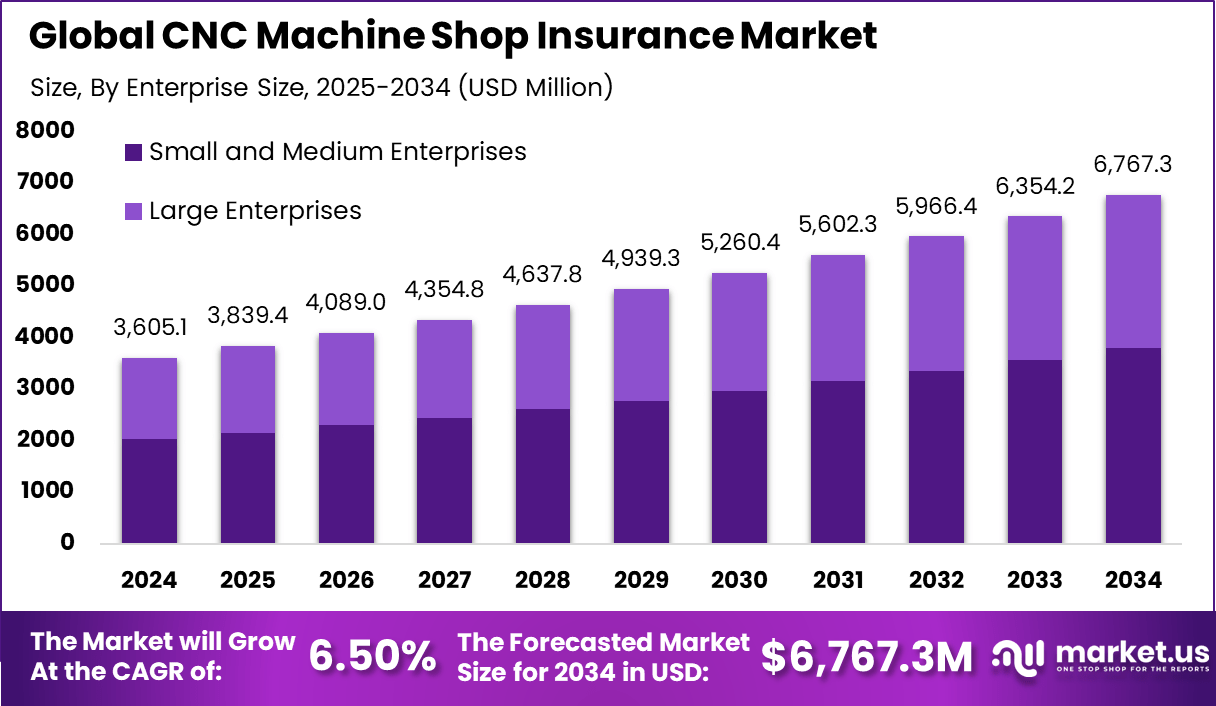
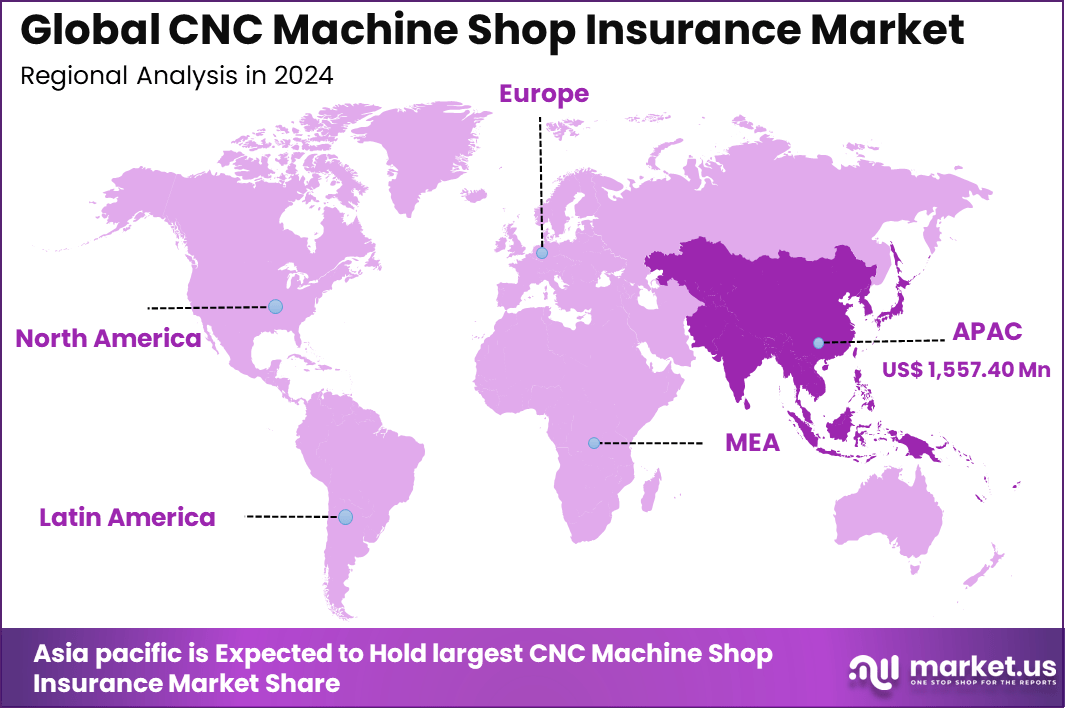
The Global CNC Machine Shop Insurance Market generated USD 3,605.1 million in 2024 and is predicted to register growth from USD 3,839.4 million in 2025 to about USD 6,767.3 million by 2034, recording a CAGR of 6.50% throughout the forecast span. In 2024, Asia Pacific held a dominan market position, capturing more than a 43.2% share, holding USD 1,557.40 Million revenue.
The CNC machine shop insurance market has expanded as manufacturing facilities increase investment in automated machining, precision engineering and digital production workflows. Growth reflects rising asset values inside machine shops, higher operational risks linked to automation and stronger demand for financial protection against business interruptions, equipment damage and liability exposure. Insurance coverage now plays a critical role in safeguarding both production output and capital investment.
The growth of the market can be attributed to increasing deployment of high value CNC machines, greater complexity in machining operations and rising safety and compliance expectations. Machine shops face exposure to equipment breakdown, fire hazards, operator injury and product liability risks. The push toward continuous production, tighter delivery schedules and just in time manufacturing further strengthens the need for strong insurance protection.
Top Market Takeaways
- By coverage type, property insurance holds 34.7% of the CNC machine shop insurance market, protecting costly equipment like lathes and mills from risks such as fire, theft, and breakdowns.
- By enterprise size, small and medium enterprises represent 56.3% of the market, requiring tailored insurance coverage to manage risks related to operator error, equipment failure, and liability in smaller-scale operations.
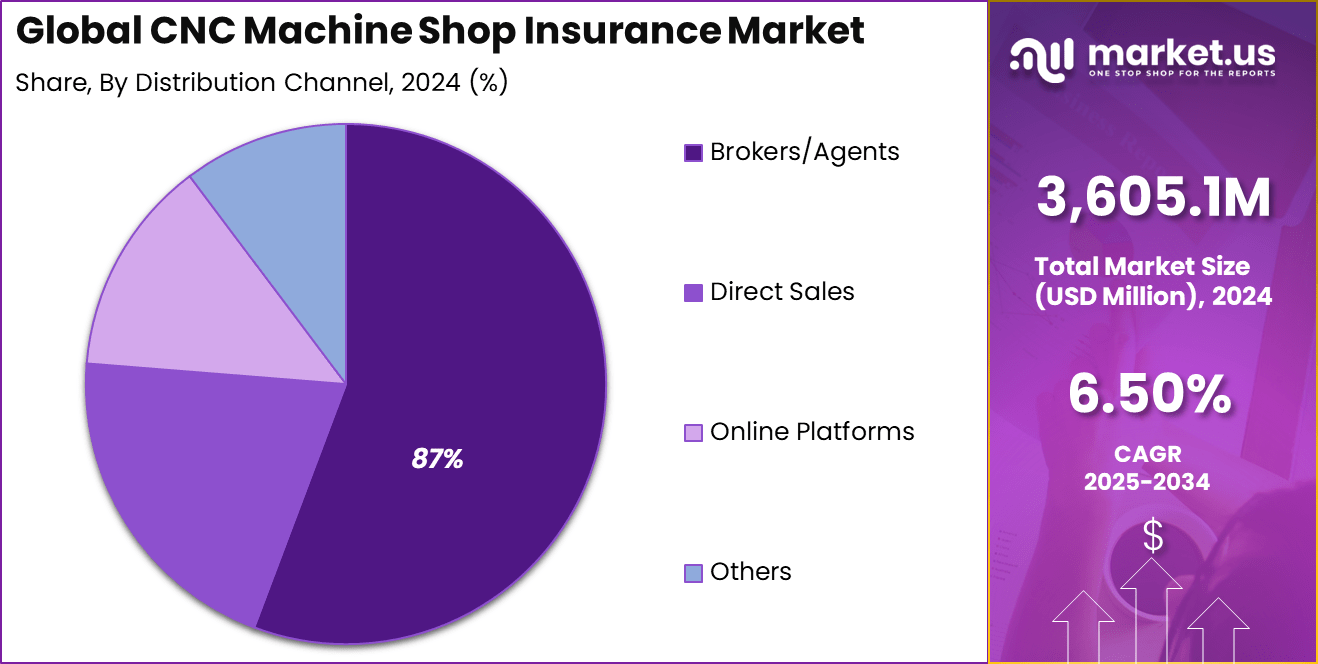
- By distribution channel, brokers and agents dominate with 86.9% share, as they provide personalized advice, help with complex policy selections, and support claims management for CNC machine shops.
- By end-user, industrial manufacturing accounts for 35.2% of the market, driven by sectors like automotive and aerospace, which demand reliable protection to avoid costly downtime and liability for defective parts.
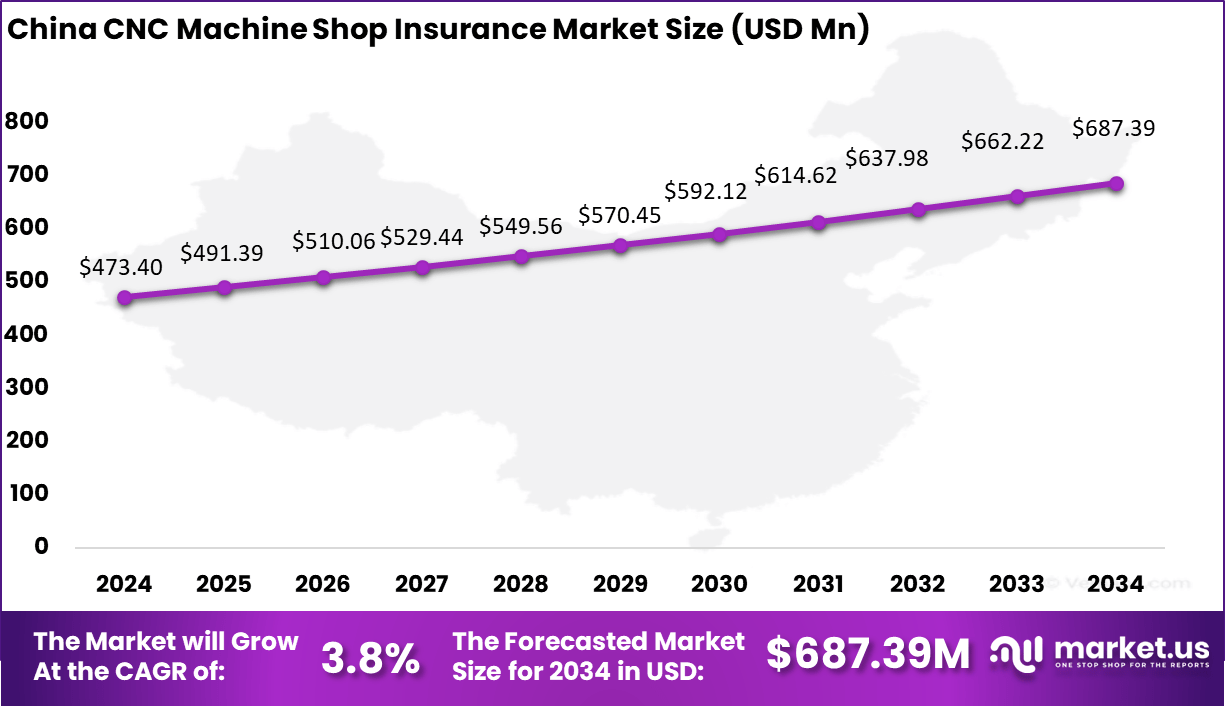
- By region, Asia Pacific leads with 43.2% of the market share, with China valued at approximately USD 473.4 million. The market in this region grows at a 3.8% CAGR, fueled by industrial expansion and the adoption of smart manufacturing technologies.
By Coverage Type
Property insurance holds a leading share of 34.7%, showing its importance in protecting physical assets within CNC machine shops. These shops depend on expensive machinery, tooling systems, and factory infrastructure, which face constant exposure to fire, electrical faults, and natural hazards.
The strong demand for property insurance is driven by the high replacement cost of CNC equipment and the financial risks linked to business interruption. Shop owners consider property coverage essential for maintaining stable operations and safeguarding long-term investments.
By Enterprise Size
Small and medium enterprises account for a dominant 56.3% share, reflecting the large number of smaller CNC machine shops operating across manufacturing supply chains. These businesses often serve automotive, aerospace, electronics, and general engineering sectors.
Insurance adoption among SMEs is increasing due to rising awareness of equipment risk, worker safety, and financial liability. Limited capital reserves make insurance coverage critical for protecting against sudden losses and production shutdowns.
By Distribution Channel
Brokers and agents dominate the market with a very high 86.9% share, confirming their central role in policy distribution. CNC shop owners rely heavily on insurance professionals to assess operational risks and match them with suitable coverage plans.
The complexity of industrial insurance products continues to support broker-led sales. Brokers help clients handle underwriting requirements, claim management, and regulatory documentation, which improves trust and long-term client relationships.
By End-User
Industrial manufacturing leads end-user demand with a 35.2% share, highlighting the heavy concentration of CNC machine shops within this segment. These facilities operate under continuous production cycles where machine downtime can result in large financial losses.
Insurance coverage supports operational continuity by protecting against equipment damage, fire loss, and liability risks. Manufacturing companies also depend on insurance to meet contractual safety and risk compliance requirements with global buyers.
Key Reasons for Adoption
- Shops run high-value CNC machines that cost hundreds of thousands to replace if they break down from power surges or mechanical faults. Equipment breakdown coverage steps in to handle those repair bills, which keeps operations going without draining cash reserves.
- Worker injuries happen often in machining environments, from cuts to crushed limbs during tool changes or startups. Workers’ compensation insurance covers medical costs and lost wages, meeting legal requirements that most states enforce strictly.
- Customers or visitors can slip on oil floors or get hit by flying chips, leading to lawsuits that wipe out small shops. General liability policies protect against these third-party claims, including legal fees and settlements.
- Fires from welding sparks or electrical shorts can destroy entire facilities overnight. Property insurance covers rebuilding and replacing inventory, which is critical as standard policies often fall short for heavy machinery.
- Downtime from any incident hits revenue hard since CNC jobs run on tight deadlines. Business interruption coverage pays for lost income during repairs, helping shops stay competitive in fast-paced manufacturing.
Key Benefits
- Covers sudden machine failures like motor burnout, cutting repair costs that average tens of thousands per event. Shops avoid dipping into profits for fixes on complex automated gear.
- Pays employee medical bills and rehab after accidents, reducing direct out-of-pocket expenses for owners. This also limits lawsuits from injured workers seeking extra compensation.
- Handles customer injury claims from shop visits or faulty parts, shielding business assets from judgments. Legal defense costs alone can exceed $50,000 in many cases.
- Replaces or repairs damaged lathes and mills from surges or defects, often excluded in basic property plans. This keeps production lines active without long delays.
- Compensates for income gaps during closures from covered events, up to 30 days in some policies. Shops can hire temp equipment or staff to minimize losses.
Usage
- A power spike fries a CNC mill’s controls during a night shift run. Breakdown insurance pays for parts and labor, getting the shop back online in days instead of weeks.
- Operator error bends a spindle on a turning center while loading stock. Policy covers the fix since it includes accidental damage, common in high-precision work.
- Employee loses fingers in a lathe jam and sues for negligence. Workers’ comp handles all claims, avoiding court battles and higher premiums from uncovered incidents.
- Fire from coolant rags spreads to storage racks with finished parts. Property and business interruption pay for cleanup, rebuild, and lost orders during downtime.
- Vendor sues over a defective machined component that fails in their assembly. Products liability within general coverage defends the shop and settles the dispute.
Emerging Trends
| Key Trends | Description |
|---|---|
| AI-driven risk prediction | Insurers use AI to analyze claims data and identify patterns for improved future claims forecasting in CNC operations. |
| Digital policy platforms | Online insurance platforms grow fast for SMEs with instant quotes and self-service claims handling. |
| Cyber coverage expansion | Insurance policies add protection for cyberattacks on digital CNC controls and data breaches. |
| Predictive maintenance integration | IoT sensors in machines connect with insurance systems for real-time monitoring and lower breakdown risks. |
| Parametric business interruption | New insurance policies pay out based on predefined triggers such as downtime hours instead of full loss proof. |
Growth Factors
| Key Factors | Description |
|---|---|
| Automation rise in manufacturing | Increasing CNC machine adoption raises equipment breakdown and cyber risks, driving insurance demand. |
| Strict safety regulations | Tighter rules on workplace and machine safety push manufacturers to buy comprehensive insurance coverage. |
| High equipment replacement costs | Heavy investment in advanced CNC tools increases demand for property and breakdown insurance. |
| Supply chain disruptions | Global supply challenges increase the need for business interruption and contingent coverage. |
| SME insurance awareness | Small manufacturers increasingly view insurance as essential for business continuity amid rising operational risks. |
Key Market Segments
By Coverage Type
- Property Insurance
- Liability Insurance
- Equipment Breakdown Insurance
- Business Interruption Insurance
- Workers’ Compensation
- Others
By Enterprise Size
- Small and Medium Enterprises (SMEs)
- Large Enterprises
By Distribution Channel
- Direct Sales
- Brokers/Agents
- Online Platforms
- Others
By End-User
- Automotive
- Aerospace
- Industrial Manufacturing
- Medical Devices
- Others
Regional Analysis
Asia Pacific holds 43.2% of the CNC machine shop insurance market. China leads this region with USD 473.4 million in value. The area grows at a 3.8% CAGR. Factories expand fast in autos and electronics, which drives demand for coverage on high-value CNC tools. Shops face risks from fires, breakdowns, and worker injuries that tie to dense production setups.
Large machine counts push insurance uptake as owners protect assets worth hundreds of thousands. Government plans like Made in China 2025 boost automation, which adds new gear needing policies for liability and downtime. Brokers sell most plans here, matching coverage to local rules on safety and claims. Steady growth comes from SME shops joining bigger networks with shared risks.
China accounts for USD 473.4 million in the CNC machine shop insurance market and 3.8% CAGR. The country runs thousands of shops tied to global supply chains in parts and gadgets. High equipment use means big needs for property and breakdown coverage against power faults or overloads.
Industrial booms raise claims from tight shifts and old sites, yet insurers add cyber add-ons for digital controls. Rules push firms to buy workers comp for common cuts and strains in machining. Demand holds firm as exports grow, with brokers handling 85% of sales through trusted ties. Low growth rate reflects mature setups but points to steady pull from new plants.
Key Regions and Countries
- North America
- US
- Canada
- Europe
- Germany
- France
- The UK
- Spain
- Italy
- Russia
- Netherlands
- Rest of Europe
- Asia Pacific
- China
- Japan
- South Korea
- India
- Australia
- Singapore
- Thailand
- Vietnam
- Rest of APAC
- Latin America
- Brazil
- Mexico
- Rest of Latin America
- Middle East & Africa
- South Africa
- Saudi Arabia
- UAE
- Rest of MEA
Driver Analysis
A major driver in the CNC machine shop insurance market is the high value of CNC machinery. These machines are costly, and any breakdown can lead to long repair times and loss of revenue. CNC equipment is sensitive to mechanical faults, programming errors, power issues, or improper handling.
Insurance that covers equipment breakdown helps shops protect their investment and avoid long periods of halted production. This need for financial protection supports market growth as more shops adopt advanced CNC systems. Another driver is rising concern about product liability. CNC shops often produce parts for industries where component failure can cause serious damage.
If a machined part used in automotive, aerospace, or medical equipment fails, the machine shop may be held responsible. Liability insurance helps shops manage this risk and maintain stable operations. As customers demand higher precision and reliability, shops are more likely to secure insurance to cover potential claims.
Restraint Analysis
A major restraint is the difficulty insurers face in predicting risk within CNC operations. Different shops produce different parts, use different materials, and serve different industries. These variations make it hard to estimate the likelihood of defects, accidents, or equipment issues. Insurers often respond with higher premiums or limited coverage. This uncertainty discourages some shops from purchasing insurance.
Another restraint is cost pressure on small and mid-sized machine shops. Full insurance packages that include property, machinery breakdown, liability, and business interruption can be expensive. Many smaller shops operate on narrow margins and may choose to take only limited coverage or none at all. This cost sensitivity slows broader adoption of specialized insurance.
Opportunity Analysis
There is a clear opportunity to offer insurance plans that match the size and risk profile of each CNC shop. Smaller shops may need basic protection, while larger facilities may require more complex coverage for high-precision work and expensive equipment. Flexible and scaled plans can help insurers reach more customers and reduce entry barriers for smaller businesses.
Another opportunity arises from the rapid adoption of automated CNC systems. As shops upgrade to faster and more precise machines, the financial impact of a breakdown becomes larger. Insurance products that cover both equipment failure and the resulting downtime become more attractive to high-value shops. Providers that offer support for advanced equipment can gain a stronger position in the market.
Challenge Analysis
A key challenge is the shortage of insurers who fully understand CNC machining. Not all insurers are familiar with issues such as complex tolerance requirements, specialized materials, operator error risks, or the downstream impact of part defects. This lack of technical knowledge limits the availability of comprehensive and well-priced policies for CNC operations.
Another challenge is setting accurate premiums for a wide variety of CNC shops. Some produce prototypes, while others manufacture regulated components with strict quality requirements. These differences make risk assessment difficult. If premiums are set too high, shops may avoid coverage, and if set too low, insurers may face higher claims. This imbalance creates barriers for both sides of the market.
Competitive Analysis
The Hartford, Chubb, Travelers Insurance, Nationwide, and Liberty Mutual lead the CNC machine shop insurance market with comprehensive coverage for equipment damage, business interruption, and product liability. Their policies address high-value machinery risks, operator safety, and production downtime. These insurers focus on tailored underwriting, fast claims handling, and strong risk engineering support. Rising automation and high-precision machining continue to reinforce their leadership among CNC shop operators.
Zurich Insurance Group, AXA XL, Allianz Global Corporate & Specialty, AIG, and CNA Financial Corporation strengthen the market with global industrial insurance programs and advanced loss-prevention services. Their offerings cover cyber risk, supply chain disruption, and international liability exposures. These providers support CNC shops serving aerospace, automotive, and defense supply chains.
Hiscox, Berkshire Hathaway GUARD Insurance Companies, Markel Corporation, Tokio Marine HCC, Sompo International, Munich Re, and others broaden the market with flexible policies for small and mid-sized CNC shops. Their coverage includes tool breakdown, recall protection, and environmental liability. These insurers focus on affordability, specialized endorsements, and strong reinsurance backing.
Top Key Players in the Market
- The Hartford
- Chubb
- Travelers Insurance
- Nationwide
- Liberty Mutual
- Zurich Insurance Group
- AXA XL
- Allianz Global Corporate & Specialty
- AIG (American International Group)
- CNA Financial Corporation
- Hiscox
- Berkshire Hathaway GUARD Insurance Companies
- Markel Corporation
- Tokio Marine HCC
- Sompo International
- Munich Re
- Others
Future Outlook
The CNC machine shop insurance market appears poised for ongoing evolution. As manufacturing embraces greater automation and digital integration, shops will encounter heightened vulnerabilities from equipment failures, cyber disruptions, and supply chain interruptions.
Insurers aim to deliver more customized protections, incorporating predictive tools and real-time monitoring to address these shifts, while stricter safety regulations push for broader coverage options. Small and medium operations, along with those in expanding sectors like aerospace and automotive, will benefit from simpler digital access to policies that support seamless growth.
Opportunities lie in
- Customized coverage for emerging cyber threats and interconnected machinery in automated shops.
- Bundled solutions combining equipment breakdown with business interruption for small manufacturers.
- Growth in emerging markets through digital platforms and IoT-based risk assessment tools.
Recent Developments
- October, 2025, The Hartford reported record third quarter net income with Business Insurance premiums growth. August 2025, company achieved strong second quarter P&C written premiums growth driven by business lines.
- November, 2025, Allianz reported strong nine-month operating profit across segments. May 2025, Allianz Global Insurance Report noted premium growth.









