


Report Overview
The Global Sustainable Marine Fuel Market size is expected to be worth around USD 836.0 Billion by 2034, from USD 13.1 Billion in 2024, growing at a CAGR of 51.5% during the forecast period from 2025 to 2034. In 2024, Europeheld a dominant market position, capturing more than a 51.0% share, holding USD 6.7 Billion revenue.
The global sustainable marine fuel (SMF) market is emerging as a crucial pillar in the decarbonisation of the maritime sector, which currently contributes about 2.5% of global greenhouse gas (GHG) emissions. Without action, this share could rise to 17% by 2050, as international trade and shipping volumes grow.
In response, the International Maritime Organization (IMO) has set ambitious targets to achieve net-zero GHG emissions from shipping by around 2050, with milestones of 20–30% reduction by 2030 and 70–80% by 2040, relative to 2008 levels. Achieving these goals will require a transition away from conventional fossil fuels toward scalable, low-carbon alternatives.
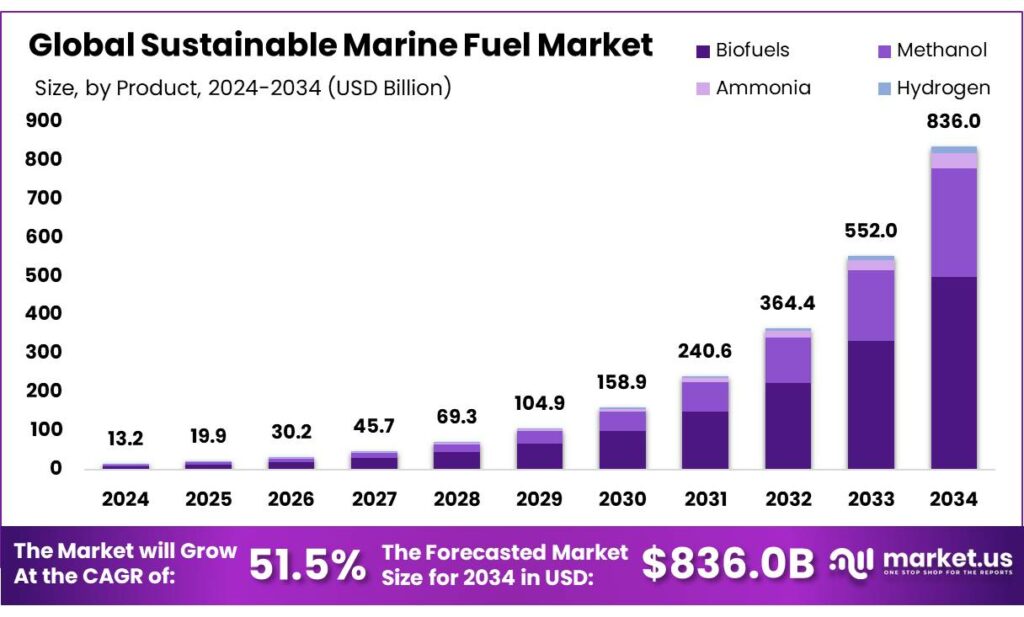
Sustainable marine fuels are central to this transformation. Produced from bio-based feedstocks, recycled carbon sources, or renewable energy pathways (Power-to-X, electrofuels, hydrogen), SMFs must deliver at least 50–60% lifecycle GHG reductions, be free from virgin fossil inputs, and carry independent sustainability certification. While liquid fuels will continue to dominate shipping, electrofuels are expected to lead adoption, complemented by advanced biofuels and methanol.
Government initiatives play a crucial role in accelerating the adoption of Sustainable marine fuel. For instance, the U.S. Department of Energy’s Bioenergy Technologies Office (BETO) is actively engaged in research to enhance the viability of marine biofuels. The U.S. maritime industry consumes an estimated 105 billion gallons of fuel annually, a figure projected to double by 2030 due to expanding global trade. BETO’s efforts aim to increase the production of marine biofuels to meet this rising demand, thereby supporting the industry’s decarbonization goals.
The EU has adopted Regulation (EU)2023/1805 (September 2023), mandating the incorporation of renewable and low-carbon fuels in maritime transport. Additionally, FuelEU Maritime, effective January 2025, will require a 2% reduction in GHG intensity, escalating to 80% by 2050. KPI OceanConnect plans to expand marine biofuel availability to 120 ports to meet demand driven by this policy.
Key Takeaways
- The global Sustainable Marine Fuel (SMF) market is projected to grow from USD 13.1 billion in 2024 to approximately USD 836.0 billion by 2034, reflecting a CAGR of 51.5% over the forecast period.
- Between types, biofuels accounted for the largest market share of 64.2%.
- Among application, tankers/carriers accounted for the majority of the market share at 44.6%.
- Europe was the leading regional market in 2024, holding a commanding 51.0% share of the global SMF market, with its value estimated at approximately USD 6.7 billion.
By Type Analysis
The Sustainable Marine Fuel Market Was Dominated By Biofuels
Based on type, the market is further divided into biofuels, methanol, ammonia & hydrogen. As of 2024, the biofuels dominated the sustainable marine fuel market with a 64.2% share. primarily due to their technological maturity, established supply chains, and compatibility with existing marine engines and infrastructure. Unlike emerging alternatives such as ammonia, hydrogen, or methanol, which often require significant retrofitting of vessels, new fueling systems, or large-scale infrastructure investments, biofuels can be blended with conventional marine fuels and used in current ship engines with minimal modifications.
Additionally, biofuels are already commercially available at scale, derived from diverse feedstocks such as waste oils, residues, and other biogenic sources, which supports both supply security and regional flexibility. Their relatively lower cost compared to other SMF options further strengthens their adoption, especially as operators balance decarbonisation with financial feasibility.
Furthermore, methanol is gaining traction as a marine fuel, but in 2024 its share remained smaller because of limited global supply capacity and the high cost of green methanol production from renewable sources. While methanol engines are being adopted in new builds, the retrofitting of older vessels is expensive. Infrastructure for bunkering methanol is also still developing, restricting widespread adoption.
Global Sustainable Marine Fuel Market, By Type, 2020-2024 (USD Mn)
| Region | 2020 | 2021 | 2022 | 2023 | 2024 |
|---|---|---|---|---|---|
| North America | 467.5 | 700.4 | 1,050.7 | 1,577.2 | 2,368.9 |
| Europe | 1,207.4 | 1,851.1 | 2,841.9 | 4,366.4 | 6,713.5 |
| Asia Pacific | 602.5 | 902.2 | 1,353.5 | 2,032.9 | 3,056.8 |
| Middle East & Africa | 62.5 | 89.9 | 129.4 | 186.5 | 269.0 |
| Latin America | 160.0 | 235.8 | 347.9 | 513.6 | 758.9 |
Key Regions and Countries Insights
- North America
- US
- Canada
- Europe
- Germany
- France
- The UK
- Spain
- Italy
- Rest of Europe
- Asia Pacific
- China
- Japan
- South Korea
- India
- Australia
- Rest of APAC
- Latin America
- Brazil
- Mexico
- Rest of Latin America
- Middle East & Africa
- GCC
- South Africa
- Rest of MEA
Key Players Analysis
product innovation and robust research & development are the key strategies of major players of sustainable marine fuel market.
To maintain a competitive edge in the sustainable marine fuel (SMF) market, major companies are prioritizing product innovation and robust research & development (R&D). By investing in advanced technologies, they are developing scalable, cost-efficient, and low-carbon fuel solutions such as bio-methanol, ammonia, hydrogen, and waste-based biofuels that meet stringent international regulations.
R&D efforts focus on improving fuel performance, reducing lifecycle emissions, and ensuring compatibility with existing ship engines and bunkering infrastructure. Innovation also extends to partnerships with ports, energy providers, and technology firms, enabling companies to accelerate commercialization, differentiate their offerings, and position themselves as leaders in the global energy transition.
Top Key Players Outlook
- Maersk
- Exxon Mobil Corporation
- Chevron Corporation
- British Petroleum (BP)
- Shell Plc
- TotalEnergies
- FincoEnergies
- Liquid Wind AB
- Methanex Corporation
- Neste Corp.
- Oyj Targray
- Other Key Players
Recent Industry Developments
November, 2024 : Hapag-Lloyd’s vessel Colorado Express has successfully bunkered a B25 bio marine fuel blend supplied by ExxonMobil, which combines Premium HDME 50™ fuel (a 0.10% sulphur Emission Control Area fuel) with 25% waste-based fatty acid methyl esters (FAME) derived from used cooking oil methyl ester (UCOME). This represents a significant advance in the use of sustainable marine fuels.
July 2023: Chevron has achieved a key milestone in sustainable marine fuel, completing 50+ biofuel deliveries at the Port of Singapore since 2022. Following its acquisition of Renewable Energy Group, the company is expanding in marine biofuels, collaborating with global shipowners, and patenting biofuel blending. Derived mainly from waste-based sources, Chevron’s biofuels cut lifecycle emissions and work without engine modifications, offering a practical near-term solution for decarbonizing shipping.
February 2023: Shell and Hapag-Lloyd have entered a multi-year deal to supply LNG for Hapag-Lloyd’s new dual-fuel container ships, with bunkering starting in Rotterdam in late 2023. The partnership also explores alternative fuels like liquefied biomethane and e-methane. LNG use is expected to cut CO₂ emissions by up to 23% and lower particulate matter, highlighting both companies’ commitment to sustainable marine fuels and driving shipping’s transition to a low-carbon future.

- 蓝茶市场(2026—2031)
0评论2026-09-15

- 泡沫材料市场(2026—2031)
0评论2026-09-15

- 重铬酸钠市场(2026—2031)
0评论2026-09-15

- 家族性淀粉样多发性神经病(FAP)市场(2026—2031)
0评论2026-09-15

- 次氯酸钙市场(2026—2031)
0评论2026-09-15

- 海上储能市场(2026—2031)
0评论2026-09-12

- 混凝土市场(2026—2031)
0评论2026-09-12

- 矫形器械市场(2026—2031)
0评论2026-09-12

- 木质素基树脂市场(2026—2031)
0评论2026-09-12

- 聚碳酸酯二元醇市场(2026—2031)
0评论2026-09-12