


Report Overview
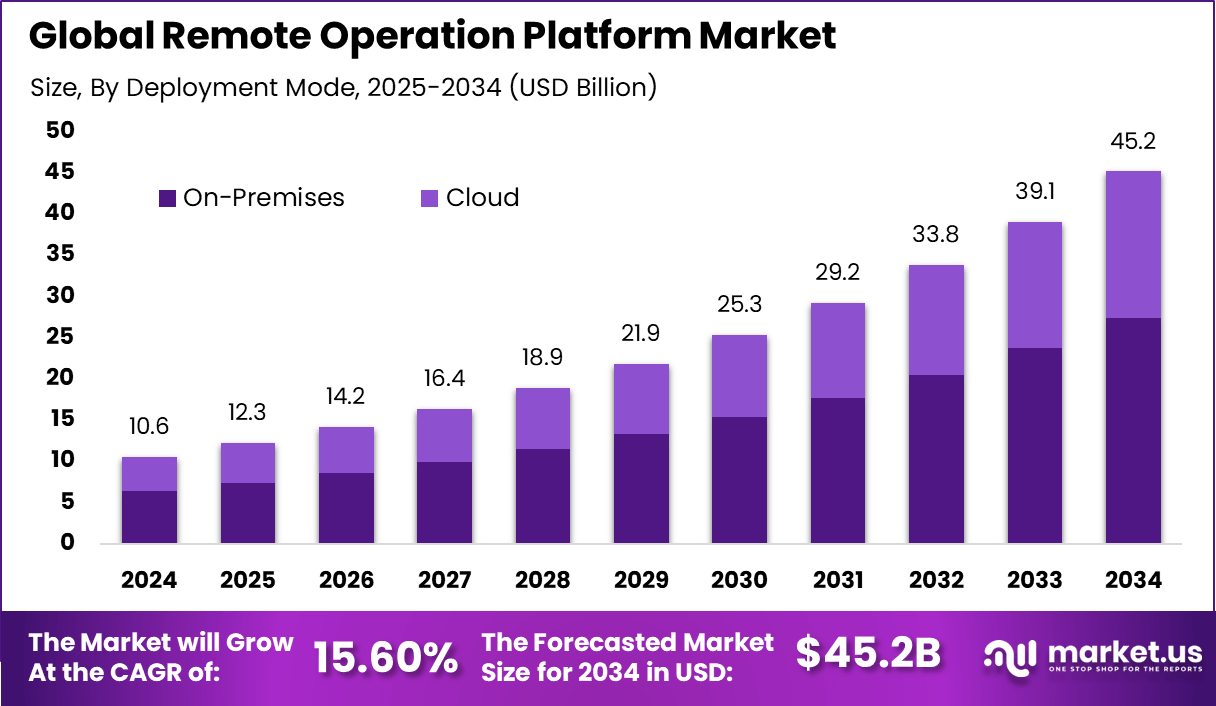
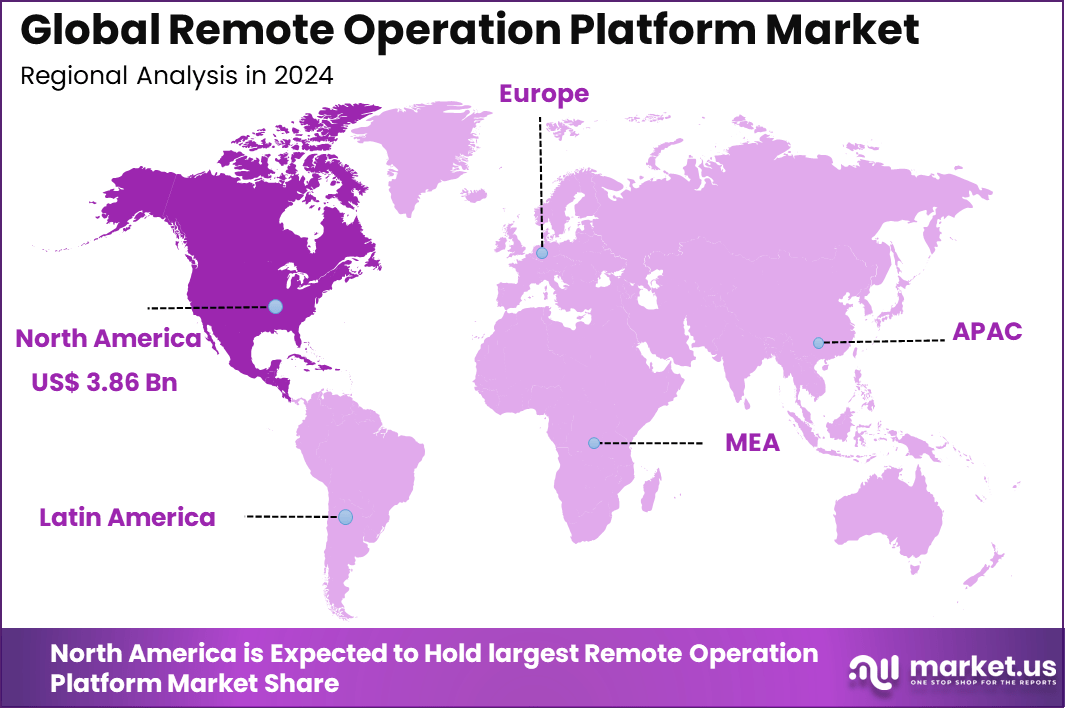
The Global Remote Operation Platform Market generated USD 10.6 billion in 2024 and is predicted to register growth from USD 12.3 billion in 2025 to about USD 45.2 billion by 2034, recording a CAGR of 15.60% throughout the forecast span. In 2024, North America held a dominan market position, capturing more than a 36.5% share, holding USD 3.86 Billion revenue.
The remote operation platform market focuses on software and system frameworks that allow machines, equipment, and processes to be monitored and controlled from a distant location. These platforms are widely used across industries such as energy, manufacturing, mining, logistics, healthcare, and infrastructure management.
The segment supports real time visibility, remote diagnostics, and centralized decision making, which helps organizations manage operations across multiple sites with limited on ground staff. Growing digital connectivity and the use of cloud based control systems have positioned remote operation platforms as a core component of modern industrial operations.
The growth of this market is mainly driven by the need to reduce operational risks and improve workforce safety, especially in hazardous or hard to reach environments. Rising labor costs and skilled worker shortages are also encouraging companies to adopt remote operation systems to maintain productivity with smaller teams.
Improvements in industrial connectivity, sensor integration, and secure communication networks have further strengthened platform reliability. In addition, the increasing focus on business continuity and uninterrupted operations has supported wider adoption across critical infrastructure and industrial facilities.
Demand for remote operation platforms is rising steadily as enterprises aim to increase efficiency while lowering operational downtime. Industries with geographically dispersed assets are showing strong interest due to the benefits of centralized monitoring and faster response times.
The adoption is also supported by the need for data driven decision making, where real time operational insights help optimize performance and reduce maintenance costs. As digital transformation continues across industrial sectors, demand is expected to remain consistent, supported by long term investments in automation and remote management capabilities.
Top Market Takeaways
- By component, hardware accounted for 53.2% of the remote operation platform market, reflecting the need for robust edge devices, sensors, and gateways to enable secure remote control and monitoring.
- By deployment mode, on-premises solutions held 60.7%, driven by enterprises that prioritize full control over operational data, latency-sensitive processes, and stringent security policies.
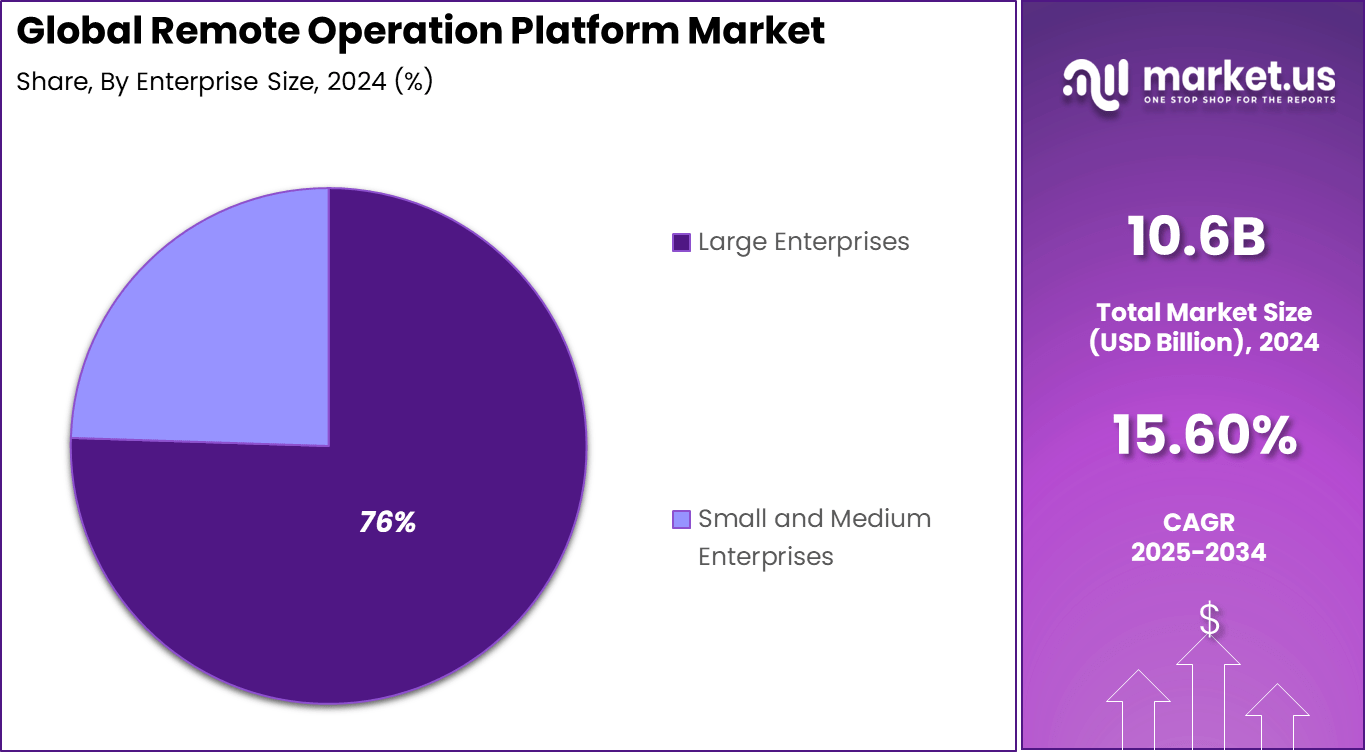
- By enterprise size, large enterprises captured 75.5% of the market, supported by extensive investments in industrial IoT, centralized control rooms, and remote operations centers.
- By application, industrial automation represented 35.6%, as manufacturers and utilities adopt remote platforms to optimize asset performance, minimize downtime, and improve worker safety.
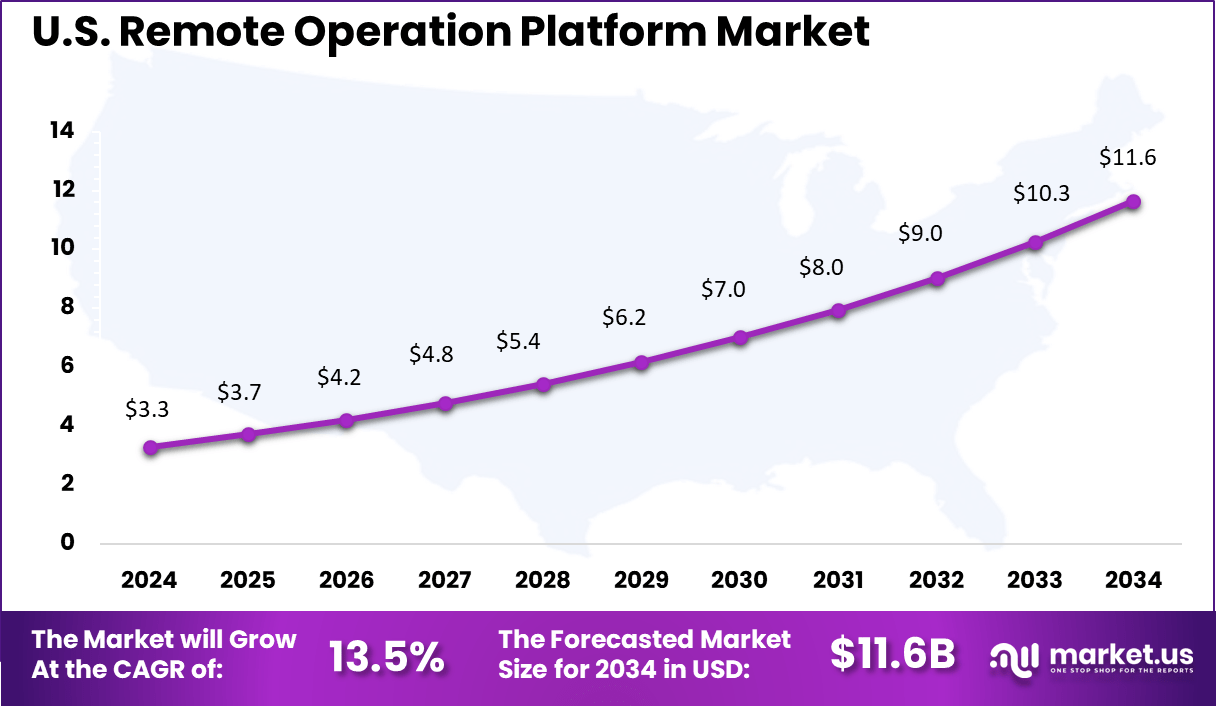
- North America accounted for 36.5% of the global market, with the U.S. valued at USD 3.28 billion in 2025 and projected to grow at a CAGR of 13.5%, underpinned by advanced automation infrastructure and high adoption of remote monitoring and control systems.
Key Statistics
Market and Adoption Trends
- About 94% of companies have upgraded cloud infrastructure to support long-term remote and hybrid work.
- Security investment is rising, with 79% of organizations adopting zero-trust frameworks and 68% offering VPN access.
- Average technology spending per remote worker increased to USD 1,800 per year, up from USD 950 in 2020, showing sustained IT investment.
Employee Preferences and Productivity
- Nearly 46% of remote-capable employees would consider leaving if required to return fully to the office.
- Around 83% of remote workers report higher productivity, while cloud collaboration tools can boost output by 35%.
- Fully remote workers show 31% engagement, higher than hybrid (23%) and in-office (19%) employees.
- Employees view 40% remote time as the ideal work balance, aligning flexibility with collaboration needs.
Key Benefits and Challenges
- Companies save about USD 11,000 per employee per year through reduced office and operational costs.
- Employees gain over 72 minutes per day by avoiding daily commutes, improving work-life balance.
- Key challenges remain, including maintaining company culture (30% of leaders), communication gaps (29% of employees), and employee isolation (22%).
Component Analysis
The hardware segment leads with 53.2%, showing that physical security components play a major role in mobile phishing protection. Hardware-based solutions include secure gateways, dedicated security appliances, and device-level protection tools that help filter malicious traffic before it reaches mobile endpoints.
Demand for hardware is driven by organizations that require strong perimeter-level defense and controlled security environments. Hardware solutions provide consistent performance, lower dependency on software updates, and improved resistance against advanced phishing attacks targeting mobile-connected systems.
Deployment Mode Analysis
On-premises deployment accounts for 60.7%, reflecting strong preference for localized control over mobile security infrastructure. Organizations handling sensitive operational data rely on internal systems to monitor threats and enforce security policies without external exposure.
This deployment mode is widely adopted in environments with strict data protection rules and internal compliance standards. On-premises solutions also allow better integration with existing security operations centers and enterprise monitoring tools.
Enterprise Size Analysis
Large enterprises represent 75.5%, highlighting their higher exposure to mobile phishing threats. These organizations manage large mobile workforces, connected devices, and complex digital ecosystems that increase attack surfaces.
Adoption among large enterprises is supported by stronger cybersecurity budgets and structured risk management strategies. Mobile phishing protection is treated as a core security layer to safeguard intellectual property, operational continuity, and employee access credentials.
Application Analysis
Industrial automation holds 35.6%, making it the leading application area. Mobile devices are increasingly used to monitor and control industrial systems, which makes them attractive targets for phishing-based attacks.
Organizations deploy phishing protection to secure operator access, prevent unauthorized system control, and protect connected industrial assets. Strong mobile security is essential to avoid production disruption and safety risks in automated environments.
Key reasons for adoption
- Risk to people can be reduced by shifting hazardous tasks away from on-site teams.
- Round the clock control can be enabled for assets that cannot stop, such as utilities, logistics, and security operations.
- Faster decisions can be supported by combining live video, sensor feeds, and system alerts in one view.
- Skill gaps can be managed by allowing experts to support multiple sites from a central location.
- Compliance and audit needs can be met through standardized workflows, access controls, and activity logs.
Benefits for users
- Worker safety can be improved by lowering exposure to dangerous environments and events.
- Downtime can be reduced through early issue detection, guided response, and remote troubleshooting.
- Operating costs can be controlled by reducing travel, optimizing staffing, and lowering repeat site visits.
- Service quality can be improved by using consistent procedures and better collaboration across teams.
- Asset performance can be improved through continuous monitoring and data-backed tuning.
Usage
- Remote monitoring and control of industrial equipment, energy assets, and critical infrastructure.
- Remote support for field technicians using live guidance, checklists, and digital work orders.
- Security operations using centralized video monitoring, incident response, and access management.
- Logistics and fleet operations using route oversight, exception handling, and operational coordination.
- Emergency response coordination using shared situational awareness and controlled task execution across sites.
Emerging Trends
| Key Trend | Description |
|---|---|
| AI Helps Machines | AI enables remote machines to make smarter decisions and operate more efficiently without full human input. |
| 5G Fast Connections | 5G supports instant control of mining equipment from long distances, enabling smooth and reliable operations. |
| Remote Centers Grow | Centralized operation centers manage multiple mining sites at once through real-time data and automation tools. |
| VR for Training | VR platforms allow workers to learn and practice operations remotely, improving safety and reducing onsite risks. |
| Robots Work Alone | Autonomous robots perform dangerous tasks in remote mines, reducing the need for human presence in hazardous areas. |
Growth Factors
| Key Factors | Description |
|---|---|
| Keep Workers Safe | Remote operation reduces injuries by keeping workers away from hazardous underground or high-risk environments. |
| Work 24 Hours | Machines operated remotely can run continuously without fatigue, increasing productivity and uptime. |
| Save Money on Labor | Fewer onsite personnel are required, lowering costs for staffing, training and worker transport to remote regions. |
| Fast Tech Changes | Advances in AI, 5G and automation are making remote mining systems more efficient and easier to deploy. |
| Big Need in Mining | Mining companies adopt remote operation to reach deeper deposits, improve accuracy and increase long-term output. |
Key Market Segments
By Component
- Software
- Hardware
- Services
By Deployment Mode
- On-Premises
- Cloud
By Enterprise Size
- Small and Medium Enterprises
- Large Enterprises
By Application
- Industrial Automation
- Oil & Gas
- Mining
- Utilities
- Transportation
- Healthcare
- Others
Regional Analysis
North America holds 36.5%, supported by high enterprise mobility adoption and strong focus on cybersecurity resilience. Organizations across the region actively invest in protecting mobile endpoints used in business operations and industrial systems.
The U.S. market hits USD 3.28 billion and grows at 13.5% CAGR. Big players in tech and auto lead with platforms for self-driving tests and factory automation. Defense projects need secure remote ops for drones and robots, driving fast adoption.
High demand comes from ports, farms, and construction sites wanting less downtime. Government funds for smart cities and trade hubs support local makers. This makes the U.S. the main force behind North America’s strong position.
Key Regions and Countries
- North America
- US
- Canada
- Europe
- Germany
- France
- The UK
- Spain
- Italy
- Russia
- Netherlands
- Rest of Europe
- Asia Pacific
- China
- Japan
- South Korea
- India
- Australia
- Singapore
- Thailand
- Vietnam
- Rest of APAC
- Latin America
- Brazil
- Mexico
- Rest of Latin America
- Middle East & Africa
- South Africa
- Saudi Arabia
- UAE
- Rest of MEA
Opportunities & Threats
Remote Operation Platform Market offers solid growth paths as industries push for better remote control. AI tools help operators spot issues early and adjust machines from afar, cutting repair times in factories and energy sites. Healthcare and power firms need these platforms to watch equipment without sending teams onsite, opening doors for vendors to sell easy setups.
Cloud systems and digital twins let users test changes before they go live, which fits well in fast-growing areas like Asia-Pacific. Local plants there want low-cost options to link old gear with new networks, helping sellers build custom plans that scale quick. This demand keeps the market moving ahead strong.
Threats come from weak spots in security that hackers target hard. Ransomware often hits remote links like old VPNs, locking out controls in key plants and power grids. Fixes take time and money, plus firms lose trust if outages drag on.
Skill gaps and high install costs slow things down too, as teams struggle to blend platforms with old systems. Tight data rules mean more spending on safe nets and staff training. Without fixes, users pull back and pick rivals with better shields.
Key Challenges
- High setup costs slow adoption, as companies need expensive hardware, software licenses, and skilled teams to integrate these systems into old infrastructure.
- Cybersecurity risks stand out, with remote access opening doors to hacks and data breaches that demand extra protection layers.
- Poor connectivity in remote sites hampers real-time control, especially where satellite bandwidth falls short for heavy data flows.
- Integrating with legacy systems proves tough, often requiring custom work and raising labor expenses.
- Staff training lags behind, as workers need time to learn new tools and workflows for safe remote operations.
Competitive Analysis
ABB, Siemens, Schneider Electric, Honeywell, Rockwell Automation, and Emerson Electric lead the remote operation platform market with industrial-grade systems that enable centralized monitoring, control, and optimization of distributed assets. Their platforms support real-time visibility, predictive analytics, and secure remote access across manufacturing, energy, and utilities. These companies focus on reliability, cyber resilience, and integration with existing control systems.
Yokogawa Electric, General Electric, Mitsubishi Electric, Cisco Systems, AVEVA Group, Hitachi, FANUC, Bosch Rexroth, and Omron strengthen the market with advanced industrial IoT, robotics integration, and remote visualization tools. Their solutions help operators manage complex processes, improve uptime, and enhance worker safety. These providers emphasize data-driven decision-making, automation, and seamless connectivity.
Aspen Technology, Toshiba, IBM, Oracle, SAP, and other participants broaden the landscape with software-centric remote operation platforms focused on analytics, digital twins, and enterprise integration. Their offerings support optimization, asset performance management, and cross-site coordination. These companies prioritize scalability, cloud compatibility, and actionable insights.
Top Key Players in the Market
- ABB
- Siemens
- Schneider Electric
- Honeywell International
- Rockwell Automation
- Emerson Electric
- Yokogawa Electric Corporation
- General Electric
- Mitsubishi Electric
- Cisco Systems
- AVEVA Group
- Hitachi
- FANUC Corporation
- Bosch Rexroth
- Omron Corporation
- Aspen Technology
- Toshiba Corporation
- IBM Corporation
- Oracle Corporation
- SAP SE
- Others
Future Outlook
The Remote Operation Platform market looks set for steady growth as industries shift toward safer, more efficient ways to control machines and processes from afar. These platforms will gain traction in mining, construction, agriculture, and manufacturing, where operators can run heavy equipment or drones without being on-site, cutting risks from hazards like dust or heights.
Advances in 5G networks, AI monitoring, and low-latency video feeds will make remote setups smoother, helping companies handle complex tasks with fewer people on the ground. Cloud integration and modular designs will let smaller firms adopt these systems without big upfront costs, while partnerships between tech providers and equipment makers push standards for secure, real-time control across global sites.
Recent Developments
- In August 2025, ABB signed a multi‑year global partnership with Dispel to embed its OT‑focused secure remote access and data‑streaming technology into ABB’s Secure Remote Platform, strengthening ABB Care services with zero‑trust, moving‑target‑defense connectivity for automation software, sensors and marine instrumentation.
- In July 2025, Siemens detailed this modular service stack, which includes vulnerability management, anomaly detection, backup and restore, and secure VPN‑based remote support, targeting industrial automation data centers and critical plants.









