


Report Overview
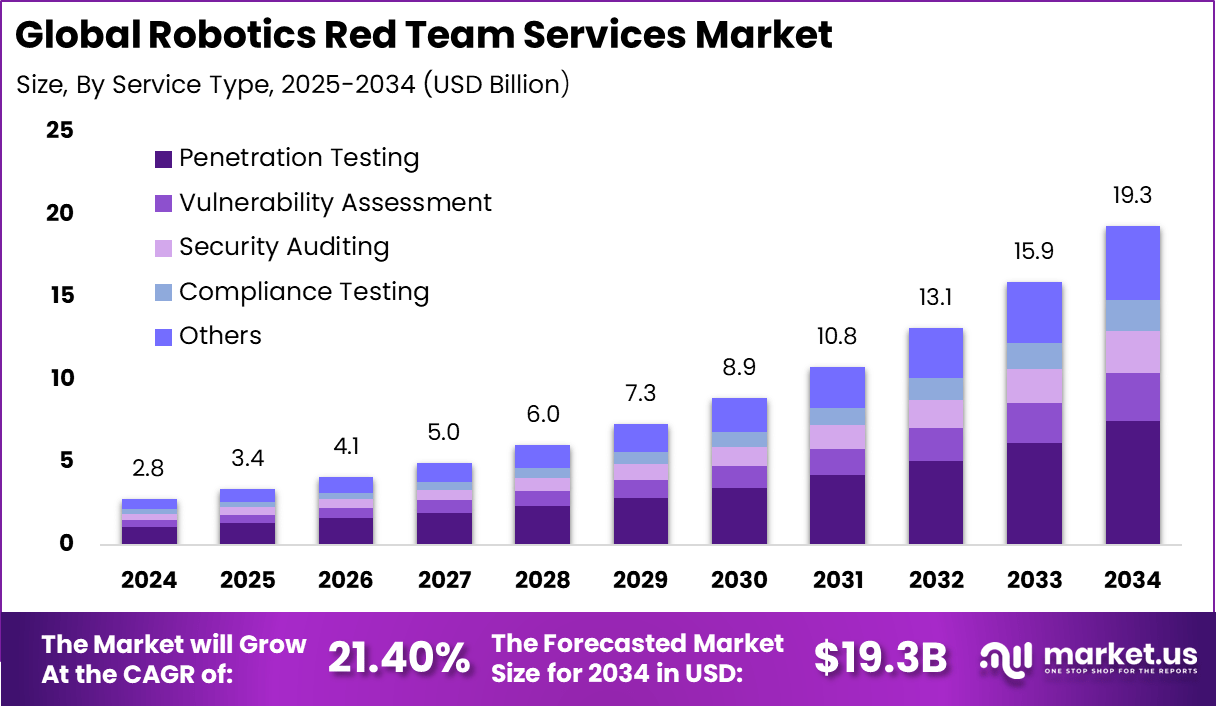
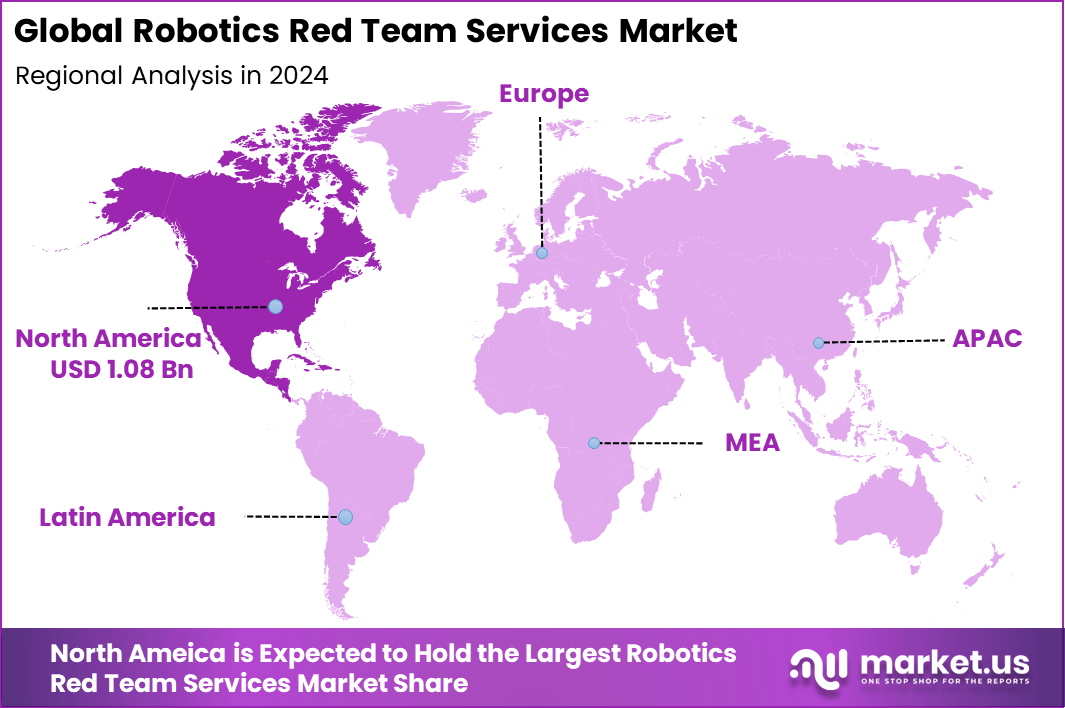
The Global Robotics Red Team Services Market generated USD 2.8 billion in 2024 and is predicted to register growth from USD 3.4 billion in 2025 to about USD 19.3 billion by 2034, recording a CAGR of 21.40% throughout the forecast span. In 2024, North America held a dominan market position, capturing more than a 38.9% share, holding USD 1.08 Billion revenue.
The robotics red team services market focuses on specialized security testing services designed to identify vulnerabilities in robotic systems before they can be exploited. These services simulate real world cyber and physical attacks on robots, autonomous systems, and connected industrial machines. The objective is to assess weaknesses across software, hardware, networks, sensors, and control systems.
This market plays a crucial role in protecting robotic systems from cyber threats and operational failures. Robotics red teams help organizations understand how attackers could manipulate robots, disrupt operations, or cause physical harm. These services support risk mitigation by uncovering flaws that traditional IT security testing often overlooks. In safety critical environments, red teaming helps prevent downtime, financial loss, and safety incidents.
Growth is driven by the rapid adoption of connected and autonomous robots across industries. Increased use of cloud connectivity, remote operation, and AI driven decision making has expanded the attack surface. Regulatory pressure around safety, data protection, and critical infrastructure security has also increased demand. High profile cyber incidents affecting industrial systems have raised awareness among operators.
Industry security reports show that industrial cyber attacks have increased by more than 30% in recent years, accelerating interest in proactive security testing. Demand for robotics red team services is rising steadily among manufacturers, logistics providers, healthcare institutions, and government agencies.
Organizations deploying autonomous mobile robots and collaborative robots are prioritizing security validation before large scale rollout. Demand is particularly strong in environments where robots interact closely with humans. Surveys of industrial security leaders show that nearly 60% plan to increase spending on operational technology and robotics security assessments.
Top Market Takeaways
- By service type, penetration testing accounted for 38.9% of the robotics red team services market, essential for identifying vulnerabilities in robotic systems, control networks, and AI decision-making algorithms before deployment.
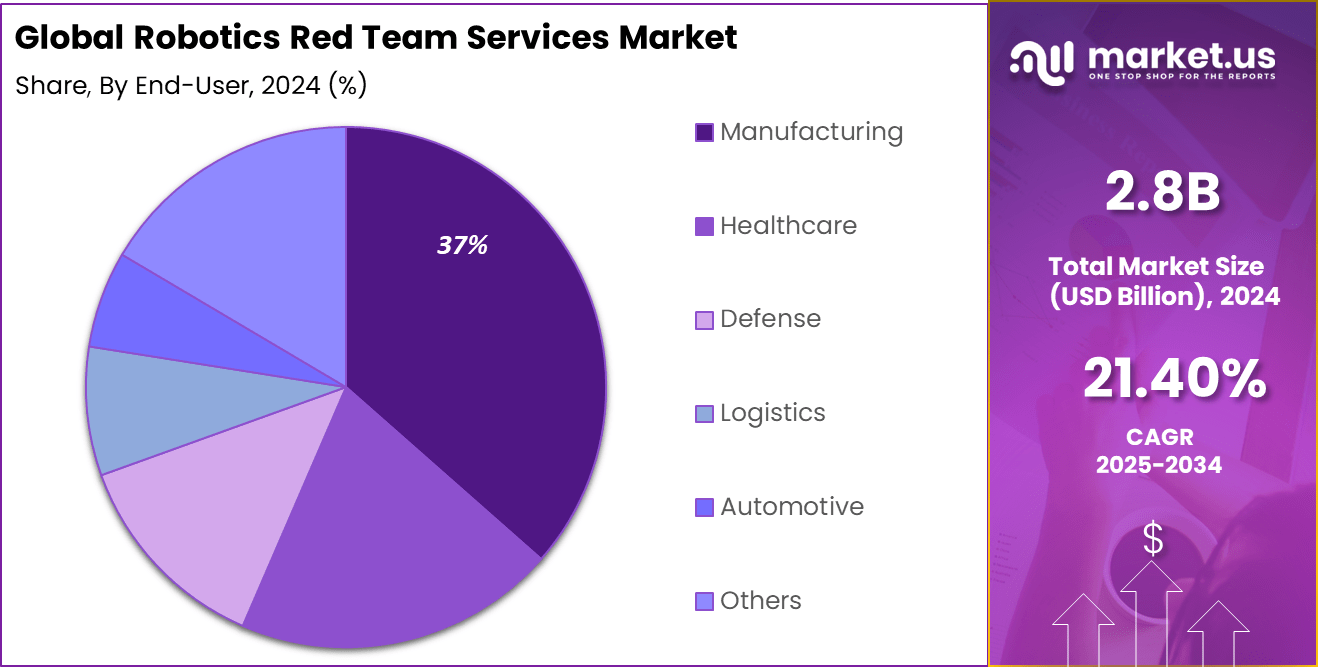
- By end-user, manufacturing held 36.5% share, driven by the need to secure industrial robots against cyber-physical threats that could disrupt production lines and compromise safety protocols.
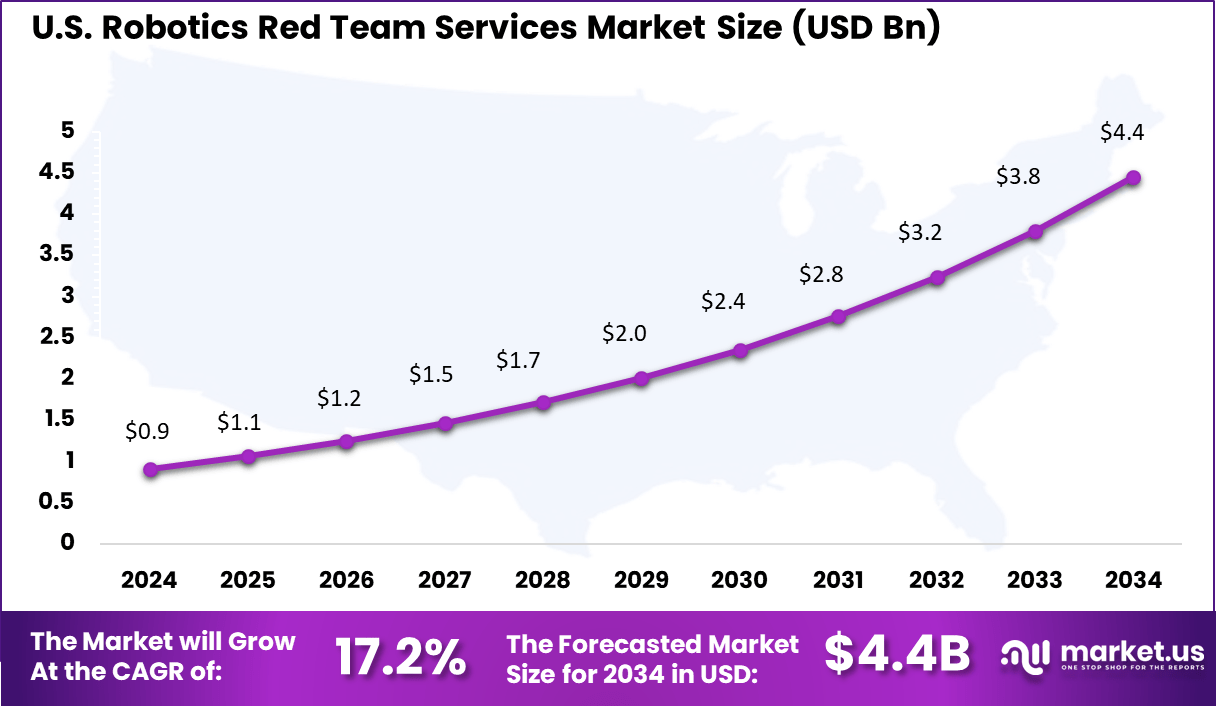
- North America captured 38.9% of the global market, with the U.S. valued at USD 0.91 billion in 2025 and projected to grow at a CAGR of 17.2% amid rising adoption of collaborative robots and smart factories.
Service Type Analysis
Penetration testing held a 38.9% share in the Robotics Red Team Services Market, making it the leading service type. This dominance is mainly driven by the growing use of connected and autonomous robots across industrial and commercial environments. Penetration testing is used to identify security gaps in robotic software, control systems, sensors, and communication networks before real attacks occur.
As robots increasingly rely on cloud platforms, APIs, and wireless connectivity, the need to test system resilience under simulated attacks has become critical. Demand for penetration testing services is also supported by rising safety and compliance requirements.
Enterprises are prioritizing proactive security assessments to avoid operational shutdowns, safety incidents, and data breaches linked to robotic systems. Penetration testing is preferred because it provides clear risk visibility and practical remediation guidance. This makes it a core service for organizations deploying robots in high risk and mission critical environments.
End User Analysis
The manufacturing sector accounted for a 36.5% share of the Robotics Red Team Services Market, reflecting its high exposure to robotic security risks. Manufacturing facilities rely heavily on industrial robots for assembly, material handling, welding, and quality inspection.
Any cyber intrusion into these systems can disrupt production lines, damage equipment, or compromise worker safety. As a result, manufacturers are investing more in red team services to test the security of robotic controllers and operational technology networks. Growth in this segment is further supported by the adoption of smart factories and Industry 4.0 practices.
Manufacturing robots are now connected to enterprise systems and external networks, which increases the attack surface. Red team services help manufacturers evaluate real world attack scenarios and strengthen defenses without interrupting daily operations. This security focused approach is becoming a standard part of risk management strategies in modern manufacturing environments.
Key reasons for adoption
- Faster expansion of robots in factories and warehouses is increasing the need to test safety, cyber risk, and failure behavior before deployment.
- More connected robotics systems are creating a wider attack surface, so independent offensive testing is being used to find weak points in networks, sensors, and control logic.
- Higher safety expectations from customers and regulators are pushing companies to validate that robots remain safe even during abnormal inputs and hostile conditions.
- Rising supply chain risk is driving checks on firmware, software libraries, and third party integrations that can introduce hidden vulnerabilities.
- Insurance, audit, and customer due diligence requirements are making documented red team testing a practical way to prove risk controls and operational readiness.
Benefits of Users
- Vulnerabilities are identified earlier, so expensive downtime and recall risk can be reduced after robots go live.
- Safety and security teams receive realistic evidence of how systems fail, so corrective actions can be prioritized with clear business impact.
- Incident response becomes stronger because teams rehearse real scenarios and improve detection, containment, and recovery steps.
- Product quality improves as weak designs in authentication, access control, and update processes are corrected before scaling deployments.
- Trust with enterprise buyers increases because testing results and remediation records support procurement, audits, and vendor assessments.
Usage
- Threat modeling and attack path mapping are performed across robot hardware, firmware, middleware, and cloud or edge management layers.
- Penetration testing is conducted on wireless links, remote access tools, APIs, and operator consoles to validate access control and segmentation.
- Safety misuse testing is executed to check how robots react to sensor spoofing, command injection, abnormal payloads, and environmental interference.
- Adversarial testing is applied to vision and autonomy modules to measure robustness against spoofed markers, altered lighting, and deceptive objects.
- Remediation validation is carried out after fixes, confirming patch effectiveness and ensuring operational performance is not degraded.
Emerging Trends
| Key Trend | Description |
|---|---|
| AI Attack Tests | AI tools are used to simulate robot attacks and identify system weaknesses at an early stage. |
| Physical Robot Hacks | Robots are tested against real world threats such as signal jamming or physical tampering. |
| Cyber Physical Mix | Both software and hardware risks are assessed together to reflect real operating conditions. |
| Auto Safety Scans | Automated tools run continuous tests to detect unsafe robot movements and behaviors. |
| Cloud Robot Checks | Remote robots and connected IoT systems are tested for cloud based security gaps. |
Growth Factors
| Key Factors | Description |
|---|---|
| Robots in Factories Grow | Higher robot adoption increases the need for regular safety and security testing. |
| Cyber Risks Rise | Robots are becoming new attack targets, driving demand for red team services. |
| New Rules Demand Tests | Regulatory frameworks are pushing mandatory safety checks for AI driven robots. |
| Factories Go Smart | Industry four point zero environments require secure and tested robot networks. |
| Cheap Test Services | Red team as a service models lower costs compared to maintaining full in house teams. |
Key Market Segments
By Service Type
- Penetration Testing
- Vulnerability Assessment
- Security Auditing
- Compliance Testing
- Others
By End-User
- Manufacturing
- Healthcare
- Defense
- Logistics
- Automotive
- Others
Regional Analysis
North America accounted for 38.9% of the Robotics Red Team Services Market, supported by strong adoption of industrial robots, autonomous systems, and AI-driven operations. The region has a high concentration of advanced manufacturing, defense programs, and critical infrastructure operators, which increases exposure to cyber and physical security risks in robotic systems.
The U.S. market reached USD 0.91 Bn and is expanding at a 17.2% CAGR, driven by rapid automation across manufacturing, defense, and warehouse operations. The country has one of the highest robot densities globally, which increases the need for advanced security testing to protect robots from cyber intrusions, manipulation, and operational failures. Robotics red team services are widely used to evaluate real-world attack scenarios and improve system reliability.
Key Regions and Countries
- North America
- US
- Canada
- Europe
- Germany
- France
- The UK
- Spain
- Italy
- Russia
- Netherlands
- Rest of Europe
- Asia Pacific
- China
- Japan
- South Korea
- India
- Australia
- Singapore
- Thailand
- Vietnam
- Rest of APAC
- Latin America
- Brazil
- Mexico
- Rest of Latin America
- Middle East & Africa
- South Africa
- Saudi Arabia
- UAE
- Rest of MEA
Opportunities & Threats
The growth of connected robots in factories, warehouses, healthcare, and defense is creating strong opportunities for robotics red team services. As robots become more software driven and cloud connected, the risk of cyber and physical attacks is increasing. Organizations are becoming more aware that traditional IT security testing is not enough for robotic systems.
This awareness is encouraging companies to adopt specialized red team services that can test both digital and operational weaknesses. The rising focus on safety standards and compliance is also supporting demand, as companies are expected to prove that their robotic systems are secure before large scale deployment.
One of the key threats to the robotics red team services market is limited awareness among small and mid sized companies. Many organizations still underestimate the security risks related to robots and prefer to invest only in basic cyber security tools.
This can slow adoption, especially in cost sensitive industries. High service costs and the need for highly skilled professionals also create challenges, as not all companies are ready to allocate dedicated budgets for advanced security testing.
Key Challenges
- Limited awareness among robotics operators about the need for offensive security testing. Many companies still treat robotics security as an IT issue rather than an operational risk.
- High complexity of robotic systems makes testing difficult. Hardware, software, networks, and sensors are tightly connected, which increases the time and effort required for effective red team assessments.
- Shortage of skilled professionals with both cyber security and robotics expertise. This talent gap slows service delivery and raises operational costs for service providers.
- Safety risks during live testing environments. Red team activities on active robots can disrupt operations or cause physical damage if not carefully controlled.
- Resistance from manufacturers and system integrators. Some vendors hesitate to allow deep testing due to intellectual property concerns or fear of exposing design weaknesses.
- Lack of common security standards for robotics systems. Inconsistent guidelines create uncertainty in testing scope and limit comparability across deployments.
- Budget constraints among small and mid sized enterprises. Many users delay adoption due to cost concerns and unclear short term return on investment.
- Rapid evolution of robotics technologies. Continuous changes in software updates and autonomous features make it difficult to maintain long term security coverage.
Competitive Analysis
Alias Robotics, GRIMM, Cylance, Rapid7, IOActive, and RoboSec lead the robotics red team services market by providing offensive security testing focused on robotic systems, industrial automation, and cyber physical environments. Their services help manufacturers and operators identify vulnerabilities in robot controllers, firmware, communication protocols, and safety logic. These companies focus on realistic attack simulations, exploit validation, and risk prioritization.
NCC Group, Mandiant, FireEye, Kaspersky Lab, Dragos, Cybernetix, Forescout Technologies, and Darktrace strengthen the market with deep expertise in industrial control systems and operational technology security. Their red team engagements cover threat modeling, adversary emulation, and breach response for robotic and industrial networks. These providers emphasize threat intelligence, detection validation, and resilience testing.
Trustwave, Synopsys, Trend Micro, McAfee, Positive Technologies, CrowdStrike, and other players expand the landscape with integrated red team, blue team, and purple team services tailored for robotics security. Their offerings combine penetration testing, secure design review, and continuous monitoring. These companies focus on improving long term security posture and regulatory readiness.
Top Key Players in the Market
- Alias Robotics
- GRIMM
- Cylance (BlackBerry)
- Rapid7
- IOActive
- RoboSec
- NCC Group
- Mandiant (Google Cloud)
- FireEye
- Kaspersky Lab
- Dragos
- Cybernetix
- Forescout Technologies
- Darktrace
- Trustwave
- Synopsys
- Trend Micro
- McAfee
- Positive Technologies
- CrowdStrike
- Others
Future Outlook
The Robotics Red Team Services market looks set for steady growth as companies building and deploying robots face rising demands to prove their systems can handle real-world threats and failures. These services, which simulate adversarial attacks on robotic hardware, AI decision-making, and control networks, will become standard in industries like defense, manufacturing, logistics, and autonomous vehicles, where downtime or hacks carry high costs.
Providers will focus on advanced testing scenarios that mimic cyber intrusions, physical tampering, and edge-case malfunctions, helping developers harden fleets before wide roll out. Demand will rise with the spread of collaborative and mobile robots into sensitive areas like hospitals and warehouses, pushing firms toward proactive red team exercises to meet regulatory standards and build customer trust.
Integration of AI-driven attack simulations and cloud-based testing platforms will make these services faster and more scalable, while partnerships with robot makers ensure tailored defenses against evolving risks like supply chain vulnerabilities and swarm manipulations.
Recent Developments
- September 2025 – Alias Robotics reported that its Cybersecurity AI (CAI) framework achieved a top‑tier ranking in the Dragos OT CTF 2025, autonomously solving complex ICS challenges such as PLC exploitation, HMI attacks and protocol reverse‑engineering, positioning AI agents as force multipliers for OT/robotics red‑team exercises.
- March 2025 – Dragos released its OT Cybersecurity Year in Review 2025, highlighting rising ransomware and ICS‑focused threat activity and positioning Dragos Red Team Services as a way for industrial operators to pressure‑test detection and response against real‑world OT adversary techniques.









