


Report Overview
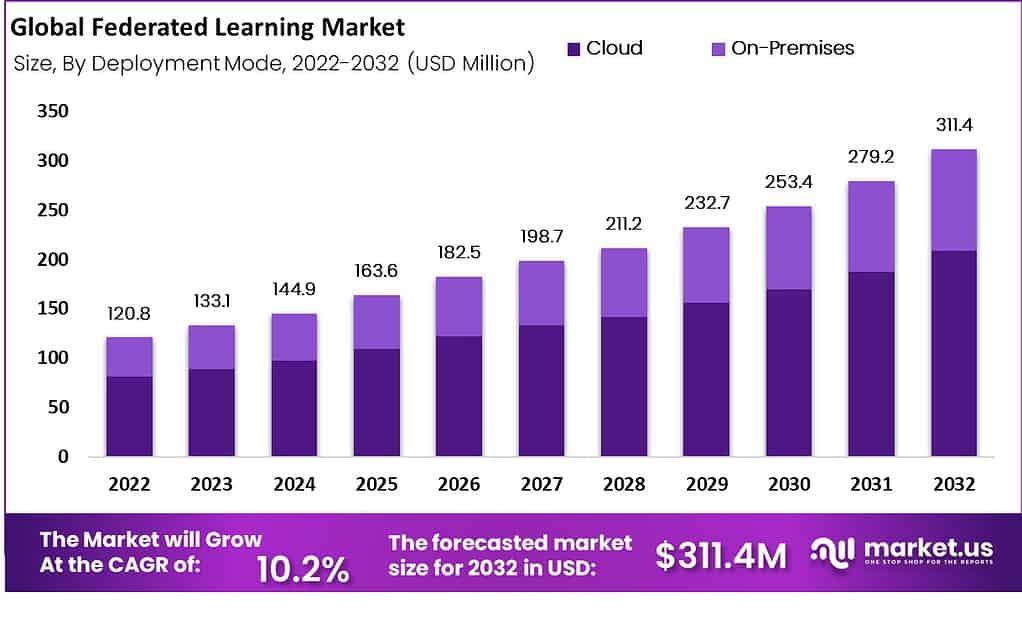
The Global Federated Learning Market was valued at USD 133.1 million in 2023. It’s predicted to increase and become worth USD 311.4 million by 2032. The growth rate from 2023 to 2032 is estimated at 10.2% CAGR.
Federated learning is a distributed machine learning approach that allows multiple devices or entities to collaboratively train a model while keeping the data decentralized and secure. Unlike traditional machine learning methods where data is collected and sent to a central server for training, federated learning enables training to occur locally on individual devices, preserving privacy and data ownership. This approach is particularly beneficial in scenarios where data is sensitive or cannot be easily shared due to legal, privacy, or security concerns.
The federated learning market is witnessing significant growth as organizations recognize the value of this approach in harnessing the power of distributed data for machine learning applications. With the proliferation of connected devices and the exponential growth of data generated at the edge, federated learning offers a solution to leverage this distributed data without compromising privacy. It enables industries such as healthcare, finance, telecommunications, and manufacturing to unlock insights and develop models while adhering to strict privacy regulations and maintaining data security.
Key Takeaways
- In 2023, the Federated Learning Market was valued at USD 133.1 million and it is projected to reach USD 311.4 million by 2032, exhibiting a compound annual compounded annual growth rate of 10.2%.
- Federated learning in finance and banking is predicted to expand significantly, with a CAGR of approximately ~49% between 2022 and 2024. This growth is primarily fueled by its use in fraud detection, credit risk analysis, and anti-money laundering efforts.
- About ~30% of organizations are expected to embrace federated learning to tackle issues related to data privacy and security. This approach allows for the utilization of distributed data in AI model training.
- In 2023, the healthcare and life sciences sector is anticipated to dominate the federated learning market, holding a ~36% share. The sector’s strong interest in federated learning is driven by its potential in medical imaging analysis and drug discovery.
- Around 40% of organizations plan to use federated learning for collaborative AI model development. This method facilitates secure data sharing among multiple entities.
- Approximately 25% of organizations will adopt federated learning to enhance data sharing and collaboration. This adoption aims to uphold data privacy and comply with regulatory standards across various locations and organizations.
- An estimated 20% of organizations will have incorporated federated learning into their AI and analytics strategies by the end of the period. This marks a significant increase from less than 5% in 2022, highlighting the growing reliance on federated learning for advanced data management and analysis.
Deployment Analysis
The cloud segment is estimated to hold the largest revenue share over the forecast period.
Based on type, the market for federated learning is segmented into cloud and on-premises. Among these types, the cloud segment is anticipated to register significant revenue growth during the forecast period because of the current trend of using cloud-based federated learning amongst several industries, owing to its cost-effectiveness, scalability, and flexibility.
Cloud-based federated learning refers to using cloud computing infrastructure to support federated learning systems. As a result, this approach allows the organizations to influence the expertise of cloud providers for implementing and managing federated learning systems, which can be resource-intensive and complex to set up and maintain on-premises.
Therefore, organizations strive to benefit from federated learning while reducing the cost and complexity of managing and implementing these systems. Furthermore, cloud-based federated learning helps organizations scale up the federated learning systems up or down as required without investing in additional hardware or infrastructure.
Moreover, it is more affordable than on-premises federated learning, as it allows the organizations to pay only for the resources they will use rather than investing in the infrastructure and resources upfront. These factors are anticipated to fuel the revenue growth of this segment over the forecast period.
Applications Analysis
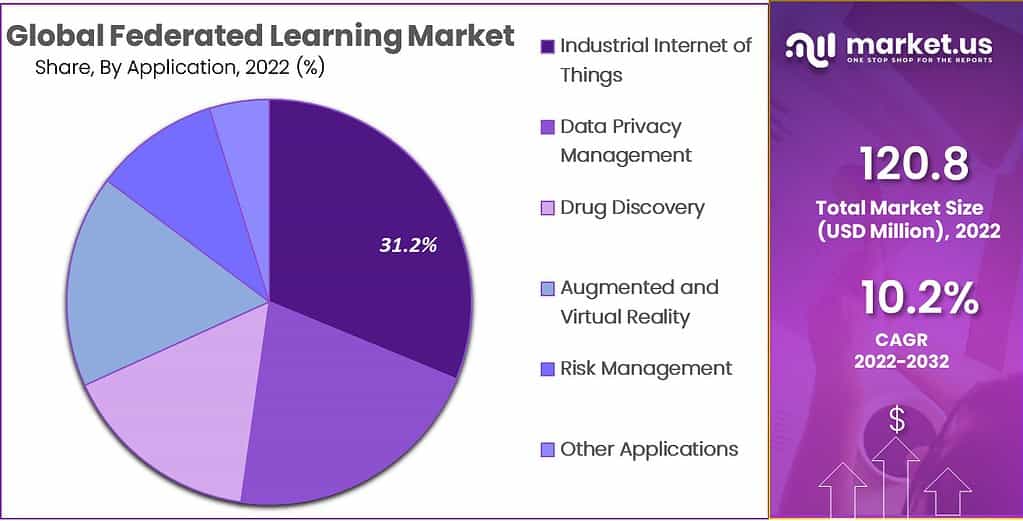
The industrial Internet of Things held the largest revenue share in 2022
By application, the global federated learning market is divided into the industrial Internet of things, data privacy management, drug discovery, augmented and virtual reality, risk management, and other applications.
Among these applications, the industrial Internet of Things segment is anticipated to hold the largest market share during the forecast period, owing to the rising adoption of big data analytics and the increase in technological advancements in emerging economies.
Moreover, the advantages of the industrial Internet of Things include decreased costs, greater productivity, and new business models that support the market growth of federated learning. In addition, the increasing use of federated learning in the Healthcare and Life Science sector will likely offer numerous growth opportunities in the coming years.
Industry Vertical Analysis
The Healthcare and Life Science segment is projected to be the fastest-expanding segment over the forecast period.
Based on industry verticals, the market for federated learning is segmented into automotive, BFSI, retail, IT & telecommunication, Healthcare & Life Science, Manufacturing, and other industry verticals. Healthcare & Life Science and Life Sciences are anticipated to dominate market share, while Manufacturing is expected to witness the swiftest growth. This surge in Manufacturing is attributed to a heightened focus on the Industrial Internet of Things (IIoT) and escalating competition that has led manufacturing firms to prioritize analyzing data from various sources.
Key Market Segments
Based on Deployment
- Cloud
- On-Premises
Based on Applications
- Industrial Internet of Things
- Data Privacy Management
- Drug Discovery
- Augmented and Virtual Reality
- Risk Management
- Other Applications
Based on Industry Vertical
- Automotive
- BFSI
- Retail
- IT & Telecommunication
- Healthcare & Life Science
- Manufacturing
- Other Industry verticals
Drivers
Rising adoption of federated learning in various applications to boost market growth
Federated learning is revolutionizing how machine learning algorithms are developed. Leading companies are delving deeply into this area, recognizing its potential to refine AI applications and enhance existing algorithms. This method addresses the growing desire for increased inter-device and inter-organization learning. In the Healthcare and Life Sciences sector, federated learning can improve patient outcomes and expedite drug discovery.
For Instance, an innovative peer-to-peer methodology called FADNet seeks to bridge the gaps in centralized learning. Unlike traditional methods that rely on a central system for learning, FADNet allows each participant to learn from its data.
Restraints
Expertise with lack of skills to hamper the market growth
The scarcity of trained IT professionals is a major roadblock for many companies trying to integrate ML into their existing workflows. This shortfall makes it particularly difficult for employees to understand and embrace the potential of federated learning as an innovative approach.
The challenge for these companies lies in understanding the concept and executing federated learning tasks. These tasks often involve intricate processes, from recruitment and machine learning implementation to maintaining the required technological prowess.
Organizations are compelled to cultivate unique skill sets and create specialized job roles. For example, there’s a pressing need for engineers who can handle the sophisticated infrastructure of federated learning, ensuring the smooth installation and maintenance of machine learning algorithms. Similarly, data scientists become indispensable with their expertise in statistics and computer science.
However, these skilled professionals come with their demands, including competitive salaries and advanced resources, which may be beyond the reach of many large enterprises, especially SMEs. Consequently, the current shortage of skilled professionals severely limits the growth of the global federated learning market.
Opportunity
Federated learning to enable collaborative learning among various users
Federated learning enables storing data on sources such as manufacturing detection equipment, smartphones, and other end devices. The ML machines are to be trained on the fly. This helps in the decision-making before it is sent back to the centralized computer. For Instance, federated learning is preferred mainly in the finance sector for debt risk analysis.
Generally, the banks utilize the whitelisting processes to keep their customers out of the Federal Reserve system based on their credit card information. In addition, risk assessment variables, such as reputation and taxation, might be employed by working with e-commerce businesses and other financial institutions. Together, these factors are likely to offer numerous growth opportunities shortly.
Regional Analysis
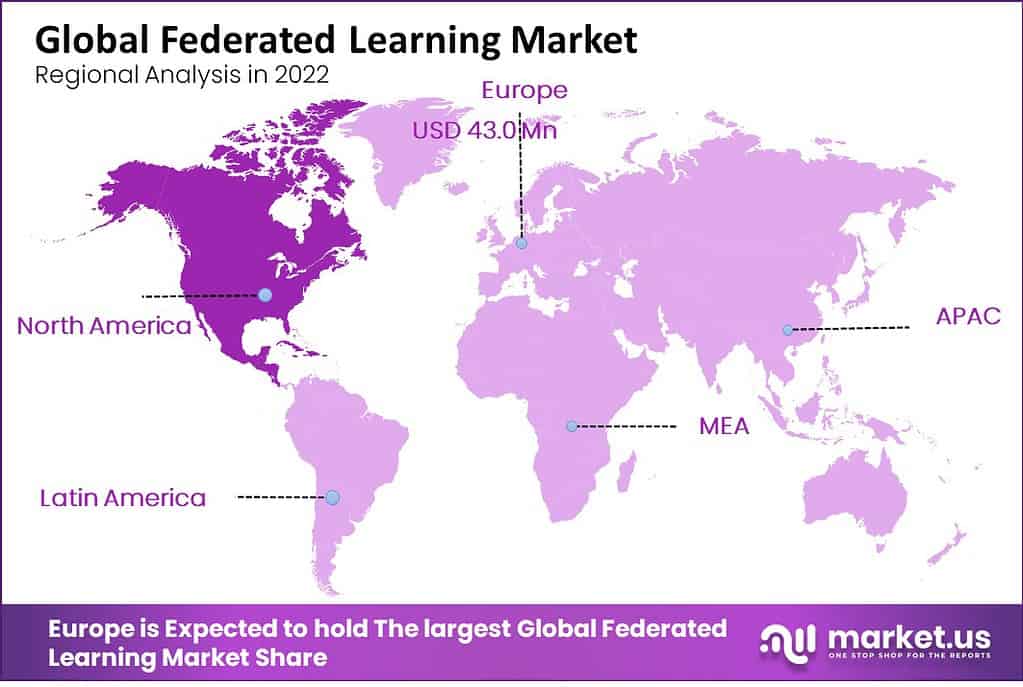
Europe is anticipated to hold the largest market share during the forecast period.
During the forecasted period, Europe is projected to dominate the federated learning market, holding a market share of 35.6%. There’s a broad spectrum of healthcare applications of federated learning, from patient data and risk analysis medical imaging and diagnostics, to lifestyle management and monitoring. Notably, drug discovery stands out due to its intricate nature.
Researchers are inundated with extensive bioscience information, from patents and genomic data to the daily influx of publications across various biomedical platforms. This complexity necessitates a revolution in the drug discovery method, and federated learning emerges as a potent tool for optimizing it. Consequently, market players are innovating and launching new products. In the European context, the challenges posed by an aging population coupled with a limited number of healthcare professionals catalyze AI’s embrace in healthcare. This trend is propelling the growth of the federated learning market in the region.
Note: The figures presented here are subject to change in the final report.
Key Regions and Countries Covered in this Report:
- North America
- The US
- Canada
- Europe
- Germany
- France
- The UK
- Spain
- Italy
- Russia & CIS
- Rest of Europe
- APAC
- China
- Japan
- South Korea
- India
- Rest of APAC
- Latin America
- Brazil
- Mexico
- Rest of Latin America
- Middle East & Africa
- GCC
- South Africa
- Rest of MEA
Key Players Analysis
The global federated learning market is fragmented, with medium-sized and large-sized players accounting for most of the market share. Major market players are implementing various growth strategies by entering into strategic agreements & contracts, mergers & acquisitions, testing, developing, and introducing more effective federated learning.
Moreover, they are involved in collaborations & partnerships, and technological advancements and are highly focused on geographic expansions to increase their market presence. All these strategies together form a competitive landscape in the global federated learning market, thereby propelling market growth.
Market Key Players
- Acuratio, Inc.
- apheresis AI GmbH
- Cloudera, Inc.
- Google LLC
- Enveil
- Edge Delta, Inc.
- FedML
- IBM Corporation
- AI.
- Nvidia Corporation
- Intel Corporation
- Lifebit
- Secure AI Labs
- Other Key Players
Recent Developments
- In June 2022, a noteworthy partnership emerged between Intel Corporation, Aster Innovation and Research Centre, and CARPL. Their aim? To roll out a secure federated learning platform, an initiative expected to spur advancements across sectors such as genomics, drug discovery, diagnosis, and the broader realm of predictive Healthcare and life Science.
- In March 2022, NVIDIA unveiled its Clara Holoscan Solution. Tailored for its Healthcare & Life Science division, this Communications Intelligence Platform has been revamped to MGX. It stands out as a unique end-to-end system, catering to intelligent Healthcare and life Science manufacturing processes and the deployment in areas like implantable augmentations and AI-driven technologies.
- In April 2021, IBM Corporation embarked on an enhancement journey for its Watson AI technology. This product development introduced new federated education features utilizing advanced ML techniques. To bolster regulatory compliance and fortify data privacy.









