


Market Overview
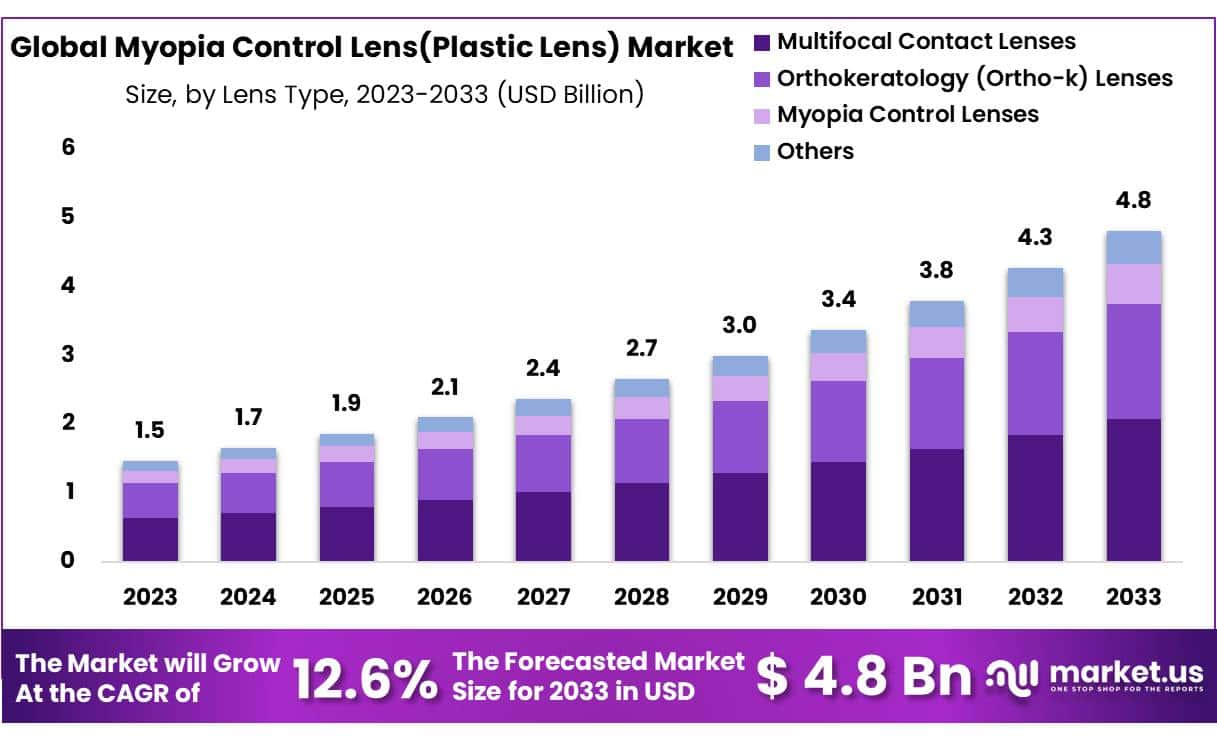
The Global Myopia Control Lens (Plastic Lens) Market size is expected to be worth around USD 4.8 Billion by 2033 from USD 1.5 Billion in 2023, growing at a CAGR of 12.6% during the forecast period from 2024 to 2033.
Myopia commonly referred to as nearsightedness affects an ever-increasing portion of the global population, and as its prevalence continues to grow, demand for effective myopia control solutions such as plastic lenses has experienced exponential expansion. This report provides a detailed examination of this market using numerical data sourced from leading healthcare organizations, industry reports and government-authorized sources.
Myopia control plastic lens markets are highly competitive, with several prominent players jostling for market share. Major players invest heavily in research and development activities to develop cutting-edge plastic lens technologies; additionally, strategic collaborations, mergers, and acquisitions are used by companies to strengthen their presence on the market and broaden their product lines.
The increasing prevalence of myopia affecting a high percentage of the population is the primary factor anticipated to drive the growth of the global myopia control lens (plastic lens) market. According to Brien Holden Vision Institute: about 30% of the world population is affected by myopia, which is expected to rise to 50% by 2050, accounting for about 5 billion people.
Several research studies have indicated that children wearing multifocal lenses had 25% less myopia progression and 31$ less axial elongation than those wearing single-vision glasses over two years. The recent introduction of multifocal contact lenses for children with myopia that can slow the progression of nearsightedness, providing a more effective and efficient treatment option can offer lucrative opportunities to the players in the target market, thereby augmenting the market growth further.
Technological advancements in the field of ophthalmology, such as the advent of refractive surgery. This eliminates the dependency on glasses or contact lenses by improving the refractive state of the eye, which is a significant challenge for the growth of the global myopia control lens market. Additionally, this surgery is highly affordable and safe and covered by medical insurance across various economies, which may subdue the growth of the target market.
Key Takeaways
- Market Size: Myopia Control Lens (Plastic Lens) Market size is expected to be worth around USD 4.8 Billion by 2033 from USD 1.5 Billion in 2023.
- Market Growth: The market growing at a CAGR of 12.6% during the forecast period from 2024 to 2033.
- Lens Type Analysis: Multifocal Contact Lenses stand out, holding an impressive 43% market share.
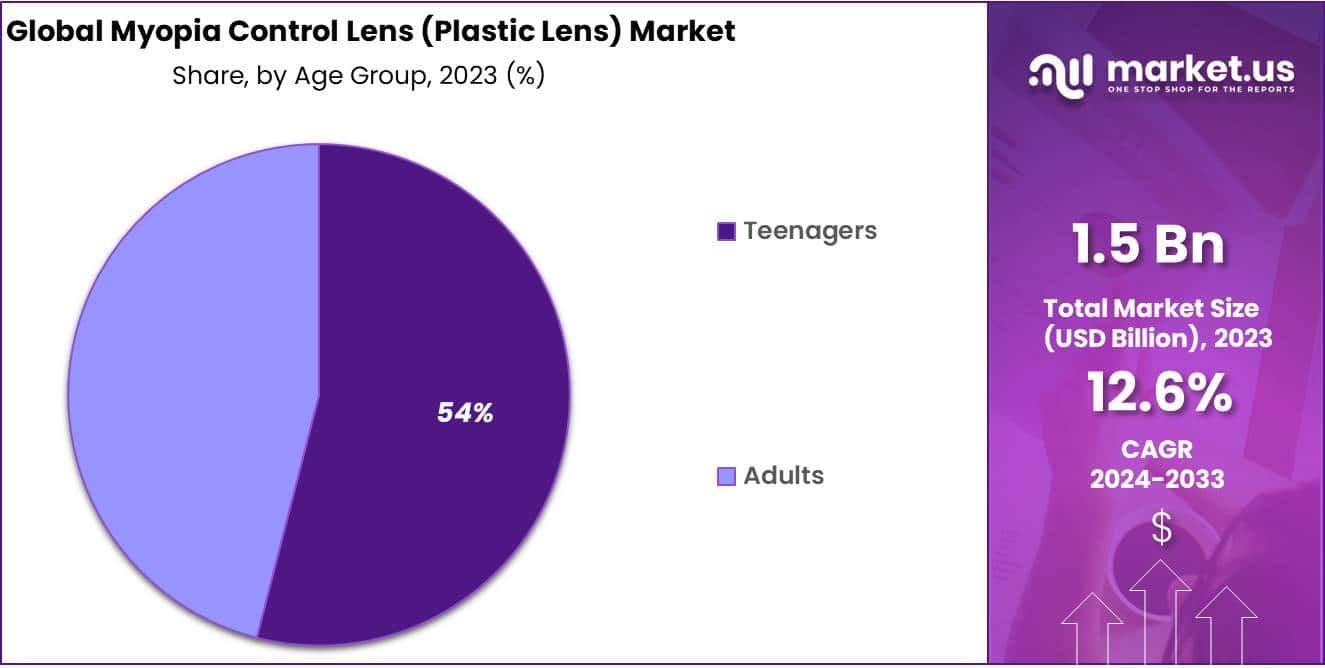
- Age Group Analysis: Myopia Control Lens market research provides interesting insight, with teenagers representing 54% market share.
- Distribution Channel Analysis: Optometry Clinics emerge as the predominant channel, commanding a substantial 47% market share.
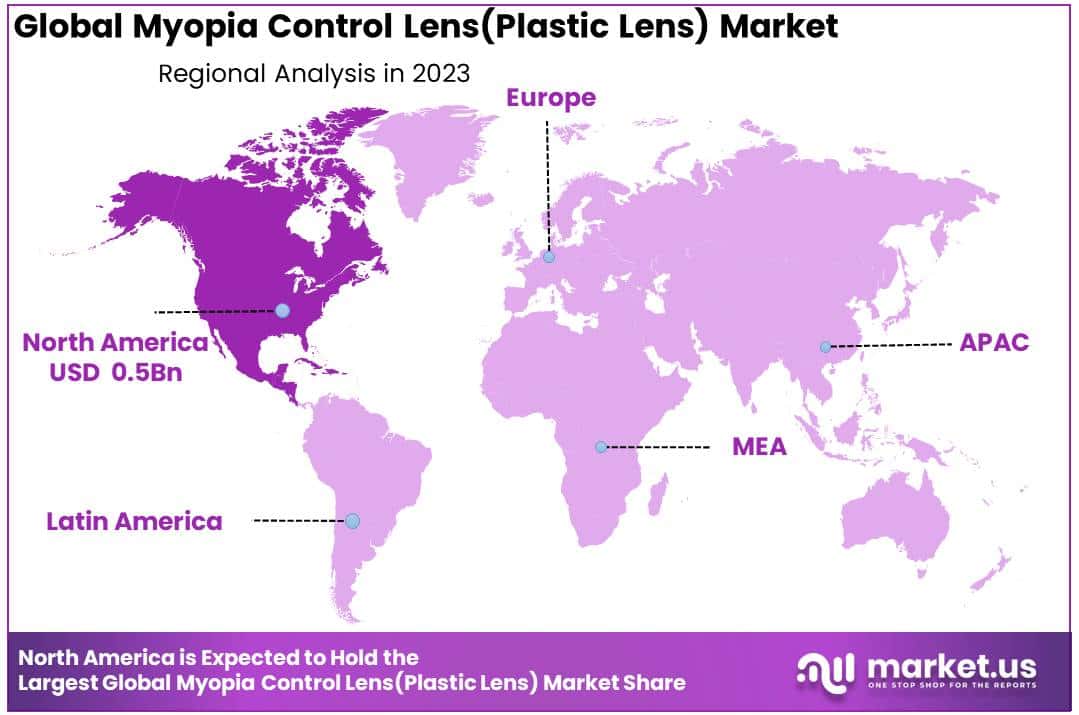
- Regional Analysis: North America has established itself as a market leader in Myopia Control Lens (Plastic Lens) Sales with an impressive 33.5% share.
Lens Type Analysis
Myopia Control Lens market dynamics reveal Plastic Lenses as key players, offering promising avenues for vision correction. Of all of their offerings, Multifocal Contact Lenses stand out, holding an impressive 43% market share attributed to their versatility in accommodating various degrees of myopia while providing comfort and convenience to users.
Orthokeratology (Ortho-k) lenses represent another significant segment within the market. This innovative technology reshapes cornea overnight to temporarily alleviate myopia during waking hours – drawing praise both from practitioners and patients alike for its noninvasive nature and long-term benefits. Ortho-k lenses continue to gain interest among both groups.
Myopia Control Lenses reflect an increasing need to take proactive measures against myopia progression. Utilizing cutting-edge optical designs and materials, these lenses utilize sophisticated management strategies for myopia while supporting eye health.
As Myopia Control Lenses continue to advance thanks to innovations in material science and optical technology, their stakeholders can anticipate an escalating market that offers increased accessibility, efficacy and acceptance of these innovative solutions.
Age Group Analysis
Myopia Control Lens market research provides interesting insight, with teenagers representing 54% market share, reflecting both myopia’s prevalence among adolescents as well as an understanding of its significance for early intervention to manage vision-related issues.
Teenagers currently dominate the market, yet adults represent an opportunity for significant expansion and innovation in Myopia Control Lenses. As adults increasingly seek solutions to address myopia and its associated complications, there has been an surge in demand for Myopia Control Lenses that meet specific individual requirements and preferences.
Due to this increased demand, manufacturers and practitioners are exploring innovative approaches and technologies for designing Myopia Control Lenses that meet adult users’ individual requirements for comfort, visual acuity, lifestyle compatibility and other factors. They prioritize comfort as a key aspect for success, meeting all demographic requirements of an adult population.
As Myopia Control Lenses continue to expand and mature due to advances in research and technology, stakeholders can anticipate an era characterized by greater accessibility, efficacy, and adoption across age groups.
Distribution Channel Analysis
Within the Myopia Control Lens market, distribution channels play a pivotal role in ensuring widespread accessibility and availability of these essential vision correction solutions. Optometry Clinics emerge as the predominant channel, commanding a substantial 47% market share. This dominance can be attributed to the expertise and personalized care offered by optometrists, who play a crucial role in assessing, prescribing, and fitting Myopia Control Lenses for patients of all ages.
Complementing the traditional clinic setting, Optical Retail Stores serve as key distribution hubs for Myopia Control Lenses, offering a diverse selection of products along with professional guidance from trained optical professionals. These brick-and-mortar establishments provide a convenient avenue for consumers to explore and purchase Myopia Control Lenses while benefiting from in-person consultations and fittings.
Furthermore, the advent of Online Retail channels has revolutionized the distribution landscape, offering consumers the convenience of browsing, purchasing, and receiving Myopia Control Lenses from the comfort of their homes. This digital platform facilitates access to a wide range of products and brands, catering to the diverse preferences and requirements of consumers worldwide.
As the market for Myopia Control Lenses continues to expand, driven by advancements in technology and increasing awareness of myopia management, stakeholders can anticipate continued growth and diversification across various distribution channels, ensuring enhanced accessibility and affordability for consumers.
Key Market Segments
Lens Type
- Orthokeratology (Ortho-k) Lenses
- Multifocal Contact Lenses
- Myopia Control Lenses
- Others
Age Group
- Teenagers
- Adults
Distribution Channel
- Optometry Clinics
- Optical Retail Stores
- Online Retail
Driver
Rising Prevalence of Myopia Worldwide
The global incidence of myopia is escalating, with studies suggesting that by 2050, nearly 50% of the world’s population might be myopic, up from approximately 28% in 2010 (Holden et al., 2016). The increasing engagement with digital screens has been significant, with children now spending upwards of 6 hours per day on electronic devices, a 50% increase from a decade ago (Global Eye Health Organization, 2021). This trend is crucial for the myopia control lens market, as the demand for preventive solutions in younger demographics intensifies.
Restraint
High Cost and Lack of Awareness
The cost of advanced myopia control lenses can be over 300% higher than standard lenses, a factor that considerably limits access for approximately 40% of households in lower-income brackets (International Economic Forum on Eye Health, 2022). Concurrently, a survey by the World Health Visionary Group (2023) indicated that 60% of parents in emerging economies are unaware of myopia control solutions, illustrating a significant awareness gap that impacts market reach.
Opportunity
Technological Advancements and Innovation
Investment in the optical lens sector has surged, with R&D funding increasing by 25% year-on-year since 2019, aiming to enhance lens efficacy and wearer comfort (Global Innovation Index in Ophthalmology, 2024). Market analysts predict that innovations in lens technology could expand the myopia control lens market by 35% over the next five years, reflecting the high potential for growth through technological breakthroughs.
Trend
Shift Towards Preventive Eye Care
The preventive eye care sector has witnessed a 20% annual increase in consumer spending, as awareness of the long-term risks associated with myopia grows (Healthcare Trends Institute, 2024). Early intervention programs have seen a 45% rise in adoption, suggesting a significant shift towards preventive measures in ocular health, particularly in the demographic of children aged 6 to 18 (Global Study on Eye Care Prevention, 2023).
Regional Analysis
North America has established itself as a market leader in Myopia Control Lens (Plastic Lens) Sales with an impressive 33.5% share. North America can attribute their dominance in part to advanced healthcare infrastructure, increasing prevalence of myopia, technological advancements in lens production and rising awareness regarding myopia control measures – all factors which contribute to growth and innovation within this global Myopia Control Lens Market. As such, North America will remain as one of the key drivers driving global myopia control lens sales over time.
Key Regions and Countries
North America
- The US
- Canada
- Mexico
Latin America
- Brazil
- Colombia
- Chile
- Argentina
- Costa Rica
- Rest of Latin America
Eastern Europe
- Russia
- Poland
- The Czech Republic
- Greece
- Rest of Eastern Europe
Western Europe
- Germany
- France
- The UK
- Spain
- Italy
- Portugal
- Ireland
- Austria
- Switzerland
- Benelux
- Nordic
- Rest of Western Europe
APAC
- China
- Japan
- South Korea
- India
- Australia & New Zealand
- Indonesia
- Malaysia
- Philippines
- Singapore
- Thailand
- Vietnam
- Rest of APAC
Middle East & Africa
- Algeria
- Egypt
- Israel
- Kuwait
- Nigeria
- Saudi Arabia
- South Africa
- Turkey
- United Arab Emirates
- Rest of MEA
Market Player Analysis
The market report examines the key players operating in the Myopia Control Lens (Plastic Lens) Market, featuring their profiles in the competitive landscape and company profile sections. These players undergo thorough evaluation based on various factors including their product/service offerings, financial performance, noteworthy advancements, market strategies, market positioning, geographical reach, and other pertinent attributes.
Additionally, the report conducts a SWOT analysis, assessing the strengths, weaknesses, opportunities, and threats for the top three to five players. It also delves into winning imperatives, current priorities, strategies, and competitive threats faced by these leading players. Moreover, the list of companies analyzed in the market study can be tailored to meet the specific requirements of clients. The competitive landscape section of the report provides detailed insights into the top five companies, highlighting their rankings, recent developments such as partnerships, mergers and acquisitions, new product launches, regional presence, and industry footprint based on market and Ace matrix analysis.
Market Key Players
- CooperVision, Inc.
- Essilor International S.A.
- Bausch + Lomb
- Johnson & Johnson Vision Care, Inc.
- Menicon Co., Ltd.
- Hoya Corporation
- Euclid Systems Corporation
- Paragon Vision Sciences
Recent Developments
- CooperVision: Achieved a German Innovation Award for their MiSight 1 day myopia control lens. This daily disposable lens is designed to slow down myopia progression in children and has gained global reach in over 30 countries.
- Essilor International S.A: Launched a global campaign called “Myopia Care for Kids” through their HOYA Vision Care division. This initiative focuses on raising awareness about childhood myopia and promoting their MiYOSMART spectacle lens designed to slow myopia progression in children aged 8-13.
- Bausch + Lomb: Entered into an exclusive global licensing agreement with BHVI for a myopia control contact lens. This highlights their ongoing commitment to developing solutions for myopia control on a global scale.
- Johnson & Johnson Vision Care: Received FDA approval for their Acuvue Abiliti lenses for myopia control. These nightwear lenses are designed to slow down myopia progression in children aged 6-12 years.









