


Report Overview
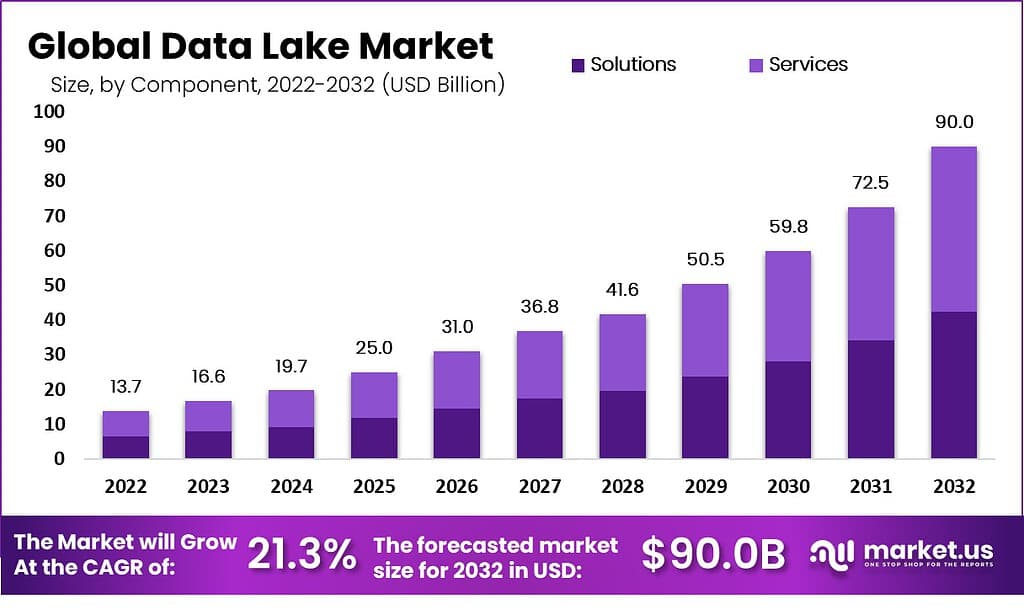
The Global Data Lake Market size is expected to be worth around USD 90 Billion by 2033, from USD 16.6 Billion in 2023, growing at a CAGR of 21.3% during the forecast period from 2024 to 2033.
A data lake is a large repository or storage system that holds vast amounts of raw and unprocessed data. It serves as a central hub where organizations can store data from various sources, such as databases, applications, and IoT devices, without the need for upfront data structuring or transformation.
Data lakes provide a flexible and scalable solution for storing diverse data types, including structured, semi-structured, and unstructured data. They enable organizations to store and analyze massive volumes of data in its raw form, facilitating data exploration, advanced analytics, and machine learning.
The data lake market has experienced significant growth as organizations recognize the value of harnessing and leveraging their data assets. Data lakes offer several advantages, such as the ability to store and process large volumes of data from multiple sources, cost-effective scalability, and the potential for extracting valuable insights. The market is driven by the increasing adoption of big data analytics, the proliferation of data-intensive technologies, and the need for real-time or near-real-time data processing.
Note: Actual Numbers Might Vary In The Final Report
Integration through data is made easy, allowing businesses to break down silos and gain comprehensive insights. Businesses continue to recognize its strategic significance for growth in the market. Organizations are rapidly adopting solutions that enable them to unleash the full potential of their data, ushering in a new era of data-driven innovation and competitiveness. This market is marked by technological innovations, numerous industry use cases, and an ecosystem of providers catering to modern enterprise’s evolving needs.
Key Takeaways
- The global Data Lake Market is predicted to reach a value of approximately USD 90 Billion by 2032, with a steady Compound Annual Growth Rate (CAGR) of 21.3% from 2023 to 2032.
- Solutions hold the major revenue share, contributing to 61.3% of the market, as organizations across various industries invest in efficient data storage, management, and scaling solutions.
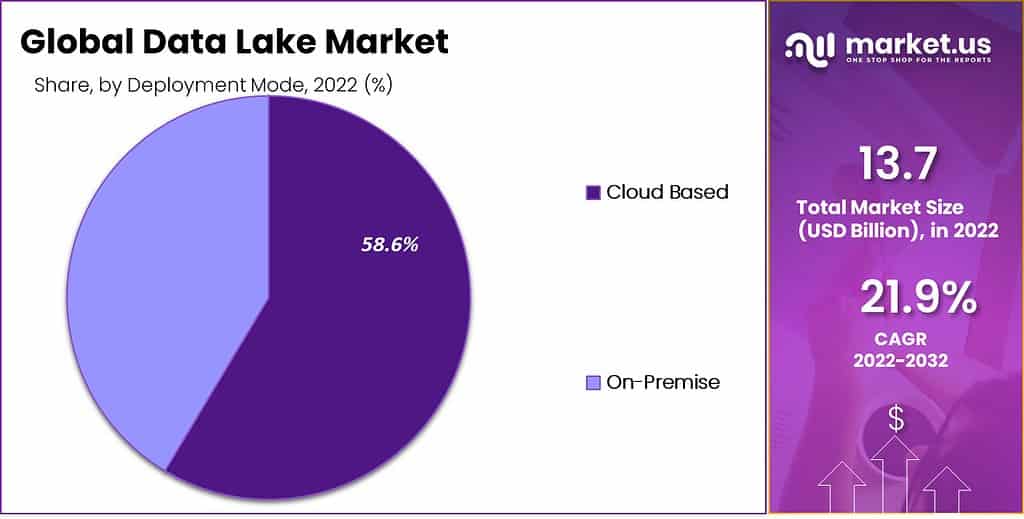
- Cloud deployment currently represents 58.6% of market share and offers organizations the scalability, flexibility, and cost-efficiency they require to manage large volumes of data effectively.
- IT industries lead in Data Lake solutions adoption with 24.6% revenue share due to their reliance on data for operations such as infrastructure monitoring, network management, security analytics and application performance analysis.
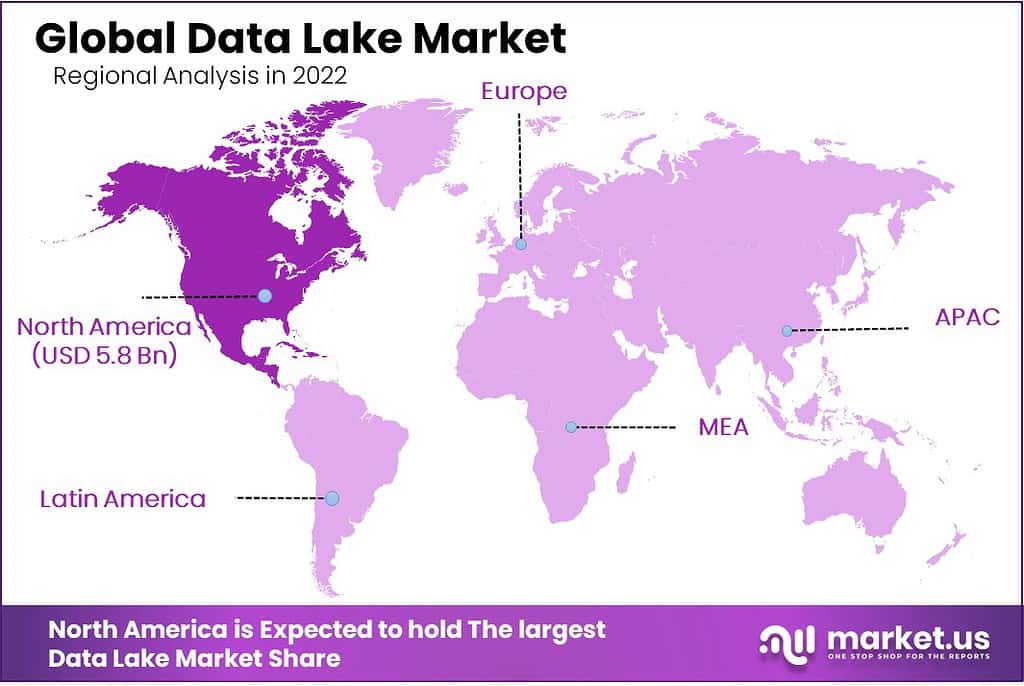
- North America leads the Data Lake Market with a major revenue share of 42.8%, driven by the presence of major tech hubs like Silicon Valley and the robust ecosystem of technology companies fostering innovation and technology adoption.
- The market is dominated by key players such as Amazon Web Services (AWS), Microsoft Corporation, Google LLC, IBM Corporation, and Oracle Corporation, with AWS emerging as the clear leader due to its cloud offerings.
- Advancements in cloud-based technology are expected to create lucrative opportunities in the market, as organizations increasingly recognize the potential of data lakes to centralize and analyze vast datasets efficiently.
- Organizations are integrating Artificial Intelligence (AI) and Machine Learning (ML) in data extraction for valuable insights, leveraging real-time data processing and analytics for instantaneous insights in a fast-paced business environment.
- Geopolitical factors, including data localization laws and national authority restrictions, can pose challenges for global data lake deployments, impacting the market’s growth.
- Concerns related to data security and privacy pose significant restraints for the market, with the growing risk of data breaches and compliance violations, complex data management, and maintenance costs deterring smaller businesses with limited resources.
Driving Factor
Increasing Data Generation Across Industries is Driving the Growth of the Market.
A key driver for the market is the exponential growth of data volumes across industries. Organizations are generating vast amounts of data daily, including customer interactions, IoT sensor data and multimedia content. This surge in data creation necessitates scalable storage and analytical solutions, which it offers. Additionally, the need for real-time analytics and the ability to derive actionable insights from diverse data sources propel the adoption.
Furthermore, regulatory compliance requirements, such as GDPR and HIPAA, drive the demand for centralized data storage and governance, enhancing the market’s growth. In essence, the market thrives on its capability to address modern data challenges in a flexible and cost-effective manner.
Restraining Factor
Data Security and Privacy are Expected to Restraint the Growth of the Market.
The market faces significant restraints, including concerns related to data security and privacy. As organizations accumulate vast amounts of sensitive information on servers, there’s a growing risk of data breaches and compliance violations. Moreover, managing and maintaining data storage can be complex and costly, deterring smaller businesses with limited resources.
Additionally, it can become data swamps if not properly organized and curated, making it challenging to extract meaningful insights. The lack of skilled data engineers and analysts also hampers adoption. Finally, integrating it with existing IT infrastructure can pose compatibility issues and slow down the implementation process, impeding market growth.
Geopolitical Impact Analysis
Data Localization Laws and National Authority Restrictions can Obstruct the Growth of the Market.
Geopolitical factors exert a notable influence on the market. Trade tensions, data localization laws, and international data transfer restrictions can complicate cross-border data sharing. Data sovereignty regulations require businesses to store it within specific geographical boundaries, posing challenges for global data lake deployments. Tariffs on technology imports can inflate costs for infrastructure.
Moreover, varying data privacy standards and government surveillance practices influence design and security strategies. Geopolitical instability can disrupt supply chains for hardware and cloud services, impacting the market’s growth. Navigating these geopolitical intricacies is crucial for businesses seeking to capitalize on the market’s potential.
By Component Analysis
Solutions Hold the Major Revenue Share to Dominate the Market.
Based on components, the market is divided into solutions and services. Among these components, solutions lead the component segment in the market by holding a major revenue share of 61.3%. This growth of solutions can be attributed to the organizations across various industries that are increasingly investing in the solutions to efficiently store, manage, and scale their rapidly growing data volumes.
It provides a centralized repository for diverse data types, making them a critical component of modern data infrastructure. The rise of cloud-based solutions from providers like AWS, Azure, and Google Cloud further boosted the adoption of data lake solutions. These cloud offerings provide scalability, flexibility, and cost-efficiency, appealing to businesses of all sizes.
By Deployment Mode Analysis
On the basis of deployment mode, the market is divided into on-premise and cloud-based deployment. From these deployment modes, Cloud-based deployment mode dominates the market with a major revenue share of 58.6%. Cloud-based solutions offer unparalleled scalability, allowing organizations to expand their data storage and processing capabilities as their data volumes grow. This flexibility is crucial in today’s data-intensive landscape.
It eliminates the need for significant upfront investments in on-premises hardware and maintenance. Organizations can pay for the resources they use, reducing capital expenditures. Moreover, Cloud-based solutions can be provisioned quickly, enabling organizations to get their data infrastructure up and running faster compared to traditional on-premises solutions.
Note: Actual Numbers Might Vary In The Final Report
By End-Use Industry Analysis
IT Industry Dominates the Market with a Major Revenue Share of 24.6%
Based on the end-use industry, the market is classified into IT, BFSI, retail, healthcare, media and entertainment, manufacturing, and other end-use industries. Out of these end-use industries, the IT industry dominates the market by covering a major revenue share of 24.6%.
The IT sector relies heavily on data for various operations, including infrastructure monitoring, network management, security analytics, and application performance analysis. It provides a centralized repository for storing and analyzing massive volumes of IT-related data. Moreover, IT organizations deal with sensitive information, and it plays a crucial role in security monitoring, threat detection, and compliance reporting. They help in real-time analysis of security events and adherence to regulatory requirements.
Key Market Segments
Component
- Solutions
- Services
Deployment Mode
- On-Premise
- Cloud-Based
End-Use Industry
- IT
- BFSI
- Retail
- Healthcare
- Media and Entertainment
- Manufacturing
- Other End-Use Industries
Growth Opportunity
Advancements in Cloud Based Technology are Expected to Create Lucrative Opportunities in the Market.
The market presents a significant opportunity for businesses across various sectors. As data generation continues to surge, organizations are increasingly recognizing the potential of data lakes to centralize and analyze vast datasets efficiently. This offers a competitive advantage by enabling data-driven decision-making, enhanced customer insights, and improved operational efficiency. Furthermore, advancements in cloud-based solutions provide scalability, cost-effectiveness, and flexibility, making it accessible to organizations of all sizes. With the rise of AI and machine learning, the demand for robust data storage and processing platforms is poised for substantial growth. Harnessing the power can unlock untapped potential and drive innovation in the data-driven economy.
Latest Trends
Organizations are Integrating AI and ML in Data Extraction for Valuable Insights.
Real-time data processing and analytics have seen an increasing demand, driven by businesses needing instantaneous insights in an ever-faster business environment. Furthermore, organizations are using AI/ML capabilities directly integrated into data storages for extracting valuable insights and predictions from their data sets. The market growth is also driven by multi-cloud strategies to increase accessibility while maintaining security levels of their storage capacities.
Regional Analysis
North America Leads the Market with a Major Revenue Share of 42.8%.
The North America region dominates the market by securing a major revenue share of 42.8%. North America is home to major tech hubs such as Silicon Valley, which foster innovation and technology adoption. This region has a rich ecosystem of technology companies that drive the implementations. Moreover, many large enterprises and cloud service providers, like AWS, Microsoft Azure, and Google Cloud, are headquartered in North America. They heavily invest in data infrastructure.
After North America, the Asia Pacific region is anticipated to witness the highest CAGR over the forecast period. The Asia Pacific region is undergoing a profound digital transformation, with businesses across various sectors embracing technology to stay competitive. This surge in digitalization generates vast amounts of data, driving the demand for data storage and analytics solutions. This is expected to drive the growth of the Asia Pacific region during the forecast period.
Note: Actual Numbers Might Vary In The Final Report
Key Regions and Countries Covered in this Report
- North America
- The US
- Canada
- Europe
- Germany
- France
- The UK
- Spain
- Italy
- Russia
- Netherland
- Rest of Europe
- APAC
- China
- Japan
- South Korea
- India
- Australia
- New Zealand
- Singapore
- Thailand
- Vietnam
- Rest of APAC
- Latin America
- Brazil
- Mexico
- Rest of Latin America
- Middle East & Africa
- South Africa
- Saudi Arabia
- UAE
- Rest of MEA
Market Share and Key Player Analysis
Amazon Web Services (AWS), Microsoft Corporation, Google LLC, IBM Corporation, and Oracle Corporation dominate a significant portion of the market share, accounting for most. AWS emerged as the clear frontrunner due to its cloud offerings, while Microsoft Azure and Google Cloud quickly established themselves as data storage and analytics solutions providers. Other prominent players in this space include SAS Institute Inc., Snowflake Inc., Cloudera Inc., Teradata Corporation, Atos SE, Google LLC, IBM Corporation, plus Other Key Players.
Top Key Players in the Data Lake Market
- Microsoft Corporation
- Oracle Corporation
- SAS Institute Inc.
- Amazon Web Services Inc
- Snowflake Inc.
- Cloudera Inc.
- Teradata Corporation
- Atos SE
- Google LLC
- IBM Corporation
- Other Key Players
Recent Developments
- In May 2023, Amazon Web Services, Inc. (AWS) unveiled Amazon Security Lake as a service that automatically aggregates security data across AWS environments, top SaaS providers, on-premise environments, and cloud sources into one consolidated data storage.
- In August 2022, Teradata announced VantageCloud Lake as their inaugural product to feature an entirely new cloud-native architecture. Drawing upon years of experience from Teradata Vantage, VantageCloud Lake provides all of the functionality found within Vantage into the Cloud for enterprise customers.









