


Report Overview
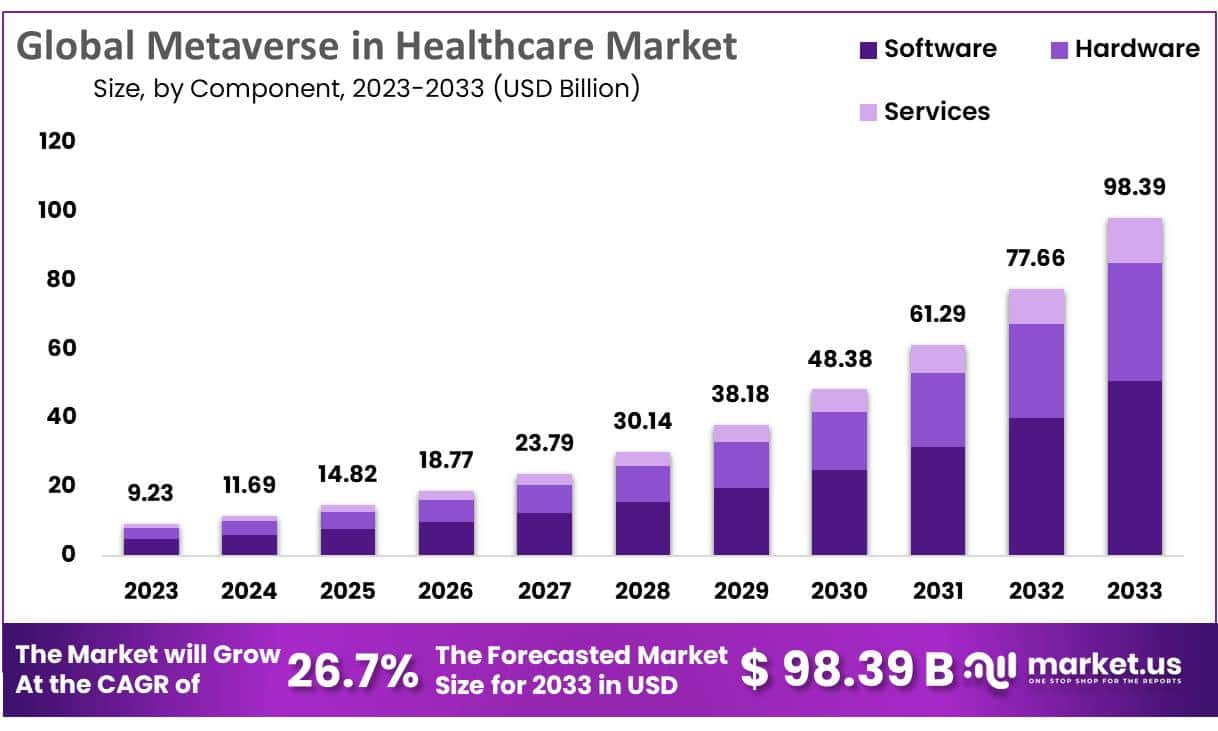
The Global Metaverse in Healthcare Market size is expected to be worth around USD 98.39 Billion by 2033 from USD 9.23 Billion in 2023, growing at a CAGR of 26.7% during the forecast period from 2024 to 2033.
The Metaverse in Healthcare market is rapidly evolving, leveraging virtual reality (VR), augmented reality (AR), and other immersive technologies to transform healthcare delivery. It enables remote consultations, medical training simulations, and patient education experiences. Key players include tech giants like Google, Microsoft, and startups focusing on healthcare-specific solutions.
The market is driven by increasing demand for telemedicine, personalized patient experiences, and advanced training methods for healthcare professionals. Challenges include data privacy concerns, regulatory compliance, and the need for scalable, accessible platforms. Despite hurdles, the Metaverse’s integration in healthcare promises revolutionary advancements in patient care and medical education.
- According to a study published in the Harvard Business Review, virtual reality (VR) training significantly enhanced participants’ surgical performance, showing a remarkable improvement of 230% compared to traditional training methods.
- As found in a study conducted by the Cedars-Sinai Hospital and published in the Wall Street Journal, virtual reality (VR) experiences can lead to a reduction in pain by 24% or more.
Key Takeaways
- The Metaverse in Healthcare market generated a revenue of USD 9.23 billion in 2023, and is expected to exceed USD 98.39 Billion by the year 2033 with a CAGR of 26.7%.
- Based on component, the software segment remained dominant in 2023, with a market share of 51.7%.
- By technology, the augmented and virtual reality maintained a stronghold on the market in 2023, with a market share of 39.2%.
- As far as application is concerned, medical education and surgery training segment claimed a revenue share of 38.4%.
- Among end-users, healthcare providers remain primary end-users in the market and secured 41.3% market share.
- Region wise, North America led the market in 2023, with a market share of 40.8%.
By Component Analysis
The software segment was dominant in the Metaverse in Healthcare market in 2023 with a market share of 51.7%. Software solutions play a crucial role in creating immersive healthcare experiences, such as virtual consultations, medical simulations, and patient education platforms. These software applications enable seamless interaction between users and the virtual environment, driving adoption among healthcare providers and patients alike.
Additionally, advancements in artificial intelligence (AI) and machine learning (ML) within software solutions have enhanced diagnostic accuracy, personalized treatment plans, and predictive analytics, further fuelling the demand for software-based Metaverse solutions in healthcare.
By Technology Analysis
The Augmented and Virtual Reality (AR/VR) segment was dominant in the Metaverse in Healthcare market in 2023 by claiming a 39.2% market share. AR/VR technologies enable immersive experiences that enhance medical training, patient education, and remote consultations. These technologies offer realistic simulations, improving learning outcomes for healthcare professionals and empowering patients with interactive health information. Research published in the Lancet Psychiatry journal effectively demonstrated that virtual reality (VR) exposure therapy can significantly reduce fear of heights, with self-reported reductions averaging 68%.
Additionally, continuous advancements in AR/VR hardware and software, coupled with decreasing costs, made these technologies more accessible and attractive to healthcare providers and patients.
By Application Analysis
The medical education and surgery training segment contributed the most to the Metaverse in Healthcare market in 2023 and claimed a revenue share of 38.4%. The segment leveraged immersive technologies like virtual reality (VR) and augmented reality (AR) to provide realistic and interactive medical training experiences. These technologies allowed healthcare professionals to practice surgical procedures, anatomical studies, and patient consultations in a virtual environment, improving skill acquisition and patient outcomes. Additionally, the COVID-19 pandemic restricted in-person training opportunities, driving the adoption of virtual platforms for medical education.
Moreover, continuous advancements in AR/VR content and simulation capabilities enhanced the effectiveness and accessibility of virtual medical training programs, further fuelling the segment’s dominance in the market.
By End-User Analysis
The Healthcare Providers segment maintained its stronghold on the market in 2023 and secured a market share of 41.3%. Healthcare providers increasingly adopted Metaverse technologies for telemedicine, virtual consultations, and patient care, especially during the COVID-19 pandemic. Virtual platforms enabled them to deliver healthcare services remotely, improving accessibility and efficiency.
Additionally, healthcare providers utilized Metaverse solutions for medical training, continuing education, and patient education, driving the segment’s dominance in the market.

Key Market Segments
By Component
- Software
- Hardware
- AR Devices
- VR Devices
- MR Devices
- Displays
- Services
By Technology
- Augmented/ Virtual reality
- Mixed Reality
- Artificial Intelligence
- Blockchain
- Digital Twin
- loT
- Medical Wearables
By Application
- Digital therapeutics
- Medical diagnostics
- Telehealth and Telemedicine
- Medical Education and Surgery Training
- Drug Discovery and Personalised Medicine
- Other Applications
By End-User
- Healthcare Providers
- Healthcare Payers
- Pharmaceutical and Medtech Companies
- Others
Drivers
Growing Adoption for Mixed Reality
The increasing adoption of mixed reality (MR) for performing minimally invasive surgeries is a significant driver for the Metaverse in Healthcare market. MR technologies combine elements of virtual and augmented reality, providing surgeons with immersive, real-time visualization and interaction capabilities during procedures. This enables precise navigation, enhanced depth perception, and improved anatomical understanding, leading to more accurate and efficient surgeries.
Moreover, MR systems facilitate collaborative surgical environments where multiple experts can remotely assist and share insights, making them invaluable tools for complex and delicate procedures. As a result, the adoption of MR in surgery is driving market growth and innovation in healthcare.
Restraints
High Costs of Implementation
One of the main restraints for the Metaverse in Healthcare market is the complexity and cost of implementing immersive technologies. Integrating virtual reality (VR), augmented reality (AR), and mixed reality (MR) solutions into existing healthcare infrastructure requires significant investment in hardware, software, training, and maintenance. This can pose challenges for smaller healthcare providers or organizations with limited resources.
Additionally, ensuring data security, patient privacy, and regulatory compliance in virtual healthcare environments adds another layer of complexity and cost. Overcoming these barriers and achieving widespread adoption will require addressing these challenges effectively, including developing more affordable and user-friendly solutions and robust cybersecurity measures.
Opportunities
Immersive Technologies
A major opportunity for the Metaverse in Healthcare market lies in revolutionizing patient care and access to healthcare services. Immersive technologies such as virtual reality (VR) and augmented reality (AR) enable remote consultations, personalized treatment plans, and patient education, enhancing healthcare accessibility and outcomes. These technologies also support medical training and simulation, allowing healthcare professionals to refine their skills in a realistic and safe virtual environment.
Moreover, the integration of artificial intelligence (AI) and data analytics within the Metaverse can unlock insights for personalized medicine, predictive diagnostics, and improved patient outcomes, creating vast opportunities for innovation and advancement in healthcare delivery.
Impact of Macroeconomic Factors
Government policies play a crucial role in shaping the Metaverse in Healthcare market, influencing regulations related to data privacy, telemedicine, and technology adoption. Trade agreements can impact market access and the flow of technology across borders, affecting market growth. Currency rates can impact the cost of importing and exporting Metaverse technologies, influencing pricing strategies and market competitiveness.
Fluctuations in interest rates can also impact investment decisions and funding availability for innovation in the healthcare and technology sectors, shaping market dynamics.
Latest Trends
The latest trends in the Metaverse in Healthcare market include the convergence of virtual and physical care settings, facilitated by advanced telemedicine platforms and wearable devices. Virtual reality (VR) and augmented reality (AR) are increasingly used for patient rehabilitation and mental health interventions, offering immersive therapeutic experiences. Artificial intelligence (AI) and machine learning (ML) are integrated into virtual healthcare systems for personalized treatment recommendations and predictive analytics, enhancing patient outcomes.
Moreover, blockchain technology is employed for secure health data management and interoperability across healthcare networks, ensuring data privacy and integrity. These trends signify a shift towards holistic, tech-driven healthcare solutions that prioritize accessibility, efficiency, and patient-centric care.
Regional Analysis
North America is leading the Metaverse in Healthcare Market
North America maintained a stronghold on the Metaverse in Healthcare market, primarily due to the presence of major market players and increased investments in healthcare infrastructure. Total market share claimed by the segment amounted to 40.8%. The region’s growing healthcare spending aims to advance medical facilities, boosting its position in the Metaverse market. Additionally, the rising adoption of augmented reality (AR), virtual reality (VR), and artificial intelligence (AI) in healthcare for improved patient experiences and enhanced education is expected to drive market growth in the foreseeable future.
The Asia Pacific region is expected to experience the highest CAGR during the forecast period
The Asia Pacific region is anticipated to witness the highest compound annual growth rate (CAGR) in the Metaverse in Healthcare market due to several factors. Firstly, the region has a large population with increasing healthcare needs, driving demand for innovative healthcare solutions like virtual reality (VR), augmented reality (AR), and artificial intelligence (AI). Additionally, rapid technological advancements, growing investments in healthcare infrastructure, and supportive government initiatives are fueling the adoption of Metaverse technologies, leading to significant market growth in the Asia Pacific region.

Key Regions and Countries
North America
- US
- Canada
Europe
- Germany
- France
- The UK
- Spain
- Italy
- Russia
- Netherland
- Rest of Europe
Asia Pacific
- China
- Japan
- South Korea
- India
- New Zealand
- Singapore
- Thailand
- Vietnam
- Rest of APAC
Latin America
- Brazil
- Mexico
- Rest of Latin America
Middle East & Africa
- South Africa
- Saudi Arabia
- UAE
- Rest of MEA
Market Players Analysis
In the Metaverse in Healthcare market, key players such as Microsoft Corporation, and Google LLC hold significant market share due to their advanced AR/VR technologies and healthcare-focused solutions. Other notable players include NVIDIA Corporation, 8chili Inc. and CAE Inc., contributing to market growth through innovative products and strategic partnerships. The market is characterized by intense competition, rapid technological advancements, and collaborations between tech giants and healthcare providers to drive innovation and meet evolving healthcare needs.
Top Key Players in
- Google LLC
- Microsoft
- NVIDIA Corporation
- CAE Inc.
- ImmersiveTouch Inc.
- Surgical Inc.
- 3D Systems Corporation
- 8chili Inc.
- AccuVein
- Other Key Players
Recent Developments
- In November 2023, Wipro collaborates with Nvidia to support healthcare firms in expediting the integration of generative artificial intelligence (gen AI) using AI-driven approaches, offerings, and solutions.
- In January 2024, Qualcomm Inc. unveiled a new chip specifically tailored for virtual reality (VR) and augmented reality (AR) applications. This chip, known as Snapdragon XR2+ Gen 2, is set to be integrated into immersive experience technologies by tech giants Google LLC and Samsung Electronics Co.









