


Report Overview
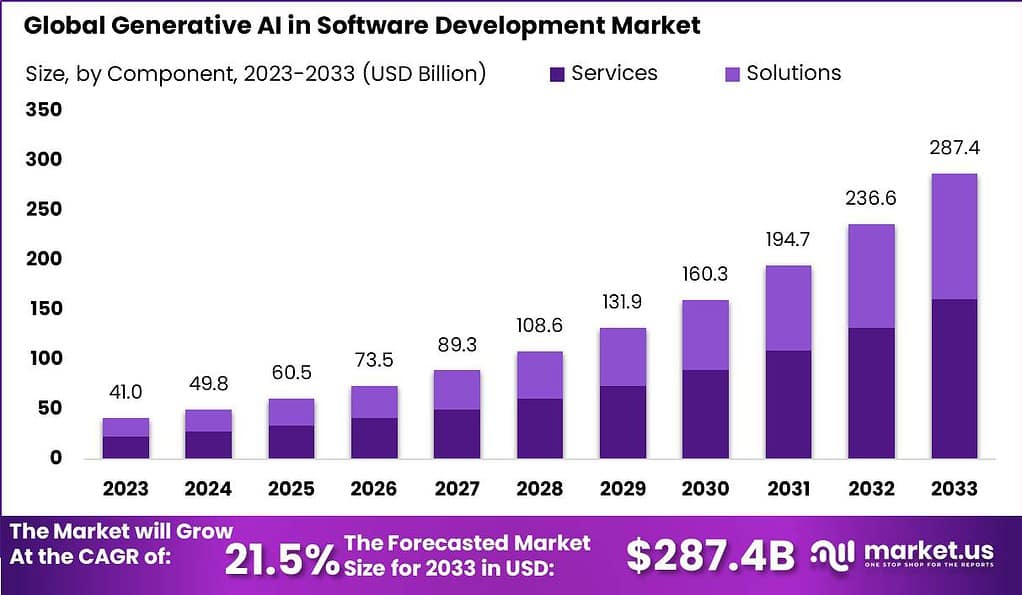
The Global Generative AI In Software Development Market size is expected to be worth around USD 287.4 Billion by 2033, from USD 41.0 Billion in 2023, growing at a CAGR of 21.5% during the forecast period from 2024 to 2033.
Generative AI in software development refers to the application of artificial intelligence techniques that can generate software code, designs, or other software-related elements. It involves leveraging machine learning models to automatically generate code snippets, prototypes, or even entire software systems based on input data, specifications, or desired outcomes.
The market for generative AI in software development has been gaining momentum as companies seek to streamline and accelerate the software development process. By utilizing generative AI techniques, developers can automate repetitive tasks, speed up prototyping, and improve code quality, ultimately leading to increased productivity and efficiency.
One of the key benefits of generative AI in software development is its ability to automate code generation. Developers can use trained machine learning models to generate code based on patterns and examples from existing codebases. This can save time and effort, especially when it comes to writing boilerplate code or implementing common functionality. By automating these tasks, developers can focus on more complex and strategic aspects of software development.
Generative AI also plays a significant role in software design. It can assist in generating user interface (UI) designs, layouts, or even entire application mockups based on user requirements or design guidelines. This enables developers and designers to explore multiple design options quickly, iterate on ideas, and gather feedback from stakeholders, leading to more efficient and collaborative design processes.
Furthermore, generative AI can aid in software testing and bug detection. By training machine learning models on large datasets of code and associated bug reports, these models can identify potential bugs or vulnerabilities in new code. This can help developers catch issues early in the development cycle, leading to more robust and secure software systems.
The landscape of software development is undergoing significant transformations, with generative AI poised to revolutionize traditional coding practices. According to a recent report by IBM, generative AI is expected to reduce coding time by up to 30% by 2024, underscoring the technology’s potential to streamline software development processes. This forecast aligns with the broader industry trend towards automating repetitive tasks, thereby allowing developers to focus on more complex and creative aspects of software creation.
Parallelly, a study conducted by the Association for Computing Machinery (ACM) has revealed that 63% of software developers believe generative AI will significantly impact the industry within the next three years. This sentiment is indicative of the growing recognition within the developer community of generative AI’s potential to enhance creativity and innovation in software development. The anticipated impact is not merely about efficiency but also about fostering a new wave of creative solutions and applications.
Key Takeaways
- The Generative AI in Software Development market is poised for substantial growth, with an estimated value of USD 287.4 billion by 2033. This represents a robust CAGR of 21.5% from 2024 to 2033, indicating significant market expansion over the forecast period.
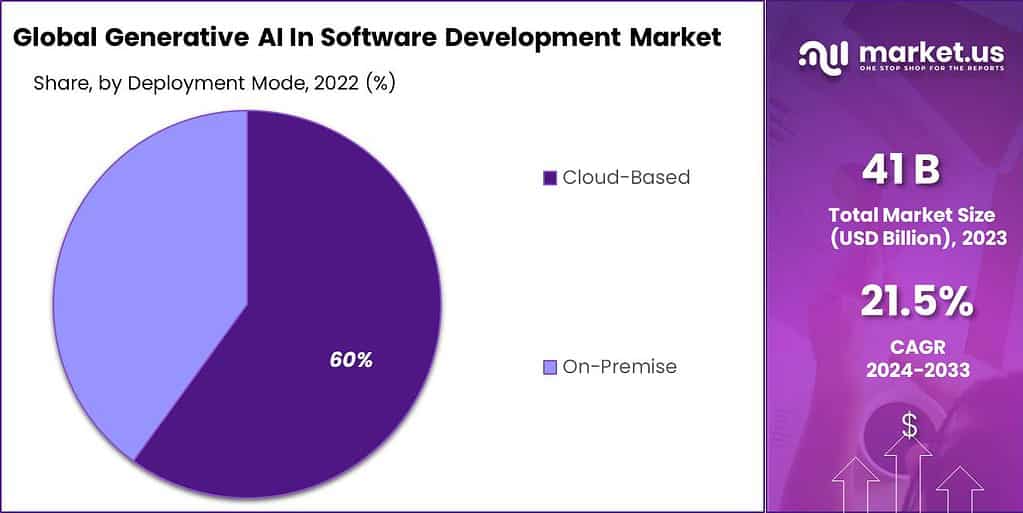
- Cloud-Based segment leads the market, capturing over 60% share in 2022. This dominance is due to the scalability, flexibility, and cost-effectiveness offered by cloud-based solutions, facilitating rapid development and deployment of software solutions.
- Services segment holds a dominant position in the market, attributed to the rising demand for customized AI solutions tailored to specific business needs. It accounted for a significant share in 2022, driven by the need for installation, implementation, and continuous support services.
- Code Generation segment held a dominant market position in 2022, contributing significantly to enhancing productivity and efficiency in the software development process.
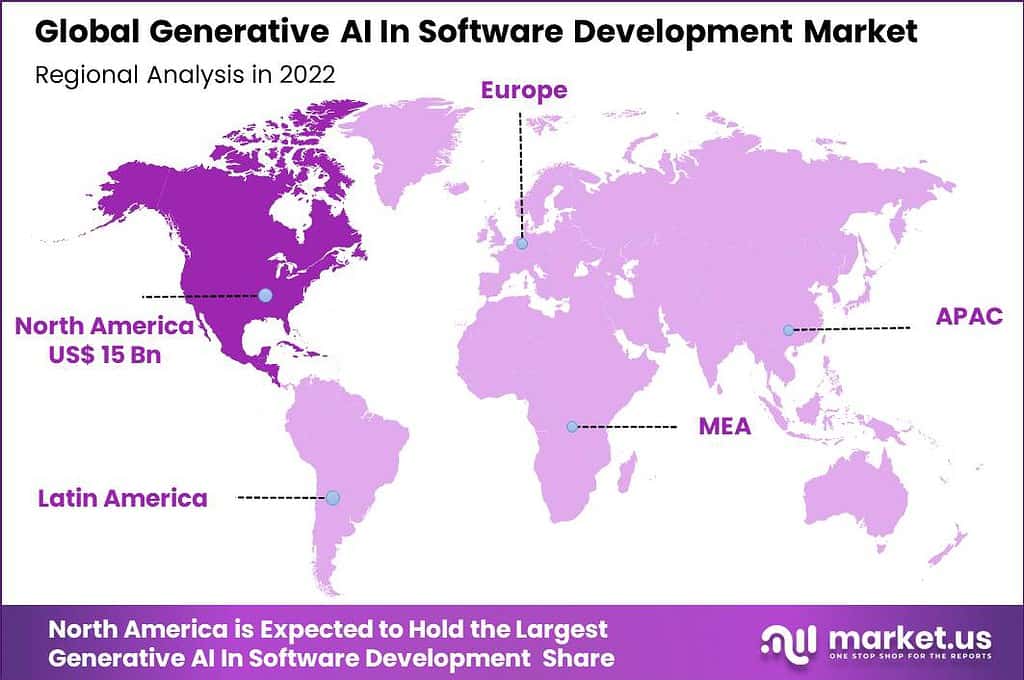
- In 2022, North America held a dominant market position in the application of generative AI in software development, capturing more than a 36.6% share.
- Microsoft’s research indicates that generative AI models can significantly enhance code accuracy, assisting developers in writing code with up to a 40% decrease in errors compared to traditional coding methods. This finding underscores the potential of AI tools to improve software quality and developer productivity.
- 45% of developers to adopt AI tools: A growing trend among software developers shows that nearly half plan to incorporate generative AI tools into their development workflows by the end of 2023. This reflects the increasing recognition of the value that AI can bring to software development processes.
- 25% reduction in software defects: The integration of generative AI with software testing and quality assurance processes is expected to lead to a substantial reduction in software defects. By enhancing the efficiency and accuracy of testing procedures, AI can contribute significantly to improving the overall quality of software products.
- According to a report, the demand for professionals with expertise in generative AI and software development is projected to grow by 30% in 2024. This anticipated increase highlights the importance of AI skills in the current job market and the need for education and training in this area.
- The use of generative AI in software development could result in cost savings of up to 25%. By reducing the time and effort required for coding and testing, AI technologies can significantly decrease development costs, thereby enabling more efficient use of resources.
- The SEI reports that the integration of generative AI with DevOps practices is expected to rise by 35% in 2024. This integration is set to enhance software delivery pipelines, enabling faster and more efficient delivery of software products to market.
Component Analysis
In 2022, the Services segment held a dominant position in the Generative AI in Software Development market, capturing a significant share. This predominance can be attributed to the increasing demand for customized AI solutions tailored to specific business needs. Organizations are increasingly seeking AI services that include installation, implementation, and continuous support, thereby driving the demand within this segment.
Services that facilitate the integration of AI into existing workflows and provide ongoing maintenance and updates are crucial for businesses aiming to stay competitive and innovative. As companies recognize the value of these services in enhancing operational efficiency and generating novel insights, the demand for specialized AI services has surged.
Moreover, the Services segment is leading due to the growing emphasis on AI-driven digital transformation strategies across industries. Companies are investing in AI services to gain a competitive edge, improve customer experiences, and optimize their processes. The integration of generative AI technologies through services allows businesses to leverage AI for developing software more rapidly and with greater creativity, further fueling the segment’s growth.
The Services segment is not only pivotal in implementing generative AI solutions but also plays a critical role in educating and training the workforce to adapt to these new technologies. This educational aspect ensures that organizations can fully utilize AI capabilities, thereby solidifying the Services segment’s leading position in the market.
Deployment Mode Analysis
In 2022, the Cloud-Based segment held a dominant market position in the Generative AI in Software Development market, capturing more than a 60% share. This leadership can largely be attributed to the scalability, flexibility, and cost-effectiveness that cloud-based solutions offer.
Organizations across the globe are increasingly adopting cloud infrastructure, which enables the easy deployment and scaling of AI applications. This shift is driven by the need for businesses to remain agile and responsive to market demands without the burden of significant upfront investments in hardware and infrastructure. Cloud-based generative AI platforms facilitate the rapid development and deployment of software solutions, offering access to powerful computing resources and AI tools on-demand.
The Cloud-Based segment’s lead is further cemented by the growing emphasis on remote work and collaborative software development practices. With cloud-based services, teams distributed across different geographies can access the same resources and work on software projects concurrently, enhancing productivity and efficiency. This segment benefits from the continuous advancements in cloud technology, including improved security measures and integration capabilities, making it a preferred choice for companies aiming to leverage generative AI for innovation in software development.
Application Analysis
In 2022, the Code Generation segment held a dominant market position within the Generative AI in Software Development market. This segment captured a significant share, attributable to its pivotal role in enhancing productivity and efficiency in the software development process.
Code Generation, facilitated by Generative AI, automates the creation of source code based on predefined templates and rules. This not only accelerates the development cycle but also minimizes human errors, leading to a robust and error-free codebase. The adoption of Code Generation technologies has been spurred by the increasing demand for faster development cycles and the need to address the growing complexity of software applications.
The leadership of the Code Generation segment in the Generative AI in Software Development market can be further elucidated by examining its impact on reducing the technical debt and improving the maintainability of software projects. By automating routine and repetitive coding tasks, Generative AI enables developers to focus on more complex and creative aspects of software development, thereby enhancing innovation and productivity.
Key Market Segments
Based on Component
- Solutions
- Services
Based on Deployment Mode
- On-Premise
- Cloud-Based
Based on Application
- Code Generation
- Code Optimization
- Bug Detection
- Testing and Quality Assurance
- Other Applications
Driver
Increasing Demand for Agile Software Development
The pressing need for agile software development processes stands as a significant driver in the Generative AI in Software Development market. In the rapidly evolving digital landscape, businesses seek to accelerate their software development cycles to stay competitive.
Generative AI aids in meeting these demands by automating code generation, optimizing existing code, and facilitating faster iterations. This acceleration is crucial for companies aiming to quickly adapt to market changes, implement new features, or fix bugs.
The ability of Generative AI to enhance productivity and efficiency in software development processes, reducing the time from conception to deployment, is a key factor fueling its adoption. As organizations increasingly prioritize agility and speed in software development, the demand for Generative AI solutions is expected to rise, driving market growth.
Restraint
Concerns Over Code Quality and Reliability
Despite the advantages offered by Generative AI in software development, concerns regarding the quality and reliability of automatically generated code pose significant restraints. Skepticism arises from the fear that AI-generated code may not always adhere to best practices or meet the specific requirements of complex projects.
There’s also apprehension about the introduction of bugs or vulnerabilities that could compromise software security. These concerns are particularly pronounced in industries where software reliability and security are paramount, such as finance and healthcare. The hesitation to fully trust AI-generated code over human-reviewed code highlights the need for advancements in AI technologies to better understand nuanced project requirements and generate code that meets high standards of quality and security.
Opportunity
Integration with Emerging Technologies
The integration of Generative AI with other emerging technologies presents a vast opportunity for the software development market. Technologies such as blockchain, Internet of Things (IoT), and edge computing are reshaping industries by offering new ways to handle data, enhance security, and deliver services. Generative AI can play a pivotal role in developing software for these technologies by providing advanced code generation and optimization solutions that cater to their unique requirements.
For instance, AI can automate the creation of smart contracts for blockchain applications or optimize code for IoT devices to operate efficiently with limited computational resources. The ability of Generative AI to adapt and provide bespoke solutions for emerging technologies not only broadens its applicability but also positions it as a crucial tool in the next wave of digital transformation.
Challenge
Ensuring Ethical Use and Bias Mitigation
One of the foremost challenges facing the Generative AI in Software Development market is ensuring the ethical use of AI technologies and mitigating bias in generated code. As AI systems are trained on large datasets, there’s a risk of inheriting biases present in the training data, leading to unfair or discriminatory outcomes in software applications. This challenge is compounded by the opaque nature of some AI algorithms, making it difficult to trace how decisions are made or biases are introduced.
Ensuring that AI-generated code is free from bias and adheres to ethical standards requires continuous efforts in developing more transparent AI models, improving the quality of training data, and implementing rigorous testing protocols. Overcoming this challenge is critical for building trust in AI-generated software solutions and ensuring they contribute positively to society.
Growth Factors
Several growth factors contribute to the success and development of industries, businesses, and economies. Here are some key growth factors:
- Technological Advancements: Advances in technology drive growth by enabling innovation, improving efficiency, and creating new opportunities. Breakthroughs in areas such as AI, automation, cloud computing, and connectivity empower businesses to enhance their operations, develop new products and services, and reach wider markets.
- Globalization and Market Expansion: The interconnectedness of economies and markets through globalization opens up new avenues for growth. Access to international markets, supply chains, and collaborations allows businesses to expand their reach, tap into new customer bases, and capitalize on emerging trends and demands.
- Demographic Changes: Changes in population demographics can significantly impact growth. Factors such as population growth, urbanization, aging populations, and shifting consumer preferences influence market dynamics, create new markets, and drive demand for various products and services.
- Infrastructure Development: Adequate infrastructure, including transportation, communication networks, and energy systems, is crucial for economic growth. Investments in infrastructure enhance connectivity, productivity, and efficiency, facilitating business operations, trade, and overall economic development.
- Government Policies and Regulations: Favorable government policies and regulations can stimulate growth by providing a conducive business environment. Policies that support innovation, entrepreneurship, investment, and trade can attract businesses, encourage competition, and drive economic expansion.
- Consumer Behavior and Demand: Understanding and responding to evolving consumer behavior and demand is essential for growth. Adapting to changing preferences, providing personalized experiences, and delivering high-quality products and services that meet customer needs can drive business growth and customer loyalty.
- Investment in Research and Development: Investments in research and development (R&D) foster innovation and drive growth across industries. R&D activities lead to the development of new technologies, products, and processes, enabling companies to stay competitive, improve efficiency, and create value for customers.
Top Emerging Trends
- Artificial Intelligence (AI) and Machine Learning (ML): AI and ML continue to advance and find applications in various domains, including healthcare, finance, manufacturing, and customer service. These technologies enable automation, predictive analytics, and personalized experiences.
- Internet of Things (IoT): The IoT involves connecting everyday devices to the internet, enabling data collection, analysis, and automation. It has applications in smart homes, smart cities, healthcare monitoring, industrial automation, and more.
- 5G Technology: The rollout of 5G networks promises faster internet speeds, lower latency, and increased connectivity. It will enable advancements in areas like autonomous vehicles, remote surgeries, augmented reality, and high-definition streaming.
- Edge Computing: Edge computing brings data processing and computation closer to the source of data generation, reducing latency and improving efficiency. It is crucial for real-time applications, IoT devices, and data-intensive tasks.
- Cybersecurity: As technology advances, cybersecurity becomes increasingly important. Emerging trends include AI-powered threat detection, blockchain for secure transactions, and enhanced data privacy regulations.
- Renewable Energy: The shift towards renewable energy sources, such as solar and wind power, is gaining momentum. Advancements in energy storage, grid integration, and sustainable practices are driving the transition to a cleaner and more sustainable energy future.
Regional Analysis
In 2022, North America held a dominant market position in the application of generative AI in software development, capturing more than a 36.6% share. This prominence can be attributed to the region’s strong technological infrastructure and the presence of key industry players. The United States, as the central hub, drives innovation through substantial investments in AI research and development.
The demand for Generative AI In Software Development in North America was valued at USD 15 billion in 2023 and is anticipated to grow significantly in the forecast period. The ecosystem in North America is highly conducive to the adoption of advanced technologies, including generative AI, due to its mature IT infrastructure, a robust startup culture, and significant venture capital investment. Moreover, the region’s strong emphasis on innovation and technology adoption across industries, including healthcare, finance, and automotive, has spurred the integration of AI in software development processes.
Furthermore, North America’s leadership in the generative AI space is bolstered by its world-class academic and research institutions, which collaborate closely with the industry to push the boundaries of AI technology. Initiatives led by these institutions, alongside governmental support for AI research, have cultivated a skilled workforce adept in AI and machine learning technologies.
This skilled labor force is crucial for developing and implementing generative AI solutions, driving efficiency and creativity in software development. As a result, North America not only leads in the adoption and development of generative AI in software development but also sets global standards for innovation and application in this field.
Key Regions and Countries Covered in this Report:
- North America
- The US
- Canada
- Europe
- Germany
- France
- The UK
- Spain
- Italy
- Russia
- Netherland
- Rest of Europe
- APAC
- China
- Japan
- South Korea
- India
- New Zealand
- Singapore
- Thailand
- Vietnam
- Rest of Asia Pacific
- Latin America
- Brazil
- Mexico
- Rest of Latin America
- Middle East & Africa
- South Africa
- Saudi Arabia
- UAE
- Rest of MEA
Key Players Analysis
The landscape of generative AI in software development is shaped by a diverse range of key players, each contributing unique technologies, services, and innovations. These entities range from tech giants to startups, driving the evolution and adoption of generative AI across various sectors. Understanding the roles and offerings of these key players is crucial for grasping the market dynamics and future trends in this domain.
Top Market Leaders
- Microsoft
- IBM
- OpenAI
- DeepMind
- Amazon Web Services (AWS)
- Alibaba Cloud
- GitHub Copilot
- Hugging Face
- Codota
- SourceAI
- AI21 Labs
Recent Developments
- Google: In April 2023, Google introduced a cutting-edge Generative Code Transformer (GCT) model. This smart tool listens to what you need in plain English and then turns that into code, making developers’ lives a lot easier by speeding up the coding process.
- Microsoft: Come June 2023, Microsoft made a strategic move by acquiring CodeGenius, a startup known for its prowess in generative AI that helps with code completion. This addition is set to supercharge Microsoft’s development tools, making it easier for coders to get suggestions that can help them code better and faster.
- OpenAI: In March 2023, OpenAI rolled out an updated version of Codex, their AI that writes code. Now, it’s even smarter, supporting cool programming languages like Rust and Go. This means developers can get help writing more accurate code and spotting mistakes more easily.
- GitHub Copilot: January 2023 saw GitHub Copilot introduce a nifty feature called “Pair Programming Mode.” It’s like having a coding buddy that helps you write code together in real time, transforming how developers collaborate on projects.









