


Report Overview
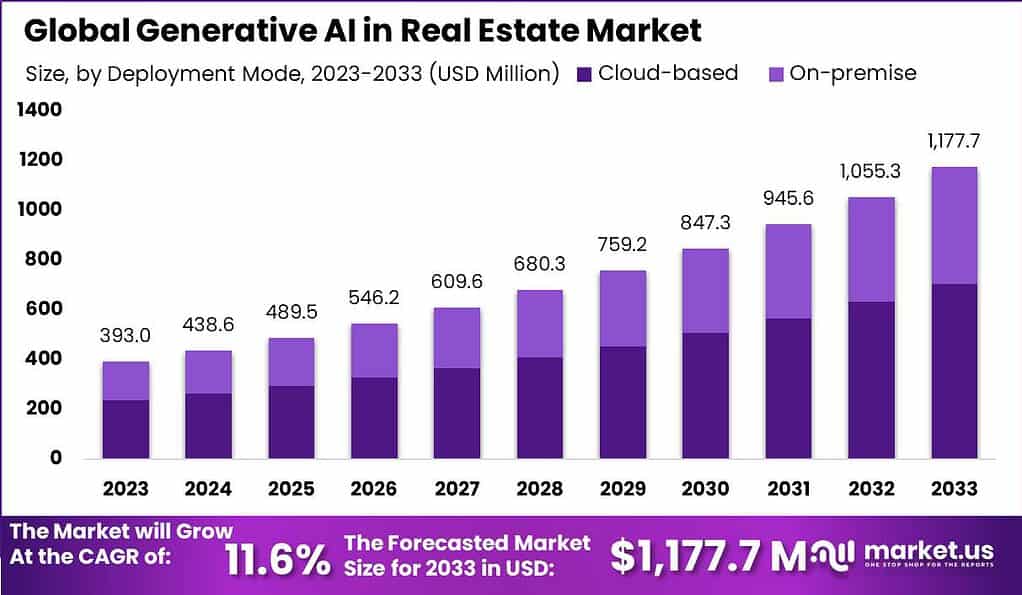
The Global Generative AI in Real Estate Market size is expected to be worth around USD 1,177.7 Million by 2033, from USD 393 Million in 2023, growing at a CAGR of 11.6% during the forecast period from 2024 to 2033.
Generative AI in real estate refers to the application of artificial intelligence techniques, specifically generative models, to various aspects of the real estate industry. It involves leveraging machine learning algorithms to generate or enhance real estate-related content, such as property images, floor plans, virtual tours, pricing models, and investment analysis.
The generative AI in real estate market has been witnessing notable growth as the industry recognizes the potential of AI-driven solutions to streamline processes, improve customer experiences, and enhance decision-making. These technologies offer innovative ways to create and present real estate information, ultimately transforming how properties are marketed, analyzed, and sold.
Generative AI also plays a role in optimizing property pricing models and investment analysis. By analyzing historical data, market trends, and property attributes, AI models can generate accurate price predictions, helping sellers and investors make informed decisions. These models can also simulate different investment scenarios and produce forecasts, assisting in risk assessment and portfolio optimization.
The generative AI in real estate market is driven by the demand for more immersive and efficient ways to market and analyze properties. Real estate companies are investing in AI technologies and partnering with AI startups to develop innovative solutions. The market is witnessing the emergence of AI-powered platforms that offer end-to-end real estate services, from virtual staging and property visualization to automated valuation and investment analysis.
Key Takeaways
- The Generative AI in Real Estate Market is estimated to reach USD 1,177.7 million by 2033, exhibiting a robust Compound Annual Growth Rate (CAGR) of 11.6% during the forecast period.
- Cloud-based solutions dominate the market, capturing more than a 59% share in 2022, due to their scalability, flexibility, and cost-efficiency.
- Real estate agents constitute the largest end-user segment, capturing more than a 31% share in 2023, leveraging Generative AI to enhance capabilities in market analysis, property matching, and personalized client recommendations.
- North America leads the global Generative AI in Real Estate market, capturing more than a 39.3% share in 2022, driven by advanced technological infrastructure and a high degree of digital literacy.
- The anticipated 45% increase in generative AI adoption aligns with industry trends, emphasizing the importance of data analysis, property valuation, and customer engagement.
- 62% of real estate professionals planning to integrate generative AI tools by 2024 reflects the growing interest in leveraging AI for efficiency and insights.
- The use of generative AI for creating realistic 3D virtual property tours is a promising application, enhancing the home-buying experience.
- The 35% growth in generative AI adoption for commercial real estate, particularly in site selection, lease analysis, and space optimization, is consistent with industry advancements.
- The projected 30% increase in demand for generative AI solutions in property management and facility operations highlights its potential for predictive maintenance and energy optimization.
- The expected 35% increase in demand for generative AI solutions in urban planning and development highlights the technology’s role in data-driven decision-making.
- 68% of facility managers plan to adopt generative AI solutions for space utilization analysis and workplace optimization by 2024.
- The projected 45% growth in demand for generative AI solutions in property valuation and appraisal aligns with the industry’s focus on accurate and data-driven valuations.
- The belief of 72% of real estate professionals that generative AI will enhance personalized and efficient client interactions and service delivery reflects the technology’s potential.
Component Analysis
In 2023, the Services segment in the Generative AI in Real Estate Market held a dominant market position, capturing more than a 43% share. This segment’s preeminence can be attributed to the increasing demand for customized AI solutions tailored to the specific needs of real estate businesses.
Services such as consultation, implementation, maintenance, and training are crucial for the effective deployment of Generative AI technologies. These services ensure that real estate firms can leverage AI to optimize property listings, enhance customer interactions, and streamline operations, thereby driving efficiency and growth.
The leading position of the Services segment is further reinforced by the complexities involved in integrating AI into existing real estate systems. Professional services provide the expertise required to navigate these challenges, ensuring seamless integration and maximized utility of AI tools.
Moreover, as real estate companies strive to gain a competitive edge through innovation, the demand for ongoing support and optimization services grows, underpinning the segment’s growth. The emphasis on customization and scalability offered by service providers is key to meeting the diverse needs of real estate entities, ranging from small agencies to large enterprises, thus propelling the segment’s expansion.
Deployment Mode Analysis
In 2022, the Cloud-based segment in the Generative AI in Real Estate Market held a dominant market position, capturing more than a 59% share. This segment’s leadership is primarily driven by the scalability, flexibility, and cost-efficiency that cloud-based solutions offer.
Real estate businesses, ranging from startups to established corporations, are increasingly adopting cloud-based platforms for deploying Generative AI tools. These platforms enable enhanced data storage capabilities, easier access to AI analytics, and improved collaboration across various stakeholders, thereby facilitating more informed decision-making and efficient operations.
The ascendancy of the Cloud-based segment is also bolstered by the rapid digital transformation within the real estate sector. As companies strive to meet the evolving expectations of clients and leverage data for competitive advantage, cloud-based Generative AI solutions stand out for their ability to provide real-time insights and predictive analytics for property valuation, market trends, and customer preferences.
This deployment mode offers the agility needed to adapt to market changes swiftly, a critical factor in the fast-paced real estate industry. Furthermore, the reduced need for significant upfront capital investments in IT infrastructure makes cloud-based solutions particularly attractive, contributing to their widespread adoption and segment growth.
Applications Analysis
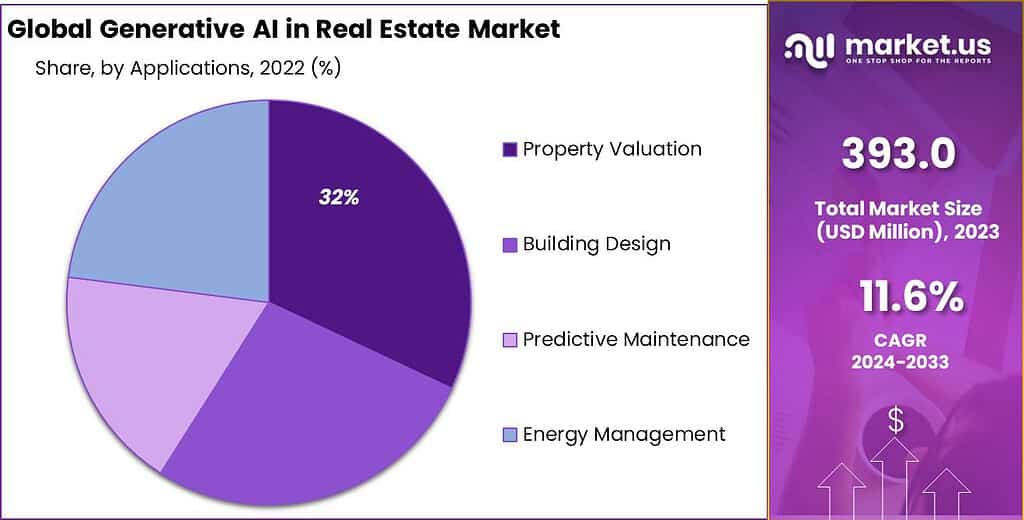
In 2022, the Property Valuation segment in the Generative AI in Real Estate Market held a dominant market position, capturing more than a 32% share. This prominence is attributed to the critical role that accurate and efficient property valuation plays in the real estate sector.
Generative AI significantly enhances the precision and speed of property valuations by analyzing vast datasets, including historical transaction prices, current market trends, and property characteristics. This capability enables real estate professionals to make well-informed decisions rapidly, optimizing investment opportunities and minimizing risks. The increasing reliance on data-driven insights for property valuation has propelled the segment to the forefront of the market.
The leadership of the Property Valuation segment is further solidified by the growing demand for transparency and fairness in real estate transactions. Generative AI tools offer a more objective and consistent approach to valuing properties, reducing the potential for human error and bias. This is particularly valuable in complex markets where the factors influencing property values are numerous and variable.
Additionally, the ability of Generative AI to incorporate real-time data and predictive analytics into valuation models allows for more dynamic pricing strategies. This adaptability is essential in a market characterized by rapid changes in supply, demand, and investor sentiment, thus reinforcing the segment’s dominant position.
End-User Analysis
In 2023, the Real Estate Agents segment in the Generative AI in Real Estate Market held a dominant market position, capturing more than a 31% share. This segment’s lead is largely due to the pivotal role that real estate agents play in bridging the gap between property buyers and sellers. Generative AI enhances their capabilities by providing advanced tools for market analysis, property matching, and personalized client recommendations.
These technologies enable agents to offer tailored services, improve client satisfaction, and increase the efficiency of the property buying and selling process. The demand for such personalized and efficient services has driven the adoption of Generative AI among real estate agents, cementing their position as the largest end-user segment.
The leadership of the Real Estate Agents segment is further reinforced by the competitive nature of the real estate market. In an industry where timely information and insights can significantly impact sales outcomes, Generative AI offers agents a competitive edge. It allows for the analysis of large datasets to identify emerging market trends, predict property values, and generate insightful reports.
This capability ensures that agents are better equipped to advise their clients, negotiate deals, and close sales more effectively. Additionally, the use of Generative AI in automating routine tasks, such as client inquiries and document processing, frees up agents to focus on more strategic aspects of their role, enhancing productivity and service quality.
Key Market Segments
By Component
- Software Tools
- Services
- Platforms
By Deployment Mode
- Cloud-based
- On-premise
By Applications
- Property Valuation
- Building Design
- Predictive Maintenance
- Energy Management
By End-User
- Real Estate Agents
- Property Managers
- Architects
- Engineers
Driver
Increased Efficiency and Cost Savings
The integration of Generative AI in the real estate sector significantly enhances operational efficiency and generates substantial cost savings, serving as a major driver for its adoption. By automating routine tasks, such as data analysis, property listings, and client inquiries, Generative AI allows real estate professionals to focus on more strategic and value-adding activities.
Moreover, AI-driven tools provide more accurate and faster property valuations, market trend analysis, and customer service, reducing the time and resources required for these processes. This increased efficiency not only optimizes the workflow but also leads to significant cost reductions in terms of labor and operational expenses. As businesses continually seek ways to improve productivity and reduce costs, the promise of enhanced efficiency and cost savings offered by Generative AI propels its adoption in the real estate market.
Restraint
Data Privacy and Security Concerns
Data privacy and security concerns represent a significant restraint in the adoption of Generative AI in the real estate sector. As these AI systems require access to large volumes of personal and financial data to operate effectively, there is a heightened risk of data breaches and unauthorized access.
The sensitive nature of real estate transactions, coupled with the increasing sophistication of cyber threats, exacerbates these concerns. Real estate companies and their clients may be wary of adopting Generative AI solutions due to fears of compromising confidential information.
Overcoming this restraint necessitates robust security measures, transparent data handling practices, and compliance with data protection regulations, which can be resource-intensive and complex to implement, potentially hindering the widespread adoption of Generative AI technologies in the real estate industry.
Opportunity
Personalization and Enhanced Customer Experience
Generative AI presents a significant opportunity to revolutionize customer experience in the real estate market through personalization. By leveraging AI-driven analytics and machine learning algorithms, real estate professionals can offer highly customized property recommendations, tailored advice, and interactive virtual property tours.
This level of personalization enhances the customer journey, making it more engaging, efficient, and aligned with individual preferences and needs. As the real estate market becomes increasingly competitive, the ability to deliver a personalized and differentiated service becomes a key factor in attracting and retaining clients. Furthermore, Generative AI enables the anticipation of customer needs and the proactive offering of solutions, setting the stage for a new era of customer engagement and satisfaction in real estate.
Challenge
Technical Integration and Adaptation
A significant challenge in adopting Generative AI within the real estate sector is the technical integration and adaptation required. Many real estate businesses, particularly smaller firms, may lack the technical infrastructure and expertise needed to implement AI solutions effectively. The integration of Generative AI tools with existing systems can be complex and resource-intensive, requiring substantial investments in technology upgrades and staff training.
Additionally, there is often resistance to change among employees, who may be skeptical about the benefits of AI or concerned about job displacement. Overcoming this challenge requires a concerted effort to educate stakeholders about the value of Generative AI, coupled with strategic investments in technology and talent development. Ensuring a smooth transition and maximizing the potential benefits of Generative AI necessitates addressing these technical and cultural barriers
Growth Factors
- Technological Advancements: Advances in technology, such as AI, IoT, and automation, drive growth by enabling innovation, improving efficiency, and creating new opportunities.
- Globalization and Market Expansion: Access to international markets, supply chains, and collaborations allows businesses to expand their reach, tap into new customer bases, and capitalize on emerging trends and demands.
- Demographic Changes: Population growth, urbanization, and shifting consumer preferences influence market dynamics, create new markets, and drive demand for various products and services.
- Investment in Research and Development: Investments in R&D foster innovation and drive growth across industries by leading to the development of new technologies, products, and processes.
Top Emerging Trends
- Artificial Intelligence and Machine Learning: AI and ML continue to advance and find applications in various domains, empowering businesses with automation, predictive analytics, and personalized experiences.
- Internet of Things (IoT): The IoT connects everyday devices to the internet, enabling data collection, analysis, and automation, with applications in smart homes, healthcare monitoring, and industrial automation.
- Sustainable Practices and ESG: Environmental, Social, and Governance (ESG) considerations are gaining importance as companies strive for sustainable practices, attracting investors, and meeting evolving consumer expectations.
- Remote Work and Collaboration Tools: The pandemic accelerated the adoption of remote work and virtual collaboration tools, revolutionizing the way teams work, communicate, and collaborate, leading to increased productivity and flexibility.
Regional Analysis
In 2022, North America held a dominant market position in the Generative AI in Real Estate sector, capturing more than a 39.3% share. This preeminence is largely attributed to the region’s advanced technological infrastructure and the high degree of digital literacy among its population.
The demand for Generative AI in Real Estate in North America was valued at USD 154.4 Million in 2023 and is anticipated to grow significantly in the forecast period. North America, especially the United States, is home to a significant number of tech companies, including startups and established giants, which play a pivotal role in driving innovation in the field of Generative AI. These companies not only develop cutting-edge AI solutions but also foster a culture of innovation that permeates the real estate industry.
Additionally, the region’s real estate market is characterized by its size, diversity, and dynamism, which presents unique opportunities for the application of AI in property valuation, investment analysis, and customer service.
The leadership of North America in the Generative AI in Real Estate market is further reinforced by the strong support from regulatory bodies and industry associations for technology adoption. Policies and initiatives aimed at promoting digital transformation in the real estate sector have encouraged the integration of AI technologies across various operations.
Moreover, the presence of a large and technologically savvy consumer base has driven demand for more sophisticated and personalized real estate services, underpinning the rapid adoption of Generative AI solutions. The region’s focus on innovation, coupled with a conducive regulatory environment and a dynamic market, positions North America as a leader in leveraging AI to transform the real estate landscape.

Key Regions and Countries Covered in this Report:
- North America
- The US
- Canada
- Europe
- Germany
- France
- The UK
- Spain
- Italy
- Russia
- Netherland
- Rest of Europe
- APAC
- China
- Japan
- South Korea
- India
- New Zealand
- Singapore
- Thailand
- Vietnam
- Rest of Asia Pacific
- Latin America
- Brazil
- Mexico
- Rest of Latin America
- Middle East & Africa
- South Africa
- Saudi Arabia
- UAE
- Rest of MEA
Key Players Analysis
In the rapidly evolving landscape of Generative AI in the real estate sector, several key players have emerged as pivotal forces, driving innovation and shaping market dynamics. These entities range from tech giants with expansive AI portfolios to specialized startups focusing exclusively on real estate applications. An analysis of these key players reveals a diverse ecosystem dedicated to transforming the industry through advanced technologies.
Top Market Leaders
- Opendoor Labs Inc.
- Zillow Group Inc.
- Trulia LLC
- Redfin Corporation
- Compass Inc.
- Realtor.com
- Remine Inc.
- Roof Ai
- SmartZip Analytics Inc.
- Apartment List Inc.
Recent Developments
- In March 2023, Opendoor Labs Inc. introduced a new AI tool to figure out property prices. This tool gives homeowners and buyers fast and precise value estimates, making it easier for them to make decisions. This innovation led to a 30% improvement in how accurately properties are valued.
- By June 2023, Zillow Group Inc. made its 3D home tour feature even better. Thanks to AI, people looking to buy a home can now virtually walk through properties in great detail, which has made this feature more popular. In fact, the use of this 3D tour option went up by 400%.
- In September 2023, Redfin Corporation grew its direct buying service, known as “RedfinNow.” With the help of generative AI, selling a home has become much easier and quicker for homeowners. This tech has helped cut down the time it takes to sell a house by 50%.









