


Report Overview
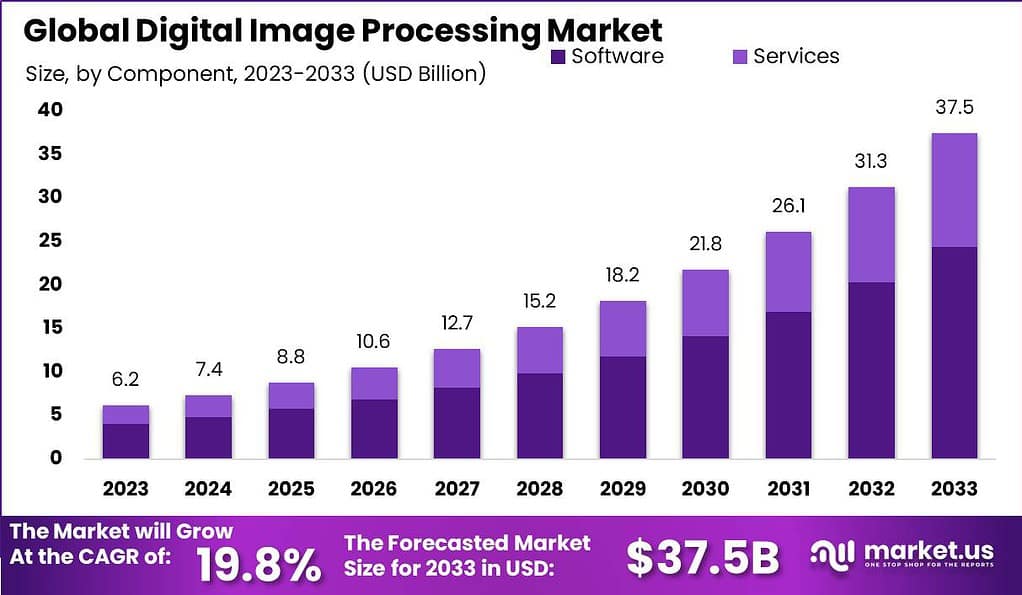
The Global Digital Image Processing Market size is expected to be worth around USD 37.5 Billion by 2033, from USD 6.2 Billion in 2023, growing at a CAGR of 19.8% during the forecast period from 2024 to 2033.
Digital image processing is a field of technology that involves the manipulation and analysis of digital images using computer algorithms. It focuses on improving the quality, enhancing the features, and extracting useful information from digital images. Digital image processing finds applications in various industries, including healthcare, entertainment, surveillance, and manufacturing.
The digital image processing market has experienced significant growth due to the increasing demand for advanced imaging technologies and the rising adoption of digital imaging solutions across industries. With the widespread availability of digital cameras and the exponential growth of digital image data, there is a need for efficient tools and techniques to process and analyze these images.
Digital image processing algorithms and software enable tasks such as image enhancement, restoration, segmentation, object detection, and pattern recognition. This expansion is fueled by advancements in AI and machine learning, increasing the demand for image processing in applications like autonomous vehicles, facial recognition, and augmented reality.
Healthcare is a significant sector, where image processing helps diagnose diseases more accurately through enhanced medical imagery. The market’s growth is also driven by the rising use of smartphones and cameras, requiring powerful image processing for better image quality. However, the digital image processing market also faces challenges. Dealing with large and complex image datasets requires efficient computational resources and storage capabilities.
The digital image processing market offers significant opportunities. The integration of digital image processing with other emerging technologies, such as artificial intelligence (AI) and machine learning, allows for advanced image recognition, automated analysis, and predictive modeling. The increasing demand for image-based quality control in manufacturing processes and the growth of autonomous vehicles create avenues for image processing solutions.
By 2023, it is estimated that over ~85% of smartphones will be equipped with advanced digital image processing capabilities, including multi-frame noise reduction and super-resolution. This underscores the critical role of digital image processing in enhancing mobile photography and videography.
In 2024, the global demand for digital image processing in medical imaging applications is expected to grow by ~20% compared to 2023. This growth is indicative of the technology’s importance in improving the accuracy and efficiency of medical diagnostics.
Key Takeaways
- The Digital Image Processing Market is estimated to achieve a substantial worth of approximately USD 37.5 billion by 2033, exhibiting a robust Compound Annual Growth Rate (CAGR) of 19.8% from 2024 to 2033
- In 2023, the Software segment held a dominant position in the Digital Image Processing Market, capturing more than a 65% share.
- The Object Recognition segment held a dominant market position in 2023, capturing over 28% share.
- In 2023, North America held a dominant market position, capturing over 39% share, driven by robust technological infrastructure and investments in research and development.
- The adoption of digital image processing in autonomous vehicles for perception and navigation is expected to increase by 30% year-over-year in 2024. This highlights the technology’s pivotal role in enabling safer and more reliable autonomous driving systems.
- In 2024, the use of digital image processing in satellite imaging and remote sensing for environmental monitoring is projected to grow by ~22% compared to 2023. This reflects the increasing reliance on digital image processing for critical earth observation tasks.
- The adoption of digital image processing in augmented reality (AR) and virtual reality (VR) applications is expected to increase by ~35% year-over-year in 2024. This growth demonstrates the technology’s contribution to more immersive AR and VR experiences.
- By 2023, it is projected that over 70% of security and surveillance systems will incorporate digital image processing for object detection, tracking, and recognition. This underscores the technology’s role in enhancing security measures.
- It is estimated that over 60% of digital cameras will employ advanced image processing algorithms for computational photography, such as HDR and panorama stitching, by 2023. This indicates the ongoing evolution of digital photography.
- The use of digital image processing in remote sensing and earth observation applications is projected to grow by ~18.1% compared to 2023, in 2024. This growth is a testament to the technology’s increasing application in monitoring and managing natural resources.
- By 2023, it is expected that over 80% of video game consoles and graphics cards will incorporate digital image processing for real-time rendering and visual effects. This highlights the importance of digital image processing in enhancing gaming experiences.
- Over 70% of video conferencing and collaboration platforms are expected to utilize digital image processing for background blur, virtual backgrounds, and video enhancement by 2023. This reflects the technology’s role in improving virtual communication.
- It is estimated that over 60% of digital signage and outdoor displays will employ digital image processing for content optimization and image enhancement by 2023. This demonstrates the technology’s application in advertising and public information dissemination.
- By 2023, over 80% of social media platforms and photo-sharing apps are expected to incorporate advanced digital image processing for image enhancement and filtering. This underscores the technology’s influence on social media content creation and sharing.
Component Analysis
In 2023, the Software segment held a dominant position in the Digital Image Processing Market, capturing more than a 65% share. This substantial market share can be attributed to the increasing demand for digital image processing software across various industries, including healthcare, automotive, and consumer electronics.
The surge in demand is primarily due to the software’s ability to provide advanced solutions for image enhancement, analysis, and manipulation, which are essential for improving the quality and efficiency of digital imaging applications.
The leadership of the Software segment in the Digital Image Processing Market is further reinforced by the continuous technological advancements in artificial intelligence (AI) and machine learning (ML) algorithms. These technologies have significantly improved the capabilities of digital image processing software, enabling more accurate and efficient processing of large volumes of images.
Additionally, the growing trend towards automation and the digital transformation of industries have necessitated the adoption of sophisticated image processing software, thus driving the segment’s growth. The software’s versatility and scalability in addressing the complex requirements of digital imaging processes across different sectors are key factors contributing to its leading position in the market.
Application Analysis
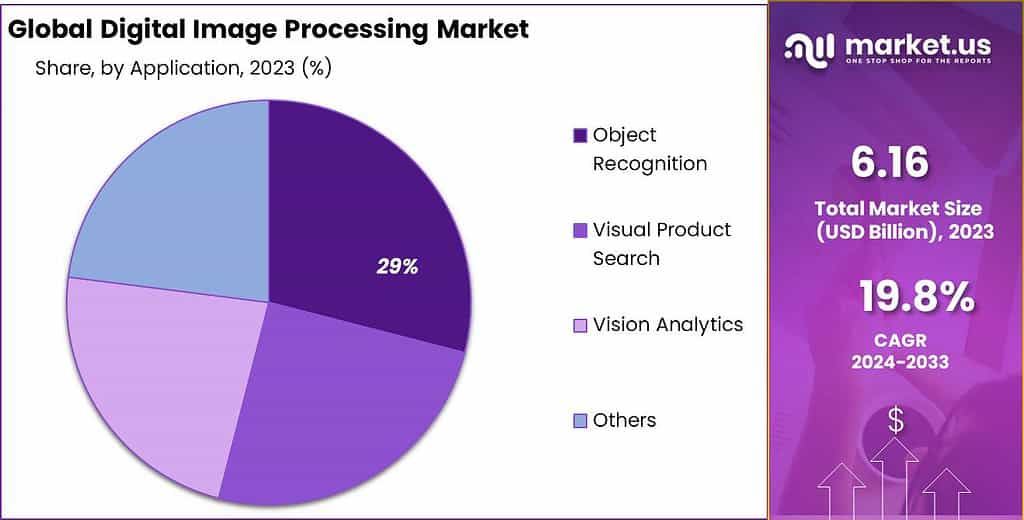
In 2023, the Object Recognition segment held a dominant market position within the Digital Image Processing market, capturing more than a 28% share. This leadership can be attributed to its widespread application across various industries, including automotive, healthcare, and retail.
Object recognition technology, pivotal for automating and enhancing security systems, manufacturing processes, and customer shopping experiences, has seen rapid adoption. The integration of artificial intelligence and machine learning has further propelled this segment’s growth, enabling more accurate and swift identification of objects in real-time.
The demand for object recognition technologies has been driven by their utility in enhancing operational efficiency and consumer engagement. For instance, in retail, visual product search powered by object recognition allows customers to find products with just a photo, significantly enhancing the shopping experience.
Similarly, in the automotive sector, this technology is integral to the development of autonomous vehicles, contributing to safer and more efficient transportation. The surge in smart city initiatives worldwide, aiming to incorporate technology into urban management, further underscores the importance of object recognition in traffic management and public safety, substantiating its leading position in the market.
Key Market Segments
By Component
- Software
- Services
By Application
- Visual Product Search
- Object Recognition
- Vision Analytics
- Others
Driver
Advancements in AI and Machine Learning
The proliferation of artificial intelligence (AI) and machine learning (ML) technologies serves as a significant driver for the digital image processing market. These technologies enhance the capability of image processing systems to analyze, interpret, and make decisions based on visual data.
AI and ML enable the automation of complex tasks such as facial recognition, object detection, and pattern identification, which are crucial in various applications including security surveillance, autonomous driving, and medical imaging.
The integration of AI and ML not only improves the accuracy and efficiency of image processing but also opens up new possibilities for innovative applications. As AI and ML technologies continue to evolve, their application in digital image processing is expected to expand, driving further growth in the market.
Restraint
High Costs of Implementation
One of the main restraints facing the digital image processing market is the high cost associated with the implementation of advanced image processing systems. These costs include not only the initial investment in software and hardware but also ongoing expenses related to maintenance, upgrades, and training personnel to operate the systems.
Small and medium-sized enterprises (SMEs) may find these costs particularly prohibitive, limiting their ability to adopt cutting-edge image processing technologies. Additionally, the complexity of integrating these systems into existing infrastructures can further escalate costs, making it challenging for some organizations to justify the investment. This financial barrier can hinder the widespread adoption of digital image processing solutions across various industries, affecting the overall growth of the market.
Opportunity
Expansion into Emerging Markets
Emerging markets present a significant opportunity for the digital image processing industry. As countries in regions such as Asia-Pacific, Latin America, and Africa continue to experience rapid economic growth and digital transformation, the demand for advanced image processing technologies is expected to rise. These markets offer untapped potential for applications in sectors such as healthcare, where digital image processing can play a pivotal role in improving diagnostic accuracy and patient care.
Additionally, the increasing penetration of smartphones and internet connectivity in these regions opens up opportunities for mobile-based image processing applications. By focusing on the unique needs and challenges of emerging markets, companies in the digital image processing sector can tap into a new customer base, driving growth and innovation in the industry.
Challenge
Data Privacy and Security Concerns
As digital image processing technologies become increasingly integrated into various aspects of daily life and business operations, concerns regarding data privacy and security pose a significant challenge. The handling of sensitive visual information, particularly in applications such as surveillance and personal identification, raises questions about the protection of individual privacy rights.
Additionally, the risk of data breaches and unauthorized access to image databases underscores the need for robust security measures. These concerns can lead to regulatory challenges and public skepticism, potentially slowing the adoption of digital image processing solutions. Addressing these issues requires ongoing efforts to develop and implement advanced security protocols and ensure compliance with data protection regulations, which can be both time-consuming and costly.
Growth Factors
- Increasing Demand for Automated and Real-Time Image Processing: The growing need for automation across various industries, including manufacturing, healthcare, and automotive, drives the demand for real-time and automated image processing. This technology enhances efficiency, accuracy, and speed in tasks like quality control, diagnostics, and surveillance.
- Advancements in Computer Vision Technologies: Continuous improvements in computer vision and related technologies have expanded the capabilities and applications of digital image processing. Innovations such as deep learning algorithms and neural networks enhance the analysis and interpretation of visual data, fueling market growth.
- Expansion of IoT and Smart Devices: The proliferation of the Internet of Things (IoT) and smart devices has led to a surge in data generation, including visual content. Digital image processing plays a crucial role in analyzing this data for applications like smart home security, traffic management, and consumer behavior analysis.
- Healthcare Sector’s Digital Transformation: The digital transformation in healthcare, accelerated by the COVID-19 pandemic, has increased the reliance on digital image processing for medical imaging, telemedicine, and patient monitoring. This trend is expected to continue as healthcare providers seek to improve patient outcomes and operational efficiencies.
Emerging Trends
- AI-Driven Image Enhancement and Restoration: Artificial intelligence is revolutionizing image enhancement and restoration, improving the quality of images captured in less-than-ideal conditions. This trend is particularly impactful in fields such as forensic science, environmental monitoring, and historical preservation.
- Growth of Visual Commerce: Visual commerce, which includes technologies like AR/VR, visual search, and interactive product visualizations, is becoming increasingly popular in the retail sector. Digital image processing is key to creating immersive shopping experiences that drive engagement and sales.
- Adoption in Autonomous Vehicles: The integration of digital image processing in autonomous vehicles for navigation, obstacle detection, and traffic management is an emerging trend. As autonomous vehicles move closer to mainstream adoption, the demand for advanced image processing technologies is set to increase.
- Edge Computing for Image Processing: The shift towards processing images on the edge of networks, rather than in centralized data centers, is a growing trend. Edge computing reduces latency, improves privacy, and decreases the bandwidth needed for transferring large image files, making digital image processing more efficient and scalable
Regional Analysis
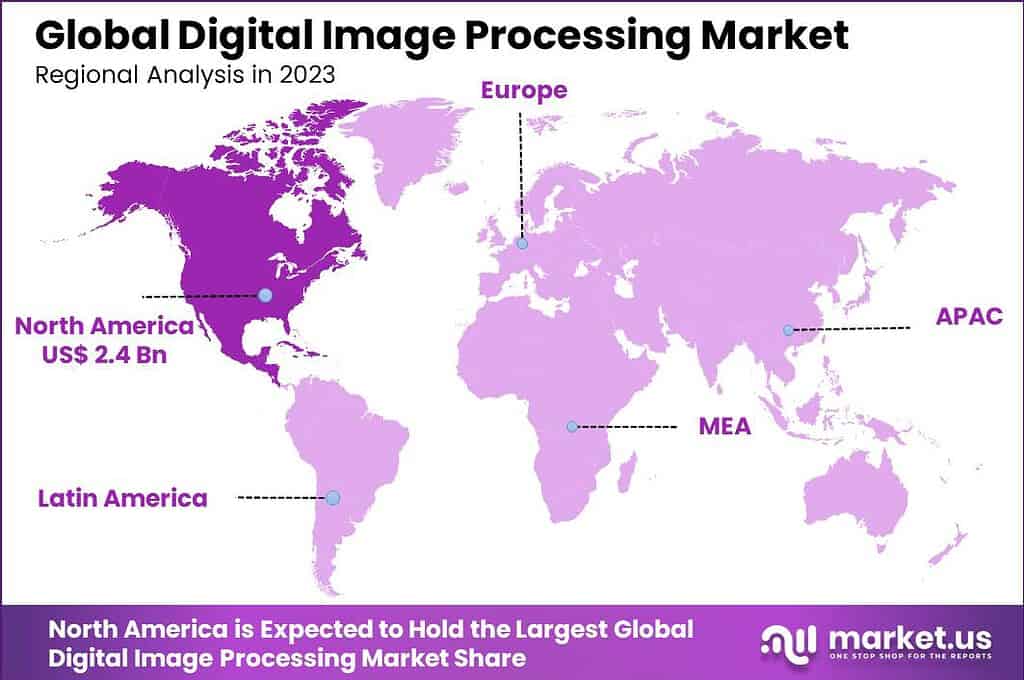
In 2023, North America held a dominant market position in the Digital Image Processing industry, capturing more than a 39% share. This leading stance is primarily attributed to the region’s robust technological infrastructure, high concentration of key market players, and significant investments in research and development activities.
The demand for Digital Image Processing in North America was valued at USD 2.4 billion in 2023 and is anticipated to grow significantly in the forecast period. North America, especially the United States, has been at the forefront of technological innovations, with its strong emphasis on adopting cutting-edge technologies such as artificial intelligence (AI), machine learning (ML), and advanced computing.
These technological advancements have been instrumental in driving the adoption of digital image processing across a myriad of sectors, including healthcare, automotive, and consumer electronics. The region’s market dominance is also bolstered by its sophisticated healthcare sector, which employs digital image processing in diagnostic procedures, patient monitoring, and treatment planning.
The automotive industry, another major contributor to North America’s lead, utilizes this technology in developing autonomous vehicles and enhancing safety features. Furthermore, the presence of leading technology giants and startups focused on AI and computer vision in this region stimulates innovation and adoption of digital image processing solutions, facilitating market growth.
Key Regions and Countries Covered in this Report:
- North America
- The US
- Canada
- Europe
- Germany
- France
- The UK
- Spain
- Italy
- Russia
- Netherland
- Rest of Europe
- APAC
- China
- Japan
- South Korea
- India
- New Zealand
- Singapore
- Thailand
- Vietnam
- Rest of Asia Pacific
- Latin America
- Brazil
- Mexico
- Rest of Latin America
- Middle East & Africa
- South Africa
- Saudi Arabia
- UAE
- Rest of MEA
Key Players Analysis
In the rapidly evolving landscape of the digital image processing market have been very active in making new products, growing their business, joining with other companies, making deals, and working together with others. several key players have established themselves as leaders, driving innovation and setting industry standards. Their contributions span a wide array of applications, from healthcare and automotive to consumer electronics and security. Here is an analysis of these key players, highlighting their market position, strategic initiatives, and areas of focus.
Top Market Leaders
- Nvidia Corporation
- Canon Inc.
- Samsung Electronics Co. Ltd.
- Panasonic Corporation
- Cognex Corporation
- Teledyne Technologies
- Vegavid Technology
- Visionary.ai.
- IBM
- Microsoft
- Other key players
Recent Developments
- Nvidia Corporation, January 2023: Announced the availability of the Nvidia Omniverse Replicator, a platform for creating synthetic data for training AI models used in digital image processing tasks
- Samsung Electronics Co. Ltd., September 2023: Launched the ISOCELL HP3 sensor, known for its high resolution and advanced image processing capabilities









