


Report Overview
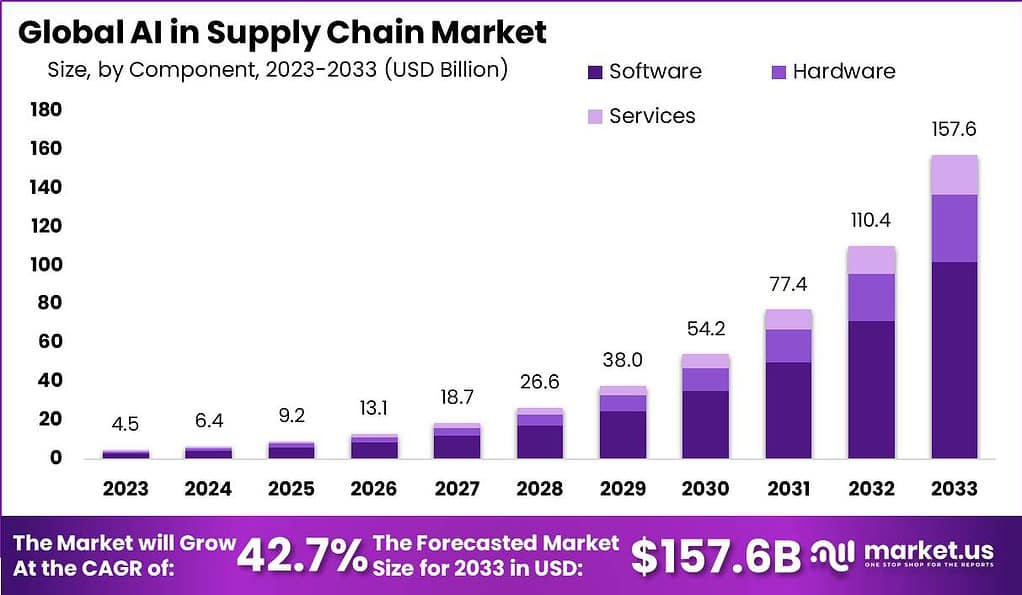
The Global AI in Supply Chain Market size is expected to be worth around USD 157.6 Billion by 2033, from USD 4.5 Billion in 2023, growing at a CAGR of 42.7% during the forecast period from 2024 to 2033.
Artificial intelligence (AI) is transforming the supply chain industry by enhancing efficiency, accuracy, and cost-effectiveness across various processes from procurement to customer delivery. AI technologies, such as machine learning, predictive analytics, and automation, are being integrated into supply chain management to optimize inventory levels, improve demand forecasting, and streamline logistics. These technologies help companies anticipate market demands, manage risks, and make informed decisions based on real-time data analysis.
The market for AI in supply chains is growing rapidly, driven by the increasing need for automation and more sophisticated data analysis capabilities in industries ranging from manufacturing to retail. Businesses are investing in AI solutions to gain a competitive edge through improved supply chain visibility and operational efficiency. This market expansion is supported by advancements in AI technology and the increasing availability of data, which together facilitate more effective supply chain solutions.
Key players in the AI in supply chain market are developing sophisticated AI solutions tailored to specific supply chain challenges. These solutions integrate with existing systems and leverage data from various sources, including sensors, IoT devices, and enterprise systems. The market is characterized by a diverse ecosystem of technology providers, system integrators, and consulting firms, all working together to harness the power of AI in transforming supply chain operations.
According to a study by Capgemini, 68% of supply chain organizations have adopted AI-enabled traceability and visibility solutions. This technology has significantly boosted transparency across the entire supply chain, leading to a notable 22% increase in efficiency. In 2023, around 70% of manufacturers employed AI-driven predictive maintenance techniques, which have proven to be highly effective.
Additionally, 75% of supply chain professionals utilized AI-powered data analytics in 2023. These tools have been instrumental in uncovering hidden insights, allowing for more informed and data-driven decisions. This strategic adoption of technology has been pivotal in enhancing supply chain management, helping organizations to handle complexities and boost efficiency more effectively.
Moreover, 82% of supply chain organizations have implemented AI-powered quality control and inspection systems, achieving a significant 18% reduction in product defects. The impact of AI-driven supply chain planning and optimization solutions has been substantial.
Early adopters have reported a 15% decrease in logistics costs and a remarkable 35% reduction in inventory levels. Furthermore, these companies have improved their service levels by an impressive 65%, markedly outperforming their slower-moving competitors. These advancements highlight the transformative effect of AI in streamlining supply chain operations and enhancing overall business performance
Key Takeaways
- The global AI in Supply Chain Market is projected to reach USD 157.6 billion by the end of 2033, with a remarkable Compound Annual Growth Rate (CAGR) of 42.7% over the forecast period from 2024 to 2033.
- Software Component: Held a dominant market position in 2023, capturing over 64.8% share. AI-driven software solutions play a crucial role in integrating artificial intelligence into supply chain operations, automating complex processes, and enhancing data analytics.
- Machine Learning Technology: Dominated the market with over 44% share in 2023. Its versatility and efficiency significantly improve precision and speed in supply chain management, especially in areas like demand forecasting and inventory management.
- Demand Forecasting: Led the market in 2023, capturing more than 35.3% share. AI-driven demand forecasting enhances the accuracy of predictions, optimizing inventory levels, and reducing costs. It also improves responsiveness to market changes, providing a competitive edge to businesses.
- Retail Industry: Held a dominant market position in 2023, with over 24.1% share. Retailers extensively adopt AI technologies to streamline operations, optimize stock levels, and improve customer experiences through personalized marketing.
- North America: Dominated the market in 2023, with over 37.9% share. Rapid adoption of advanced technologies, substantial investments in AI research and development, and a strong focus on improving supply chain transparency contribute to its leadership position.
Component Analysis
In 2023, the Software segment held a dominant market position in the AI in Supply Chain Market, capturing more than a 64.8% share. This segment’s leadership can be attributed to the essential role that software solutions play in integrating artificial intelligence into supply chain operations.
AI-driven software helps businesses automate complex processes, enhance data analytics, and improve decision-making accuracy, which are crucial for optimizing supply chain efficiency and reducing operational costs. AI software solutions are increasingly being adopted for tasks such as inventory management, demand forecasting, route optimization, and freight brokerage, all of which contribute to streamlined supply chain operations.
For instance, AI-powered predictive analytics tools are instrumental in forecasting product demands based on historical data and market trends, thereby allowing companies to adjust their production schedules and inventory levels accordingly. Moreover, the continuous advancements in machine learning algorithms and the increasing availability of cloud-based AI solutions are further driving the growth of the Software segment.
These technological improvements enhance the scalability and accessibility of AI solutions, making them more attractive to a broader spectrum of businesses, from startups to large enterprises. The deployment of cloud-based AI solutions also reduces the need for substantial upfront investments in hardware, which is particularly appealing to companies looking to implement AI without significant capital expenditures.
Technology Analysis
In 2023, the Machine Learning segment held a dominant market position in the AI in Supply Chain Market, capturing more than a 44% share. This leadership stems primarily from the versatility and efficiency that machine learning (ML) technologies bring to supply chain management.
Machine learning enables the automation of various decision-making processes within the supply chain, significantly improving precision and speed compared to traditional methods. Its ability to analyze large datasets and generate actionable insights is particularly valuable in managing complex logistics operations, forecasting, and inventory management.
Machine learning’s impact is profound in areas such as demand forecasting, where it analyzes historical sales data to predict future demand trends with high accuracy. This capability allows companies to optimize their inventory levels, thereby reducing costs associated with overstocking or understocking. Additionally, ML algorithms are instrumental in route optimization for transportation and delivery, which minimizes delays and reduces fuel consumption, leading to cost savings and environmental benefits.
Furthermore, the continued development and integration of machine learning technology in supply chain applications are being supported by increased investments from major tech companies. These investments are not only enhancing the capabilities of existing ML solutions but are also fostering innovation, leading to the creation of more advanced and specialized applications.
Application Analysis
In 2023, the Demand Forecasting segment held a dominant position in the AI in supply chain market, capturing more than a 35.3% share. This segment leads primarily due to its critical role in enhancing the accuracy of predictions regarding future product demands, which significantly optimizes inventory levels and reduces costs.
Advanced algorithms and machine learning techniques analyze historical sales data, market trends, consumer behavior, and external factors such as economic shifts or seasonal changes. This enables companies to make informed decisions about production and distribution, minimizing overproduction and shortages which are costly to any supply chain.
The efficacy of AI in Demand Forecasting extends to improving responsiveness to market changes. For instance, AI systems can rapidly adjust forecasts in real-time based on new information, providing a competitive edge to businesses that need to adapt quickly to changing consumer preferences or supply disruptions.
Furthermore, the integration of AI with IoT devices and real-time data streams enhances the precision of forecasts, allowing for even finer adjustments in supply chain operations. This adaptability is crucial in volatile markets and is a key driver behind the substantial market share held by the Demand Forecasting segment.
Moreover, the strategic benefits of AI-driven Demand Forecasting include better resource allocation and enhanced supply chain visibility. Companies utilizing AI in this capacity can allocate their resources more efficiently, ensuring optimal investment in inventory and logistics.

End-Use Industry Analysis
In 2023, the Retail segment held a dominant market position within the AI in supply chain market, capturing more than a 24.1% share. This segment’s leadership is largely attributed to the extensive adoption of AI technologies to streamline operations and enhance customer experiences.
Retailers are leveraging AI for a variety of functions, including inventory management, customer demand forecasting, and personalized marketing. These applications help reduce operational costs, optimize stock levels, and improve sales by aligning product availability with consumer demands efficiently.
AI-driven solutions in the Retail sector also contribute to significant enhancements in customer service and satisfaction. Through predictive analytics, retailers can anticipate market trends, adjust their inventory in real-time, and manage supply chain disruptions proactively.
Additionally, AI enables more effective data integration from multiple sources, leading to more accurate demand forecasts and better supply planning. This capability is crucial for maintaining competitiveness in the fast-paced retail industry, where consumer preferences and trends change rapidly.
Furthermore, the application of AI in retail extends to improving the logistics of order fulfillment. Automated warehouses, intelligent logistics solutions, and advanced delivery systems powered by AI have transformed how products are stored, picked, and shipped.
Key Market Segments
By Component
- Software
- Hardware
- Services
By Technology
- Machine Learning
- Computer Vision
- Natural Language Processing (NLP)
- Other Technologies
Application
- Inventory Management
- Demand Forecasting
- Fleet Management
- Supplier Management
- Other Applications
End-Use Industry
- Retail
- Transportation & Logistics
- Automotive
- Food & Beverage
- Consumer Goods & Electronics
- Healthcare
- Other End-Use Industries
Driver
Increased Efficiency and Cost Savings
One of the primary drivers of AI adoption in the supply chain is the potential for increased efficiency and significant cost savings. AI technologies, particularly machine learning and predictive analytics, allow businesses to automate complex decision-making processes involved in supply chain management. This automation reduces human error and increases the speed of operations, enabling companies to respond more quickly to market changes and customer demands.
AI-driven tools optimize inventory management, enhance demand forecasting, and improve transportation logistics, leading to lower operational costs and increased profitability. The ability to process and analyze large volumes of data in real-time helps businesses to make informed decisions, reduce waste, and manage resources more effectively, all of which contribute to greater efficiency and reduced costs.
Restraint
Data Privacy and Security Concerns
A significant restraint in the adoption of AI in supply chains is the concern over data privacy and security. Supply chains involve the handling of sensitive information, including personal data of customers and detailed insights into company operations. The integration of AI necessitates the collection, processing, and storage of vast amounts of data, raising concerns about the vulnerability of these systems to cyber-attacks and data breaches.
Businesses are cautious about adopting AI technologies without robust security measures in place, which can be costly and complex to implement. Additionally, regulatory compliance with data protection laws such as GDPR in Europe and CCPA in California imposes additional layers of complexity and risk, potentially slowing down the integration of AI into existing supply chain systems.
Opportunity
Expansion into Emerging Markets
AI in supply chains presents a significant opportunity for expansion into emerging markets. These markets often face challenges such as less developed infrastructure and more volatile market conditions, which AI can help mitigate. By leveraging AI for predictive analytics and demand forecasting, businesses can better understand and adapt to the unique needs and consumption patterns of these regions.
AI can also assist in optimizing logistical operations to overcome infrastructural constraints, thereby ensuring smoother operations. Furthermore, the deployment of AI-powered solutions in emerging markets can enable companies to gain a competitive edge by enhancing their responsiveness and customer service, positioning them as leaders in untapped markets.
Challenge
Integration with Existing Systems
A major challenge in implementing AI in supply chains is the integration of advanced AI technologies with existing legacy systems. Many supply chain operations still rely on outdated technology that may not be compatible with the latest AI solutions. The cost and complexity of upgrading these systems can be substantial, posing a significant barrier to AI adoption.
Additionally, there is often a skills gap within the workforce, as employees must be trained to work with new AI tools effectively. This integration issue requires significant investment in both technology and personnel training, which can delay the realization of AI’s benefits in supply chain management.
Emerging Trends
- Actionable AI: This trend emphasizes AI’s role in enhancing decision-making by learning from past decisions and adapting to changing circumstances, which is crucial for dynamic supply chain environments.
- Smart Operations: Extending beyond manufacturing, this involves integrating AI across various operational facets like logistics and global trade to optimize performance.
- Mobile Asset Optimization: This focuses on using sensory technologies and business process software to maximize the utilization and monitoring of mobile assets, such as in transportation and warehousing.
- Industry Cloud Platforms: These platforms are evolving to provide industry-specific capabilities in a more modular and agile way, greatly benefiting supply chain management by enhancing flexibility and scalability.
- Cyber Resilient Supply Chains: With the growing integration of digital technologies, maintaining cybersecurity has become crucial, especially as supply chains become more digitally interconnected.
Growth Factors
- Increased Data Utilization: Leveraging big data analytics for improved forecasting accuracy and operational efficiency remains a fundamental growth driver.
- Focus on Sustainability: With rising environmental concerns, companies are increasingly integrating sustainable practices into their supply chains, which not only helps in meeting regulatory requirements but also improves brand reputation.
- Resilience and Risk Management: Building resilient supply chains capable of withstanding various disruptions – from pandemics to geopolitical tensions – is increasingly critical.
- E-commerce Growth: The surge in online shopping necessitates supply chains to become more agile and integrated to handle increased online consumer demands efficiently.
- Technological Integration: The adoption of technologies like IoT, blockchain, and AI-driven automation tools is crucial for modernizing supply chains and ensuring competitiveness in the global market.
Regional Analysis
In 2023, North America held a dominant market position in the AI in supply chain market, capturing more than a 37.9% share. This significant market share is primarily due to the region’s rapid adoption of advanced technologies and the presence of major technology leaders and innovators in the United States and Canada.
The demand for AI in Supply Chain in North America was valued at USD 1.7 billion in 2023 and is anticipated to grow significantly in the forecast period. North American companies are at the forefront of integrating AI into their supply chain operations, driven by the need to enhance operational efficiency and maintain competitiveness in global markets. This integration is supported by substantial investments in AI research and development, as well as a robust technological infrastructure.
The leadership of North America in this market is also bolstered by the region’s strong focus on improving supply chain transparency and reducing operational risks. AI technologies are employed extensively to predict disruptions, optimize routes, and manage inventories more effectively. This proactive approach to supply chain management not only minimizes costs but also improves the responsiveness of businesses to changing market conditions.
Moreover, the stringent regulations regarding supply chain operations in many North American industries compel companies to adopt advanced AI solutions to ensure compliance and efficiency. Additionally, the presence of a highly skilled workforce in the region supports the development and implementation of innovative AI solutions across various sectors.
Educational institutions and industry partnerships frequently focus on nurturing AI skills, thereby creating a talent pool that is well-equipped to drive the adoption of AI in supply chains. This synergy between technology, expertise, and industry needs is what positions North America as a leader in the global AI in supply chain market, demonstrating not only its current dominance but also its potential for future growth and innovation in the field

Key Regions and Countries Covered in this Report:
- North America
- The US
- Canada
- Europe
- Germany
- France
- The UK
- Spain
- Italy
- Russia
- Netherland
- Rest of Europe
- APAC
- China
- Japan
- South Korea
- India
- Australia
- New Zealand
- Singapore
- Thailand
- Vietnam
- Rest of APAC
- Latin America
- Brazil
- Mexico
- Rest of Latin America
- Middle East & Africa
- South Africa
- Saudi Arabia
- UAE
- Rest of MEA
Key Players Analysis
The Artificial Intelligence (AI) in Supply Chain market is rapidly evolving, driven by key players who are shaping the industry through technological advancements and strategic partnerships. Microsoft Corporation, NVIDIA Corporation, Oracle Corporation, and IBM Corporation are prominent in this field. These companies are instrumental in developing AI solutions that enhance supply chain operations by improving forecasting accuracy, optimizing logistics, and increasing overall operational efficiency.
Furthermore, these key players are not only focused on enhancing supply chain operations but are also actively involved in expanding AI applications in various segments such as warehouse management, inventory management, and fleet management. This expansion is supported by continuous innovation and research, fostering a competitive market environment where AI technologies are becoming increasingly critical to maintaining competitive advantages in various industries.
Top Market Leaders
- IBM Corporation
- Microsoft Corporation
- SAP SE
- Oracle Corporation
- Google LLC
- Amazon Web Services Inc.
- NVIDIA Corporation
- Blue Yonder Group Inc.
- C3.ai Inc.
- Kinaxis Inc.
- Coupa Software
- Anaplan Inc.
- Other Key Players
Recent Developments
- FourKites, Inc. expanded its partnership with NFI Industries in June 2023 to offer enhanced visibility and data points to transportation partners. The integration allows customers to track their deliveries and improve tracking accuracy through FourKites Connect. The tools provide valuable insights for improved performance and customer relationships.
- In June 2023, Vizion, a company that specializes in supply chain visibility solutions, introduced a new tool for tracking intermodal transportation. This tool aims to enhance supply chain transparency by providing better visibility into the movement of goods across different modes of transportation.
- In May 2023, Resilinc, a provider of solutions for managing supply chain risks and ensuring resiliency, formed a partnership with SEMI, an industry association serving the global electronics manufacturing and design supply chain. Through this collaboration, Resilinc aims to support over 2,500 SEMI members in achieving improved supply chain visibility and transparency.









