


Report Overview
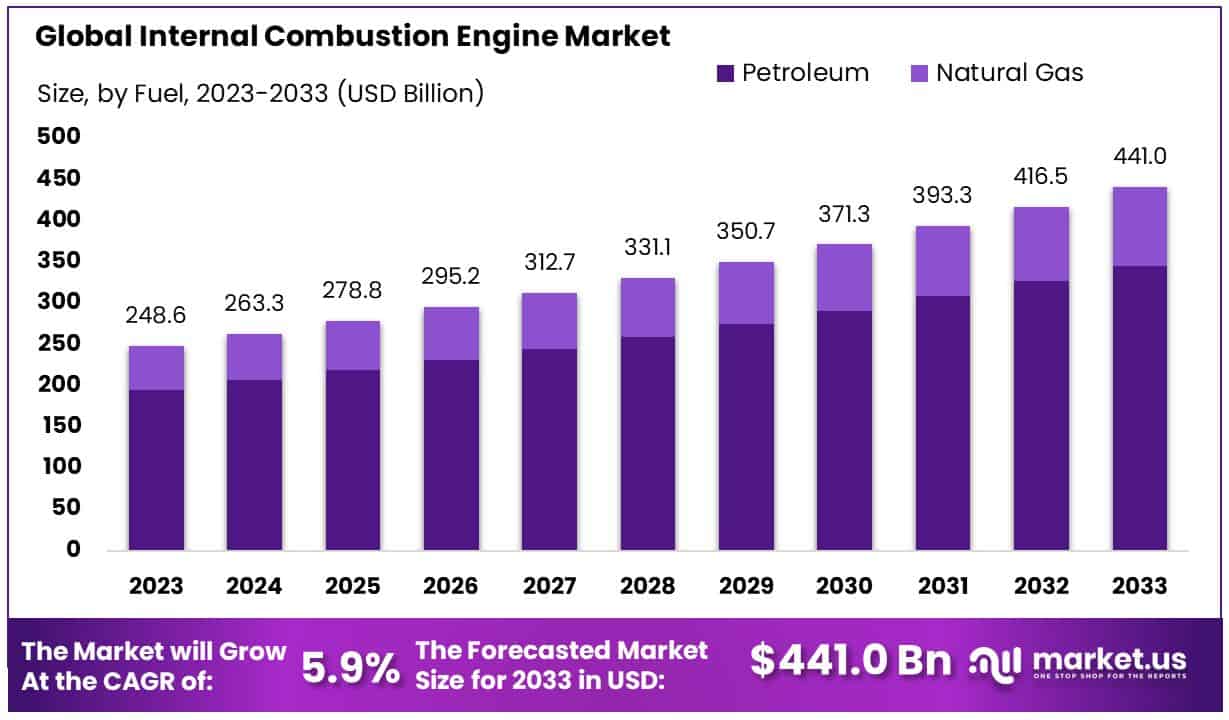
The Global Internal Combustion Engine Market size is expected to be worth around USD 441.0 Billion by 2033, from USD 248.6 Billion in 2023, growing at a CAGR of 5.90% during the forecast period from 2024 to 2033.
The internal combustion engine market encompasses the production and sale of engines that generate mechanical power by burning a combustible fuel with air inside the engine itself. This market includes various engine types, notably gasoline and diesel, used primarily in automotive, aviation, and marine applications.
As businesses strive for efficiency and performance, this market is critical for sectors reliant on traditional power systems. Despite the rise of electric vehicles, internal combustion engines remain integral due to their performance benefits and existing infrastructure. Key factors influencing this market include technological advancements, emission regulations, and fuel economy standards.
The internal combustion engine (ICE) market remains a cornerstone of global transportation, powering the vast majority of vehicles in operation today. With approximately 1.3 billion ICE vehicles navigating roads worldwide, and over 250 million of these in the United States alone, the significance of this market is undeniably profound. This extensive deployment underscores the ICE’s central role in highway transportation, logistics, and personal mobility.
Despite emerging trends towards electric vehicles (EVs), internal combustion engines continue to dominate due to their established supply chains, comprehensive infrastructure, and the current economic scale of petroleum-based fuels. The market’s durability is also supported by continual advancements in engine technology, which aim to enhance fuel efficiency and reduce emissions. Such innovations are critical as regulatory pressures intensify globally to mitigate environmental impact.
Looking forward, the ICE market is poised to experience a dynamic shift. While growth prospects may be tempered by the rise of EVs and stricter emission regulations, there is significant ongoing demand in emerging markets where electric infrastructure remains nascent. Additionally, the development of hybrid technologies, which combine ICEs with electric motors, presents a transitional opportunity, potentially prolonging the relevance of internal combustion engines in the automotive sector.
While the internal combustion engine market faces challenges from environmental policies and the growth of alternative technologies, its extensive existing base and ongoing technological improvements suggest a continued, albeit evolving, role in the global economy. Market stakeholders should monitor regulatory developments and technological advancements closely to adapt strategies effectively in this transitioning landscape.
Key Takeaways
- Market Value: The Global Internal Combustion Engine Market is forecasted to reach USD 441.0 Billion by 2033, experiencing substantial growth from USD 248.6 Billion in 2023, with a projected CAGR of 5.90% during the period from 2024 to 2033.
- Dominant Segments:
- Fuel Analysis: Petroleum-based fuels, including diesel and gasoline engines, hold a dominant share of 78.6% in the internal combustion engine market due to their energy density and existing infrastructure.
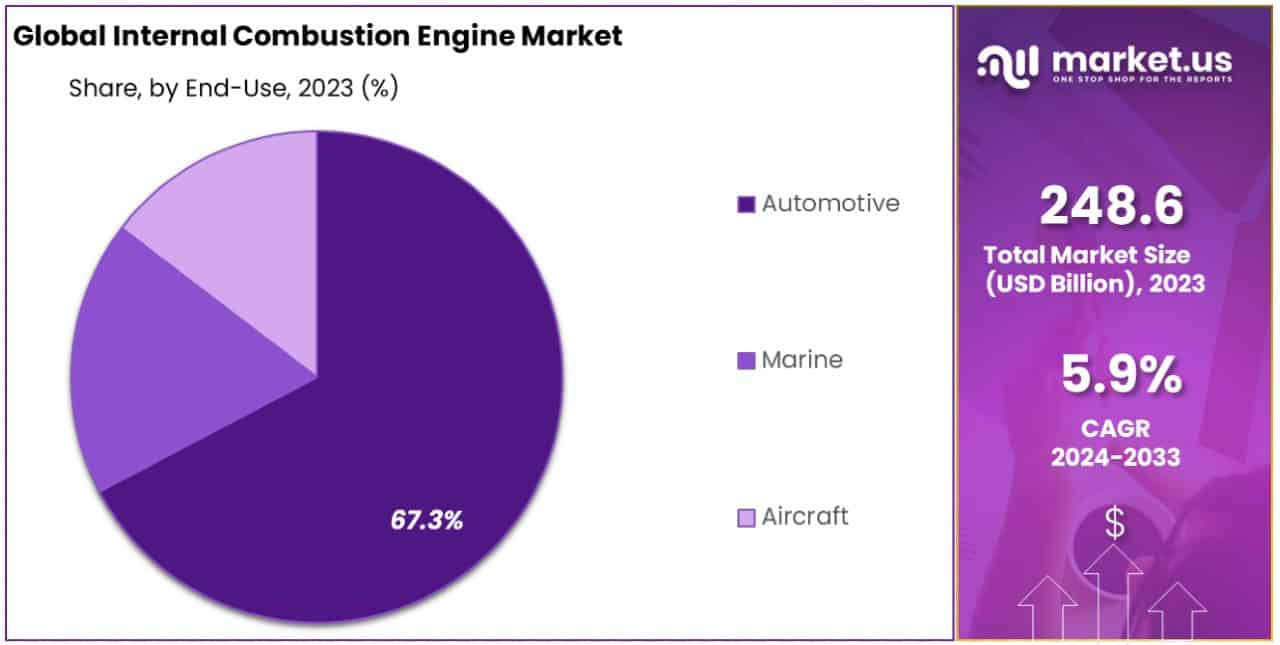
- End-Use Analysis: The automotive sector accounts for 67.3% of the internal combustion engine market, despite the rise of electric vehicles, by leveraging hybrid technology and maintaining performance, range, and lower emissions.
- Regional Dynamics:
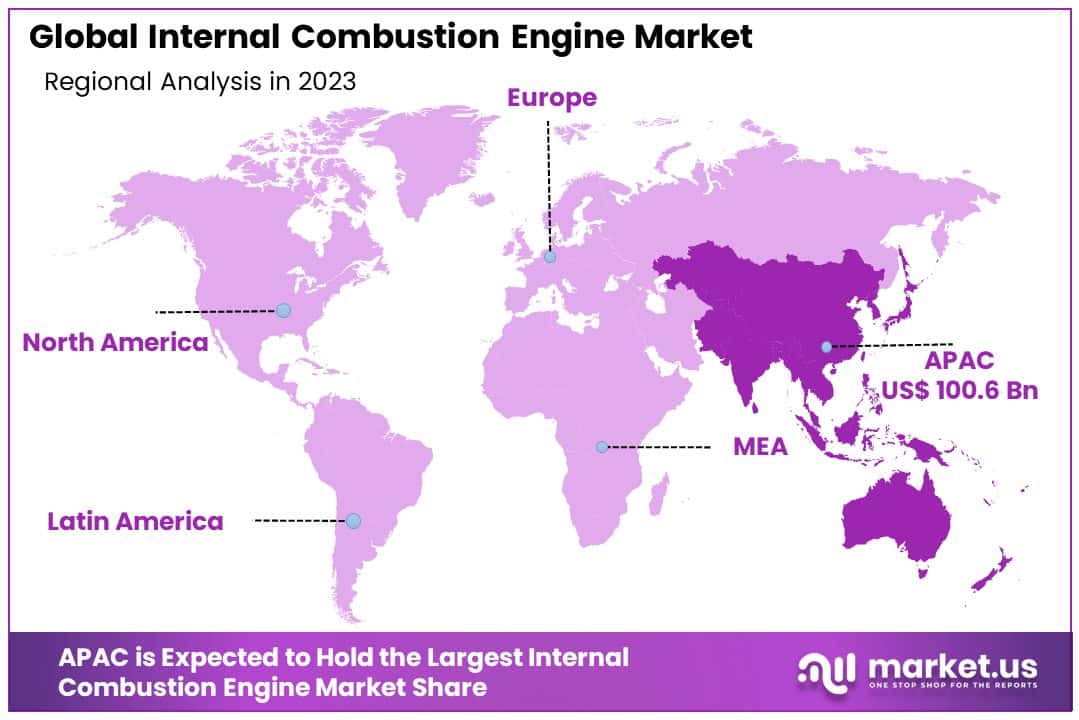
- APAC Dominates: Asia-Pacific (APAC) holds the largest market share of 40.5%, reflecting its strong automotive and industrial sectors.
- North America Follows: North America accounts for approximately 25.8% of the market, with a significant presence in automotive and aerospace industries.
- Analyst Viewpoint: Analysts underscore the enduring dominance of petroleum-based fuels while noting the growing momentum of natural gas as an alternative fuel option. They emphasize the adaptive strategies of the automotive sector, leveraging hybrid technology amidst the transition towards electric vehicles.
- Growth Opportunities: Opportunities lie in further innovation and optimization of internal combustion engines to meet evolving emission standards and regulatory requirements while exploring the potential of alternative fuels like natural gas. Additionally, diversification into emerging markets and industries such as marine and aerospace can contribute to sustained growth and resilience in the market.
Driving Factors
Increasing Demand for Automotive Vehicles Drives Market Growth
The internal combustion engine market is primarily fueled by the expanding automotive sector. As the world’s population increases and economies in regions like China and India grow, the demand for personal and commercial vehicles surges. This trend is further supported by rising urbanization and growing personal incomes, which enable more individuals to purchase vehicles.
Current statistics reveal a robust link between economic growth in emerging markets and increased vehicle sales. This not only drives demand for internal combustion engines directly but also stimulates related industries, including auto parts manufacturing and fuel production. Consequently, the sustained demand for traditional vehicles ensures a steady market for internal combustion engines, even as alternative technologies begin to emerge.
Growth in Agricultural and Construction Equipment Sectors Drives Market Growth
The need for internal combustion engines in the agricultural and construction sectors is witnessing significant growth due to increased mechanization and infrastructure development. As global populations rise, the demand for food production and the mechanization of farming escalate, necessitating more agricultural machinery like tractors and harvesters.
Simultaneously, global urbanization drives infrastructure projects, increasing the need for construction equipment. These industries rely heavily on the durability and power output of internal combustion engines, ensuring their continued demand. The growth in these sectors not only supports engine sales directly but also boosts the development and refinement of engine technologies to meet specific industrial needs.
Adoption of Alternative Fuels and Hybridization Drives Market Growth
The internal combustion engine market is adapting to changes in fuel technology and consumer preferences by incorporating alternative fuels and hybrid systems. Engines designed to run on biofuels, compressed natural gas (CNG), and liquid petroleum gas (LPG) offer reduced emissions and help diversify fuel sources, which is critical in regions with stringent environmental policies.
Additionally, the rise of hybrid vehicles, which combine internal combustion engines with electric motors, presents new growth avenues. This hybridization allows the market to leverage the benefits of both technologies, satisfying consumer demand for more environmentally friendly options while maintaining the performance advantages of traditional engines. This dual approach helps engine manufacturers maintain market relevance and meet regulatory standards, facilitating sustained industry growth.
Restraining Factors
Stringent Emissions Regulations and Environmental Concerns Restrains Market Growth
Governments worldwide are enacting tougher emissions standards to tackle air pollution and mitigate climate change impacts, significantly impacting the internal combustion engine market. These regulations compel manufacturers to invest heavily in developing and integrating advanced emissions control technologies, which can be both costly and technically challenging.
Furthermore, the public’s growing environmental awareness and concerns about the long-term ecological impacts of fossil fuels are shifting consumer preferences towards greener alternatives. This shift not only challenges the current market position of internal combustion engines but also pressures the entire automotive industry to innovate towards more sustainable solutions, potentially limiting traditional market growth.
Competition from Electric and Hybrid Vehicles Restrains Market Growth
The emergence and growing acceptance of electric vehicles (EVs) and hybrid electric vehicles (HEVs) represent formidable competition for the internal combustion engine market. Advances in battery technology, coupled with expanding global charging infrastructure, are making EVs and HEVs more accessible and appealing to consumers. This trend is accelerated by governmental incentives and subsidies promoting cleaner transportation options.
As a result, there is a noticeable shift in consumer preferences towards these environmentally friendly alternatives, which directly undermines the demand for traditional internal combustion engines. This competitive landscape challenges the market’s expansion as manufacturers and consumers increasingly opt for newer, greener technologies.
Fuel Analysis
Petroleum Fuels Dominate Internal Combustion Engine Market with 78.6% Share, While Natural Gas Gains Momentum for Lower Emissions
The internal combustion engine market is extensively segmented by fuel type, with petroleum-based fuels holding a dominant position, accounting for 78.6% of the market. This segment primarily includes diesel and gasoline engines, which are ubiquitous across various applications due to their energy density and existing supply infrastructure.
Diesel engines, renowned for their efficiency and durability, are extensively utilized in commercial vehicles, heavy machinery, and industrial applications. They are preferred for their high torque and lower fuel consumption compared to gasoline engines. Gasoline engines, on the other hand, are more commonly found in personal vehicles and light commercial vehicles due to their lower cost and quieter operation.
Natural gas, including Compressed Natural Gas (CNG) and Liquefied Natural Gas (LNG), represents a smaller yet significant segment. These fuels are gaining traction due to their lower emissions profile compared to traditional petroleum fuels, aligning with global trends towards sustainability and reduced environmental impact.
The market for CNG and LNG is bolstered by the increasing number of natural gas vehicles and the expansion of refueling infrastructure, particularly in regions striving to meet stringent emission standards. The ‘Others’ category within the petroleum segment includes fuels like biofuels and hydrogen blends, which, although still niche, are expected to grow in relevance as technology advances and regulatory landscapes evolve.
End-Use Analysis
Automotive Sector Leads Internal Combustion Engine Market with 67.3% Share, Rise of Electric Vehicles
The internal combustion engine’s role in the automotive sector is profound, with this segment accounting for 67.3% of the market. Internal combustion engines are central to the operation of most passenger cars, trucks, buses, and motorcycles currently in use. This dominance is underpinned by the extensive development and optimization of these engines over more than a century, which has enabled them to achieve high levels of reliability, efficiency, and performance at competitive costs.
However, the automotive segment is at a pivotal point as it confronts increasing environmental regulations and a shift in consumer preferences towards electric vehicles (EVs). Despite these challenges, the internal combustion engine remains integral in hybrid vehicles, combining with electric motors to offer a balance of performance, range, and lower emissions. This hybrid approach is particularly appealing in markets where EV infrastructure is still developing or where long-range travel is common, thus sustaining the demand for internal combustion engines in the transitional phase towards fully electric mobility.
Other significant end-use segments for internal combustion engines include marine and aircraft. In the marine sector, engines are essential for both commercial and recreational vessels, valued for their power and reliability in demanding conditions. The aircraft industry also relies on internal combustion engines, particularly in smaller, propeller-driven aircraft where the weight-to-power ratio and reliability of these engines are crucial.
Key Market Segments
By Fuel
- Petroleum
- Diesel
- Gasoline
- Others
- Natural Gas
- CNG
- LNG
- Others
By End-Use
- Automotive
- Marine
- Aircraft
Growth Opportunities
Development of High-Efficiency and Low-Emission Engines Offers Growth Opportunity
The push for high-efficiency and low-emission internal combustion engines presents a substantial growth opportunity within the market. As global environmental regulations tighten and societal focus on air quality and climate change intensifies, manufacturers are compelled to innovate. Companies like Cummins and Daimler are leading the way by investing in technologies such as waste heat recovery systems and advanced emissions after-treatment systems.
These advancements not only improve the thermal efficiency of engines but also significantly reduce harmful emissions. By developing engines that meet or exceed regulatory standards while maintaining performance and cost-effectiveness, manufacturers can secure a competitive edge and expand their market share in a rapidly evolving automotive landscape. This shift towards more sustainable engine technologies is expected to drive continued investment and development in the sector.
Integration with Hybrid and Alternative Fuel Systems Offers Growth Opportunity
The integration of internal combustion engines with hybrid and alternative fuel systems marks another significant avenue for growth. As demand for sustainable and efficient transportation solutions rises, manufacturers that can adapt their engines to work seamlessly with electric motors, hydrogen fuel cells, and alternative fuels such as biofuels and compressed natural gas (CNG) are poised to thrive.
Leading automotive companies like Toyota and Ford are at the forefront, developing advanced hybrid powertrains that combine the best of both internal combustion and electric technologies. This hybridization not only enhances fuel efficiency but also reduces overall vehicle emissions, aligning with consumer preferences and regulatory demands for cleaner transport options. The ability to offer flexible and environmentally friendly solutions will likely open new markets and extend the relevance of internal combustion engines in the transition towards greener energy alternatives.
Trending Factors
Adoption of Connectivity and Internet of Things (IoT) Technologies Are Trending Factors
The internal combustion engine market is increasingly adopting connectivity and Internet of Things (IoT) technologies, making it a prominent trend. Engine manufacturers are integrating advanced sensors, telematics, and data analytics into their products, enabling features like remote monitoring, predictive maintenance, and optimized engine performance.
This technological infusion is driven by the demand for enhanced operational efficiency, minimized downtime, and superior fleet management capabilities. Such advancements not only cater to the evolving needs of digitalization in automotive technologies but also add value to traditional engine operations by reducing operational costs and increasing reliability. This trend is reshaping how engines are managed across their lifecycle, highlighting a significant shift towards smarter, more connected engine solutions in the industry.
Emphasis on Lightweighting and Material Innovation Are Trending Factors
Lightweighting and material innovation are becoming increasingly significant in the internal combustion engine market. Manufacturers are turning to advanced materials such as lightweight alloys and composites and employing innovative manufacturing techniques to reduce engine weight. This trend is propelled by the imperative to enhance fuel efficiency and cut emissions; lighter engines consume less fuel and, as a result, emit fewer pollutants.
The adoption of these materials not only meets regulatory demands for lower emissions but also aligns with consumer preferences for more efficient vehicles. Moreover, the advancements in material sciences and manufacturing processes are opening new avenues for engine design, allowing for the development of more efficient, high-performance engines that can meet the rigorous demands of modern transportation and environmental standards.
Regional Analysis
APAC Dominates with 40.5% Market Share
Asia-Pacific (APAC) holds a substantial 40.5% share of the global internal combustion engine market, primarily driven by high vehicle production and industrial activity in the region. Countries like China, India, and Japan are significant contributors, with their automotive industries requiring a steady supply of engines for both domestic consumption and export. The rapid industrialization, coupled with increasing agricultural mechanization, further propels the demand for internal combustion engines in this region.
APAC’s dominance is bolstered by its extensive manufacturing capabilities and growing middle-class population, which drives demand for vehicles and machinery. The region’s competitive manufacturing costs and favorable government policies also attract substantial foreign investment, enhancing its market position. Additionally, the ongoing urbanization and infrastructure development in several APAC countries require robust machinery and equipment, all powered by internal combustion engines.
Other Regions:
- North America: With approximately 25.8% of the market share, North America’s internal combustion engine market is driven by advanced technological integration and a strong presence of leading automotive manufacturers. The region’s emphasis on emission reductions and fuel efficiency continues to shape market trends.
- Europe: Holding around 22.3% of the market share, Europe is characterized by stringent environmental regulations, leading to significant innovations in engine technology. The push towards reducing carbon footprints and the high adoption rate of hybrid and electric vehicles influence the internal combustion engine market dynamics.
- Middle East & Africa: This region accounts for about 5.7% of the market share. The demand is primarily driven by the construction and mining sectors, with a slow but growing interest in improving fuel efficiency and adopting newer technologies.
- Latin America: Latin America has a smaller share of the market, at around 5.7%, similar to the Middle East & Africa. The region’s market is driven by agricultural applications and the automotive sector, with economic instability often affecting growth rates and technology adoption.
Key Regions and Countries
- North America
- The US
- Canada
- Mexico
- Western Europe
- Germany
- France
- The UK
- Spain
- Italy
- Portugal
- Ireland
- Austria
- Switzerland
- Benelux
- Nordic
- Rest of Western Europe
- Eastern Europe
- Russia
- Poland
- The Czech Republic
- Greece
- Rest of Eastern Europe
- APAC
- China
- Japan
- South Korea
- India
- Australia & New Zealand
- Indonesia
- Malaysia
- Philippines
- Singapore
- Thailand
- Vietnam
- Rest of APAC
- Latin America
- Brazil
- Colombia
- Chile
- Argentina
- Costa Rica
- Rest of Latin America
- Middle East & Africa
- Algeria
- Egypt
- Israel
- Kuwait
- Nigeria
- Saudi Arabia
- South Africa
- Turkey
- United Arab Emirates
- Rest of MEA
Key Players Analysis
In the internal combustion engine market, major automotive and industrial manufacturers such as Ford, Nissan, Volkswagen AG, and General Motors play pivotal roles. These companies are strategically positioned due to their extensive geographical reach, robust product lines, and substantial investments in research and development. For example, Ford and Volkswagen are heavily involved in enhancing engine efficiency and integrating advanced emissions control technologies, aligning with global regulatory demands and environmental concerns.
Industrial giants like Caterpillar and MAN SE cater to construction and heavy machinery sectors, focusing on durable and high-performance engines that can withstand rigorous operating conditions. Bosch Robert GmbH contributes through technological innovation, particularly in fuel injection systems and emissions control technologies that enhance engine performance and efficiency.
Moreover, companies like Mahindra and Mahindra Ltd. and AGCO Corporation leverage their strong presence in agricultural sectors, providing engines for equipment that requires reliability and power.
Collectively, these key players not only drive technological advancements and market growth through competition but also shape industry trends by responding to evolving regulatory landscapes and shifting consumer preferences towards more sustainable solutions. Their strategic market positions are crucial in defining the directions for the overall market development.
Market Key Players
- Ford AB
- Nissan Motor Company
- AG Volkswagen
- Royce Holding Plc
- Mahindra and Mahindra Ltd.
- Nissan SA
- Tokyo Heavy Industries
- MAN SE
- Company General Motors
- Automaker Ford
- Dodge Chrysler
- Bosch Robert GmbH
- Corporation AGCO
- Corporation Caterpillar
Recent Developments
- On March 2024, Lamborghini’s CEO, Stephan Winkelmann, expressed optimism about the future of internal combustion engine (ICE) technology in super sports cars beyond 2030.
- On March 2024, Time Technoplast Ltd. achieved a significant milestone by receiving PESO approval for manufacturing high-pressure hydrogen cylinders. This approval marks a crucial step forward in the company’s efforts towards sustainable green energy solutions.
- On March 2024, TCPL Green Energy Solutions inaugurated a new manufacturing facility to produce hydrogen-based internal combustion engines for medium and heavy commercial vehicles.









