


Report Overview
The Global Generative AI In Chatbots Market size is expected to be worth around USD 1,714.3 Million by 2033, from USD 151.0 Million in 2023, growing at a CAGR of 27.5% during the forecast period from 2024 to 2033.
Generative AI in chatbots represents a transformative advancement in the field of artificial intelligence, significantly enhancing the capabilities of chatbots in various industries. This technology enables chatbots to generate human-like responses by understanding and natural language processing on a profound level, thereby improving interaction quality and customer experience.
The generative AI in chatbots market has experienced rapid growth in recent years. Businesses across various industries are adopting chatbot solutions to enhance customer support, streamline sales processes, and improve overall user experiences. Generative AI-powered chatbots offer several advantages, including 24/7 availability, scalability, and the ability to handle multiple conversations simultaneously.
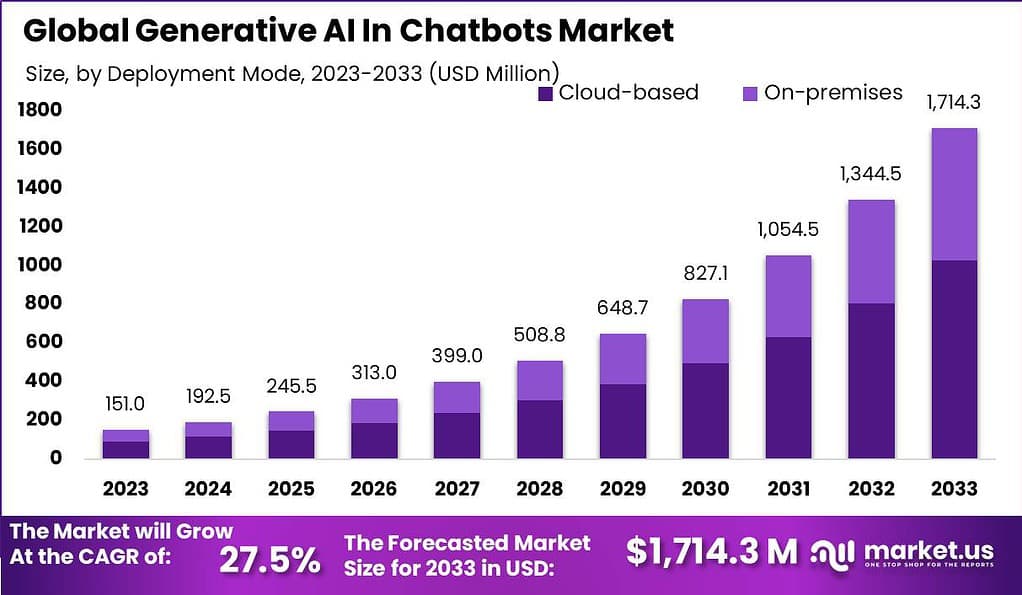
The market for generative AI in chatbots is expected to continue its growth trajectory as businesses increasingly recognize the value and potential of AI-driven conversational interfaces. The ability to provide personalized, interactive, and efficient customer experiences makes generative AI-powered chatbots a valuable tool for businesses seeking to enhance their digital presence and customer engagement strategies.
According to Market.us, The Generative AI Market is poised for significant growth. From a value of USD 13.5 Billion in 2023, it is projected to surge to around USD 255.8 Billion by 2033. This represents a robust compound annual growth rate (CAGR) of 34.2% from 2024 to 2033, indicating a rapidly expanding interest and investment in AI technologies.
As per survey by expert.ai, In 2023 alone, a substantial USD 2.1 billion was invested specifically in advancing natural language processing (NLP) and generation models. These investments are focused on enhancing the capabilities of AI chatbots, making them more adept at understanding and replicating human-like conversations and contexts.
Moreover, the impact of Conversational AI on commerce is remarkable. In the retail sector, AI chatbots have been instrumental in achieving a 67% increase in eCommerce sales. By 2023, these AI-driven interactions are expected to generate approximately USD 112 billion in retail sales.
Retailers effectively employing conversational commerce strategies are witnessing annual revenue growth rates between 7% to 25%. This substantial growth underscores the critical role that AI chatbots play in modern retail strategies, transforming how businesses engage with customers and drive sales
Key Takeaways
- The Generative AI In Chatbots Market size is expected to reach USD 1,714.3 Million by 2033, projected at a CAGR of 27.5% during forecast period.
- In 2022, cloud-based deployment held over a 60% market share, driven by scalability, cost-effectiveness, and ease of integration.
- In 2022, customer service applications held over a 29% market share, driven by automation of customer interactions, reduced response times, and improved satisfaction.
- In 2022, retail and e-commerce dominated the market, driven by rapid digitalization, personalized shopping experiences, and increased customer engagement.
- In 2022, North America held a dominant market position in the generative AI chatbots market, capturing more than a 38% share.
- More than 60% of companies are utilizing generative AI in their workplaces. This adoption of generative AI is expected to result in a substantial reduction in workload, with estimates ranging from 60% to 70%.
- In the realm of eCommerce, businesses that leverage chatbots for their communication purposes experience impressive engagement rates. On average, these businesses achieve an open rate of 85% and a click-through rate (CTR) of 40%. In comparison, traditional email communication has an average open rate of only 23% and a CTR of just 3%.
- The implementation of chatbots in eCommerce brings several benefits. Notably, it helps customers save time and assists them in finding the information or products they desire. Research indicates that 73% of customers prefer self-service features like chatbots over engaging in live agent (human) chat, as it enables them to save more than 10 minutes.
Based on the Deployment Mode
In 2022, the Cloud-based segment held a dominant market position within the generative AI in chatbots industry, capturing more than a 60% share. This considerable market share can primarily be attributed to the scalability, cost-effectiveness, and ease of integration that cloud-based solutions offer. Businesses, especially those with fluctuating data usage and demand, benefit significantly from the cloud model’s flexibility.
Cloud deployment does not require substantial upfront capital investment in infrastructure, which lowers entry barriers for small and medium-sized enterprises (SMEs) seeking advanced AI chatbot functionalities. Additionally, cloud-based platforms facilitate faster and continuous updates, ensuring that AI chatbot technologies remain cutting-edge and can adapt to evolving market needs and consumer behaviors.
This deployment mode enhances the capability of chatbots to handle complex queries and deliver personalized customer experiences, leveraging real-time data analytics and machine learning algorithms. Such technical advantages are crucial as businesses increasingly focus on enhancing customer service and engagement through automated yet personalized communication. Furthermore, the trend toward remote work models and digital transformation strategies has accelerated the adoption of cloud-based services.
As organizations aim to provide seamless service across multiple customer touchpoints globally, cloud-based chatbots offer the necessary agility and global accessibility without significant geographical or physical constraints. The ongoing enhancements in cloud security and compliance measures also reassure enterprises about the safety and integrity of their data, contributing to the growing preference for cloud-based chatbot solutions.
Based on Application
In 2022, the customer service applications segment held a dominant market position within the generative AI in chatbots industry, capturing more than a 29% share. This prominence is driven by the segment’s pivotal role in automating customer interactions, thereby reducing operational costs and improving service availability.
Organizations increasingly integrate AI chatbots into their customer service frameworks to provide 24/7 support, handling routine inquiries and complaints efficiently without human intervention. This not only enhances customer satisfaction through reduced response times but also allows human agents to focus on more complex and sensitive issues, optimizing overall workforce management.
Moreover, AI-driven chatbots are becoming more sophisticated with advancements in natural language processing and machine learning, enabling them to understand and respond to customer queries with greater accuracy and context sensitivity. This technological evolution helps in tailoring interactions based on individual customer preferences and past interactions, which significantly boosts the personalization of customer experiences – a key competitive advantage in today’s market.
The ongoing digital transformation across various industries fuels further adoption of AI chatbots in customer service. As businesses expand their online presence, the demand for efficient, scalable customer service solutions that can manage high volumes of requests across multiple platforms continues to grow. Additionally, the integration of AI chatbots with existing customer relationship management (CRM) systems and analytics tools provides valuable insights into customer behavior, helping companies refine their customer service strategies and improve service outcomes.

Based on Industry
In 2022, the Retail and E-commerce segment held a dominant market position within the generative AI in chatbots industry, capturing a substantial share. This leadership can be largely attributed to the rapid digitalization of retail services and the growing consumer preference for online shopping.
AI chatbots have become integral in managing vast customer interactions that range from product inquiries and recommendations to purchase transactions and post-sale support. The ability of chatbots to handle these tasks with high efficiency and minimal downtime significantly enhances customer experience, driving sales and fostering loyalty.
Moreover, generative AI chatbots in retail are not only limited to customer service but also extend to personalized shopping experiences. They analyze user data and shopping behavior to tailor product recommendations, promotions, and discounts, thereby increasing the likelihood of purchases. This level of personalization is becoming a key differentiator in the competitive e-commerce landscape, where retaining customer interest and optimizing conversion rates are critical for success.
The ongoing expansion of e-commerce globally, coupled with technological advancements in AI and machine learning, suggests a promising growth trajectory for this segment. Retailers are continuously innovating their approach to incorporate AI-driven solutions that can scale according to demand, manage cross-platform integrations, and provide real-time analytics.
5 Generative AI Chatbots
- ChatGPT: ChatGPT, developed by OpenAI and launched in November 2022, quickly became the fastest-growing consumer software application, reaching over 100 million users by early 2023. It’s based on the GPT-3.5 and later GPT-4 models, which are fine-tuned for conversational applications using supervised learning and reinforcement learning from human feedback. The chatbot is recognized for generating human-like text, understanding and generating responses that consider conversational context.
- Google Bard: Google Bard is a conversational AI developed by Google as a response to ChatGPT. It leverages Google’s Language Model for Dialogue Applications (LaMDA) and is designed to provide detailed responses that draw on information from the web, aiming to be up-to-date and factual. Bard emphasizes creativity and can generate content like poems, recipes, and code, but its reliability and accuracy are critical areas of development as it continues to evolve .
- Microsoft Copilot: Microsoft Copilot is integrated across Microsoft 365 apps, designed to enhance productivity by assisting with tasks such as summarizing emails, drafting documents, and preparing presentations. It uses the GPT-4 model from OpenAI but is specifically tailored to interact seamlessly with the suite of Microsoft software, leveraging organizational data securely to provide contextually relevant assistance.
- Llama 2: Llama 2, developed by Meta AI, is part of a new generation of AI models focusing on efficiency and accessibility. It is designed to be an open-source alternative, providing capabilities similar to ChatGPT but with a focus on enabling researchers and developers to contribute to its development and application in diverse fields. Llama 2 emphasizes ethical AI development and broad usability in academic and practical applications.
- Claude: Claude is an AI chatbot developed by Anthropic, focusing on safety and usability in conversational AI. It is designed to avoid generating harmful or misleading information and is tuned to understand context better, aiming for high reliability in interactions. Claude supports applications ranging from customer service to more personal assistant-like roles, reflecting the company’s commitment to ethical AI development.
Key Market Segments
Based on the Deployment Mode
- Cloud-based
- On-premises
Based on Application
- Customer Service
- E-commerce and Sales
- Virtual Assistants
- Information Retrieval
- Social Media and Messaging Platforms
Based on Industry
- Retail and E-commerce
- Banking and Finance
- Healthcare
- Travel and Hospitality
- Telecom and IT
- Other industries
Driver
Integration with E-commerce and Customer Service Platforms
The integration of generative AI chatbots within e-commerce and customer service platforms represents a significant driver in the market. As e-commerce grows, so does the demand for efficient, scalable customer service solutions that enhance the shopping experience and manage large volumes of customer interactions without the need for extensive human resources.
Generative AI chatbots are increasingly capable of providing personalized shopping advice, handling transactions, and resolving customer issues, leading to increased customer satisfaction and retention. Businesses are leveraging these technologies to ensure 24/7 customer service availability, reduce operational costs, and improve the overall customer experience, which in turn drives revenue growth.
Restraint
Privacy Concerns and Data Security
Privacy concerns and data security issues constitute a major restraint in the adoption of generative AI chatbots. These systems often require access to vast amounts of personal and sensitive user data to train the AI models and deliver personalized services.
Consumers and regulatory bodies are increasingly wary of how this data is managed, leading to heightened scrutiny and the implementation of stringent data protection regulations like GDPR and CCPA. Companies must navigate these regulations and invest in robust cybersecurity measures to protect user data, which can increase operational costs and slow down the adoption of AI chatbot technologies.
Opportunity
Advancements in Natural Language Processing (NLP)
Advancements in natural language processing (NLP) technologies present significant opportunities for the generative AI chatbots market. These advancements are improving the ability of AI chatbots to understand and generate human-like responses more accurately.
As AI becomes better at context handling, sentiment analysis, and multi-turn conversations, the applications of chatbots expand into more complex domains such as healthcare for patient management, financial services for personalized banking advice, and personal assistants that manage daily tasks more effectively. This technological progress is opening new markets and applications for generative AI chatbots, enhancing their appeal to businesses across various sectors.
Challenge
Overcoming Public Skepticism and Building Trust
One of the major challenges facing the deployment of generative AI chatbots is overcoming public skepticism and building trust among users. Despite their capabilities, these AI systems often face criticism for generating misleading or inaccurate information and for potential biases in their responses. Building systems that consistently deliver reliable and ethical interactions is crucial.
Furthermore, there is the challenge of ensuring these technologies are inclusive and equitable in terms of access and usability. Companies must address these issues through transparent practices, continuous improvement of AI models, and engagement with stakeholders to foster a positive perception and widespread adoption of chatbot technologies.
Growth Factors
- Increased Automation Needs: The demand for automation in customer service and business processes has significantly increased. Companies are implementing AI-driven chatbots to enhance efficiency and reduce operational costs.
- Advancements in Natural Language Processing (NLP): Continuous improvements in NLP technologies allow chatbots to understand and mimic human conversations better, making interactions more natural and effective.
- Rising Omnichannel Retail Strategies: As businesses strive to provide a seamless customer experience across multiple platforms, the integration of AI chatbots has become crucial. They ensure consistent communication across all channels.
- Growing Acceptance of AI Solutions: There is a broader acceptance and trust in AI technology among businesses and consumers, driving the adoption of AI chatbots for varied applications, from customer support to personalized recommendations.
- Enhanced Data Analytics Capabilities: AI chatbots are being equipped with sophisticated data analytics tools to gather insights from customer interactions, aiding businesses in making data-driven decisions and improving services.
Emerging Trends
- Emotion Recognition: Emerging technologies enable chatbots to detect and respond to user emotions, improving engagement and personalization.
- Voice-Activated Interfaces: The integration of voice recognition technology in chatbots is increasing, allowing for hands-free operation and expanding use cases in diverse environments.
- Multilingual Support: To cater to a global audience, AI chatbots are increasingly supporting multiple languages, thus broadening their applicability and reach.
- Predictive Customer Engagement: AI chatbots are evolving to not only respond to queries but also to anticipate customer needs and initiate conversations, offering a proactive service approach.
- Integration with IoT Devices: There is a growing trend of integrating chatbots with IoT devices, enabling users to control smart devices through conversational interfaces, enhancing user experience and functionality.
Regional Analysis
In 2022, North America held a dominant market position in the generative AI chatbots market, capturing more than a 38% share. The demand for Generative AI In Chatbots in North America was valued at USD 57.38 Million in 2022 and is anticipated to grow significantly in the forecast period.
This leadership can be attributed to several key factors. Firstly, the region boasts a strong presence of leading technology companies that are pioneers in AI and machine learning innovations. These companies continuously invest in research and development, driving advancements in AI technologies and their applications, including chatbots. Moreover, North American businesses across various sectors are keen adopters of AI to optimize customer interactions and streamline operational efficiencies.
Additionally, the regulatory and investment climate in North America is highly conducive to AI development. Significant funding from venture capitalists and governmental support for AI initiatives encourage startups and established companies to develop new AI solutions. The high adoption rate of digital technologies among consumers also promotes an environment where AI-driven chatbots are rapidly integrated into everyday business practices and customer service strategies.
Furthermore, the advanced IT infrastructure and widespread internet connectivity in North America facilitate seamless deployment and integration of AI technologies, including chatbots. The market is further driven by a strong focus on enhancing customer engagement and building personalized experiences through sophisticated AI tools. This trend is expected to continue, reinforcing North America’s leadership in the global generative AI chatbots market.

Key Regions and Countries Covered in this Report:
- North America
- The US
- Canada
- Europe
- Germany
- France
- The UK
- Spain
- Italy
- Russia
- Netherland
- Rest of Europe
- APAC
- China
- Japan
- South Korea
- India
- Australia
- New Zealand
- Singapore
- Thailand
- Vietnam
- Rest of APAC
- Latin America
- Brazil
- Mexico
- Rest of Latin America
- Middle East & Africa
- South Africa
- Saudi Arabia
- UAE
- Rest of MEA
Key Players Analysis
The generative AI in chatbots market is characterized by a dynamic and competitive landscape with key players that span a range of specialties from AI technology development to specific applications in customer service and engagement. Leading companies in this sector include OpenAI, creator of GPT-3, which has significantly impacted the market with its advanced natural language processing capabilities. Google and Microsoft are also prominent players, both pushing the boundaries of AI chatbot functionalities through continuous improvements in AI and cloud computing technologies.
Other notable companies include IBM with its Watson Assistant, which offers sophisticated AI-driven solutions for complex business environments, and Amazon, which integrates AI chatbot technology into its Alexa and AWS offerings to enhance user interactions and automate responses. These companies not only lead in technology but also in the strategic deployment of AI chatbots across various industries including retail, healthcare, and financial services, providing tailored solutions that enhance customer experience and operational efficiency.
Top Market Leaders
- OpenAI
- IBM Watson
- Microsoft Bot Framework
- Amazon Lex
- Chatfuel
- LivePerson
- Rasa
- Botsify
- ai Software India Pvt Ltd
- Nuance India Pvt Ltd
- Artificial Solutions
- Ada Support
- Botpress
- Other Key Players
Recent Developments
- Deloitte’s Generative AI Practice: In April 2023, Deloitte announced the creation of a new Generative AI practice. This initiative is designed to help clients harness the power of AI to boost productivity and innovate business processes. Deloitte has integrated this new practice with advanced AI models and deep industry experience to push forward client innovations.
- Capgemini’s New AI Offerings: In July 2023, Capgemini launched a comprehensive portfolio of generative AI services. This rollout is aimed at supporting digital transformation across industries with a focus on enhancing customer experience and operational efficiencies. The launch represents a significant step in Capgemini’s commitment to leading in the AI-driven market solutions space
- Major Funding Rounds: The sector has also seen significant investments, including Microsoft’s ~$10 billion funding to OpenAI in January 2023. This investment underscores the growing financial commitment to the development and integration of generative AI technologies in various business applications.









