


Report Overview
The Global AI In Trading Market size is expected to be worth around USD 50.4 Billion by 2033, from USD 18.2 Billion in 2023, growing at a CAGR of 10.7% during the forecast period from 2024 to 2033.
AI trading, commonly referred to as algorithmic trading, involves the use of computer algorithms to execute trades within financial markets. These algorithms are designed to analyze extensive data sets, encompassing historical price movements, prevailing market trends, and a wide range of economic indicators. The integration of artificial intelligence (AI) technologies, such as machine learning algorithms and natural language processing, has enabled market participants to analyze vast amounts of data with unprecedented speed and accuracy.
The AI in trading market has witnessed substantial growth in recent years, driven by the increasing adoption of algorithmic trading and the proliferation of big data analytics. Market participants, including hedge funds, investment banks, and asset management firms, are leveraging AI-powered tools to enhance trading efficiency, mitigate risks, and optimize portfolio performance. These tools encompass a wide range of applications, from automated trading systems and sentiment analysis platforms to predictive analytics and risk management solutions.

Key factors contributing to the expansion of the AI in trading market include advancements in AI technologies, the availability of vast amounts of financial data, and the growing demand for sophisticated trading strategies in increasingly complex and dynamic markets. Moreover, regulatory developments, such as the adoption of algorithmic trading regulations and increased scrutiny on market manipulation, are driving the adoption of AI-driven compliance and surveillance solutions.
In 2023, the investment landscape for AI-powered trading platforms and solutions demonstrated significant growth, evidencing a robust expansion in this sector. Total investments surged to a remarkable ~$3.5 billion, marking a 40% increase from the previous year. This substantial growth underscores the heightened investor confidence and the strategic importance of AI technologies in enhancing trading capabilities and financial services.
Further emphasizing the focus on AI, over 25% of all investment dollars in American startups were directed towards AI-related companies. This allocation represents a notable rise from previous years, reflecting a broader trend of increasing investments in digital and technological innovations.
Looking forward, the momentum in AI investments is expected to continue its upward trajectory, with global investments projected to escalate to approximately ~$200 billion by 2025. This forecast highlights the ongoing commitment of venture capital and private equity sectors to capitalize on the transformative potential of AI technologies across various industries, including financial services.
Key Takeaways
- The global AI In Trading Market is estimated to reach USD 50.4 billion by 2033, experiencing a strong Compound Annual Growth Rate (CAGR) of 10.7% from 2024 to 2033.
- In 2023, the Cloud-Based segment held a dominant market position, capturing over 72.5% share due to its flexibility, scalability, and cost-effectiveness.
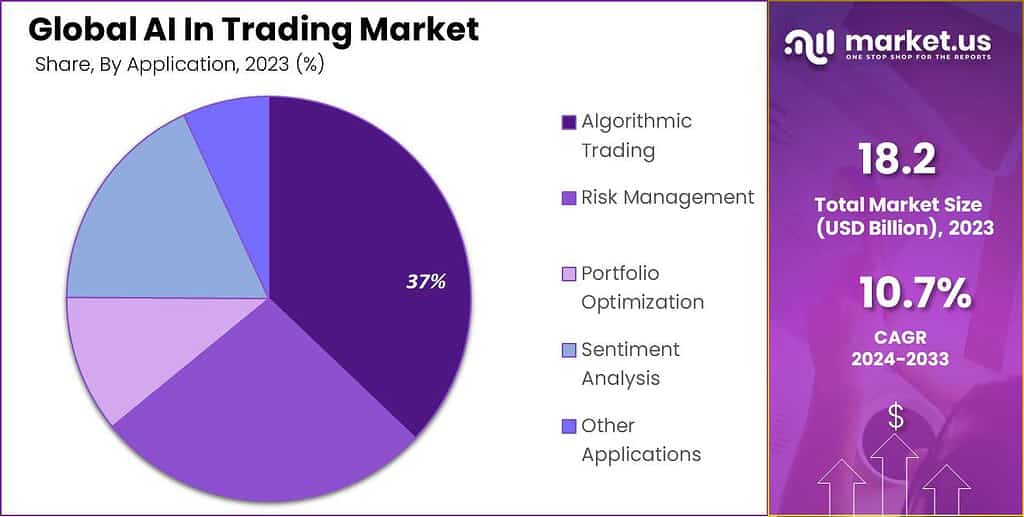
- In 2023, the Algorithmic Trading segment dominated the market with over 37.1% share due to its efficiency, speed, and ability to handle vast datasets beyond human capability.
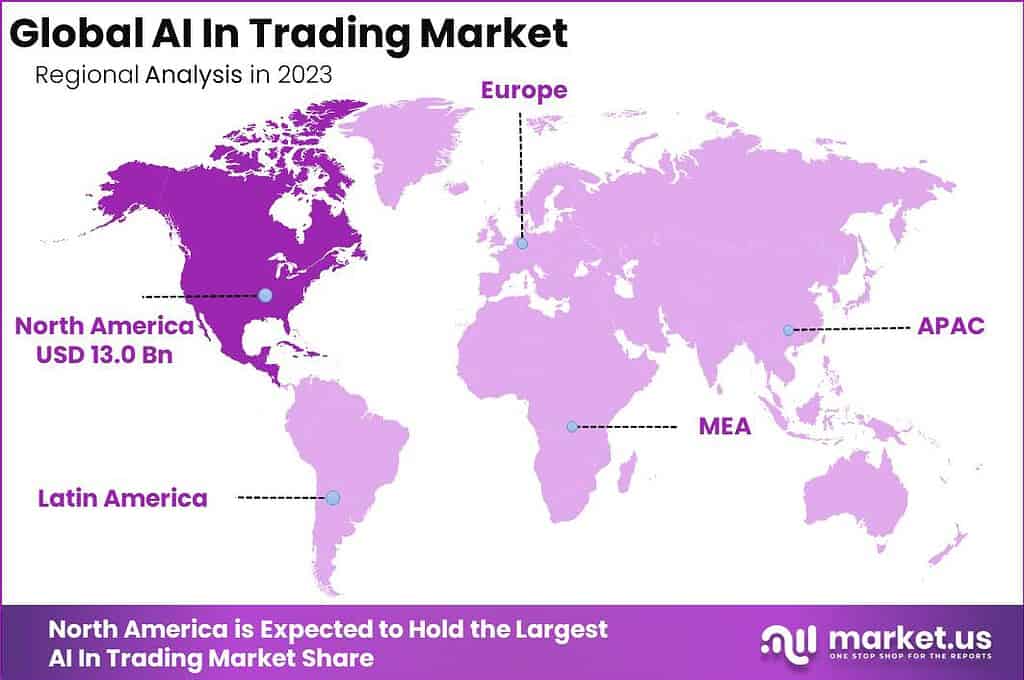
- In 2023, North America held over 40.9% market share, driven by advanced technological infrastructure, high concentration of AI technology firms, favorable regulatory environment, and significant investments in AI research and development.
Deployment Mode Analysis
In 2023, the Cloud-Based segment held a dominant market position in the AI in trading market, capturing more than a 72.5% share. This significant market share can be attributed to the flexibility, scalability, and cost-effectiveness that cloud-based solutions offer to financial institutions.
Cloud-based platforms enable traders to access powerful artificial intelligence tools without the need for extensive on-site infrastructure, which considerably reduces upfront investments and ongoing operational costs. Moreover, these platforms facilitate easier and quicker updates for AI algorithms, ensuring that trading strategies can rapidly adapt to changing market conditions.
The dominance of the Cloud-Based segment is further supported by its inherent capability to handle vast volumes of data efficiently, a critical requirement in the trading sector where real-time data analysis and decision-making are crucial. Cloud computing offers robust data processing capabilities, which are essential for implementing complex AI models such as machine learning and deep learning. These models require extensive computational resources to analyze historical and real-time data, making the scalability of cloud environments a key factor in their adoption.
Furthermore, the increased emphasis on regulatory compliance and data security in trading has also propelled the growth of cloud-based AI solutions. Cloud providers are continually enhancing their security measures and compliance protocols, thereby assuring trading firms of the safety and integrity of their data.
This assurance is vital for the adoption of AI technologies in trading, where the protection of sensitive financial information is paramount. Consequently, the Cloud-Based segment is poised to maintain its leadership position, driven by its ability to provide secure, scalable, and efficient AI trading solutions
Application Analysis
In 2023, the Algorithmic Trading segment held a dominant market position within the AI in trading market, capturing more than a 37.1% share. This substantial market share can be attributed to the increasing reliance on automated trading systems among financial institutions, which are designed to execute large volumes of transactions at very high speeds.
Algorithmic trading utilizes complex algorithms to analyze multiple markets and execute orders based on market conditions that are most favorable. The efficiency and speed offered by these systems significantly reduce the possibility of human error and enhance the potential for profitability.
Financial firms increasingly prefer algorithmic trading as it enables them to handle vast datasets beyond human capability to analyze manually, allowing for more strategic trading decisions. As a result, these systems can detect changes in market conditions faster than traditional trading methods, providing a critical competitive advantage.
Furthermore, the integration of machine learning and AI into algorithmic trading systems has enabled continual improvement of trading strategies based on data-driven insights, further bolstering its adoption. This segment’s leadership is also reinforced by regulatory changes that favor transparency and efficiency in financial markets. Algorithmic trading platforms help firms comply with these regulations by providing detailed records of all transactions and real-time monitoring capabilities.
Moreover, the ongoing advancements in AI technology, such as predictive analytics and model-based decision making, are expected to drive further growth in this segment. This trend is supported by increasing investments in AI and machine learning technologies by major financial entities aiming to leverage these tools for enhanced trade execution and risk management.
Key Market Segments
Deployment Mode
- Cloud-Based
- On-Premise
Application
- Algorithmic Trading
- Risk Management
- Portfolio Optimization
- Sentiment Analysis
- Other Applications
Driver
Technological Advancements in AI
The rapid advancement in artificial intelligence technology represents a significant driver for the AI in trading market. Enhanced computational power and improved algorithmic efficiency allow for more sophisticated analysis and faster processing of large datasets, critical for real-time trading decisions.
Innovations in machine learning and neural networks have enabled the development of algorithms that can predict market movements and execute trades with high precision. As AI technology continues to evolve, it is expected to further integrate into trading strategies, thereby increasing the efficacy and attractiveness of AI-driven trading systems. This trend is crucial in maintaining the competitive edge of financial institutions in a highly volatile trading environment.
Restraint
High Implementation Costs
A major restraint for the AI in trading market is the high cost associated with implementing AI solutions. The development and integration of advanced AI systems require significant investment in both hardware and software. Additionally, financial firms must invest in skilled personnel capable of managing and maintaining these complex systems.
The substantial initial and ongoing financial outlay can be a barrier for smaller firms or those with limited resources, potentially slowing down the widespread adoption of AI in trading. This high cost factor limits the market’s growth by making AI-driven trading solutions less accessible to a broader segment of the trading community.
Opportunity
Increasing Demand for Personalized Trading Solutions
There is a growing opportunity in the AI in trading market with the increasing demand for personalized trading solutions. As individual investors become more sophisticated, there is a rising interest in custom trading strategies that align with personal risk tolerances and investment goals.
AI technology can cater to this need by providing tailored recommendations and automations based on individual behavioral data and financial profiles. This personalization not only enhances customer satisfaction and retention but also opens new market segments for AI in trading among retail investors and boutique financial firms.
Challenge
Data Privacy and Security Concerns
One of the main challenges in the AI in trading market is addressing data privacy and security concerns. Trading algorithms require access to vast amounts of sensitive information, including personal financial data and investment patterns. Ensuring the integrity and confidentiality of this data while it is stored, processed, and transmitted is paramount.
Any breach can lead to significant financial losses and damage to reputation. As regulatory scrutiny around data privacy intensifies globally, AI trading platforms must navigate complex legal landscapes and invest in robust cybersecurity measures, adding to operational costs and complexity.
Emerging Trends
- Generative AI in Business Applications: The rapid expansion of generative AI into various business functions, including trading, marks a significant trend. Companies are leveraging these AI capabilities to create new products and optimize existing processes, enhancing value across financial markets.
- Increased Cloud Integration: With the growth of AI, more cloud service providers are incorporating AI tools into their offerings, making advanced AI more accessible and integrated into standard cloud services.
- Regulation and Governance of AI: As AI becomes more pervasive, there is a growing focus on establishing regulatory frameworks to manage its use effectively. This trend towards governance is expected to increase transparency and accountability in AI applications, including trading.
- AI-Driven Cybersecurity Enhancements: The use of AI in cybersecurity is becoming increasingly sophisticated, with AI systems automating threat detection and response. This trend is crucial for protecting sensitive financial data in trading environments.
- Edge AI for Real-Time Data Processing: The deployment of edge computing technologies to handle data processing closer to the source of data generation reduces latency and improves the efficiency of real-time trading systems.
Growth Factors
- Advancements in AI and Machine Learning: Continuous improvements in AI and machine learning algorithms enhance the accuracy and speed of trading decisions, driving the adoption of AI in trading.
- Demand for Real-Time Processing: The need for real-time data analysis and processing in trading is pushing advancements in AI technologies that can operate at the edge of networks, significantly impacting market dynamics.
- Focus on Personalization and User Experience: AI is increasingly used to tailor trading strategies and improve user interfaces, making trading platforms more intuitive and responsive to individual user needs.
- Integration of AI with Regulatory Compliance: As regulatory demands grow, AI tools that can ensure compliance and manage risks effectively are becoming indispensable in trading.
- Expansion of AI in Cybersecurity: With the growing threat landscape, AI is becoming critical in cybersecurity within the trading sector, safeguarding against data breaches and other cyber threats.
Regional Analysis
In 2023, North America held a dominant market position in the AI in trading market, capturing more than a 40.9% share. This substantial market share can largely be attributed to the region’s advanced technological infrastructure and the high concentration of prominent AI technology firms.
The demand for AI In Trading in North America was valued at USD 13.0 billion in 2023 and is anticipated to grow significantly in the forecast period. The United States and Canada are pivotal in driving the adoption of AI technologies in trading systems due to their well-established financial markets and openness to adopting innovative technologies. Moreover, significant investments in AI research and development by both public and private sectors have further strengthened North America’s leadership in this arena.
Additionally, the integration of AI in trading is extensively supported by the regulatory environment in North America which tends to be more favorable towards technological advancements in financial services. The presence of major stock exchanges such as the New York Stock Exchange (NYSE) and NASDAQ, which are leaders in utilizing AI for trading operations, also contributes to the region’s dominant position.
These exchanges use AI to optimize trading algorithms, manage risks, and provide analytical tools that enhance trading strategies. Furthermore, the growing trend of data-driven investments and the availability of sophisticated computational infrastructure have empowered traders and financial analysts in the region to adopt AI at a faster pace compared to other regions.
Key Regions and Countries Covered in this Report:
- North America
- The US
- Canada
- Europe
- Germany
- France
- The UK
- Spain
- Italy
- Russia
- Netherland
- Rest of Europe
- APAC
- China
- Japan
- South Korea
- India
- Australia
- New Zealand
- Singapore
- Thailand
- Vietnam
- Rest of APAC
- Latin America
- Brazil
- Mexico
- Rest of Latin America
- Middle East & Africa
- South Africa
- Saudi Arabia
- UAE
- Rest of MEA
Key Players Analysis
AI (Artificial Intelligence) has revolutionized the trading market by automating and optimizing various processes involved in trading. It has become an essential tool for traders and investors, enabling them to make data-driven decisions and gain a competitive edge. Several key players have emerged in the AI in trading market, offering innovative solutions and shaping the industry’s landscape.
One prominent player in the AI in trading market is AlphaSense. AlphaSense utilizes natural language processing and AI algorithms to analyze vast amounts of financial data and extract actionable insights. Their platform enables traders to quickly search and discover relevant information, empowering them to make informed investment decisions.
Top Market Leaders
- Alphasense Inc.
- NVIDIA Corporation
- OpenAI
- Amazon Web Services Inc.
- Hudson Labs
- Kavout Corporation
- QuantConnect
- Numerai
- Sentieo
- Other Key Players
Recent Developments
- In September 2023, AlphaSense raised ~$150 million in a Series E funding round, boosting its valuation to ~$2.5 billion. The funding was led by Bond and included participation from major investors like CapitalG, Viking Global Investors, Goldman Sachs, and new backer BAM Elevate. This strategic financial injection is poised to enhance AlphaSense’s capabilities in generative AI for enterprise customers.
- At the Consumer Electronics Show (CES) in January 2024, NVIDIA announced new AI innovations, focusing on consumer technologies and robotics, which are part of their broader strategy to enhance AI applications across various sectors including finance and trading









