


Report Overview
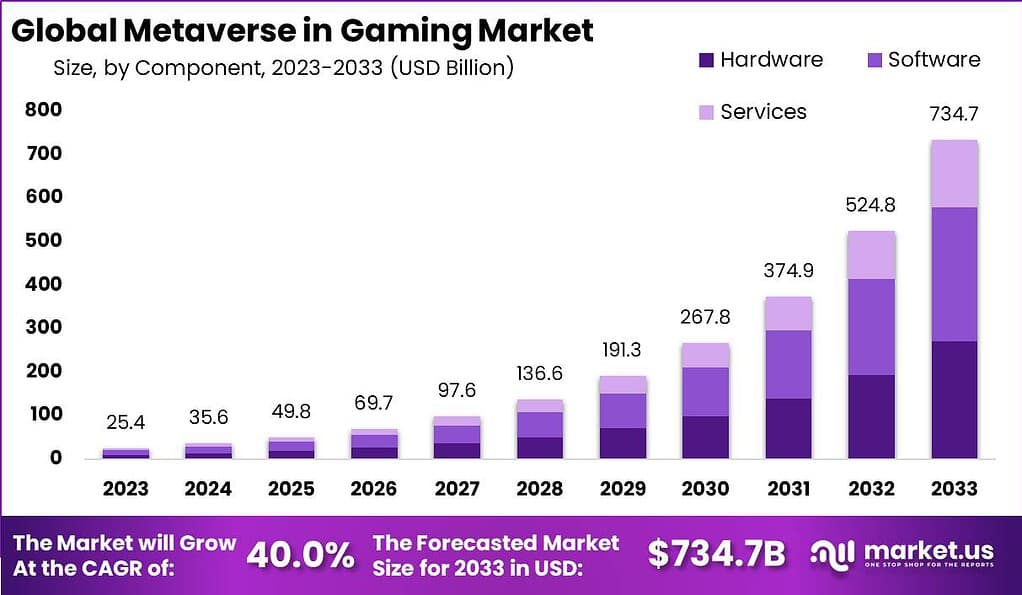
The Global Metaverse in Gaming Market size is expected to be worth around USD 734.7 Billion by 2033, from USD 25.4 Billion in 2023, growing at a CAGR of 40% during the forecast period from 2024 to 2033.
The Metaverse in gaming represents a rapidly expanding sector where virtual worlds are created, allowing players to interact in a three-dimensional space that mimics real-life interactions. These gaming platforms are not just about playing games; they also serve as social spaces where users can meet, collaborate, and create their own experiences. The concept of the Metaverse in gaming blends traditional gaming elements with advanced virtual reality (VR) and augmented reality (AR) technologies, making the experience immersive and interactive.
The metaverse in gaming market has experienced significant growth, driven by advancements in technology, increasing demand for immersive experiences, and the rise of online gaming communities. Major gaming companies are investing heavily in the development of metaverse platforms and ecosystems, aiming to create expansive virtual universes that transcend individual game titles. These metaverse platforms offer tools and frameworks for developers to build and monetize their own virtual experiences within the metaverse.
The metaverse in gaming market is also witnessing the emergence of blockchain technology, which enables secure ownership and trading of in-game assets. Non-fungible tokens (NFTs) have gained prominence, allowing players to own unique digital items and participate in decentralized economies within the metaverse. This fusion of blockchain and metaverse technology has the potential to revolutionize the gaming industry, creating new opportunities for player-driven economies and decentralized gaming experiences.
For instance, in September 2022, Hadean Supercomputing Ltd., a spatial computing startup based in the UK, secured an investment of ~USD 30 million from prominent industry players Epic Games, Inc. and Tencent Holdings Ltd. This substantial financial backing enabled Hadean to enhance the infrastructure essential for the development of the Metaverse in gaming. Collaborations such as this between key market participants are anticipated to significantly contribute to the expansion of the market during the forecast period.
Furthermore, the integration of cloud computing into the metaverse is generating substantial growth opportunities. In March 2023, NVIDIA formed a strategic partnership with Microsoft, granting their enterprise users access to advanced industrial metaverse and AI supercomputing capabilities via cloud services. This collaboration is providing benefits to hundreds of millions of users and is anticipated to consistently drive market growth.
As of 2024, the Metaverse boasts over 600 million active users globally. A significant portion of these users, 80%, are under the age of 16, highlighting a youthful demographic engagement. Roblox emerges as the most favored metaverse game, drawing 55 million active players daily.
Interestingly, 60% of gamers engage in non-gaming activities within the metaverse, including socializing and shopping. This indicates a versatile use of the platform beyond mere entertainment. Approximately 52% of internet users worldwide utilize the Metaverse for work-related purposes, while 48% participate for entertainment.
Social activities, including online dating, draw about 32% of users, showcasing the metaverse’s role as a social platform. Projecting into the future, by 2026, about 25% of all users are expected to spend at least one hour daily in the Metaverse. This data underscores the growing integration of the Metaverse into everyday activities and its broadening appeal across various aspects of life
Key Takeaways
- Metaverse in Gaming Market size is expected to reach USD 734.7 billion by 2033, projected at a CAGR of 40% during forecast period.
- In 2023, the Software segment held a dominant market position within the Metaverse in Gaming Market, capturing more than a 41.9% share.
- In 2023, the Virtual Reality (VR) segment held a dominant market position within the Metaverse in Gaming Market, capturing more than a 38.5% share.
- In 2023, the Adventure Games segment held a dominant market position within the Metaverse in Gaming Market, capturing more than a 37% share.
- In 2023, North America held a dominant market position in the metaverse gaming industry, capturing more than a 39.8% share.
- $18 billion is projected to be invested in AR/VR gaming technology by the end of 2024, representing 62% of all AR/VR investments during this period. Metaverse gaming predominantly attracts young male players, with 59% of Metaverse gamers being males around the average age of 27.
- Roblox leads as the most popular Metaverse game, boasting 55 million active daily players. Other significant platforms include VRChat and Horizon Worlds. Over 25% of global consumers are interested in trying virtual experiences, with significant interest in applications like virtual museum tours, concerts, and educational classes.
- Governments are increasingly interested in the Metaverse for enhancing public services and have started to invest in Metaverse platforms, marking a new area of expansion beyond private sector entertainment and gaming. 54% of technology experts anticipate the metaverse will offer immersive experiences by 2040, while 31% of US adults have never heard the term “metaverse”.
- 68% of tech experts think the metaverse will boom within the next 5 years. The computer and IT sectors comprise 17% of all investments in the metaverse. 60% of gamers have used the metaverse for non-gaming activities such as socializing and shopping.
- The Global Extended Reality (XR) Market size is expected to be worth around USD 519.5 Billion by 2032, from USD 49.6 Billion in 2023, growing at a CAGR of 30.8% during the forecast period from 2024 to 2033.
- The valuation of Global Virtual Reality Headset Market is expected to surpass USD 121.9 billion by the year 2032 from USD 13 Billion in 2023, expanding steadily at the highest CAGR of 29.1%.
- The Global Mixed Reality Market size is expected to be worth around USD 1,224.0 Bn by 2032 from USD 52.6 Bn in 2023, growing at a CAGR of 43.2% during the forecast period from 2023 to 2032.
- The Global Immersive-reality Technologies market size is poised to cross USD 90.8 Billion in 2023 and is likely to attain a valuation of USD 780.4 Billion by 2033, with a CAGR of 24% during the forecast period 2024-2033.
- The global Augmented Reality Market is anticipated to be USD 591.7 billion by 2033. It is estimated to record a steady CAGR of 39.5% in the Forecast period 2024 to 2033. It is likely to total USD 29.6 billion in 2024.
- Companies investing heavily in the Metaverse include Microsoft, which recently acquired Activision Blizzard for $70 billion, thereby securing major gaming IPs like Call of Duty and World of Warcraft.
- It’s estimated that by 2026, 25% of the population will spend at least an hour daily in the Metaverse, indicating rising consumer engagement and market potential.
- In terms of daily active users, the Metaverse had over 400 million in 2022, with platforms like Roblox and Fortnite being significant contributors. Governments are also investing in the Metaverse; for instance, the South Korean government launched a $48.3 million fund to support Metaverse startups.
Component Analysis
In 2023, the Software segment held a dominant market position within the Metaverse in Gaming Market, capturing more than a 41.9% share. This prominence can be attributed to the critical role software plays in creating immersive and interactive gaming environments that are essential to the metaverse experience.
Software solutions not only enable the development and operation of complex virtual worlds but also facilitate the integration of advanced features such as AI-driven avatars, real-time interactions, and personalized gaming experiences. As gaming platforms increasingly shift towards offering more enriched and multifaceted virtual experiences, the demand for sophisticated software that can deliver these capabilities continues to surge.
Furthermore, the leadership of the Software segment is reinforced by continuous innovations in gaming technology, including the development of more advanced game engines and user interface tools. These advancements enhance the visual fidelity and responsiveness of virtual environments, making them more engaging for users.
The expansion of cloud gaming services and the increasing accessibility of game development platforms have also lowered barriers for content creators, fostering a more dynamic and expansive market for gaming software. This environment encourages ongoing investment and interest in software solutions, sustaining its growth trajectory.
Technology Analysis
In 2023, the Virtual Reality (VR) segment held a dominant market position within the Metaverse in Gaming Market, capturing more than a 38.5% share. The significant share of the VR segment can be attributed to its ability to provide immersive experiences that are integral to the metaverse concept. VR technology transports users into fully realized 3D environments where they can interact with the virtual space and other players in ways that mimic real-life interactions. This level of immersion is particularly appealing in the gaming industry, where the demand for rich, immersive, and interactive content is continuously growing.
The dominance of VR in the gaming metaverse is also bolstered by substantial investments from major tech companies in VR hardware and software development. Innovations such as improved motion tracking, haptic feedback, and enhanced graphical fidelity have made VR gaming more accessible and enjoyable for a broader audience. Moreover, the decreasing cost of VR headsets and the increasing availability of VR content are important factors driving consumer adoption and market growth.
Looking ahead, the VR segment is expected to maintain its leadership due to ongoing technological advancements and increased content creation. As VR technology continues to evolve, with developments in wireless technology and augmented reality integration, it will likely attract even more gamers seeking unique and compelling virtual experiences. Additionally, as social and multiplayer VR experiences become more prevalent, they will further drive the segment’s growth, reinforcing VR’s position at the forefront of the metaverse in gaming.
Gaming Genre Analysis
In 2023, the Adventure Games segment held a dominant market position within the Metaverse in Gaming Market, capturing more than a 37% share. This significant market share is largely due to the natural alignment of adventure games with the immersive, explorative nature of the metaverse.
Adventure games are designed to offer rich narratives and expansive worlds that encourage exploration, puzzle-solving, and interaction with diverse environments and characters. These elements are enhanced by the metaverse’s capabilities, allowing for deeper immersion into the game’s universe, which appeals greatly to players seeking a comprehensive and engaging experience.
The leadership of the Adventure Games segment is further supported by the integration of advanced technologies such as Virtual Reality (VR) and Augmented Reality (AR), which elevate the immersive experience. These technologies make virtual landscapes more tangible and interactive, offering gamers an even more engaging and sensory experience. The narrative depth and interactive gameplay, combined with technological enhancements, make adventure games particularly attractive in the metaverse context.
Moving forward, the Adventure Games segment is expected to continue its growth trajectory. As technology advances, the potential for more complex and engaging narratives, as well as more interactive and realistic environments, expands. Moreover, as social interaction within these virtual worlds becomes more sophisticated, it will likely draw a broader audience, further cementing the position of Adventure Games as a leading genre in the metaverse gaming market.

Key Market Segments
By Component
- Hardware
- VR Headsets
- AR Devices
- Gaming Consoles
- Others
- Software
- Services
By Technology
- Virtual Reality (VR)
- Augmented Reality (AR)
- Mixed Reality (MR)
- Artificial Intelligence (AI)
- Other Technologies
By Gaming Genre
- Adventure Games
- Role-Playing Games
- Action Games
- Simulation Games
- Sports and Racing Games
- Others
Driver
Gamification and virtual world simulators drive brand promotions
The integration of gamification and virtual world simulators into marketing strategies has emerged as a significant driver for brand promotions within the metaverse gaming industry. This approach leverages the engaging and interactive nature of gaming environments to create compelling brand experiences that captivate and retain consumer attention. By incorporating elements such as points, leaderboards, and interactive challenges, brands can enhance user engagement and foster a deeper emotional connection with their audience.
Virtual world simulators further amplify this effect by providing a realistic and immersive platform where consumers can interact with products and services in a dynamic, virtual setting. This method not only increases the visibility of brands but also boosts consumer loyalty and advocacy, as users are more likely to share unique and enjoyable experiences. The trend is supported by the growing popularity of virtual and augmented reality technologies, which enhance the realism and appeal of gamified promotional activities, making them an essential tool in modern digital marketing strategies.
Restraint
Regulating metaverse in gaming is essential for cybersecurity and privacy
Regulating the metaverse in gaming is crucial to ensure the safety, privacy, and security of users. As these virtual spaces become increasingly complex and interconnected, they also become more susceptible to cyber threats such as data breaches, hacking, and unauthorized surveillance. Implementing robust regulatory frameworks can help mitigate these risks by establishing clear standards for data protection, user identity verification, and secure software development practices.
Additionally, regulation can enforce the ethical use of technology, preventing abuses that could harm users or erode trust in virtual gaming platforms. Ensuring cybersecurity and privacy not only protects consumers but also supports the sustainable growth of gaming metaverse developers and operators by maintaining a safe and trustworthy environment for all participants.
Opportunity
Despite economic slowdown, metaverse gaming offers growth opportunities
Despite potential economic slowdowns, the metaverse gaming sector presents significant growth opportunities. This resilience stems from the continuous innovation and technological advancements that characterize the industry, appealing to a diverse and expanding user base. During economic downturns, entertainment, especially interactive and immersive forms like gaming, tends to maintain consumer interest as individuals seek cost-effective ways to engage and socialize.
The unique features of metaverse gaming, such as the ability to offer cross-platform play, virtual events, and new forms of content monetization, provide additional revenue streams and business models that are not available in traditional gaming or digital media sectors. Furthermore, the global nature of the metaverse means that it can tap into new markets and demographics, driving growth regardless of regional economic conditions.
Challenge
Regional government regulations and environmental impact challenge metaverse development.
Navigating regional government regulations and addressing environmental impacts pose considerable challenges to the development of the metaverse in gaming. Regulatory variance from one region to another can complicate the deployment and scalability of new games and technologies, requiring companies to adapt their operations to comply with diverse legal environments.
Additionally, the environmental impact of maintaining large-scale, high-intensity server farms necessary for running sophisticated virtual worlds is becoming an increasing concern. Energy consumption and electronic waste associated with gaming hardware and data centers prompt a need for sustainable practices and solutions. Addressing these challenges requires ongoing dialogue between industry stakeholders, policymakers, and environmental experts to find balanced approaches that foster innovation while ensuring compliance and sustainability.
Growth Factors
- Technological Advancements: Continuous innovations in VR, AR, and AI technologies are enhancing the realism and interactivity of virtual gaming experiences, attracting more users and increasing engagement.
- Increased Investment: Growing interest from tech giants and venture capitalists in metaverse initiatives provides essential funding for research, development, and scaling of gaming platforms within the metaverse.
- Broader Demographic Appeal: The metaverse in gaming is increasingly designed to cater to a diverse audience, including various age groups and preferences, which broadens its market base and drives growth.
- Expansion of Digital Economies: In-game purchases and virtual goods create lucrative revenue streams for developers and offer players a highly customizable gaming experience, fueling further economic activity within the metaverse.
- Global Connectivity: The metaverse’s capability to connect users from different geographical regions fosters a unique global community, encouraging cross-cultural exchanges and collaborations that enhance user retention and market expansion.
Emerging Trends
- Social Gaming Experiences: The integration of social media elements into gaming platforms, allowing players to connect, share, and interact in the virtual spaces, is becoming a core feature of metaverse gaming.
- Sustainable Gaming Practices: With an increased focus on environmental impact, there is a rising trend towards more sustainable gaming practices, including energy-efficient gaming technologies and eco-friendly operational strategies.
- Hybrid Events: The blend of virtual and physical experiences, such as hybrid esports tournaments and mixed reality concerts, is gaining traction, providing immersive experiences that draw a larger audience.
- Personalization through AI: Artificial Intelligence is increasingly used to personalize gaming experiences, adapting game dynamics and content in real-time based on individual player behavior and preferences.
- Blockchain Integration: Utilization of blockchain technology to enhance security, enable transparent transactions, and facilitate the creation of decentralized gaming platforms is a trend gaining momentum within the metaverse gaming sector.
Regional Analysis
In 2023, North America held a dominant market position in the metaverse gaming industry, capturing more than a 39.8% share. This significant market dominance can largely be attributed to the high penetration of advanced gaming technologies and the robust presence of leading gaming and tech companies. The demand for Metaverse in Gaming in North America was valued at USD 10.1 billion in 2023 and is anticipated to grow significantly in the forecast period.
North American companies, particularly in the U.S. and Canada, have been pioneers in integrating augmented reality (AR) and virtual reality (VR) within gaming platforms, which are fundamental components of the metaverse framework. Furthermore, the region’s consumers exhibit a high willingness to adopt new technologies, coupled with substantial purchasing power, thereby driving the demand for immersive and interactive gaming experiences.
The region’s technological infrastructure also supports the rapid growth of the metaverse in gaming. With widespread high-speed internet access and increasing investments in 5G networks, North American gamers enjoy enhanced connectivity, leading to a smoother and more engaging metaverse experience. Additionally, significant investments in cloud technologies and data centers by major tech giants have minimized latency issues, which are crucial for real-time gaming and interactions within the metaverse.
Moreover, the presence of major players like Meta Platforms Inc., Microsoft Corporation, and Epic Games, who are actively developing metaverse platforms, contributes to the pioneering role of North America in this market. These companies not only invest heavily in R&D but also in collaborative projects and partnerships that further integrate various aspects of gaming, social interactions, and digital economies, setting a rapid pace for market expansion and technological adoption in the region.

Key Regions and Countries Covered in this Report:
- North America
- The US
- Canada
- Europe
- Germany
- France
- The UK
- Spain
- Italy
- Russia
- Netherland
- Rest of Europe
- APAC
- China
- Japan
- South Korea
- India
- Australia
- New Zealand
- Singapore
- Thailand
- Vietnam
- Rest of APAC
- Latin America
- Brazil
- Mexico
- Rest of Latin America
- Middle East & Africa
- South Africa
- Saudi Arabia
- UAE
- Rest of MEA
Key Players Analysis
The metaverse in gaming market has attracted the attention of several key players in the industry who are actively contributing to its growth and development. These companies are at the forefront of creating immersive virtual worlds, innovative gameplay experiences, and exploring the vast potential of the metaverse.
One of the prominent players in the metaverse gaming market is Epic Games, the creator of the popular game Fortnite. Epic Games has been actively investing in building a metaverse by integrating its Unreal Engine technology and collaborating with other developers to create interconnected virtual experiences. The company’s vision for the metaverse extends beyond gaming, with plans to incorporate social interactions, entertainment, and virtual events.
Another major player is Roblox Corporation, known for its user-generated content platform Roblox. Roblox provides a vast metaverse-like ecosystem where players can create and share their own games and experiences. The platform has gained immense popularity, particularly among younger audiences, and has fostered a vibrant community of developers and players.
Top Market Leaders
- Meta Platforms Inc.
- Microsoft Corporation
- NVIDIA Corporation
- Epic Games Inc.
- Unity Technologies
- Sony Corporation
- Electronic Arts Inc.
- Roblox Corporation
- Tencent Holdings Ltd.
- Niantic Inc.
- Sansar Inc.
- Other Key Players
Recent Developments
- In April 2023, Electronic Arts launched EA SPORTS FC, introducing a fresh brand identity and logo. This platform is set to innovate and broaden football gaming experiences across consoles, mobiles, online platforms, and esports, aiming to connect a vast global audience.
- In March 2023, Epic Games unveiled the Unreal Editor for Fortnite (UEFN). This tool incorporates major features of Unreal Engine 5, enabling creators to directly craft and publish unique gaming experiences within Fortnite. UEFN enhances customization through features like device chaining and simplified game logic creation, enriching the creative possibilities for millions of users.
- In January 2023, Unity, in collaboration with Google, enhanced developer tools for building multiplayer gaming experiences. Through the Unity Gaming Services, specifically Game Server Hosting (Multiplay) and Voice and Text Chat (Vivox), available on the Google Cloud Marketplace, developers are provided streamlined services to support the creation of real-time 3D content, facilitating easier and more efficient game development processes.









