


Report Overview
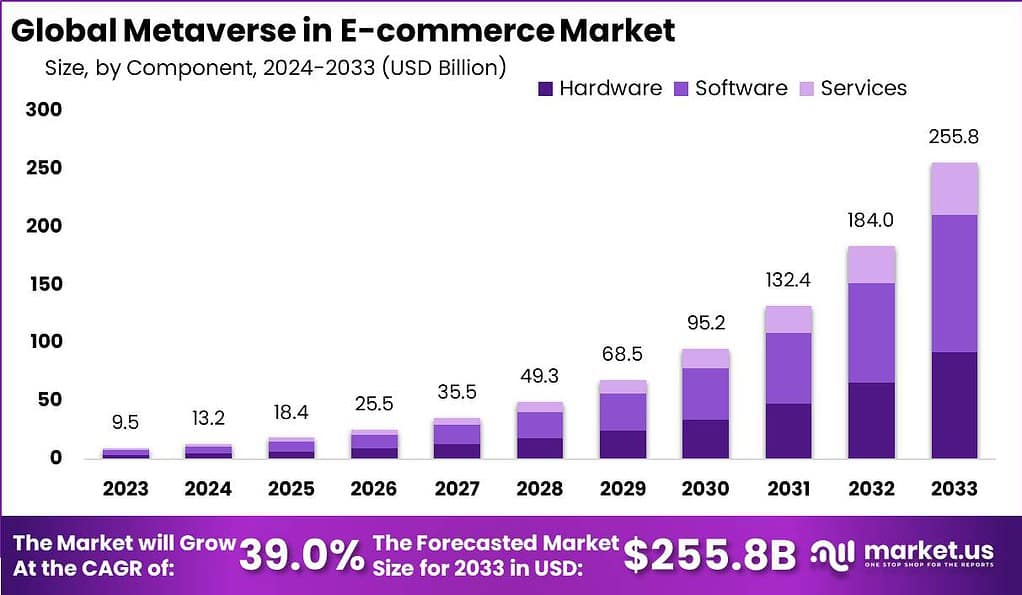
The Global Metaverse in E-commerce Market size is expected to be worth around USD 255 Billion by 2033, from USD 9.5 Billion in 2023, growing at a CAGR of 39% during the forecast period from 2024 to 2033.
The metaverse is a virtual reality space where users can interact with a computer-generated environment and other users in real-time. In recent years, the concept of the metaverse has gained significant attention and has the potential to revolutionize various industries, including e-commerce.
The Metaverse in E-commerce market is experiencing significant growth as businesses explore virtual environments to enhance customer engagement and drive sales. This sector capitalizes on advanced technologies such as virtual reality (VR) and augmented reality (AR) to create immersive shopping experiences.
Market dynamics are influenced by the increasing consumer demand for interactive and personalized shopping experiences, which are facilitated by the metaverse platforms. Key players in this market are investing heavily in developing virtual stores and interactive marketing strategies that leverage the unique capabilities of the metaverse to offer consumers a blend of entertainment and commerce.
The integration of blockchain technology further enhances the security and efficiency of transactions within these virtual spaces. As the technology infrastructure continues to evolve, the metaverse is poised to redefine the e-commerce landscape, offering significant opportunities for growth and innovation.
The interest in augmented reality (AR) tools during shopping experiences is notable. According to a Google survey, 66% of individuals prefer using AR tools because it enhances their satisfaction and increases their likelihood to purchase products they can test in a 3D format.
The global metaverse market is on a rapid ascent. From a valuation of USD 94.1 billion in 2023, it is projected to soar to USD 2,346.2 billion by 2032. This represents a remarkable compound annual growth rate (CAGR) of 44.4% from 2023 to 2032.
It’s estimated that by 2026, 25% of people worldwide might spend at least one hour every day in the metaverse. This shows a growing engagement with virtual environments. Furthermore, 30% of businesses and organizations globally are expected to develop metaverse products and services, indicating a significant shift towards these technologies. Currently, over 32% of consumers are already using AR technologies when shopping, which points to a strong adoption rate and potential growth in this space.
Key Takeaways
- Metaverse in E-commerce Market size is expected to be worth around USD 255 Billion by 2033, growing at a CAGR of 39% during the forecast period from 2024 to 2033.
- In 2023, the Software segment held a dominant market position within the metaverse in e-commerce, capturing more than a 46.5% share.
- In 2023, the Virtual Reality (VR) segment held a dominant market position within the metaverse in e-commerce, capturing more than a 38.2% share.
- In 2023, the Virtual Events segment held a dominant market position within the metaverse in e-commerce, capturing more than a 53% share.
- In 2023, North America held a dominant market position in the metaverse in e-commerce, capturing more than a 37.5% share.
- By the end of 2023, the number of Augmented Reality (AR) device users is expected to reach approximately 1.3 billion.
- A significant 71% of e-commerce shoppers indicate they would shop more frequently if AR technology were more accessible.
- Looking ahead to 2030, the Metaverse eCommerce market is poised to include around 1,293.0 million users.
- User penetration in the Metaverse eCommerce, which represents the percentage of the population using these services, is forecasted to be 7.3% in 2024. This figure is expected to climb significantly to 19.5% by 2030.
- The average revenue per user (ARPU) within this market is estimated to be US$65.1.
- Additionally, a quarter of business executives predict that more than 15% of their company’s revenue will be derived from metaverse-related activities within the next five years.
- Currently, about 60% of consumers who have engaged with the metaverse express a preference for its immersive activities over traditional, physical-world alternatives.
Component Analysis
In 2023, the Software segment held a dominant market position within the metaverse in e-commerce, capturing more than a 46.5% share. This leadership stems primarily from the crucial role that software plays in creating and managing virtual environments. The demand for robust, scalable, and secure platforms that can support intricate virtual experiences is essential for both vendors and consumers.
Software solutions facilitate the development of immersive and interactive virtual stores, where customers can simulate physical shopping experiences from their homes. Additionally, the integration capabilities of this software with existing e-commerce systems and data analytics tools are fundamental in providing a seamless and enriched user experience.
The dominance of the Software segment is further propelled by continuous innovations and upgrades in virtual reality (VR) and augmented reality (AR) applications, which are integral components of the metaverse. These technologies require sophisticated software that can render high-quality, real-time graphics and handle complex user interactions.
As companies invest in developing more advanced and user-friendly interfaces, the demand for software that can support these technologies increases. Moreover, as the metaverse environment grows, there is an escalating need for security and privacy protections, which are primarily enabled through software solutions. This need ensures ongoing investments and development in the segment, reinforcing its market dominance.
Additionally, the software segment benefits from the growing trend of digitalization across various sectors, including retail, real estate, and entertainment, which are expanding their digital presence into the metaverse to capitalize on new marketing and sales opportunities.
Technology Analysis
In 2023, the Virtual Reality (VR) segment held a dominant market position within the metaverse in e-commerce, capturing more than a 38.2% share. This prominence is largely due to VR’s ability to offer immersive and interactive shopping experiences that closely mimic physical retail environments.
Through VR technology, consumers can navigate virtual stores, interact with products in three-dimensional space, and engage in a highly interactive form of online shopping. This level of immersion significantly enhances customer engagement and satisfaction, making VR a critical technology in the transformation of e-commerce into more experiential platforms.
The leadership of the VR segment is also bolstered by substantial advancements in VR hardware and software. As VR headsets become more affordable and accessible, and as the software powering these experiences becomes more sophisticated, the barriers to entry for both consumers and retailers are lowering. This accessibility is critical for adoption on a larger scale.
Furthermore, VR technology has been at the forefront of bridging the gap between digital convenience and the tactile, engaging nature of traditional shopping, which is a significant draw for both e-commerce platforms and their customers.
Moreover, the VR segment benefits from strategic investments by major tech companies aiming to capitalize on and expand the capabilities of VR in e-commerce. These investments not only drive the development of new and improved VR technologies but also foster a growing ecosystem of developers and content creators focused on creating unique VR shopping experiences. This vibrant ecosystem ensures continuous innovation within the segment, promising further growth and a sustained leadership position in the market.

Application Analysis
In 2023, the Virtual Events segment held a dominant market position within the metaverse in e-commerce, capturing more than a 53% share. This segment has thrived primarily due to the shift in consumer and business behavior favoring remote interactions, a trend accelerated by the global shift toward digital solutions for communication and engagement.
Virtual events in the metaverse provide a dynamic platform for hosting product launches, fashion shows, trade fairs, and other marketing events, attracting attendees from across the globe without the need for physical travel. This global reach and the ability to engage with a wider audience have been significant drivers of the segment’s growth.
The success of the Virtual Events segment is also supported by the enhanced capabilities these platforms offer in terms of interaction and personalization. Unlike traditional online webinars or video conferences, virtual events in the metaverse can create immersive experiences that mimic physical events closely.
Attendees can explore virtual spaces, interact with products, and network with others in a more engaging and intuitive manner. These capabilities make virtual events more attractive to businesses looking to cut down on costs while maximizing outreach and consumer engagement.
Furthermore, technological advancements in virtual reality (VR) and augmented reality (AR), which enable more realistic and engaging virtual environments, have bolstered the Virtual Events segment. The integration of these technologies with e-commerce platforms allows for seamless transitions between experiencing an event and making purchases related to the event, enhancing the overall user experience and effectiveness of marketing strategies within the metaverse.
Key Market Segments
By Component
- Hardware
- Software
- Services
By Technology
- Virtual Reality (VR)
- Augmented Reality (AR)
- Mixed Reality (MR)
- Other Technologies
By Application
- Virtual Events
- Virtual Stores
- Virtual Try-On
- Other Applications
Driver
Increasing Consumer Demand for Immersive Experiences
One significant driver for the metaverse in e-commerce is the increasing consumer demand for immersive and interactive shopping experiences. As digital natives become a larger part of the consumer base, there is a growing expectation for engaging and technologically integrated shopping environments. The metaverse provides a unique platform that blends entertainment with commerce, offering users the ability to interact with products and brands in a fully immersive way.
This demand is pushing retailers to innovate beyond traditional online storefronts, incorporating virtual reality (VR), augmented reality (AR), and other technologies to create distinctive, memorable customer experiences. As such, the drive for immersion is accelerating the adoption of metaverse elements in e-commerce strategies, enhancing customer engagement and potentially increasing sales.
Restraint
Technological Complexity and Integration Challenges
A major restraint in the adoption of the metaverse within e-commerce is the technological complexity and integration challenges associated with these advanced digital environments. Implementing metaverse technologies often requires significant investment in new systems and software, as well as the integration of these elements with existing e-commerce platforms.
Furthermore, retailers must ensure that their virtual environments are accessible to consumers with varying levels of technological literacy and hardware capabilities. These challenges can deter businesses, especially small and medium-sized enterprises, from adopting metaverse technologies.
Additionally, concerns regarding data privacy and security in these highly interactive and immersive environments can further inhibit growth, as both consumers and businesses must navigate the complexities of maintaining data security in new and evolving digital spaces.
Opportunity
Expansion of Global Reach and Accessibility
The metaverse presents a substantial opportunity for e-commerce businesses to expand their global reach and accessibility. Virtual stores and events in the metaverse are not constrained by geographical boundaries, allowing brands to showcase their products to an international audience without the costs associated with physical expansion. This global accessibility can democratize shopping experiences, offering high-end retail experiences to consumers in remote or underserved locations.
Furthermore, the metaverse enables businesses to operate 24/7 in a variety of languages and cultural settings, potentially increasing sales and customer engagement across different time zones and markets. As connectivity improves globally, the potential for the metaverse to connect brands with a diverse, worldwide customer base will continue to grow, offering significant market expansion opportunities.
Challenge
Ensuring User Engagement and Retention
A critical challenge in the metaverse for e-commerce is ensuring sustained user engagement and retention. While the novelty of virtual shopping environments can initially attract consumers, maintaining their interest over time requires continuous content updates, innovative features, and highly engaging user experiences. Businesses must invest in creating dynamic, appealing virtual spaces that are regularly updated to reflect new products and trends.
Moreover, the user experience must be seamless and rewarding to prevent frustration that could lead to high dropout rates. The challenge lies in balancing the excitement of new technological capabilities with user-friendly design and meaningful interactions that resonate with diverse consumer groups. This requires ongoing commitment to content development, system maintenance, and customer feedback integration.
Growth Factors
- Technological Advancements: Continuous improvements in VR, AR, and AI technologies are making the metaverse more accessible and enjoyable. These advancements enable more realistic and engaging virtual environments, essential for attracting and retaining consumers.
- Increased Consumer Engagement: The immersive nature of the metaverse allows for deeper interaction between customers and brands. This heightened engagement is translating into longer session times and potentially higher sales, as customers are more involved in the shopping process.
- Expansion of Digital Infrastructure: As global internet connectivity improves and more consumers gain access to high-speed internet and compatible devices, the potential customer base for metaverse e-commerce platforms expands significantly.
- COVID-19 Pandemic Impact: The shift towards remote interaction, accelerated by the COVID-19 pandemic, has led to increased interest in virtual platforms for both shopping and socializing, pushing companies to invest in metaverse technologies as a means to capture this growing market.
- Brand Differentiation: In a highly competitive market, brands are constantly seeking new ways to differentiate themselves. The metaverse offers an innovative platform for unique marketing campaigns and customer experiences, setting pioneering brands apart from their competitors.
Emerging Trends
- Hybrid Retail Experiences: Combining physical and virtual shopping experiences, such as virtual try-ons linked with online purchases or in-store interactions, is becoming more prevalent. This hybrid model enhances convenience and customer satisfaction, offering a seamless transition between real and virtual worlds.
- NFT Integration: Non-fungible tokens (NFTs) are being increasingly used within the metaverse to offer unique, personalized shopping experiences. Brands use NFTs for everything from ownership verification to exclusive event access, adding a layer of value and exclusivity.
- Sustainability Focus: The metaverse allows brands to showcase their products and services without the physical limitations or environmental costs associated with traditional retail. This can align with the growing consumer demand for more sustainable shopping practices.
- Social Shopping Experiences: Social features are being integrated into metaverse shopping, enabling users to interact with friends, attend events, or consult with sales representatives in real-time. This trend emphasizes the social aspect of shopping, traditionally seen in physical stores.
- AI-Driven Personalization: Artificial intelligence is being employed to enhance personalization in the metaverse, from personalized avatars to AI-assisted shopping assistants. This technology helps tailor the shopping experience to individual preferences, improving satisfaction and loyalty.
Regional Analysis
In 2023, North America held a dominant market position in the metaverse in e-commerce, capturing more than a 37.5% share. This leadership can be largely attributed to the region’s advanced technological infrastructure and the strong presence of key technology and retail giants that are early adopters and innovators in metaverse technologies.
Companies based in North America, particularly in the U.S., have been at the forefront of developing and integrating AR, VR, and AI technologies, which are fundamental to creating immersive and interactive e-commerce experiences. This technological edge has fostered a conducive environment for the growth of the metaverse in e-commerce.
Moreover, North American consumers are typically early adopters of new technologies, showing a greater willingness to engage with and spend within virtual environments. This consumer behavior drives demand for metaverse experiences, prompting more companies to invest in virtual stores and marketing campaigns within these digital realms. Additionally, the region’s robust economic environment supports higher investment in R&D activities related to the metaverse, further propelling its development.
The region’s regulatory landscape also plays a critical role in its dominance. With progressive policies that often support technological innovation and digital commerce, businesses operating in North America have a clearer pathway to integrate new technologies into their operations and consumer offerings. This regulatory support, combined with a tech-savvy consumer base and continuous technological advancements, ensures that North America remains a leading market for metaverse in e-commerce

Key Regions and Countries
North America
- US
- Canada
Europe
- Germany
- France
- The UK
- Spain
- Italy
- Russia
- Netherlands
- Rest of Europe
Asia Pacific
- China
- Japan
- South Korea
- India
- Australia
- Singapore
- Thailand
- Vietnam
- Rest of APAC
Latin America
- Brazil
- Mexico
- Rest of Latin America
Middle East & Africa
- South Africa
- Saudi Arabia
- UAE
- Rest of MEA
Key Players Analysis
The metaverse in e-commerce market is characterized by the participation of a diverse range of key players, each contributing to the growth and innovation within this space. These key players typically span from technology giants to specialized startups, and their roles and influence can vary significantly.
Major tech companies like Facebook (now Meta Platforms), Microsoft, and Google are instrumental in shaping the metaverse in e-commerce. They provide the fundamental technologies, such as cloud computing services, AI, VR, and AR technologies, that underpin the metaverse. For instance, Meta Platforms is heavily investing in VR through its Oculus devices and platforms, aiming to create a more interconnected virtual environment for both social interactions and commerce.
Top Market Leaders
- Meta Platforms Inc.
- Microsoft Corporation
- Roblox Corporation
- NVIDIA Corporation
- Unity Technologies
- Amazon.com, Inc.
- Tencent Holdings Ltd.
- Alibaba Group Holding Limited
- Adobe Inc.
- eBay Inc.
- Decentraland
- Other Key Players
Recent Developments
- Microsoft Corporation: In January 2024, Microsoft announced new generative AI and data solutions designed for retailers. This includes the introduction of a copilot template within Microsoft Cloud for Retail, enabling personalized shopping experiences through AI. This initiative allows retailers to create more engaging and tailored online shopping experiences by integrating AI to better understand and interact with customers
- Decentraland hosted its third annual Metaverse Pride event in June 2023. This event, which attracted over 45 million attendees, featured interactive exhibitions and live music performances, emphasizing the role of virtual events in enhancing community engagement and e-commerce within the metaverse.
- NVIDIA Corporation: NVIDIA is deeply involved in the technological underpinnings that support Metaverse environments, such as VR and AR, which are crucial for creating immersive experiences in e-commerce and beyond.
- Tencent Holdings Ltd.: In January 2022, Tencent launched new Metaverse services aimed at supporting Japanese businesses by integrating cloud computing solutions and virtual human avatars. This move is indicative of Tencent’s broader strategy to expand its Metaverse capabilities and services across different regional markets.









