


Report Overview
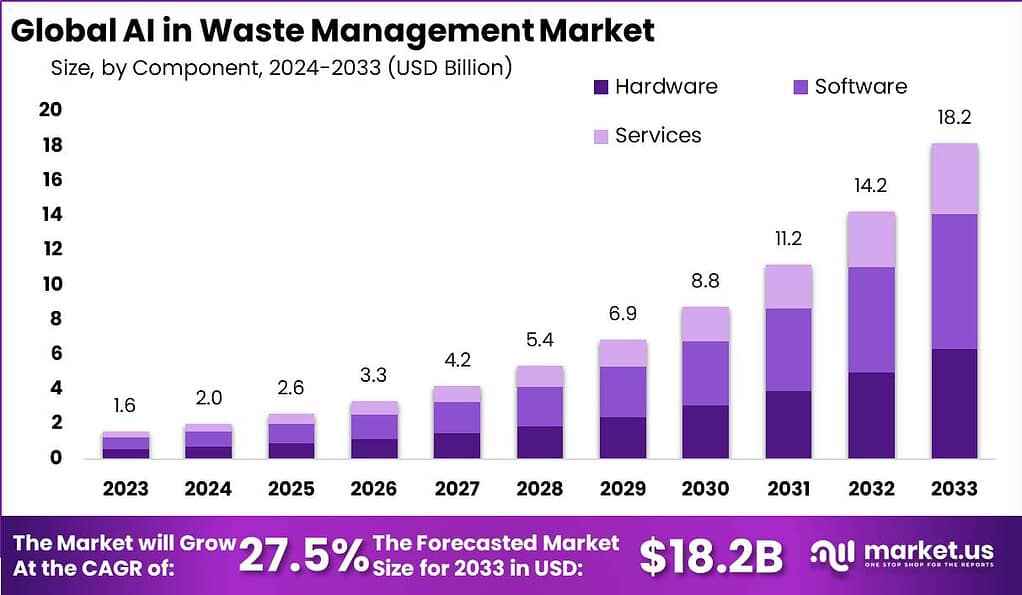
The Global AI in Waste Management Market size is expected to be worth around USD 18.2 Billion by 2033, from USD 1.6 Billion in 2023, growing at a CAGR of 27.5% during the forecast period from 2024 to 2033.
Artificial intelligence (AI) is increasingly utilized in waste management to enhance efficiency and sustainability. AI technologies, like machine learning and smart sensors, help in identifying, sorting, and managing waste materials. These tools can rapidly categorize different types of waste, such as plastics, metals, and organics, facilitating more effective recycling processes. Additionally, AI-driven analytics can predict waste generation patterns and optimize collection routes, reducing operational costs and environmental impact.
The market for AI in waste management is experiencing significant growth due to the rising awareness of environmental issues and the push for sustainability. Governments and corporations are investing in AI technologies to improve waste management systems. This market expansion is further fueled by technological advancements and the increasing adoption of smart waste management solutions worldwide.
The industry is set to grow as more regions prioritize waste reduction and resource recovery, capitalizing on AI’s potential to transform traditional waste management practices. However, the market faces challenges, including high initial investment costs and a lack of technological infrastructure in developing regions. Additionally, the complexity of accurately categorizing diverse waste types through AI poses a significant technical challenge.
Despite these obstacle, the market presents robust opportunities for new entrants. The continuous innovation in AI and machine learning creates a fertile ground for fresh solutions and business models. New entrants can capitalize on unexplored niches within the sector, such as customized AI applications for local waste management needs or integration with existing IoT infrastructures.
The market for Artificial Intelligence (AI) in waste management is anticipated to surpass USD 8.8 billion by 2030. This growth is driven by the increasing adoption of AI technologies for improving efficiency and effectiveness in waste management practices.
The Asia Pacific region stands out as the fastest-growing market for AI in waste management, according to findings from Zipdo. This growth can be attributed to rapid urbanization, escalating waste production, and strong governmental focus on sustainable waste management practices in the region.
Among the various applications of AI in this sector, the container management segments are poised for the most significant expansion, with an expected growth rate of over 30%. This surge is due to the adoption of AI to optimize routes, enhance collection processes, and improve the overall efficiency of waste handling.
Currently, nearly 80% of waste generated by cities is disposed of untreated in landfills, highlighting a significant opportunity for AI to play a transformative role in managing urban waste more sustainably. In contrast, Europe demonstrates exemplary waste management practices, with over 88% of its trash being recycled or composted. This high rate of waste diversion is largely credited to the integration of AI technologies in waste processing, which enhances sorting efficiencies and recycling capacities.
Key Takeaways
- AI in waste management market is estimated to reach USD 18.2 billion by 2033, Riding on a Strong 27.5% CAGR throughout the forecast period.
- In 2023, the Software segment held a dominant position in the AI in waste management market, capturing more than a 42.5% share.
- In 2023, the Machine Learning segment held a dominant market position in the AI in waste management sector, capturing more than a 44.1% share.
- In 2023, the Waste Sorting and Segregation segment held a dominant market position in the AI in waste management industry, capturing more than a 38% share.
- In 2023, North America held a dominant market position in the AI in waste management sector, capturing more than a 36.9% share.
By Component Analysis
In 2023, the Software segment held a dominant position in the AI in waste management market, capturing more than a 42.5% share. This segment’s leadership can be attributed to the crucial role software plays in the functionality of AI systems.
Software solutions are the backbone of AI in waste management, providing the necessary algorithms and data processing capabilities that enable intelligent decision-making and operational efficiencies. These software platforms analyze vast amounts of data collected from various sources, including smart bins and IoT sensors, to optimize routes, manage inventories, and improve sorting accuracy, thereby enhancing overall waste management processes.
The demand for software in AI waste management is further driven by its scalability and adaptability to different environments, which is essential for handling the increasing complexity and volume of waste generated globally. Additionally, software updates and cloud-based technologies allow for continual improvements and integrations, making the software segment not only a leader but also a catalyst for innovation within the market.
As AI technologies advance, the integration of machine learning models and sophisticated analytics in software continues to unlock new possibilities for waste management. These advancements facilitate more accurate waste sorting, better resource recovery, and enhanced predictive maintenance for waste management equipment.
By Technology Analysis
In 2023, the Machine Learning segment held a dominant market position in the AI in waste management sector, capturing more than a 44.1% share. This predominance is largely due to machine learning’s ability to enhance various aspects of waste management through predictive analytics and pattern recognition.
Machine learning algorithms are adept at analyzing historical data and predicting future waste generation patterns, which helps in optimizing collection schedules and routes. This not only improves operational efficiency but also reduces costs and environmental impact by minimizing unnecessary collections and fuel consumption.
Furthermore, machine learning contributes to improved sorting technologies, which are crucial for effective recycling and waste reduction. These technologies enable precise separation of waste materials, such as plastics, metals, and paper, enhancing the quality of recyclables and reducing contamination. This accuracy is vital for maintaining the sustainability of recycling operations and supporting the circular economy.
As machine learning technology continues to evolve, its applications in waste management are expected to expand, potentially incorporating real-time data analysis and more complex decision-making scenarios. This ongoing development promises to keep the machine learning segment at the forefront of the AI in waste management market, as it continues to offer innovative solutions that address both current and future waste management challenges.
By Application Analysis
In 2023, the Waste Sorting and Segregation segment held a dominant market position in the AI in waste management industry, capturing more than a 38% share. This segment’s lead is primarily due to the critical importance of efficient sorting and segregation in recycling and waste reduction processes.
AI technologies, particularly machine learning and computer vision, have revolutionized how waste materials are sorted at scale. These technologies enable automated systems to recognize and separate different types of waste, such as plastics, glass, metals, and organics, with high accuracy. This not only enhances the quality of the recycled output but also significantly reduces the amount of waste sent to landfills.
The growing emphasis on sustainability and the global push towards zero waste policies have further propelled the demand for advanced sorting and segregation solutions. Efficient sorting ensures that materials are appropriately recycled, which is essential for conserving resources and minimizing environmental impact. Additionally, as more stringent regulations regarding waste management are implemented worldwide, the reliance on advanced AI solutions in this segment is expected to increase.
Looking forward, the Waste Sorting and Segregation segment is set to maintain its market lead by continuing to innovate. Ongoing advancements in AI and machine learning algorithms are expected to improve the efficiency and accuracy of sorting systems even further.

Key Market Segments
By Component
- Hardware
- Software
- Services
By Technology
- Machine Learning
- Natural Language Processing
- Computer Vision
- Other Technologies
By Application
- Waste Sorting and Segregation
- Predictive Maintenance
- Route Optimization
- Other Applications
Driver
Technological Advancements and Cost Efficiency
One of the primary drivers of the AI in waste management market is the ongoing technological advancements that enhance the efficiency and effectiveness of waste management processes. Innovations in AI, such as machine learning, computer vision, and smart sensors, significantly improve the precision of waste sorting and the optimization of collection routes.
These technologies not only streamline operations but also reduce costs associated with waste collection and disposal. As these AI systems become more sophisticated and widespread, they allow for greater scalability and adaptability across different regions and types of waste, promoting broader adoption and market growth.
Restraint
High Initial Investment Costs
A significant restraint facing the AI in waste management market is the high initial investment required for the adoption of advanced technologies. Implementing AI solutions often involves substantial upfront costs, including the purchase of sophisticated equipment, software licensing, and integration with existing waste management systems.
This financial barrier can be particularly challenging for smaller municipalities and companies in developing regions, where budgets are limited. The high cost also slows down the pace of technological adoption, as stakeholders may be hesitant to invest in new and relatively untested technologies.
Opportunity
Increasing Regulatory Support for Sustainability
The global shift towards sustainability and stricter environmental regulations presents a substantial opportunity for the AI in waste management market. Governments worldwide are implementing policies that encourage or mandate reduced waste generation and increased recycling rates.
These regulations often come with incentives for adopting greener technologies, creating a favorable environment for AI-driven waste management solutions. Companies can leverage this regulatory backing to innovate and expand their offerings, potentially opening new markets and enhancing their competitive edge.
Challenge
Complexity in Handling Diverse Waste Types
A major challenge in the AI in waste management market is the complexity involved in handling diverse and evolving waste streams. Different materials require different handling and processing techniques, which can be difficult to manage efficiently with AI technologies.
The variability in waste composition, particularly in regions with less stringent sorting practices at the source, complicates the training and accuracy of AI models. Ensuring that AI systems can adapt to these complexities while maintaining high sorting accuracy and operational efficiency remains a significant challenge for technology developers and waste management firms.
Growth Factors
- Environmental Regulations: Stricter environmental regulations globally are driving the adoption of AI in waste management. Governments are imposing tougher standards for waste reduction and recycling, pushing companies to adopt advanced technologies that can help them comply with these new rules.
- Technological Advancements: Continuous improvements in AI technology, such as enhanced machine learning algorithms and better sensor technology, are making waste management processes more efficient and cost-effective, thus driving market growth.
- Demand for Sustainability: Increasing consumer and corporate demand for sustainable practices is leading to greater investment in technologies that can help reduce waste and improve recycling rates. This is particularly significant as companies look to enhance their corporate social responsibility profiles.
- Urbanization and Smart Cities: Rapid urbanization and the development of smart cities are creating opportunities for integrated AI waste management systems. These systems are essential for managing the increasing volume of waste in urban areas efficiently.
- Data-Driven Insights: AI enables the analysis of large datasets to optimize waste collection routes, manage waste processing, and forecast future waste generation trends. This capability to utilize data more effectively is a significant growth driver for the market.
Emerging Trends
- AI-Powered Waste Sorting Robots: The use of AI-driven robots for sorting waste is becoming more prevalent. These robots are increasingly capable of distinguishing between different types of materials with high accuracy, improving the efficiency of recycling processes.
- Internet of Things (IoT) Integration: Integrating IoT with AI technologies is a growing trend, where sensors collect data directly from waste bins and management facilities to optimize operations, from collection schedules to route planning.
- Cloud-Based AI Solutions: The adoption of cloud-based AI solutions in waste management is on the rise. These platforms offer scalability, real-time data processing, and cost-efficiency, making them attractive for both large-scale and smaller operations.
- Advanced Machine Learning Models: There is an increasing application of advanced machine learning models that predict waste generation patterns and optimize management strategies. These models are becoming more sophisticated, capable of handling complex scenarios and providing more accurate forecasts.
- Focus on Circular Economy: AI is playing a crucial role in advancing the circular economy by enabling more efficient resource recovery and recycling. This trend is growing as more businesses and governments focus on reducing the environmental impact of waste.
Regional Analysis
In 2023, North America held a dominant market position in the AI in waste management sector, capturing more than a 36.9% share. This leadership can be attributed to several key factors, including advanced technological infrastructure, high environmental awareness, and robust regulatory frameworks.
The region has been at the forefront of integrating AI technologies into waste management, with numerous initiatives encouraging the adoption of smart waste solutions across cities and municipalities. The demand for AI in Waste Management in North America was valued at USD 0.6 billion in 2023 and is anticipated to grow significantly in the forecast period.
North America’s strong tech industry provides a supportive ecosystem for innovation and development in AI applications, further solidifying its market leadership. Additionally, stringent waste management regulations in the U.S. and Canada compel businesses and public sectors to invest in efficient and sustainable waste management systems.
The high priority placed on sustainability by both the government and private sectors drives the adoption of AI to achieve waste reduction targets and improve recycling rates. This is complemented by significant investments in research and development from both governmental and private entities, aimed at advancing AI technologies in the waste management field.

Key Regions and Countries
North America
- US
- Canada
Europe
- Germany
- France
- The UK
- Spain
- Italy
- Russia
- Netherlands
- Rest of Europe
Asia Pacific
- China
- Japan
- South Korea
- India
- Australia
- Singapore
- Thailand
- Vietnam
- Rest of APAC
Latin America
- Brazil
- Mexico
- Rest of Latin America
Middle East & Africa
- South Africa
- Saudi Arabia
- UAE
- Rest of MEA
Key Players Analysis
In the AI in waste management market, several key players are leading the way in developing and implementing AI technologies to revolutionize waste management processes. These companies are actively involved in research, innovation, and the deployment of AI-powered solutions to improve waste sorting, recycling, collection, and overall sustainability.
IBM is a prominent player in the AI space and offers a range of solutions for waste management. Their AI technologies, including predictive analytics and optimization algorithms, enable efficient waste collection route planning, bin monitoring, and waste composition analysis. IBM’s expertise in AI and data analytics helps waste management companies improve operational efficiency and sustainability.
Emerging players like CleanRobotics and Rubicon have made substantial strides with AI-driven waste sorting and management solutions, focusing on reducing contamination and increasing recycling rates. AMP Robotics Corporation specializes in AI for recycling automation, significantly improving the sorting of recyclables at a granular level. Greyparrot AI, Ltd., and Intuitive AI are notable for their innovative use of AI in monitoring and analyzing waste to prevent environmental impact.
Top Key Players in the Market
- IBM Corporation
- TOMRA Systems ASA
- Terex Corporation
- Microsoft Corporation
- ABB Group
- CleanRobotics
- Rubicon
- AMP Robotics Corporation
- Greyparrot AI Ltd.
- Intuitive AI
- Other Key Players
Recent Developments
- IBM Corporation:
- In March 2023, IBM announced the acquisition of a startup specializing in waste management AI technology. This move strengthens IBM’s position in the AI-driven waste management solutions market.
- In October 2024, IBM launched a new AI-powered waste sorting solution, enhancing efficiency and sustainability in waste management processes.
- TOMRA Systems ASA:
- In June 2023, TOMRA Systems ASA unveiled a groundbreaking AI-based waste sorting system, aimed at revolutionizing recycling operations globally.
- In January 2024, TOMRA Systems ASA merged with a leading AI technology firm, expanding its portfolio and market reach in waste management solutions.
- Terex Corporation:
- In September 2023, Terex Corporation acquired a startup specializing in AI-driven waste collection robotics, further diversifying its product offerings in the waste management sector.
- In March 2024, Terex Corporation announced the launch of its advanced AI-powered waste compaction system, designed to optimize waste handling processes for enhanced sustainability.









