


Report Overview
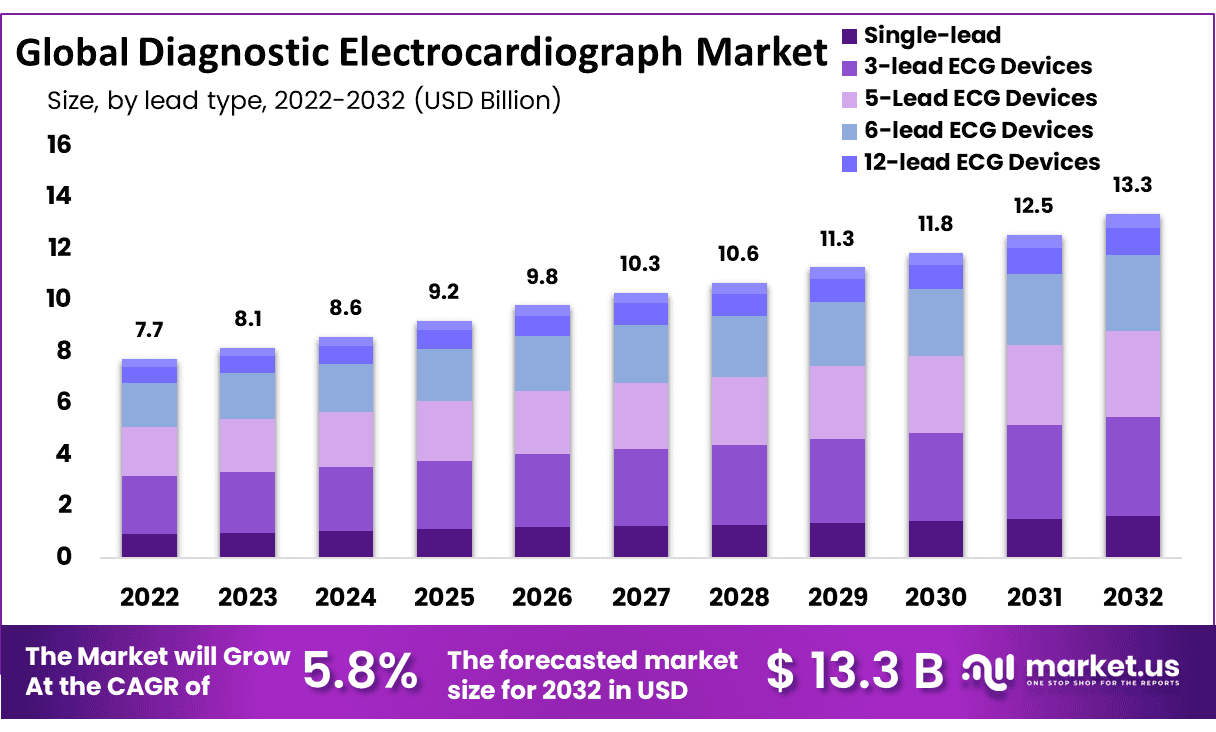
According to a recent report by Market.us, the Global Diagnostic Electrocardiograph Market size is expected to be worth around USD 13.3 Billion by 2032 from USD 7.7 Billion in 2022, growing at a CAGR of 5.8% during the forecast period from 2023 to 2032.
A diagnostic ECG is a medical device that helps diagnose problems with the electrical activity of the heart. Among other cardiac conditions, ECG is used to diagnose cardiac stress testing, cardiac murmur, myocardial infarction, and fainting.
Over the forecast period, it is anticipated that the market for diagnostic electrocardiographs around the world will expand. Market expansion is anticipated to be driven by rising rates of cardiovascular diseases like stroke, hypertension, IHD, and peripheral artery diseases. The global diagnostic electrocardiograph (ECG) market is anticipated to be driven by improved healthcare infrastructure, an expanding geriatric population, and favorable reimbursement policies. The diagnostic ECG market is also anticipated to expand during the forecast period due to the introduction of ongoing technological advancements and remote monitoring devices in ECG devices.
Due to the fact that developed nations markets are nearly saturated, developing nations have greater growth opportunities than developed nations. Additionally, rising healthcare costs, favorable government policies, and largely untapped potential markets are expected to provide lucrative growth opportunities for developing nations.
*Actual Numbers Might Vary In The Final Report
Key Takeaways
- Market Developments: The diagnostic ECG market has experienced steady expansion due to an increasing prevalence of cardiovascular disorders among older populations as well as technological innovations within ECG technology.
- Types of ECG Devices: Today’s market features numerous ECG devices ranging from traditional 12-lead ECG machines used clinically, to portable and wearable monitors designed specifically to provide continuous home monitoring.
- Wireless and Wearable ECG: Wireless and wearable ECG devices have expanded the market significantly, offering real-time remote monitoring of patient heart health as well as long-term tracking capabilities.
- Telemedicine and Remote Monitoring: ECG devices have increasingly become integrated with telemedicine platforms, allowing healthcare providers to remotely monitor patients and offer timely interventions when required.
- Point-of-Care Testing: Emergency departments, clinics and home healthcare settings often utilize point-of-care ECG devices that deliver immediate results for patient care, thus speeding up services to them and expediting care delivery.
Product and Service Analysis
The Resting ECG Devices Segment Accounted for the Highest Market Share.
The diagnostic ECG market’s Resting ECG Devices segment has the largest market share and it will be the fastest-growing segment. This is primarily due to the quicker and more precise diagnosis that does not require prior preparation. The Victorian Department of Health says that a patient can usually be diagnosed with a resting ECG in 5 to 10 minutes when his body is completely still.
In addition, it quickly identifies specific heart conditions like ischemia, heart hypertrophy, cardiac arrhythmias, myocardial infarction sequelae, and myocardial infarction, which contribute to the growth of this segment. Myocardial infarction affects approximately 800,000 people annually, according to the CDC. The remaining 600,000 had myocardial infarction before, while about 600,000 had it for the first time.
Holter monitors are anticipated to experience the industry’s fastest growth. As the most common type of ambulatory ECG monitoring, Holter ECG monitors are widely utilized in the detection of numerous cardiovascular diseases. It has been discovered that Holter monitors are cheaper than conventional ECG machines. A Holter monitor costs approximately USD 64, while a conventional ECG rate is USD 128, according to a study. The rapid expansion of wireless Holter monitors in the global diagnostic electrocardiogram industry can be largely attributed to their development.
Lead Type Analysis
3-Lead ECG Devices and 6-Lead ECG Devices Held the Largest Share of the Global Diagnostic Electrocardiograph Market.
In the diagnostic ECG market, 3-6 Lead held the largest share of the market. This is mainly due to the fact that it is utilized frequently in various cardiac diagnostic tests. Additionally, its low price and high-efficiency rate contribute to the growth of this market. An NCBI study found that a 3-lead ECG is 96.4% more accurate than a 12-lead ECG.
End-User Analysis
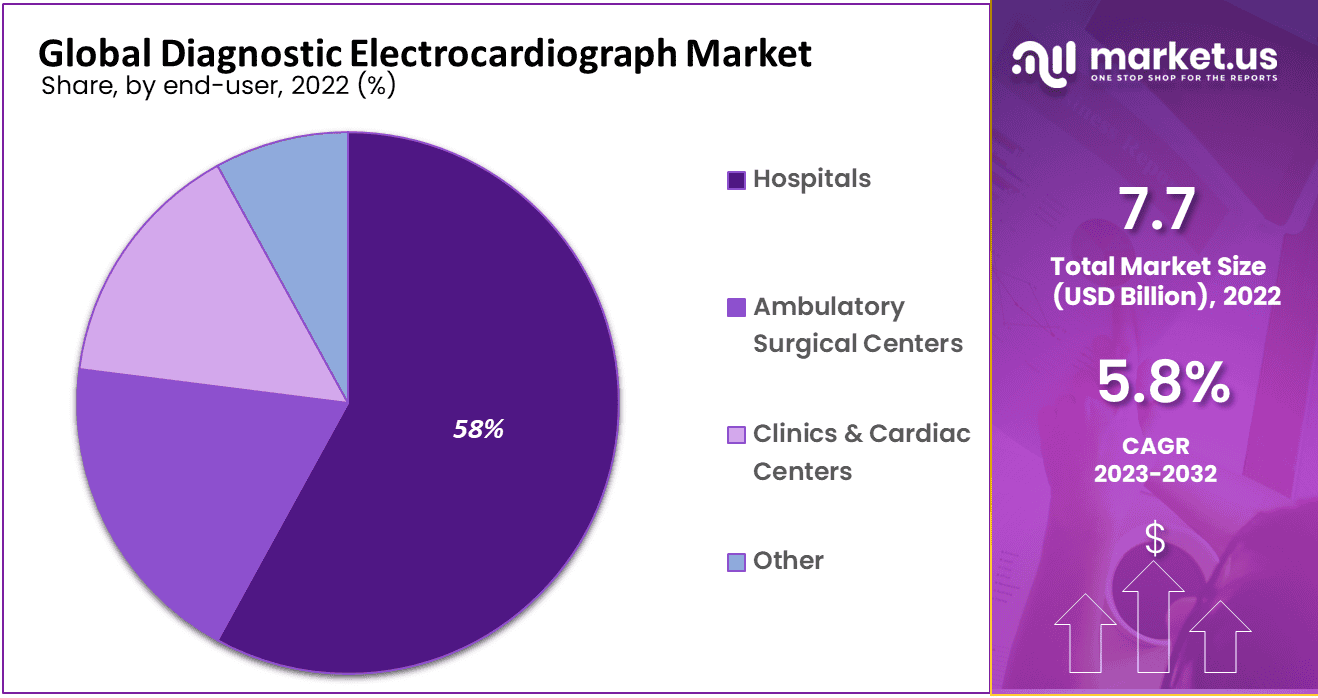
The Hospital Segment Has Dominated the Market and Held the Largest Share of the Market.
Due to a large number of hospitals and the high cost of purchasing ECG devices, the hospital market dominated the entire ECG market. This market segment also dominates due to the rising number of people seeking hospital treatment and diagnosis for cardiovascular disease. 4.6% of adults in the U.S have been diagnosed with coronary heart disease, according to the CDC. 6.5% of Americans went to the doctor for their cardiovascular conditions. 7.4% of Americans have sought treatment and diagnosis for these illnesses in emergency rooms. The growth of the market is also boosted by an increase in spending on ECG devices for good cardiac treatment.
Key Market Segments
Based on Product and Service
- Stress ECG Devices
- Resting ECG
- Implantable Loop Recorders
- Smart ECG Monitors
- Event Monitors
- Holter Monitors
- MCT Devices
Based on Lead Type
- Single-lead
- 3-lead ECG Devices
- 5-lead ECG Devices
- 6-lead ECG Devices
- 12-lead ECG Devices
- Other Lead Types
Based on End-User
- Hospitals
- Ambulatory Surgical Centers
- Clinics & Cardiac Centers
- Other End Users
Drivers
Significance of Cardiac Diseases Drive the Market’s Growth.
The prevalence of cardiac diseases is the primary factor propelling the global diagnostic electrocardiograph market. The World Health Organization stated that cardiovascular disease is one of the leading causes of death worldwide. Cardiovascular diseases cause approximately 18 million deaths annually, or 31% of all deaths worldwide. Diagnostic ECGs are in high demand as a result of the prevalence of cardiovascular diseases and the industry’s expansion.
The fact that electrocardiographs are more accurate than other methods of diagnosing the heart makes them more in demand and helps the industry grow. Diagnostic electrocardiographs, as stated by the American Heart Association, can accurately measure cardiac rhythm to an accuracy of 88%. 95% of the time, sinus rhythm was correctly interpreted.
Restraints
High Cost of Diagnostic Electrocardiograph Hindered the Market’s Growth.
Clinicians in many third-world nations are forced to use older ECG machines rather than the most advanced ones because of the cost-effectiveness factor. The diagnostic electrocardiograph market is hindered in emerging nations by high purchasing and upkeep costs and a lack of technical expertise.
Opportunities
New Technical Advancements
The electrocardiograph (ECG) industry will be driven by technological advancements and increased access to novel treatment options. Using resting ECG, Holter monitor, ambulatory ECG, exercise testing systems, event monitor, pacemaker, and cardio data management can quickly treat cases of rising coronary artery disease, arrhythmia, and cardiomyopathy. More than 2.6 out of every 1,000 people in the United States of America have pacemakers attached to treat various heart conditions, according to an NCBI study.
As there is a rise in the geriatric population, pacemakers became more common, with 0.4 per 1000 people in the 18-64 age range using them and 26 per 1000 people in the 65-plus age range. The home ECG, mobile ECG devices, and ECG equipment industries could benefit from the new advanced developments and access to advanced treatment options.
Regional Analysis
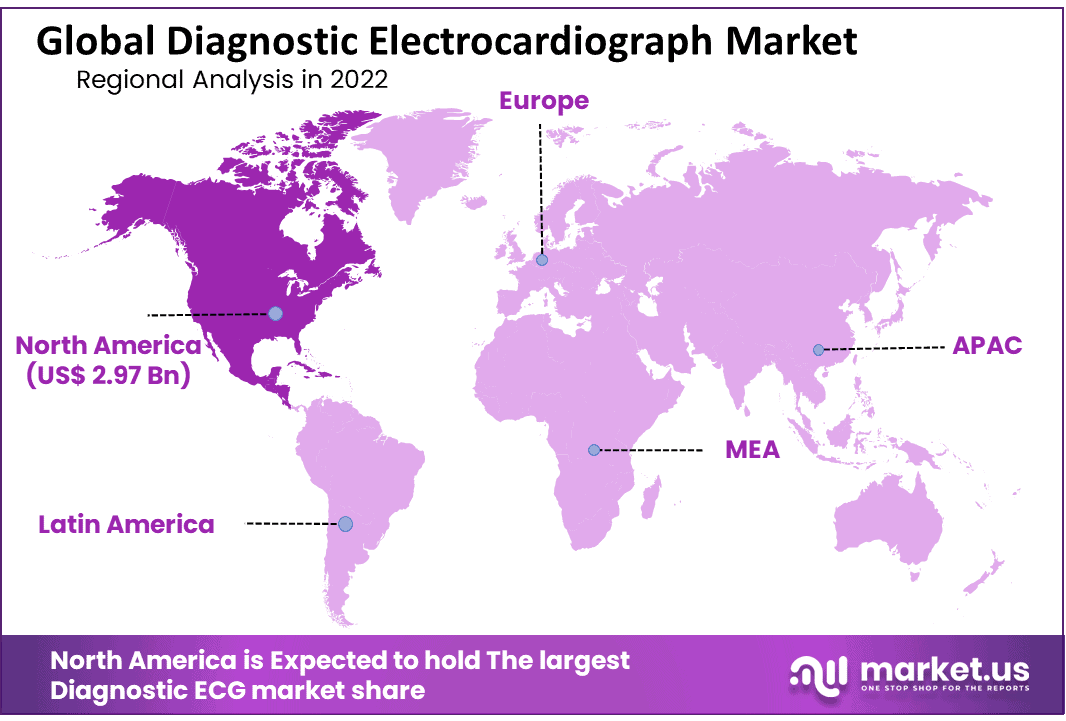
North America dominates the global diagnostic electrocardiograph market during the forecast period.
Due to the rising demand for minimally surgical procedures, the diagnostic electrocardiograph (ECG) market is dominated by North America with a revenue share of 38.8%. The diagnostic ECG market in NA will also expand during the forecast period as a result of the rising number of geriatric populations and the increase in income per capita.
Due to the growing population, the diagnostic electrocardiograph market is expected to expand significantly in Asia-Pacific. Additionally, the increase in disposable income. In addition, it is anticipated that the expanding healthcare infrastructure will further propel the diagnostic electrocardiograph market’s expansion in the APAC in the upcoming years. India, China, Myanmar, Japan, Brazil, and other Asian nations make up the Asia-Pacific region.
Due to its large population, rising disposable income, and improved healthcare infrastructure, this region is anticipated to experience lucrative growth. In China, cardiovascular diseases affect more than 290 million people, as per the study by NCBI. Approximately 11 million Chinese had coronary heart disease and 13 million had a stroke.
Changes in domestic regulation and individual market-impacting factors that influence the market’s present and future trends are also provided in the country section of the report. Case studies, technical trends, porter’s five forces analysis, and downstream and upstream value chain analysis are a few of the indicators used to forecast the market position for specific nations.
In addition, the impact of trade routes, domestic tariffs, and the availability and presence of worldwide brands, as well as the challenges they face as a result of strong or weak competition from domestic and local brands, are taken into account when providing forecast examination of the data of the particular country.
Key Regions
- North America
- The US
- Canada
- Mexico
- Western Europe
- Germany
- France
- The UK
- Spain
- Italy
- Portugal
- Ireland
- Austria
- Switzerland
- Benelux
- Nordic
- Rest of Western Europe
- Eastern Europe
- Russia
- Poland
- The Czech Republic
- Greece
- Rest of Eastern Europe
- APAC
- China
- Japan
- South Korea
- India
- Australia & New Zealand
- Indonesia
- Malaysia
- Philippines
- Singapore
- Thailand
- Vietnam
- Rest of APAC
- Latin America
- Brazil
- Colombia
- Chile
- Argentina
- Costa Rica
- Rest of Latin America
- Middle East & Africa
- Algeria
- Egypt
- Israel
- Kuwait
- Nigeria
- Saudi Arabia
- South Africa
- Turkey
- United Arab Emirates
- Rest of MEA
Key Players Analysis
Koninklijke Philips NV Announced its Acquisition of Biotelemetry, Inc to Enhance Care Delivery Throughout the Health Continuum with Integrated Solutions.
Due to a large number of market players, the market is very competitive. To avoid becoming out of date in the market, businesses must make significant investments in R&D. BioTelemetry, Inc. was acquired by Koninklijke Philips NV in February 2021.
The acquisition of BioTelemetry complements Philips’ cardiac care portfolio and its strategy to improve care delivery across the health continuum through integrated solutions. A few major players in the market are Spacelabs Healthcare, Philips Healthcare, Allengers Medical Systems, Ltd., VectraCor, Inc., Norav Medical, BPL Medical Technologies, Edan Instruments, Inc., Hill-Rom Services, Inc., SUZUKEN Co., Ltd., and other key players that are responsible for market growth.
Listed below are some of the most prominent global diagnostic electrocardiograph market players.
Market Key Players
- Koninklijke Philips N.V.
- Bio-Medical Electronics Co.
- Innomed Medical Inc.
- Bionet Co., Ltd.
- Scottcare Corp
- Spacelabs Healthcare Inc
- VectraCor, Inc.
- Allengers Medical Systems, Ltd.
- Other Key Players.
Key Industry developments
- In March 2022– GE Healthcare and AliveCor announced their partnership. GE Healthcare’s MUSE system can be accessed by medical professionals using the KardiaMobile 6L ECG device. By enhancing the integration and quality of patient data, the partnership hopes to decrease cardio-based hospitalizations and improve patient convenience.
- In January 2022– A first-at-home, 12-lead ECG integrated solution for decentralized clinical trials was introduced by Koninklijke Philips. By introducing a new system to reduce the necessity and burden of clinical trials, Koninklijke Philips hopes to improve patient compliance, retention, and trial outcomes.
- In December 2021– Hillrom was purchased by Baxter International, Inc. for USD 12.5 billion. With the Hillrom acquisition, Baxter begins the next phase of its transformation, promising to have a greater impact on patients, shareholders, employees, clinicians, and other communities it serves around the world.









