


Report Overview
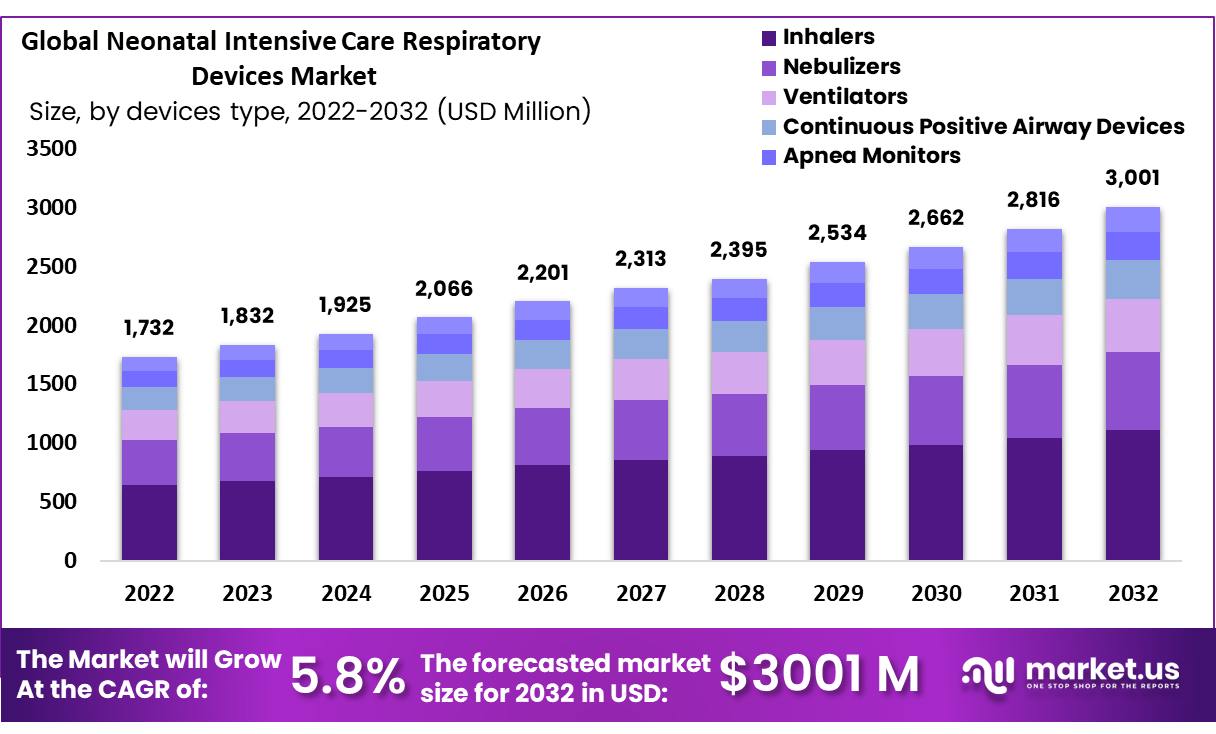
The Global Neonatal Intensive Care Respiratory Devices Market size is expected to be worth around USD 3000 Million by 2032 from USD 1,731.52 Million in 2022, growing at a CAGR of 5.08% during the forecast period from 2023 to 2032.
In the given report, the market outlook section mainly includes the fundamental dynamics of the market, including opportunities, challenges faced by the industry, key trends, drivers, and restraints. Opportunities and challenges are extrinsic factors, whereas drivers and restraints are intrinsic. Besides, the report will determine the market to choose the right segment for business growth.
The Neonatal Intensive Care Unit (NICU) facilitates the treatment of premature infants. The growing healthcare expenditure and improving healthcare expenditure in neonatal care units in developing countries are the factors that are responsible for driving the market in the upcoming years. Various neonatal infant care devices, infant ventilators, advanced technologies, and medical facilities are available to deliver the best medical care, and it covers the major share of the market.
Government bodies in most developed and developing countries heavily enhance their investment in healthcare facilities. Compared with other countries, in the US, investment in healthcare by their government is much more. It is helping advance machinery and equipment, research and development, and insurance policies to make medical facilities affordable. These factors further fuel the market growth.
*Actual Numbers Might Vary In The Final Report
Key Takeaways
- Market Growth: The neonatal intensive care respiratory devices market has experienced steady expansion as a result of factors including an increasing rate of preterm births, advancements in neonatal care services and increasing awareness regarding respiratory support needs for newborns.
- Respiratory Distress Syndrome (RDS): Many premature infants need assistance for RDS, an uncommon yet critical respiratory condition in newborns that needs respiratory support from Neonatal respiratory devices. Neonatal respiratory devices play an essential part in managing RDS as well as other conditions associated with newborn respiratory health.
- Types of Devices for Neonatal Care: Today’s neonatal healthcare market features numerous respiratory devices for neonatal care, including mechanical ventilators, continuous positive airway pressure (CPAP) devices, high frequency oscillatory ventilators (HFOV) and bubble CPAP systems – each designed for specific functions related to infant respiratory support.
- Technological Advancements: Advancements in technology have led to more user-friendly neonatal respiratory devices that aim to minimize potential harm while providing effective support. These innovations work effectively while protecting infants.
- Surfactant Therapy: Surfactant replacement therapy is an integral component of neonatal care. This process entails providing surfactant to premature infants in order to improve lung function and decrease their need for respiratory support systems.
- Patient Safety and Comfort: Patient safety and comfort are of utmost importance in neonatal care, so respiratory devices designed for neonates contain features to minimize any risk or discomfort while providing support when necessary.
Devices Type Analysis
The Global Neonatal Intensive Care Respiratory Devices Market is divided based on device types such as Apnea monitors, Continuous Positive Airway Devices, Nebulizers, Inhalers, and Others. Of all these devices, inhaler has the largest share of the market. It is due to severe pollution, which leads to a rise in tremendous respiratory cases. The sector is predicted to record more significant sales in upcoming years due to the continuous drop in Air Quality Index and the pollution level.
Owing to the increasing cases of preterm births, the global neonatal intensive care respiratory devices market is estimated to gain stimulus. According to the WHO (World Health Organization), approximately 15 million babies are born annually. 11% of babies are preterm among them.
End-User Analysis
Occupational respiratory disorder is segmented into specialty clinics, hospitals, home care, research institute, and others. The hospital’s segment holds the largest share around the world. The reason is the increased sales of devices and NICU admissions for treating respiratory disorders, mainly respiratory distress syndrome in neonates.
In addition, hospitals worldwide have contributed to the segment’s growth because of the adoption of CPAP systems, neonatal ventilators, and other respiratory devices. The adoption of these devices aims to improve neonatal intensive care units. Furthermore, the specialty clinics segment accounted for a considerable share of the global market in 2022, as the treatment at the nearby clinics having advanced care facilities for neonatal respiratory care has been preferred.

Key Market Segments
Based on the Devices Type
- Nebulizers
- Inhalers
- Ventilators
- Continuous Positive Airway Devices
- Apnea Monitors
- Others
Based on End Users
- Specialty Clinics
- Hospitals
- Home Care
- Research Institute
- Others
Drivers
Due to premature births and respiratory problems
Due to premature births and respiratory problems in neonates, the prevalence of Newborn respiratory distress syndrome (NRDS) is rising vigorously in neonates. The leading cause of NICU admissions is RDS, which is frequent in neonates. The treatment recommended for a syndrome is the continuous supply of O2 with the help of several respiratory airway machines, like ventilators, resuscitators, cannulas, and others.
The rising incidence ratio of the syndrome demands developed respiratory support of airway devices for neonates and infants. In addition, it increases the need for respiratory consumables, CPAP devices, and others. Hence, during the forecast period, the increase in respiratory distress in newly born babies is projected to surge the desire for pediatric respiratory machines in 2021-2028.
Development of high-quality innovations
The desire for therapeutically efficient devices has enhanced the need to develop high-quality innovations and advanced neonatal equipment amongst key players in the global neonatal intensive care respiratory devices market. Furthermore, the growing technical development has supported the demand for CPAP systems, classified accessories for developed and rising economies, and ventilators.
The device is designed to control the stimulated O2 delivery for keeping the SpO2 level of neonatal patients. Thus, companies’ primary concern is launching sophisticated products to confirm better quality patient care. With this initiative, the market is estimated to be driven during the forecast period.
Restraints
Development is low because of the lack of minimal funds.
Due to the lack of minimal funds for development in developing countries, the infrastructure development of healthcare got slower. It can gradually result in disconcerting the implementation of advanced machines for patient care.
Additionally, the less realization of the CDC and WHO guidelines regarding the protocol care and NICU care to be routed, specifically in countries with low economies, will cause the improper management of NICU patients. All the above factors will drive decreased desire for respiratory products in these countries, resulting in the inclusive sales of healthcare device companies.
Opportunity
Increasing breathing disorders in newborn babies
The global neonatal intensive care respiratory devices market was emerging effectively and stood at US$ 1,731.52 Million in 2022 and is estimated to reach US$ 3000 Million by 2032. Around the world, increasing breathing disorder in newborn babies, with the increasing frequency of respiratory syndrome, results in significant global revenue. Accomplishments along with device launches and respiratory equipment in the neonatal care market, the growth of the market is driving in the rising nations worldwide.
Emerging cardiovascular and other respiratory disorders in newborns are the significant variables responsible for the overall growth of the global neonatal intensive care respiratory devices market. In 2016, as per FDA, in the US, above 6% of 4 Million childbirths need admission to the NICU (Neonatal Intensive Care Unit) every year, most of which is due to premature birth.
In addition, the NICU is occupied for newborn babies with health issues such as congenital disabilities, health problems, and infections. The increasing population and expanding hospital admissions in the APAC are s main factors in accelerating the growth in the end-user segment. Furthermore, increased government funding for child care and the change in the nursing homes and specialty clinics in emerging nations have prolonged the administration of neonatal intensive care respiratory devices globally.
In 2022, the US-led most significant revenue in the global neonatal intensive care respiratory devices market was attributed to the emerging prevalence of respiratory disorders. The main factors include FDA approvals for advanced devices, increasing emergency care services with better reimbursement structure, and increasing reimbursement awareness about diseases.
Developing nations always suffer the burden of fetal and neonatal deaths. About 2.5 million fetal deaths were reported in 2017, per the WHO report. However, the availability of advanced devices is limited in poorer nations. The factors restraining the market’s growth are the high cost of different products, significantly less suitability of medical treatment, and lack of skilled physicians.
Trends
Technological development in Neonatal Intensive Care
When newborn babies are born with breathing disorders or face problem in breathing problems, they are kept in Neonatal Intensive care to give them proper facilities. Technological advancement in Neonatal Intensive care was developed over the years. The following improvements allowed the integration of various facilities into a system. All these factors fuel the growth of the market. The acceleration and scope of the Research and Development have increased because several private organizations have entered into private and public agreements.
Most middle-class people find it hard to afford neonatal intensive care for a longer duration; because of these issues in many developing and underdeveloped countries, the death rate of newborns is increasing. But, due to Public- Private Partnerships, there is an increase in research and development. Research is making the NICU cheaper so that mass adoption can occur and may include in future trends. The government’s encouragement of insurance is one of the Key opportunities made in this market..
Regional Analysis
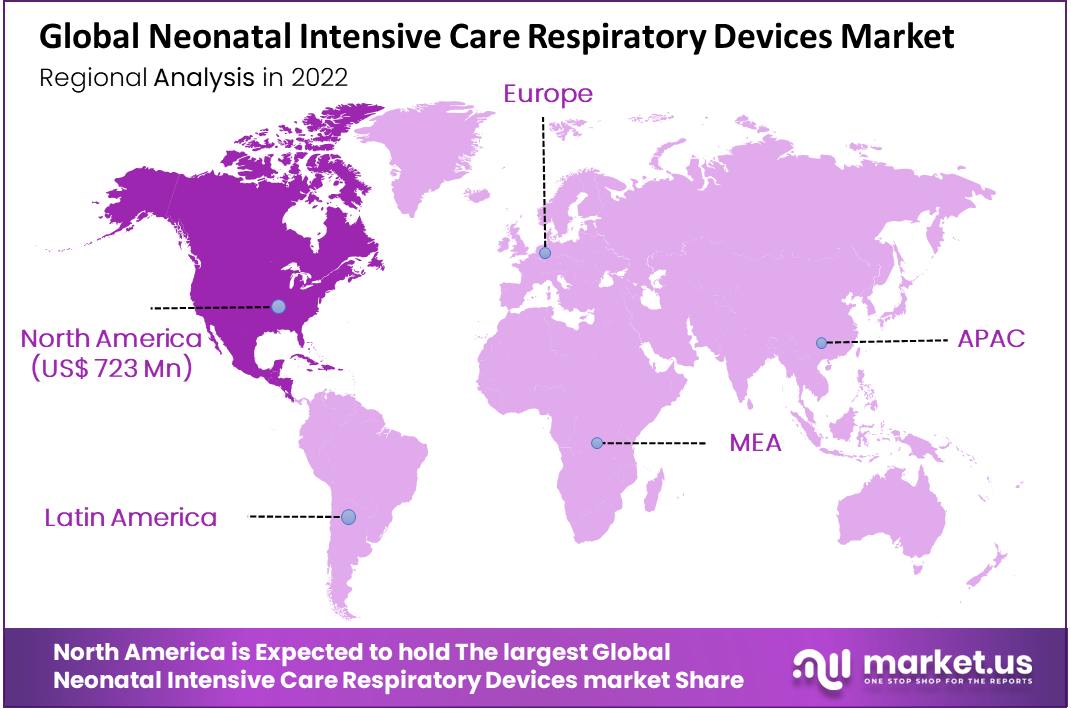
North America dominates the global neonatal intensive care respiratory devices market.
North America’s market size is estimated at US$ 727.2 Million in 2022, and it dominates the market in terms of the revenue share of 42%. The supremacy of this region is accountable to the emerging significance of neonatal RDS, along with the greater NICU admissions because of the respiratory conditions. Also, in the US, several medical device companies are launching advanced products is another factor resulting in the region’s growth.
Due to massive investment in R&D for developing neonatal respiratory care devices, Europe holds the 2nd largest market share. APAC is expected to have the highest CAGR growth due to the rising demand for consumables & accessories.
Due to increased product launches in the region, rising healthcare costs, and a large population base, Middle-Income countries like Asia-Pacific are expected to dominate the global market during the forecast period and, depending on the area, the Neonatal Intensive Care Market in 2021. However, due to key players, well-established healthcare infrastructure, and development in healthcare infrastructure, developed countries like North America are anticipated to experience significant growth.
Key Regions
- North America
- The US
- Canada
- Western Europe
- Germany
- France
- The UK
- Spain
- Italy
- Portugal
- Ireland
- Austria
- Switzerland
- Benelux
- Nordic
- Rest of Western Europe
- Eastern Europe
- Russia
- Poland
- The Czech Republic
- Greece
- Rest of Eastern Europe
- APAC
- China
- Japan
- South Korea
- India
- Australia & New Zealand
- Indonesia
- Malaysia
- Philippines
- Singapore
- Thailand
- Vietnam
- Rest of APAC
- Latin America
- Brazil
- Colombia
- Chile
- Argentina
- Mexico
- Costa Rica
- Rest of Latin America
- Middle East & Africa
- Algeria
- Egypt
- Israel
- Kuwait
- Nigeria
- Saudi Arabia
- South Africa
- Turkey
- United Arab Emirates
- Rest of MEA
Key Players Analysis
Global Neonatal Intensive Care Respiratory Devices Market is estimated to reach US$ 1,731.52 Million in 2022, rising at a compound annual growth rate of 5.8% from 2023 to 2032. A rise in Public and Private Partnerships increased government investments in healthcare infrastructure, and increased premature births are key market drivers. The global neonatal intensive care respiratory devices report provides a complete evaluation of this market.
The market is combined, with few players reporting for the maximum share. Owing to the wide range of neonatal intensive care respiratory devices and consumables, Fisher & Paykel Healthcare Corporation is dominant in the market. Additionally, considerable research and development funded by companies like GE Healthcare and Dragerwerk AG& Co. KGaA have collected significant global market shares. In November 2020, the advancement of PulmoVista 500 monitors was announced by Dragerwerk AG & Co. KGaA.
It helps in providing ventilation information in pediatrics and patients. With the help of new technologies and strategic acquisitions, other major players like Inspiration Healthcare Group plc., SLE, Johnson & Johnson, Phoenix Medical Systems Pvt Ltd., Utah Medical Products, Inc., Natus Medical Incorporated, Siemens Healthcare GmbH, B. Braun Melsungen AG, Coeo Labs, Koninklijke Philips N.V., Vyaire Medical, Ibis Medical, Terumo Corporation, and Galemed Corporation will likely establish an expected market place at the time of forecast period.
Below are some of the most prominent global Neonatal Intensive Care Respiratory Devices market players.
Market Key Players
- Airon Corporation
- Fisher & Paykel Healthcare Limited
- Dragerwerk AG & Co. KGaA
- GaleMed Corporation
- GE Healthcare
- Medtronic
- VYAIRE MEDICAL, INC
- Hamilton Medical
- SLE
- Other Key players
Key Industry developments
- Sentec and PyrAmes established a business collaboration in September 2022 to make Boppli, PyrAmes’ pioneering continuous non-invasive blood pressure device, available to newborn critical care teams across the United States. Boppli has been given FDA 510(k) clearance and has been designated as a “breakthrough device” by the US Food & Drug Administration (FDA). This is expected to happen in the first half of 2023.
- The PulmoBioMed technology, developed by Northumbria University Medtech in September 2022, may revolutionize how diseases are diagnosed. Deep lung infections can be examined with PBM-HALE, reducing the need for invasive or costly treatments frequently required for disease diagnosis. By blowing into it, patients can get non-invasive lung samples using the PBM-Hale, a hand-held aerosol collection device.
- The USFDA authorized Beyond Air’s nitric oxide generator and delivery system in June 2022 to treat hypoxic respiratory failure in term and near-term newborns. LungFit PH generates on-demand unlimited nitric oxide from ambient air and distributes it to a ventilator circuit, regardless of dose or flow, using patented ionization technology. With the aid of a compressor and electrical pulses comparable to a 60 W lightbulb, LungFit PH ionizes oxygen and nitrogen molecules to form nitric oxide, filtered to remove harmful nitrogen dioxide.









