


Report Overview
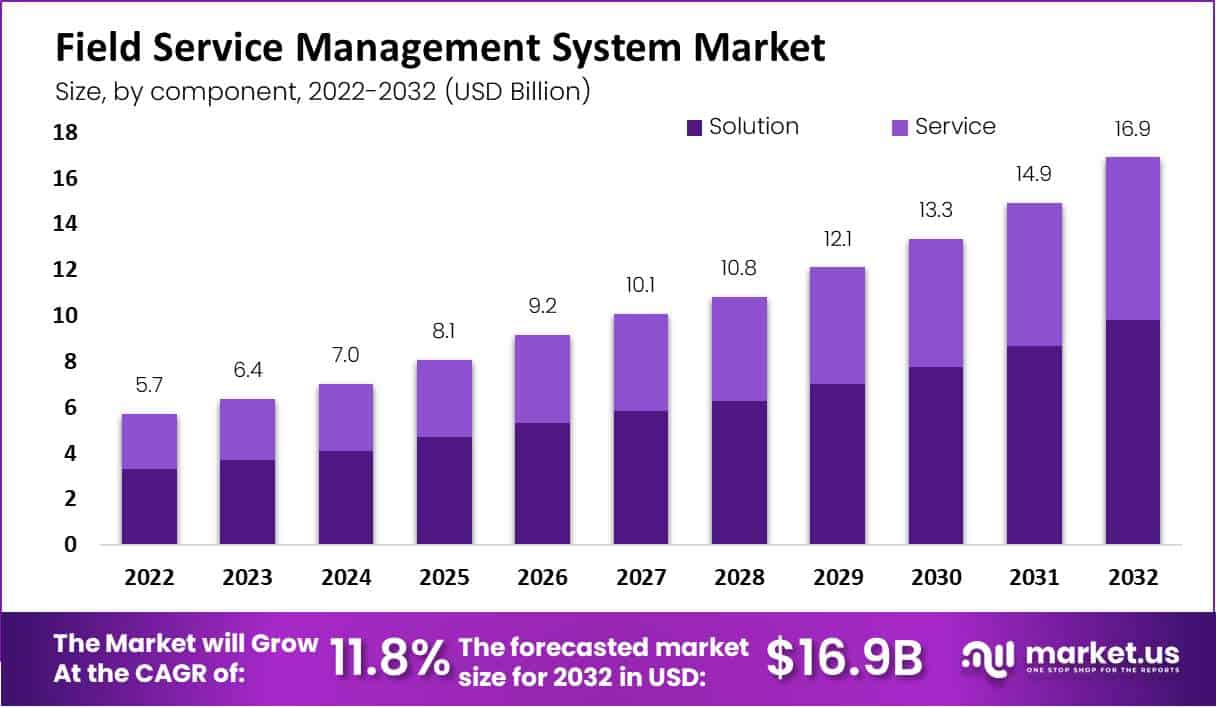
In 2022, the Global Field Service Management System Market was valued at USD 5.7 billion and is expected to reach USD 16.9 billion in 2032. This market is estimated to register the highest CAGR of 11.8% between 2023 and 2032.
Field Service Management Systems (FSMs) are software solutions designed to assist businesses in effectively utilizing their resources in the field. FSM systems aim to streamline operations, boost productivity and enhance customer satisfaction; usually including features such as scheduling, dispatching, work order management, inventory control and reporting capabilities. FSM systems are particularly beneficial to companies that rely on field operations such as maintenance repair service industries.
The demand for field service solutions has increased even more due to the persistent demand that various businesses have for solutions focused on their customers. Businesses are also using mobile-driven solutions to create experiences led by customers and increase productivity. Furthermore, the market share is likely to be driven by FSM’s technologically advanced innovations.
Note: Actual Numbers Might Vary In The Final Report
Key Takeaways
- Market Growth Projection: The Field Service Management System Market is expected to reach USD 16.9 billion by 2032, growing at a CAGR of 11.8% from 2023 to 2032.
- Driving Factors: Growing demand for real-time visibility services for improved customer satisfaction and Increasing adoption of advanced FSM solutions propelling market share.
- Restraining Factors: Inadequately skilled workforce hindering effective field service management. Limited workforce leading to operational challenges and communication gaps.
- By Component Analysis: Solutions include Salesforce Field Service and CoConstruct, enhancing customer communication and service management. Services comprise managed and professional services, including integration, implementation, training, and support, all vital for effective field service management.
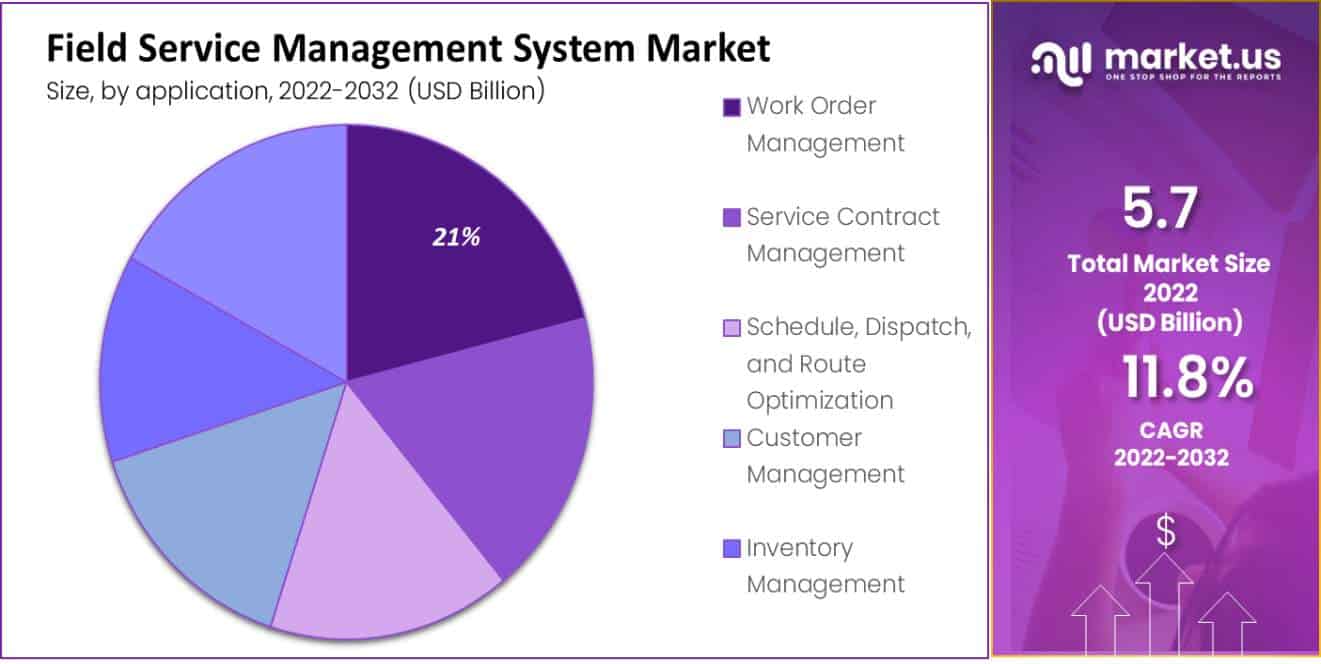
- By Application Analysis: Application segmentation covers areas like work order management, schedule and dispatch, customer management, inventory management, and more
- By Deployment Analysis: On-premises deployment is preferred for its security, particularly in industries like BFSI and healthcare. Cloud deployment, with its lower initial costs and accessibility, is rapidly gaining popularity across various verticals.
- By Vertical Analysis: Industry verticals include BFSI, IT & Telecom, Healthcare & Life Sciences, Manufacturing, Transportation & Logistics, and others.
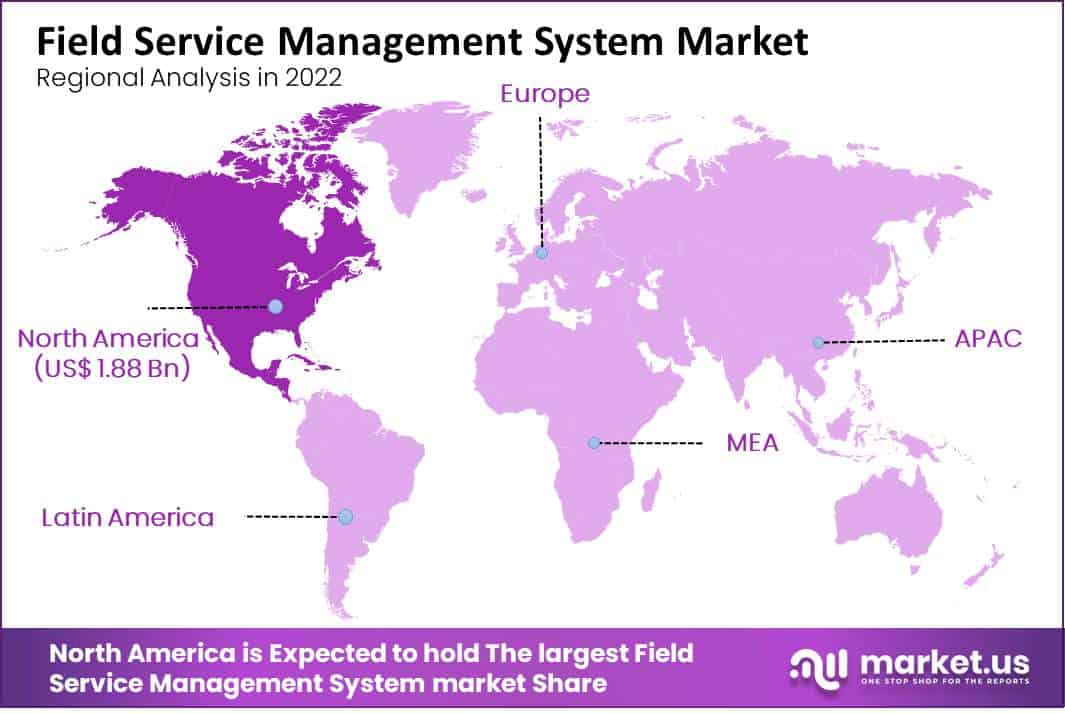
- Regional Analysis: North America leading the market with a focus on enterprise mobility and technological advancement.
- Key Players Analysis: Major players include Oracle, Salesforce.com, PRAXEDO, and others.
Companies adopting strategies like product launches and business expansions to maintain market position. - Latest Trends: Integration of technologies like augmented reality (AR) enhancing operational efficiency and customer experience.
Driving Factors
Increasing Demand for Real-time Visibility Services to Fuel Market Growth
The demand for real-time field service systems to improve customer satisfaction is growing across all industries. By connecting customers to the closest service provider, businesses can respond to customer inquiries right away, thanks to field technicians’ real-time monitoring and management. Consequently, all businesses are adopting these solutions. Businesses are able to respond more quickly to customer issues thanks to these solutions, which contributes to an improved customer experience and relationship. In order to make better business decisions, the real-time FSM solution can effectively manage all field operations.
Constant observation of field tasks is smoothing out the most common way of getting and dispatching administration demands in a fast and productive way. For example, in Walk 2021, ORTEC sent off a cloud-based Field Administration with planning and dispatching programming to screen and access the tasks consistently. This persistent observation aids in offering consumer loyalty and capacities to deal with difficulties quickly. In this way, continuous permeability to handle tasks offers a superior client experience as well as business manageability.
Restraining Factors
Underskilled Workforce to Hamper Market Growth
Managers and service providers have difficulty managing complex assets and services due to the low-skilled workforce. On-the-ground challenges are being faced by service providers, such as miscommunication regarding job tasks, increased return trips, scheduling conflicts, and the incapability to understand instructions.
This is due to a limited workforce. On-field operations will be affected by a lack of knowledge transfer and training among technicians. Companies are finding it difficult to retain and attract employees due to increasing pressure on their field workforce. This will have a negative impact on market growth. Companies are looking for ways to control this situation, such as automating work processes in order to decrease the workload.
By Component Analysis
Major Focus on Customer Service to Boost Solution Market Share
Based on the component, the market is categorized into solutions and services. It is important to capture the maximum market share over the forecast period. Salesforce Field Service, CoConstruct, and mHelpDesk are just a few of the solutions that were included in the study. These solutions enable workers at all levels to communicate with customers effectively and allow managers to focus on customer service. It will also be fueled by increasing automation and digitalization during the forecast period.
Services are expected to experience rapid expansion due to their capacity to provide management and solution functionality support. The market is divided into managed and professional services, with professional services accounting for the majority of sales. Integration and implementation services, training and education services, and support and maintenance services are additional subcategories of these services.
By Application Analysis
Analysis Growing Focus on Customer Satisfaction to Drive Customer Management Growth
The market can be segmented based on application into schedule, dispatch and route optimization, work order and customer management, inventory and service contract management, reporting, analytics, and other applications.
There is a growing demand for work order management solutions to help organize critical tasks. This shows a strong CAGR over the forecasting years. Service contract management will continue to grow due to renewal and contact management automation. Schedule, dispatch, route optimization, and route optimization are becoming increasingly popular to manage the workforce collaboratively and ensure timely product dispatch to improve customer satisfaction.
Management of customers in order to maximize market share in light of the growing emphasis on customer experience and retention. The customer experience must be a high priority for businesses as the world begins to adopt customer-centric business strategies. Businesses would see an increase in revenue and sales if they were able to provide better service to their customers.
Note: Actual Numbers Might Vary In The Final Report
By Deployment Analysis
Flexible and Real-time Access of Data to Fuel Cloud-based Deployment
Based on deployment, the market is bifurcated into on-premises and cloud. Due to its high level of security and adaptability when retrieving data, on-premise deployment holds a significant share of the market. On-premises demand is being driven by industries like BFSI, government, and healthcare, among others, that place a greater emphasis on security data.
Because it enables businesses to manage information in a secure, efficient, remote-accessible, and consolidated manner, cloud deployment is seeing significant adoption growth over the forecast period. In addition, cloud deployment has a lower installation cost than more conventional deployment methods.
By Vertical Analysis
Growing Automation to Fuel Field Service Solution Demand in Manufacturing Industry
BFSI, IT and telecommunications, manufacturing, construction and real estate, healthcare and life sciences, transportation and logistics, energy, and utilities, and others are the verticals that make up the market.
This market’s largest revenue share will likely be held by the manufacturing sector. The manufacturing industry is embracing technologies that automate their field operations and processes due to rapid industrialization. Manufacturing companies are becoming more customer-centric and delivering value-added, cost-optimized services to customers.
The energy and utility industry is probably going to arise as the quickest developing fragment, inferable from the rising reception of portable-driven FSM arrangements. The business requires a greater part of the labor force in the fields to guarantee regular work. Additionally, medical care is quite possibly the main business in embracing field administration answers for dealing with their business tasks. The arrangements dispose of desk work from their day-to-day responsibility, diminishing the time expected for the organization and spending it on dealing with the patients.
Key Market Segments
Based on Component
- Solution
- Service
Based on Application
- Work Order Management
- Schedule, Dispatch, and Route Optimization
- Customer Management
- Inventory Management
- Service Contract Management
- Reporting & Analytics
- Other Application
Based on Deployment
- On-Premise
- Cloud
Based on Industry Verticals
- Banking, Financial Services and Insurance (BFSI)
- IT & Telecom
- Healthcare & Life Sciences
- Manufacturing
- Transportation & Logistics
- Construction & Heavy Equipment
- Energy & Utilities
- Other Industry Verticals
Growth Opportunity
Emergence of technologies, such as augmented reality
Many new technologies are entering the mainstream. This trend is also evident in the field service management sector. Field service organizations are looking to improve their operational efficiency with technologies like augmented reality (AR) and virtual reality (VR). AR can increase efficiency by allowing technicians to repair and training modules and upload sensor data to their AR glasses. This allows the technician to guide him through the process. It also allows him to access the device’s temperature, sensor, pressure, and other data. The technician can also inspect the device visually without touching it. This reduces distractions and eliminates the need for lengthy manuals.
The outcome is achieved effectively, resulting in savings and pleased customers. Customers will be able to virtually be guided through the procedures for maintenance or repair by customer service representatives and field service technicians. In addition, a field technician may guide customers through a virtual tour to assist them in resolving straightforward issues during minor repairs and service calls.
Latest Trends
Mobile Field Services to Revolutionize Market Growth
Field service providers were the first to adopt mobile technology, and today, businesses that use mobile-enabled software also benefit significantly. To provide a top-notch experience, FSM providers are concentrating on mobile-driven culture companies. For instance, the company can take advantage of mServiceOrder, a field service management tool provided by SAP SE. The app gives field technicians real-time insights that help them quickly fix problems.
As a result, having access to mobile and smart devices enables employees to provide support and assistance at any time and from any location. It enhances both the day-to-day activities of the staff and customer service. As a result, the field service management market share is expected to increase as a result of the rising demand for mobile technology and apps.
Regional Analysis
North America will likely dominate the market share due to its growing preference for enterprise mobility and ongoing focus on streamlining field service operations and teams. In addition, it is the region’s hub for technological advances and houses key players in field service management solutions. These players invest in research-and-development activities to provide efficient services to customers.
Due to the adoption of automation in the current manual field service processes, Europe is experiencing exponential growth in adopting these solutions. In order to assist their respective field forces, numerous European industries are eager to invest in new technologies. For instance, Anesco, a UK-based provider of renewable energy solutions, and Advanced, a provider of FSM software, collaborated in February 2020 to increase field safety, efficiency, and cost savings.
In terms of CAGR, Asia-Pacific outpaced the market. The rapid industrialization of nations like India, Japan, and China necessitates a sophisticated FSM strategy for maximizing productivity and workflow efficiency. In addition, the region’s businesses are moving toward novel approaches to customer service, which has increased the need for efficient FSM solutions even more.
Note: Actual Numbers Might Vary In The Final Report
Key Regions and Countries Covered in this Report:
- North America
- The US
- Canada
- Europe
- Germany
- France
- The UK
- Spain
- Italy
- Russia
- Netherland
- Rest of Europe
- APAC
- China
- Japan
- South Korea
- India
- Australia
- New Zealand
- Singapore
- Thailand
- Vietnam
- Rest of APAC
- Latin America
- Brazil
- Mexico
- Rest of Latin America
- Middle East & Africa
- South Africa
- Saudi Arabia
- UAE
- Rest of MEA
Key Players Analysis
In order to maintain their market position and increase the value of their businesses, major players are employing a variety of strategies. Key players are bolstering their market position by launching new products and services or adding new features to the existing portfolio. In addition, key players are concentrating on expanding their business network and acquiring smaller businesses to strengthen their competitiveness.
Market Key Players
Listed below are some of the most prominent field service management industry players.
- Oracle Corporation
- Salesforce.com, Inc
- PRAXEDO
- Infor, Inc.
- Comarch SA
- OverIT S.p.A.
- FieldAware Group Ltd.
- GEOCONCEPT SAS
- Other Key Players
Recent Developments
- Data Migration and Advanced Connector solutions for Unison’s Contract Lifecycle Management (CLM) system were announced in April 2022 by Unison, a prominent supplier of contract management software and insight to government contractors and federal agencies. Amazon Textract is used by Data Migration to extract line-item, header, and clause data from awards and modifications. A “Data Vac” in Data Migration makes it unnecessary for contract professionals to enter data from any source documents manually.
- On September 26, 2022, innovation investments in FTV LABS Pte were made public by Mitsubishi Electric Corporation Ltd., a field service management platform provider based in Singapore, to focus on last-mile digitization. ME Innovation Fund has made a second investment in a target company with this one.









