


Report Overview
The Simulation Software Market size is expected to reach USD 56.1 billion by 2032, exhibiting an impressive CAGR of 12.9% between 2023 and 2032, from its current value of USD 19.4 billion in 2023.
Simulation Software is a tool that is used by many industries and for various applications to create a real-time environment for testing the efficiency and applicability of various processes and products. Therefore, software simulation is used across various industries for applications like producing gaming & immersive experiences, high-fidelity experiential 3D training, manufacturing process optimization, engineering, research, modeling & simulated testing, cyber simulation, and many such applications.
A computer-based simulation is a model that is built on ideas-based mathematics and physics. It enables the development, testing, and enhancement of products and services that are also considered multipurpose tools for various applications. Businesses are drawn to simulation and analysis technology due to their ability to design verification and validation for R&D efforts.

Actual Numbers Might Vary in the Final Report
Simulation software provides flexible and accelerated learning, strengthens foundational abilities, and simulated environments that are beneficial for education and training. Moreover, R&D initiatives in software simulation are also experiencing increased attention from businesses in order to maintain their competitiveness. With all these factors in account, the simulation software market is anticipated to grow significantly over the forecast period.
Key Takeaways
- The global Simulation Software Market is projected to reach USD 56.1 billion by 2032, growing at a compound annual growth rate of 12.9% from 2023-2032. It was currently valued at USD 17.2 billion as of 2022.
- Wide applications of simulation software across various industries are driving the market growth. These applications include gaming & immersive experiences, engineering, research, modeling & simulated testing, manufacturing process optimization, cyber simulation and more.
- The on-premise deployment mode dominates the market with a revenue share of 72.2%, owing to its data security benefits, while cloud-based deployment is expected to grow at the fastest CAGR during the forecast period.
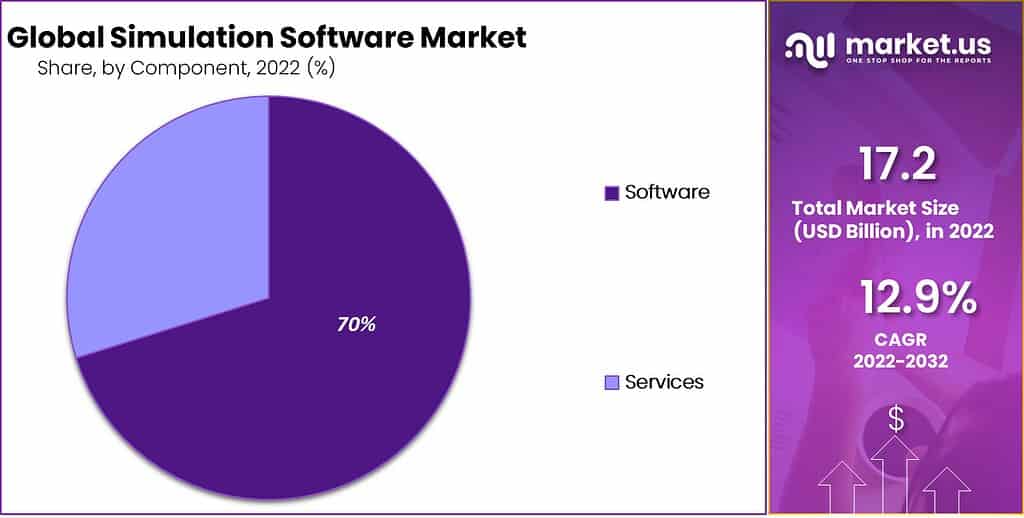
- The software component segment holds a significant revenue share of 70.2% in the global market, offering benefits such as reliability, data safety, and uninterrupted testing, while the services segment is anticipated to grow at the fastest rate.
- The engineering, research, modeling & simulated testing application segment dominates the market, owing to the widespread adoption of simulation software by companies in these fields. This adoption allows for cost-effective and high-quality services.
- The automotive industry holds the major revenue share in the end-use industry segment, primarily due to the early adoption of simulation software for virtual tools in product development.
- North America leads the global market, with the US and Canada being major contributors, owing to the presence of key companies and their focus on research and development activities. Asia Pacific is expected to grow rapidly during the forecast period.
- Major players in the market include Altair Engineering Inc., Autodesk Inc., Ansys Inc., Bentley Systems, Inc., Dassault Systèmes, MathWorks Inc., Rockwell Automation Inc., Simulations Plus, ESI Group, and GSE Systems, among others.
- The integration of virtual reality (VR) and augmented reality (AR) platforms in simulation software is expected to create numerous opportunities for immersive training, product blueprinting, and design visualization across various sectors.
- The emergence of cloud-based services is expected to propel the growth of the global simulation software market, making simulation tools more accessible to a diverse array of companies by minimizing upfront investment.
Driving Factor
Wide Applications of Simulation Across Various Industries are Driving the Growth of the Global Simulation Software Market.
Industries are aiming for process enhancement, error reduction, and faster time to market, which has led to optimizing solutions like simulation software. Simulation software assists in picturing and emulating real-world scenarios, aiding decision-making, design refinement, and problem resolution. Due to this, many industries are able to preview the real-time simulation of various processes. It helps for easy understanding to the individuals and also enhances the visual experience.
Therefore, the wide usage of simulation software across various industries is driving the growth of the global simulation software market. Moreover, the advent of Industry 4.0 and digital twins has skyrocketed the demand for simulation software in the Market. Several businesses are leveraging digital twin technology to virtually reproduce physical systems, facilitating performance refinement and upkeep quality. All these factors are boosting the growth of the global simulation software market.
Restraining Factor
High Cost of Integration
Simulation software is growing significantly in the Market due to wide applications across industries. However, the high expense associated with the adoption and usage of state-of-the-art simulation software is restricting many SMEs from integrating the simulation software with their systems. The simulation software requires high computing power possessing systems to process the data. Therefore, many SMEs are not able to adopt the simulation software due to the high cost involved in the integration process. This is obstructing the growth of the simulation software market.
Moreover, data security and privacy issues are also impacting the growth of the simulation software market. Simulation software often manages confidential and proprietary information. Therefore, the data breach can lead to compromise of the confidential information of the organization. All these factors are expected to hinder the growth of the global simulation software market.
Deployment Mode Analysis
The On-Premise Deployment Dominated Over the Cloud-Based Deployment in Deployment Mode Segment of Global Simulation Software Market.
Based on deployment mode, the global simulation software market is divided into on-premise and cloud-based deployment. Between these deployment modes, on-premise leads the Market with a major revenue share of 72.2% in the account. This growth of on-premise deployment is owing to the benefits of on-premise deployment over cloud-based deployments, such as more data security than cloud-based deployment.
Companies that wish to maintain the confidentiality of their data and secure the data from data breaches and other threats prefer to adopt on-premise deployment over cloud-based deployment. This is driving the growth of on-premise deployment over cloud-based deployment in the global simulation software market. However, cloud-based deployment is anticipated to grow at the fastest CAGR during the forecast period.
Component Analysis
Software Dominates Over the Services in the Component Segment of the Global Simulation Software Market
On the Basis of the Component, the global simulation software market is divided into software and services. From these components, the software dominated the component segment by holding a major revenue share of 70.2%. This massive growth of the software segment is due to the benefits offered by software, such as reliability, data safety, and uninterrupted testing. This is boosting the growth of software over services segment in the global simulation software market. However, the services segment is expected to be the fastest-growing segment over the forecast period.
Note- Actual Numbers Might Vary in the Final Report
Application Analysis
Engineering, Research, Modeling & Simulated Testing Dominated the Application Segment by Covering Major Revenue Share in the Market.
The global simulation software market is categorized into various applications, including research, modeling & simulated testing, gaming & immersive experiences, engineering, manufacturing process optimization, cyber simulation, high-fidelity experiential 3D training, and other applications. Among these, engineering, research, modeling & simulated testing have emerged as dominant segments, holding the major revenue share.
The remarkable growth of engineering, research, modeling & simulated testing can be attributed to the widespread adoption of simulation software by companies offering such services. This adoption enables companies to provide cost-effective and high-quality services to their customers, which, in turn, boosts the growth of engineering, research, modeling & simulated testing in the global simulation software market’s application segment.
End-Use Industry Analysis
Automotive Industry Dominates the End-Use Industry Segment by Covering the Major Revenue Share in the Market.
On the basis of the end-use industry, the global simulation market is classified into automotive, electronics & semiconductor, aerospace & defense, healthcare, transportation & logistics, and other end-use industries. From these end-use industries, the automotive industry holds the major revenue share account to dominate the end-use industry segment of the global simulation software market.
The growth of the automotive segment is attributed to the early adoption of simulation software for virtual tools for product development within the automotive industry. The increasing simulation-based product development in the automotive industry is driving the growth of the automotive industry in the end-use industry segment of the global simulation software market.
Key Market Segments
Deployment Mode
- On-Premise
- Cloud-Based
Component
- Software
- Services
Application
- Engineering, Research, Modeling & Simulated Testing
- Gaming & Immersive Experiences
- High-Fidelity Experiential 3D Training
- Manufacturing Process Optimization
- Cyber Simulation
- Other Applications
End-Use Industry
- Automotive
- Electronics & Semiconductor
- Aerospace & Defense
- Healthcare
- Transportation & Logistics
- Other End-Use Industries
Growth Opportunity
The introduction of AR and VR is Anticipated to Create Many Opportunities in the Market Over the Forecast Period.
The integration of VR and AR platforms in simulation software is expected to create novel opportunities for immersive training, product blueprinting, and design visualization across various sectors. With the growing accessibility and affordability of these technologies, there is likely to be a heightened demand for simulation software compatible with VR and AR.
Moreover, there is increasing demand for designed and customized simulation software to meet the particular requirements of various sectors. Industries such as automotive, aerospace, healthcare, and energy need tailored simulations to streamline their operations, minimize development periods, and augment productivity. Companies that can offer such advantages for industry-focused solutions may secure a competitive advantage. These key factors are expected to create many lucrative opportunities in the simulation software market over the forecast period.
Latest Trends
The emergence of Cloud Based Services is expected to propel the Growth of the Global Simulation Software Market.
The advancement in computing capabilities is continuously emerging in an era of real-time simulations. This trend is poised to revolutionize industries that require instantaneous feedback, such as video gaming, military training, and beyond. Moreover, the proliferation of cloud computing has led to an emerging trend of offering simulation software as a service (SaaS). This development lowers barriers to entry, making simulation tools accessible to a more diverse array of companies by minimizing upfront investment. These trends are expected to propel the growth of the global simulation software market.
Regional Analysis
North America Dominates the Global Simulation Software Market by Holding Major Revenue Share in Account.
North America region dominates the global simulation software market by holding a major revenue share of 35.2%. This massive growth of the North American region can be attributed to the presence of major companies within countries like the United States and Canada in the North America region. The major companies offering simulation software in the North American region are focusing on research and development activities to introduce advanced products in the Market.
Moreover, the early adoption of technology is also playing a significant role in the growth of the global simulation software market. All these key factors are boosting the growth of the North America region in the global simulation software market. After North America, Asia Pacific is expected to grow at a fast CAGR over the forecast period. The high adoption of technological products in developing counties in the Asia Pacific region is expected to propel the growth of the Asia Pacific region in the global simulation software market.

Note: Actual Numbers Might Vary In The Final Report
Key Regions and Countries Covered in this Report:
- North America
- The US
- Canada
- Europe
- Germany
- France
- The UK
- Spain
- Italy
- Russia
- Netherland
- Rest of Europe
- APAC
- China
- Japan
- South Korea
- India
- Australia
- New Zealand
- Singapore
- Thailand
- Vietnam
- Rest of APAC
- Latin America
- Brazil
- Mexico
- Rest of Latin America
- Middle East & Africa
- South Africa
- Saudi Arabia
- UAE
- Rest of MEA
Key Player Analysis
The global simulation software market is fragmented into many companies offering simulation software. The major companies in the Market are adopting various strategies like mergers, acquisitions, collaboration, and partnership to expand the market share across various regions and strengthen their position in the Market. Some of the key players in the global simulation software market are Simulations Plus, ESI Group, Altair Engineering Inc, MathWorks Inc., Rockwell Automation Inc., GSE Systems, ., Autodesk Inc., Ansys Inc., Bentley Systems, Inc., Dassault Systèmes and Other Key Players.
Top Key Players in Simulation Software Market
- Altair Engineering Inc.
- Autodesk Inc.
- Ansys Inc.
- Bentley Systems, Inc.
- Dassault Systèmes
- MathWorks Inc.
- Rockwell Automation Inc.
- Simulations Plus
- ESI Group
- GSE Systems
- Other Key Players
Recent Developments
- In February 2021, Mathworks partnered with an automotive company Aimotive to add the RoadRunner tool of Aimotive into an automotive grade simulation platform aiSim.
- In September 2020, Mathworks announced the launch of an update for their software named Simulink 2020.









