


Report Overview
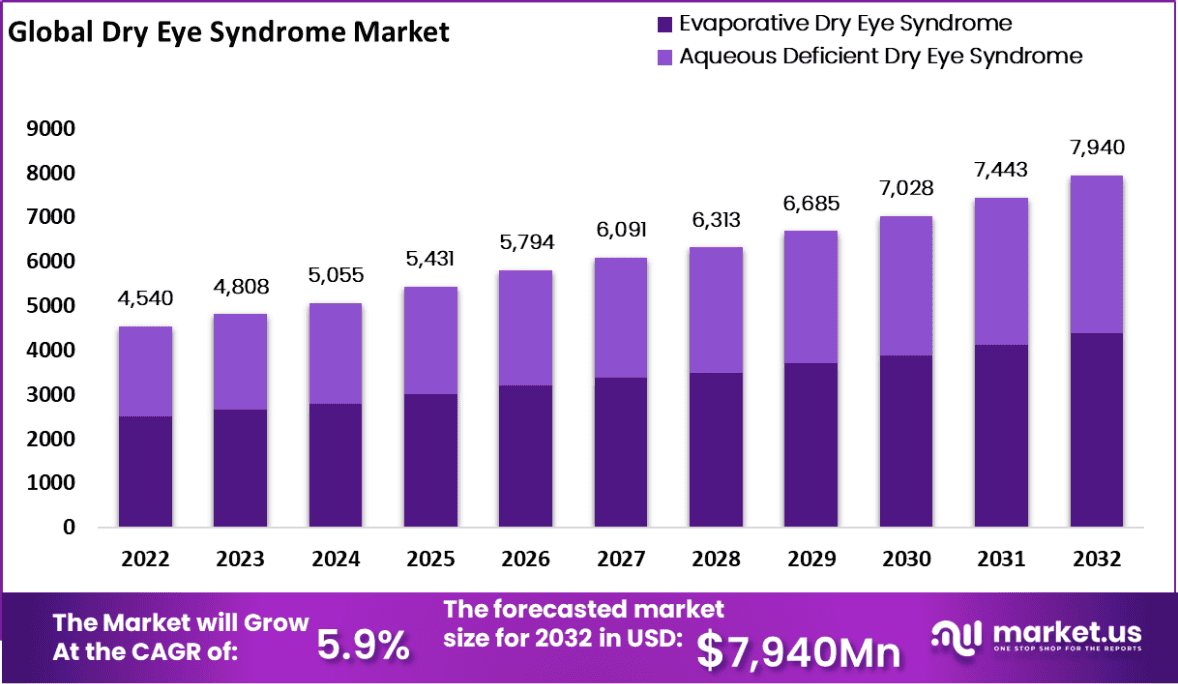
The Dry Eye Syndrome Market size is expected to be worth around USD 7,940 Million by 2032 from USD 4,540 Million in 2022, growing at a CAGR of 5.9% during the forecast period from 2023 to 2032.
The absence of moisture or lubrication on an infected person’s eye surface is referred to as dry eye syndrome or keratoconjunctivitis sicca (KCS) in medical terminology. It is a disease that can affect almost anyone and is prevalent. Burning sensations in the eyes, aching, red eyes, itchy eyes, fatigued eyes, photophobia, and other symptoms are all signs of dry eye.
In addition, the dry surface of the eyes overstimulates the production of the watery component of tears to reduce the dryness, resulting in watery eyes. Excessive computer use, allergies, aging, smoking, menopause, hormone replacement therapy, LASIK eye surgery, and other factors can all contribute to dry eye syndrome.
The market is expanding as a result of a number of factors, including the rising prevalence of dry eye syndrome, the existence of a lucrative pipeline, and the growing public awareness of the condition. In the early stages of the pandemic, the COVID-19 outbreak had a negative impact on the market because fewer people went to the eye doctor.
However, the market showed signs of recovery as soon as the eye care practices opened. Additionally, even after receiving treatment for the disease, SARS-CoV-2 patients continued to experience dry eye, increasing the population that should be treated. Additionally, the prevalence of dry eye symptoms has increased during the pandemic due to the increased use of screens and sedentary activities.
*Actual Numbers Might Vary In The Final Report
Key Takeaways
- The global Dry Eye Syndrome Market is expected to reach USD 7,940 million by 2032.
- It’s growing at a CAGR of 5.9%, from 2023 to 2032.
- Evaporative dry eye syndrome was the most common type in 2022.
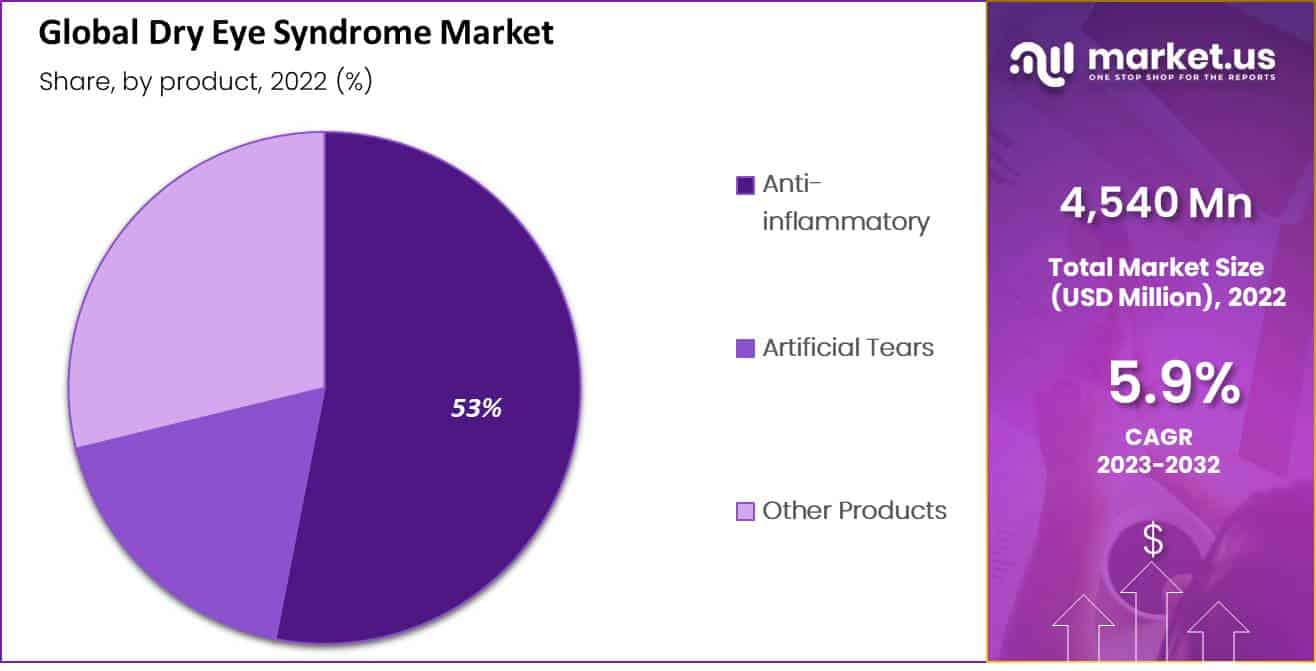
- Anti-inflammatory products had the highest sales in 2022.
- Eye drops were the most popular dosage form in 2022.
- Over-the-counter sales were the most profitable channel in 2022.
- Hospital pharmacies dominated distribution in 2022.
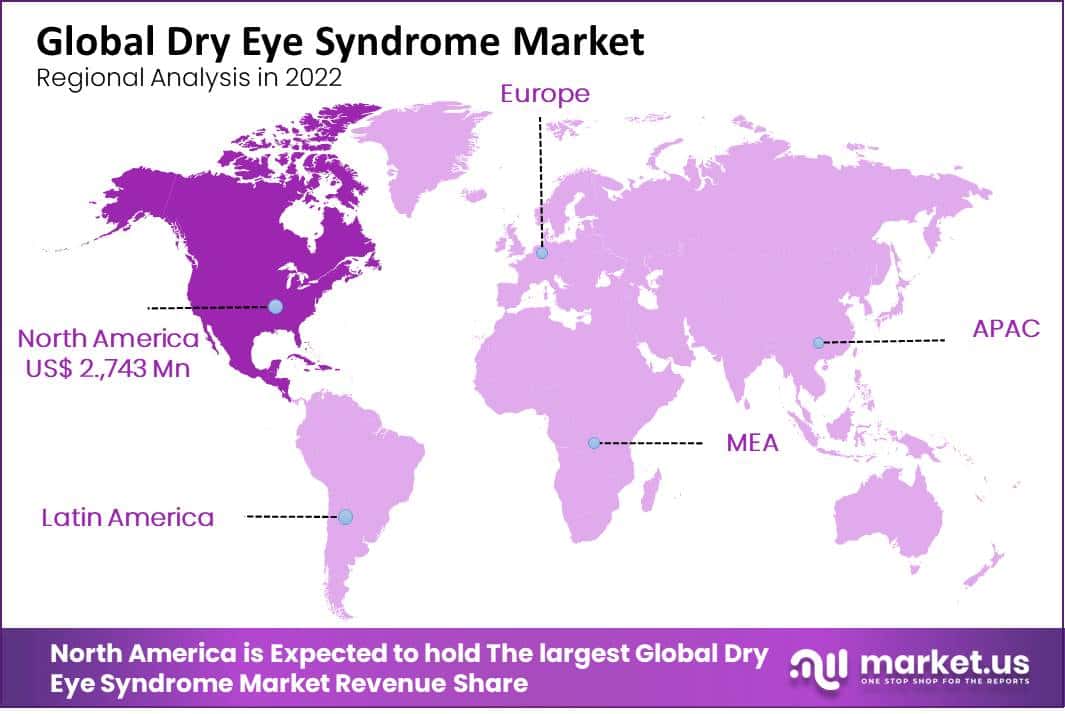
- North America led the market in 2022, with 38.9% of the revenue.
- Asia-Pacific is expected to grow the fastest from 2023 to 2032.
- Factors driving market growth include a higher incidence of dry eyes, a growing pipeline of treatments, and increased awareness.
- Rising cases of dry eye disease, especially in older people, contribute to market growth.
- Contact lens usage is a common cause of dry eyes.
- Increasing awareness of dry eye syndrome is expected to boost the market.
- North America dominated the market in 2022 due to a large target population and better healthcare access.
- Asia Pacific is expected to grow due to rising dry eye cases and improved healthcare infrastructure.
- Older people producing fewer tears and increased awareness contribute to market growth.
- Stringent regulations, side effects, and high costs limit market expansion.
- Major players include Novartis AG, AbbVie Inc., Johnson & Johnson Services, and more.
By Disease Type Analysis
Evaporative dry eye syndrome dominated the market in 2022
Based on disease, the global dry eye syndrome market is categorized into evaporative dry eye syndrome and aqueous deficient dry eye syndrome. Due to the high prevalence of the disease, which can be linked to factors such as a reduced rate of blinking, an increase in screen time, and reduced tear formation due to age, evaporative dry eye syndrome dominated the market in 2022 with the largest revenue share. Access to treatment is made easier by the readily available products that target the evaporative form of the disease, such as EvoTears.
The incapability of the lacrimal glands to produce tears is the cause of a condition known as aqueous dry eye syndrome. Aqueous tear deficiency and dry eye can be brought on by the accumulation of tears in the lacrimal gland as a result of chronic inflammation and thickened tear ducts. Medications like cyclosporine and punctual plugs are used to treat aqueous dry eye syndrome. Artificial tears are also used to treat the condition.
By Product Analysis
The anti-inflammatory segment dominated the global market
Based on the product, the market for dry eye syndrome is divided into anti-inflammatory, artificial tears, and lubricant eye drops; out of these, the anti-inflammatory segment is the most lucrative one. The anti-inflammatory segment is further subdivided into cyclosporine, corticosteroids, lifitegrast, and others.
Due to the long-standing use of medications that are based on cyclosporine, the cyclosporine segment accounted for the largest revenue share in 2022, which was over 61.0%. Research has shown that it is effective in treating the symptoms and clinical signs of dry eye disease. T-cell proliferation has been found to be inhibited by cyclosporine, an inflammatory reaction that contributes to illness.
Over the forecast period, corticosteroids are expected to expand at the fastest rate. Rather than immunomodulatory-based drugs, the market’s expansion is attributed to corticosteroid medications’ rapid action.
Some artificial tears work to reduce tear evaporation and promote eye healing in addition to lubrication of the eyes. Thickening agents, which keep the solution on the eyes’ surface for longer, are also present in artificial tears. Due to this, the artificial tears segment is expected to grow more.
Dosage Form Analysis
The eye drops segment estimated for the largest revenue share
Based on dosage form, the market for dry eye syndrome is classified into eye drops, eye solutions, gels, ointments, capsules & tablets, and other dosage forms.
Due to their ease of use and administration, which increases patient compliance with the treatment, eye drops accounted for the largest revenue share in 2022, with over 37.5%. However, the product’s effect is shorter-lived and simpler to eradicate because it is applied topically. Players in this market demonstrate the rapid movement of new products.
Due to the availability of products like Restasis and Xiidra, eye solutions are anticipated to expand at the fastest rate. However, due to their long-lasting effects, ointments and gels are preferred for use at night, making this market lucrative for major players.
Sales Channel Analysis
In 2022, the OTC segment held the highest revenue share
Based on sales channels, the global dry eye syndrome market is classified into prescription drugs and OTC drugs. The OTC drugs segment registered the highest revenue share in 2022 due to its simplicity of use and purchase. People have shifted towards buying over-the-counter as a result of the pandemic’s onset, and an increasing number of people are turning to self-medication. The market is expanding as more and more simple-to-use eye drops are made available.
Over the forecast period, the market for prescription drugs is expected to expand at a profitable rate. The rising incidence of dry eye in the general population is a significant driver for the expansion of the market.
Distribution Channel Analysis
The hospital pharmacies segment currently dominates the global market
Based on the distribution channel, this market for dry eye syndrome is segmented into retail pharmacies, hospital pharmacies, and online pharmacies. Among all these, hospital pharmacies account for holding the largest market share. Hospitals are favored because the majority of medicines can only be prescribed after thorough medical examinations. Thus the hospital’s pharmacies are anticipated to expand their market share over the forecast period.
The ease of access to retail pharmacies is the key factor behind the expansion of the retail pharmacies segment. In addition, the segment gains a competitive advantage in the market due to the presence of pharmacists who can assist with dosages, provide customer service, and offer consultations in certain regions.
Due to an increase in the number of people purchasing products out of convenience, the online pharmacy sector is anticipated to expand at the fastest rate during the forecast period. Online pharmacies have also grown in popularity as a result of the pandemic’s restrictions on individuals. Additionally, the lower prices offered by these online stores encourage repeat purchases.
Key Market Segments
Based on Disease Type
- Evaporative Dry Eye Syndrome
- Aqueous Deficient Dry Eye Syndrome
Based on Product
- Anti-inflammatory (Cyclosporine, Corticosteroids, Lifitegrast, and Others)
- Artificial Tears
- Other Products
Based on the Dosage Form
- Eye Drops
- Ointments
- Eye Solutions
- Gels
- Capsules & Tablets
- Other Dosage Forms
Based on the Sales Channel
- Prescription Drugs
- OTC Drugs
Based on the Distribution Channel
- Hospital Pharmacies
- Retail Pharmacies
- Online Pharmacies
Drivers
The rising geriatric population supports market growth
As older people’s eyes produce fewer tears, resulting in increased evaporation and dryness, the market is expected to be driven by the growing geriatric population worldwide. Additionally, the widespread use of contact lenses contributes to the onset of dry eyes, which in turn encourages the use of products designed to safeguard eye health.
Dryness, irritation, redness, fatigued eyes, and blurred vision are all experienced by the patients. Although the prevalence varies depending on age, it is rising in both the younger and older populations as a result of the increasing use of screens, poor diet, contact lenses, and LASIK procedures.
Increase in awareness among individuals regarding dry eye disease
Aging, systemic inflammatory diseases, a decrease in supportive hormones, surgeries, and ocular surface diseases that affect the cholinergic nerves and stimulate tear secretion are common causes of dry eye disease. Dry eye syndrome is one example of this.
The global dry eye syndrome market has expanded as a result of increased public awareness. Because it does not result in any kind of weakness in any part of the body, dry eye syndrome is ignored by many patients. However, the global dry eye syndrome market is being driven by an increase in the number of patients actively attempting to cure the condition as a result of increased awareness of the disease’s diagnosis and treatment.
By granting researchers permission to treat patients with this disease in a more comprehensive and precise manner, the government supports medical research.
Restraints
Rising preference towards self-medication, high cost, competitive pricing, and stringent regulations are subjected to hinder the market growth
The primary constraint on the dry eye syndrome market at this time is the patient preference for self-medication, the high cost, and the limited availability of effective treatments. In addition, the global dry eye syndrome market is significantly constrained by the expiration of major drug patents used to treat the condition.
Competitive pricing is the strategy being used by manufacturers in the dry eye syndrome industry to gain a significant share of the market. In addition, strategic acquisitions and technological advancements are the manufacturers’ primary areas of focus.
However, the drugs that are available for treatment and the long-term treatment plans are subject to stringent regulations, which limit their use and adoption among the general population. The treatment can have side effects that slow the growth of the market as a whole and can take weeks or even three to six months to start working.
Opportunity
Rising investment in healthcare infrastructure
The rising cost of healthcare, which contributes to the infrastructure’s improvement, is a major driver of the market for dry eye syndrome treatments.
The market for dry eye syndrome treatment will also grow as a result of rising initiatives by public and private organizations to raise awareness. Additionally, the market for dry eye syndrome treatment will expand as a result of rising demand for standard treatment and high disposable income. During the forecast period, the market dynamics will be influenced by shifting dietary patterns and sedentary lifestyles. The market’s growth rate will also be boosted by an increase in the elderly population and public awareness of dry eye conditions.
Trends
Increase in R & D activities and rising investment in technological advancements
An increase in the number of R&D activities is driving the market’s expansion. The growth of the market for dry eye syndrome treatment will benefit from these opportunities. The market’s growth rate will also be accelerated by rising drug approvals and launches.
Additionally, during the forecast period, beneficial opportunities for the growth of the dry eye syndrome treatment market will be provided by rising investment in advanced technology development and an increase in the number of emerging markets.
Regional Analysis
Based on region, the global dry eye syndrome market is classified into North America, Europe, Asia Pacific, Latin America, and Middle East & Africa. Among these regions, North America currently dominates the market. It held the largest revenue share of 38.9% of the total market in 2022.
The market in this region is anticipated to be driven by the presence of a large target population, improved access to healthcare, and a high rate of treatment adoption. Additionally, players in this region are drawn to the lucrative nature of the market.
Due to the rising prevalence of dry eye disease, improved access to healthcare, and improvements in overall healthcare infrastructure, Asia Pacific is anticipated to be the fastest-growing segment over the forecast period. Additionally, the overall market is anticipated to be driven by the presence of significant players in this region, such as Santen Pharmaceuticals and Otsuka Pharmaceuticals Co. Ltd.
Key Regions
- North America
- The US
- Canada
- Mexico
- Western Europe
- Germany
- France
- The UK
- Spain
- Italy
- Portugal
- Ireland
- Austria
- Switzerland
- Benelux
- Nordic
- Rest of Western Europe
- Eastern Europe
- Russia
- Poland
- The Czech Republic
- Greece
- Rest of Eastern Europe
- APAC
- China
- Japan
- South Korea
- India
- Australia & New Zealand
- Indonesia
- Malaysia
- Philippines
- Singapore
- Thailand
- Vietnam
- Rest of APAC
- Latin America
- Brazil
- Colombia
- Chile
- Argentina
- Costa Rica
- Rest of Latin America
- Middle East & Africa
- Algeria
- Egypt
- Israel
- Kuwait
- Nigeria
- Saudi Arabia
- South Africa
- Turkey
- United Arab Emirates
- Rest of MEA
Key Players Analysis
The most prominent players are concentrating on growth strategies like new product launches, research and development, and mergers and acquisitions. These strategies will contribute to market growth by forming a competitive landscape in the global market and developing of major players’ portfolios. Listed below are some of the prominent players in the global dry eye syndrome market.
Market Key Players
- Novartis AG
- AbbVie Inc.
- Johnson & Johnson Services
- Sun Pharmaceutical Industries Ltd.
- Otsuka Pharmaceutical Co., Ltd.
- Oasis Medical
- Santen Pharmaceutical Co., Ltd.
- AFT Pharmaceuticals
- Oyster Point Pharma, Inc.
- Bausch & Lomb Pvt Ltd.
- Other Key Players
Recent Developments
- In January 2022, Avenova lubricating eye drops were introduced by NovaBay Pharmaceuticals to alleviate symptoms of dry eye.
- In, November 2022, The phase 3 clinical trial of 0.25% reproxalap ophthalmic solution, an investigational new drug candidate for treating allergic conjunctivitis, was completed by Aldeyra Therapeutics, Inc. At the 2022 Annual Meeting of the American Academy of Optometry, the business presented the trial’s clinical data.









