


Report Overview
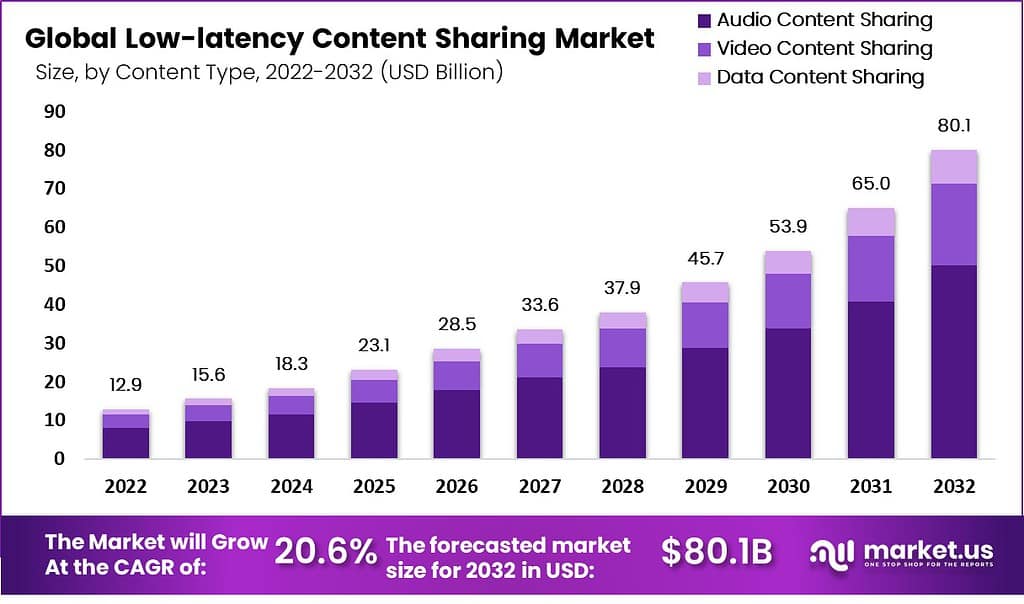
The Global Low-Latency Content Sharing Market is projected to grow at a CAGR of 20.6%, with its worth expected to increase from USD 15.6 Bn in 2023 to approximately USD 80.1 Bn by 2032.
Low-latency content sharing refers to the smooth and swift exchange of digital content like data, audio, and video, characterized by minimal delay or latency, that is, the time taken for content to traverse from source to destination. The demand has surged due to growing requirements for instantaneous communication and collaboration across diverse domains. This surge is supported by various applications, including live video streaming, online gaming, video conferencing, telemedicine and interactive multimedia encounters. The global low-latency content-sharing market is rapidly evolving with the new technological changes, which are expected to affect the market growth positively.
Note: Actual Numbers Might Vary In The Final Report
Key Takeaways
- Robust Growth Projection: Anticipated CAGR of 20.6% propelling the low-latency content sharing market to reach approximately USD 80.1 billion by 2032.
- Swift, Seamless Exchanges: Low-latency content sharing enables rapid transmission of digital content, ensuring minimal delays, crucial for live streaming, gaming, and virtual interactions.
- Demand for Real-Time Interactions: Increasing demand for virtual events and live streaming emphasizes the need for smooth content delivery, enhancing user engagement and experience.
- Network Infrastructure Challenges: Inadequate network coverage in some regions poses challenges to real-time content exchange, affecting user experiences in various applications.
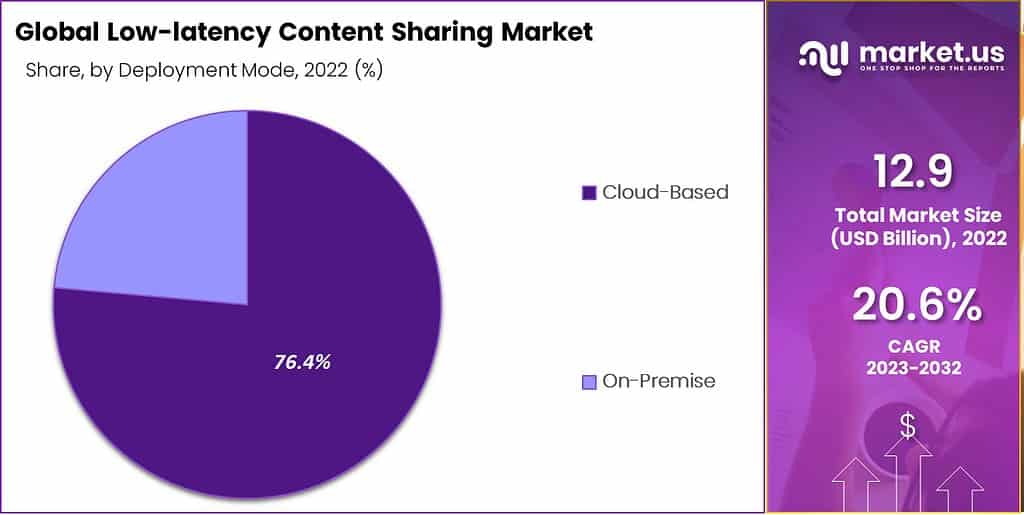
- Dominant Market Segments: Video content sharing leads at 62.7%, cloud-based deployment holds 76.4% share, and media & entertainment dominates the industry vertical segment.
- Education Sector Opportunities: Emphasis on virtual learning creates opportunities for low-latency content sharing, facilitating interactive virtual classrooms and personalized learning experiences.
- Emerging 5G Integration: Integration of edge computing and low-latency content sharing, especially in the context of 5G network evolution, gains significant traction, reducing latency and enhancing data delivery in real-time.
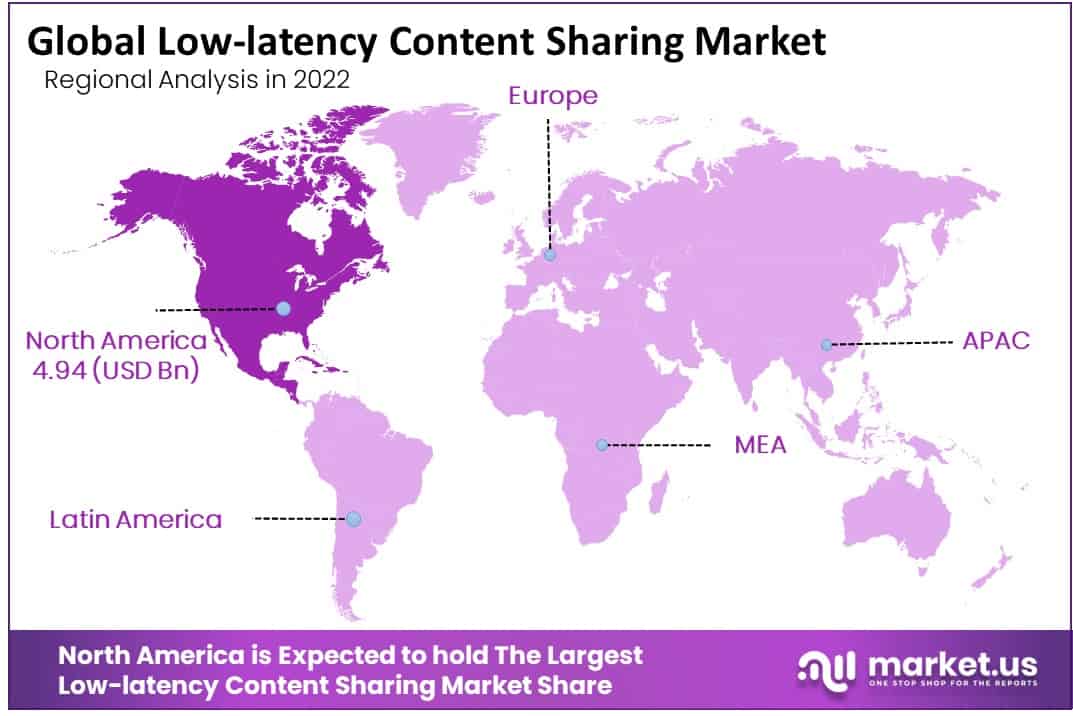
- North America’s Market Dominance: North America’s advanced technological infrastructure solidifies its position as the leading region in the low-latency content sharing market.
- Key Players in the Field: Major companies such as Amazon Web Services, Google LLC, and Microsoft Corporation play a crucial role in shaping the low-latency content sharing market.
- Comprehensive Market Analysis: The report provides in-depth coverage of market dynamics, the impact of COVID-19, competitive landscape, recent developments, and segmentation across various regions globally.
Driving Factor
Rising Demand for Real-Time Interactions
The rise of virtual events, live streaming, and online broadcasting across industries has underscored the importance of smooth content delivery. Low-latency content sharing plays a vital role in ensuring high-quality video and multimedia content reaches global audiences without disruptions. This enhances user engagement and experience by enabling real-time interactions and reactions, leading to more immersive and enjoyable virtual experiences.
Restraining Factor
Network Infrastructure Challenges
The expansion of the Global Low-latency Content Sharing Market can be hampered by the challenges related to network infrastructure. Despite the growth of high-speed connectivity options, there remain regions with inadequate or unreliable network coverage. Limited access to high-speed internet negatively affects the exchange of content in real-time, impacting user experiences in various applications, including video conferencing, live streaming, and online gaming. Additionally, variations in network quality across geographies may introduce inconsistencies in latency, posing a significant hurdle for low-latency content-sharing solutions.
Content Type Analysis
Video Content Sharing Segment Dominates the Market by Holding Major Revenue Share
Based on content type, the global low-latency content-sharing market is classified into audio content sharing, video content sharing, and data content sharing. Among these content-type segments, the video content-sharing segment dominates the market by holding a major revenue share of 62.7%. This dominance of the video content-sharing segment is due to its applicability across various applications, including healthcare’s telemedicine, education’s virtual classrooms, and corporate remote training initiatives. Also, the video content-sharing segment is rapidly booming as it provides users with an immersive experience in various applications. Overall, these factors affect the growth of the video content-sharing segment in the target market positively.
Deployment Mode Analysis
Cloud-Based Dominates the Deployment Mode Segment with a Major Revenue Share in Account.
On the basis of deployment mode, the market is classified into cloud-based and on-premise. Among these deployment mode segments, the cloud-based segment leads the market by covering a major revenue share of 76.4%. This growth of the cloud-based segment can be attributed to various advantages of cloud-based solutions, including enhanced scalability and flexibility, cost-effectiveness, and improved efficiency. However, the on-premise segment is also expected to grow at a significant CAGR during the forecast period.
Note: Actual Numbers Might Vary In The Final Report
Industry Vertical Analysis
Media & Entertainment Industry Dominates the Industry Vertical Segment in the Global Low-Latency Content Sharing Market.
Based on industry verticals, the market is segmented into media & entertainment, healthcare, education, gaming, financial services, telecommunications, automotive, and other industry verticals. Among these industry verticals, the media & entertainment segment holds the major revenue share account to dominate the industry vertical segment in the global low-latency content-sharing market. This growth of the media & entertainment industry can be attributed to growing consumer demand for low-latency content sharing in various applications, including live streaming, broadcasting, and interactive media. The consumption of both audio and video content is rapidly growing, especially in the media & entertainment industry, contributing to the market growth positively.
Key Market Segments
Content-Type
- Audio Content Sharing
- Video Content Sharing
- Data Content Sharing
Deployment Mode
- Cloud-Based
- On-Premise
Industry Vertical
- Media and Entertainment
- Healthcare
- Education
- Gaming
- Financial Services
- Telecommunications
- Automotive
- Other Industry Verticals
Growth Opportunity
E-Learning Evolution and Virtual Classrooms
The growing emphasis of the education sector on virtual learning is expected to create opportunities in the global low-latency content-sharing market. Educational institutions are adopting online learning models that require real-time content-sharing capabilities for interactive virtual classrooms. Low-latency solutions facilitate faster interactions between educators and students, creating engaging and personalized learning experiences. As the education sector adapts to digital environments, low-latency content-sharing solutions can play an important role in enhancing the quality and accessibility of remote education.
Latest Trends
5G Network Evolution
The integration of edge computing and low-latency content sharing has gained significant traction recently. This integration involves processing data closer to its source, reducing latency, and enhancing real-time content delivery. Particularly relevant for time-sensitive applications like IoT, this trend has the potential to revolutionize real-time data processing and distribution, overcoming previous latency challenges and opening up opportunities across various sectors.
Regional Analysis
North America Dominates the Global Low-Latency Content Sharing Market by Holding the Major Revenue Share.
The North America region dominated the global low-latency content-sharing market by holding a major revenue share of 38.3%. North America’s dominance in the global low-latency content-sharing market arises from a synergy of factors. The region’s robust technological infrastructure, encompassing advanced communication networks, data centers, and cutting-edge computing capabilities, forms the basis for seamless, low-latency content sharing. This addresses real-time data needs in sectors such as finance, healthcare, and entertainment, solidifying North America’s preeminent role.
Note: Actual Numbers Might Vary In The Final Report
Key Regions and Countries Covered in this Report
- North America
- The US
- Canada
- Europe
- Germany
- France
- The UK
- Spain
- Italy
- Russia
- Netherland
- Rest of Europe
- APAC
- China
- Japan
- South Korea
- India
- Australia
- New Zealand
- Singapore
- Thailand
- Vietnam
- Rest of APAC
- Latin America
- Brazil
- Mexico
- Rest of Latin America
- Middle East & Africa
- South Africa
- Saudi Arabia
- UAE
- Rest of MEA
Market Share and Key Player Analysis
The global low-latency content-sharing market is fragmented into many companies offering low-latency content-sharing solutions and services. Major players in the market are focusing on strengthening their position through strategic partnerships and collaborations. Companies are focusing on developing new and advanced low-latency content-sharing solutions to cater to the market needs.
Top Key Players in the Low-latency Content Sharing Market
- Amazon Web Services, Inc.
- Akamai Technologies, Inc.
- Google LLC
- Microsoft Corporation
- Fastly
- Cloudflare, Inc.
- Cisco Systems, Inc.
- Verizon Communications Inc.
- Ericsson
- Huawei Technologies Co., Ltd.
- Other Key Players
Recent Developments
- In July 2023, Microsoft Corporation announced new developments in Azure Networking, including ultra-low latency and high-performance connectivity between Azure regions.









