


Report Overview
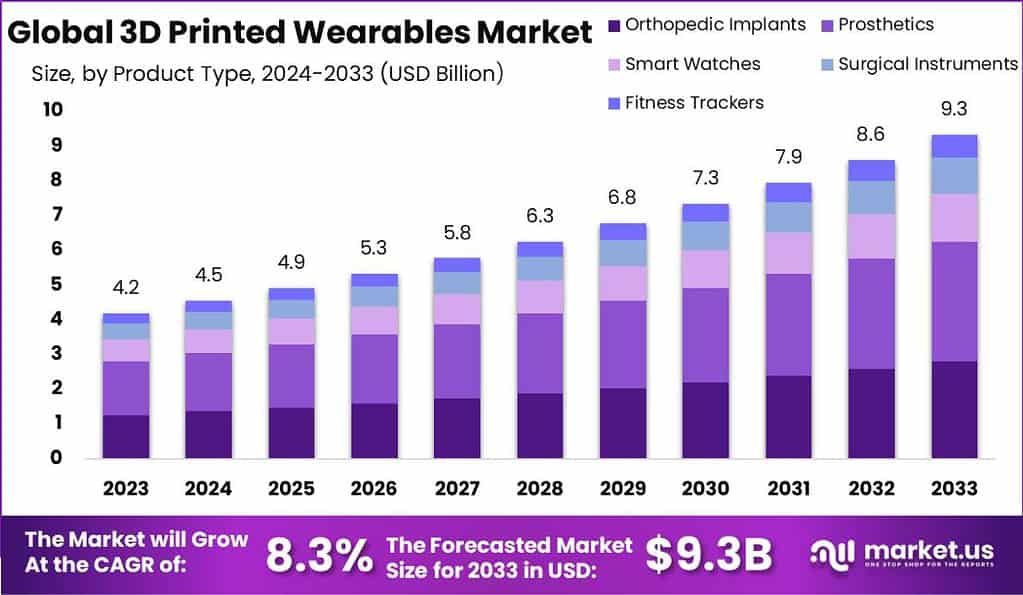
The Global 3D Printed Wearables Market size is projected to surpass USD 4.2 Billion in 2023 and is likely to attain a valuation of USD 9.3 billion by 2033. The 3D Printed Wearables industry share is expected to rise at an astounding CAGR of 8.3% from 2024 to 2033.
3D printing, also known as additive manufacturing, has revolutionized the production of various wearables, including prosthetics, orthopedic implants, smartwatches, and fitness trackers. The technology allows for the creation of complex structures with previously unprecedented design freedom, leading to a surge in its popularity within the consumer wearables industry.
3D printed wearables refer to clothing, accessories, footwear and other items worn on the body that are created using 3D printing or additive manufacturing technologies. This involves depositing successive layers of materials like plastics, rubbers or metals to build up a 3D object based on a digital design.
Note: Actual Numbers Might Vary In The Final Report
The key benefit is the ability to easily customize designs to an individual’s exact measurements and preferences. 3D printing enables creation of complex shapes and designs that are not feasible using traditional manufacturing methods for wearables. While still an emerging industry, 3D printed wearables allow for greater personalization, reduced waste, rapid prototyping and simplified supply chains compared to conventional manufacturing.
Additionally, 3D printed wearables can be tailored to fit specific body shapes and sizes, leading to a more customized and comfortable experience for the wearer. As 3D printing technology continues to advance, it is expected to play an increasingly significant role in the production of innovative and customizable wearables, contributing to the evolution of the fashion and design industries.
Product Type Insights
In 2023, Prosthetics held a dominant market position, capturing more than a 37% share. This growth was primarily fueled by the increasing adoption of advanced prosthetic limbs that offer improved mobility and functionality to individuals with limb disabilities. Additionally, the rising prevalence of amputations due to accidents and medical conditions contributed to the expansion of the prosthetics segment.
Orthopedic Implants, another vital segment, exhibited steady growth due to the escalating demand for personalized orthopedic solutions, such as knee and hip implants. The aging population, coupled with the prevalence of orthopedic disorders like osteoarthritis, acted as key factors driving the demand for these implants. Moreover, technological advancements in implant materials and designs contributed to the segment’s upward trajectory.
Smart Watches, a burgeoning segment within the 3D printed wearables market, experienced significant growth owing to the integration of advanced health monitoring features and sleek designs. The increasing consumer focus on health and fitness, coupled with the rising awareness of preventive healthcare, stimulated the demand for smartwatches. Furthermore, the incorporation of 3D printing technology facilitated the customization of smartwatches, catering to diverse consumer preferences.
Surgical Instruments, although a niche segment, demonstrated notable growth, driven by the enhanced precision and efficiency offered by 3D-printed surgical tools. The ability of 3D printing to produce intricate designs and complex geometries enabled the development of specialized surgical instruments, contributing to improved surgical outcomes and reduced procedural complexities.
Fitness Trackers, a rapidly evolving segment, witnessed substantial growth owing to the growing emphasis on maintaining an active lifestyle and tracking fitness metrics. The integration of 3D printing technology enabled the production of lightweight and durable fitness trackers with enhanced functionalities, fostering their widespread adoption among fitness enthusiasts and health-conscious consumers.
Overall, the 3D printed wearables market is poised for significant expansion across all segments, driven by technological advancements, increasing healthcare needs, and the growing preference for personalized and innovative wearable solutions.
End-user Insights
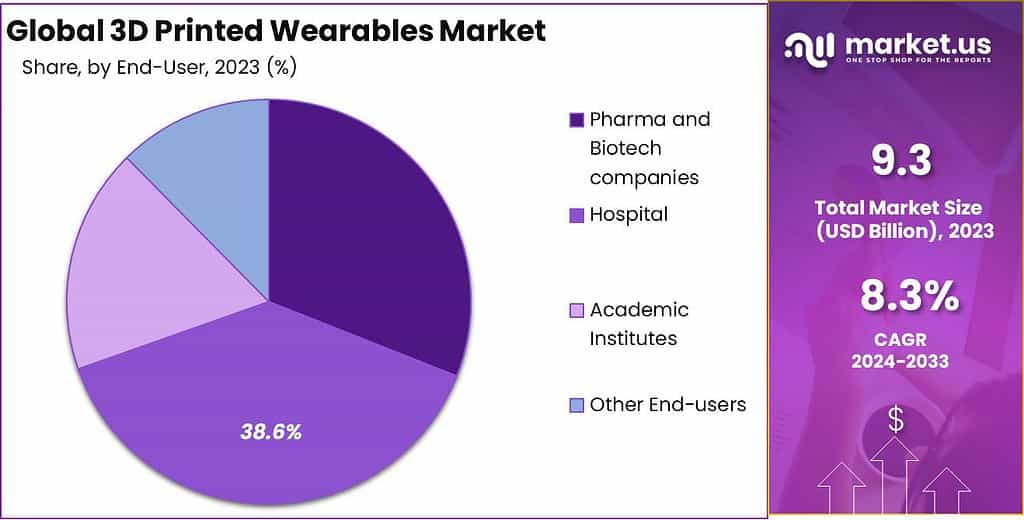
In 2023, hospitals held a dominant market position, capturing more than a 38.6% share. This growth was propelled by the increasing adoption of 3D printed wearables for patient-specific applications, including customized prosthetics, orthopedic implants, and surgical instruments. Hospitals leveraged 3D printing technology to offer tailored solutions, thereby enhancing patient outcomes and streamlining medical procedures.
Pharma and Biotech companies emerged as a key end-user segment, experiencing significant growth due to the utilization of 3D printing in drug delivery systems and personalized medicine. The ability of 3D printing to create intricate drug structures and controlled-release mechanisms enabled pharmaceutical companies to innovate their drug development processes, leading to improved therapeutic efficacy and patient compliance.
Academic institutes, while a smaller segment, demonstrated notable growth in the 3D printed wearables market, primarily driven by research and development activities focused on advancing wearable technology applications. Academic institutions utilized 3D printing to foster innovation in the development of wearable sensors, smart textiles, and biomedical devices, contributing to the exploration of novel healthcare solutions and fostering collaborations between academia and industry.
Other end-users, including rehabilitation centers and research organizations, also contributed to the market’s expansion through the adoption of 3D printed wearables for rehabilitation purposes and research initiatives. These end users leveraged 3D printing technology to develop customized orthoses and assistive devices tailored specifically for patients in rehabilitation programs, and advance biomedical research and development efforts.
Note: Actual Numbers Might Vary In The Final Report
Overall, the 3D printed wearables market experienced tremendous growth across various end-user segments in 2018, thanks to the efforts of hospitals, pharmaceutical companies, academic institutes, and other end users who leverage 3D printing technology for improving healthcare solutions, spurring innovation and providing better patient care.
Drivers
- Personalization and Customization: People nowadays want things that show off their unique style. With 3D printing, you can get wearables like jewelry or accessories that are made just for you, reflecting your personality perfectly.
- Design Freedom: 3D printing lets designers make intricate and complex designs that were hard to achieve before. This means wearables can have cool patterns, shapes, and textures that were once impossible to create, making them more unique and eye-catching.
- Cost Efficiency: 3D printing cuts down on costs for making wearables, which means you can get customized products without breaking the bank. It gets rid of the need for expensive tools and molds, making it more affordable for smaller production runs.
- Sustainability: 3D printing helps to reduce waste and is better for the environment. It produces items only when needed, reducing leftover inventory and the environmental impact of long-distance shipping.
Restraints
- 3D Printing Is Limited in Its Material Variety: Although 3D printing provides plenty of materials, its selection still falls short compared to traditional manufacturing techniques, which means not all types of wearables can be created using this technology, thus restricting market diversity.
- Quality and Durability Concerns: Ensuring 3D printed wearables meet high-quality standards is no small undertaking, which makes selecting materials and processes essential to meeting this goal. Selecting durable yet top-grade materials ensures products do not wear out quickly.
- Intellectual Property Concerns: With 3D printing becoming more prevalent, there’s a real threat that people will copy designs without permission, which poses a real challenge to designers and companies who wish to protect their original creations and ideas from being stolen or copied by others.
Opportunities
- Healthcare Applications: 3D printing can be a game-changer for making custom-fit prosthetics and orthotics in the healthcare industry. This means better-fitting and more comfortable solutions for people who need them, bringing more innovation to healthcare.
- Fashion Industry Collaboration: Fashion designers teaming up with technology companies can lead to amazing new wearable products. 3D printing in the fashion industry allows for the creation of bold and creative wearables, pushing the boundaries of what’s possible in fashion.
- Consumer Electronics Integration: Combining 3D printing with electronics can create some really cool smart wearables. These wearables can have special features like sensors or displays, making them more functional and appealing for tech-loving folks.
- Online Customization Platforms: Websites that let you design and personalize your own wearables are becoming more popular. These platforms use 3D printing to make your custom designs, giving you a fun and unique shopping experience.
Challenges
- Choice of materials: Materials used in 3D printed wearables should be biocompatible, durable, and lightweight to achieve aesthetic, functionality, and safety benefits. Your choice of material could have an effect on aesthetics, functionality, and safety aspects of the wearable.
- Reliability and accuracy: Wearables need to perform their intended function reliably and accurately.
- Power: Wearables need a power source that is reliable and long-lasting.
Key Market Segments
By Product Type
- Orthopedic Implants
- Prosthetics
- Smart Watches
- Surgical Instruments
- Fitness Trackers
By End-user
- Pharma and Biotech companies
- Hospital
- Academic Institutes
- Other End-users
Regional Insights
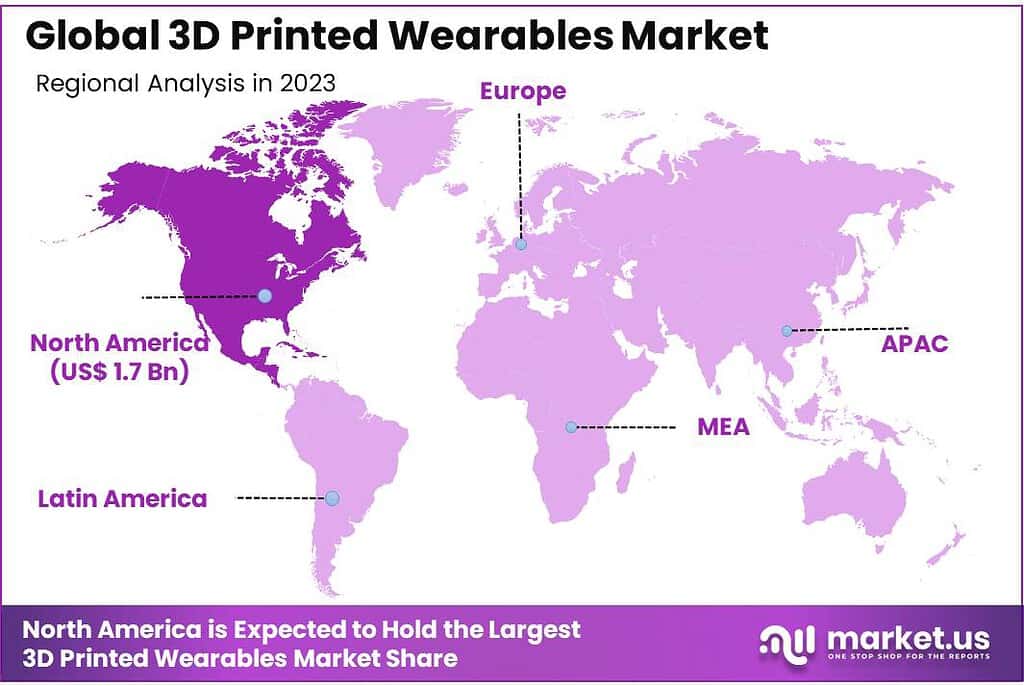
The North American region dominated the 3D printed wearables market in 2023, accounting for a substantial 42% share. This impressive market share can be attributed to the region’s robust healthcare infrastructure and advanced technological capabilities, as well as key players investing in 3D printed wearable solutions research and development.
Furthermore, North America’s increasing adoption of personalized healthcare and increasing prevalence of chronic diseases fueled the increase in demand for 3D printed wearables such as prosthetics, orthopedic implants and smart healthcare devices. North America’s strong focus on technological innovations and supportive regulatory environment for medical innovations further fueled its 3D printed wearables market growth in this region.
Note: Actual Numbers Might Vary In The Final Report
Key Regions and Countries Covered in this Report:
North America
- The US
- Canada
Europe
- Germany
- France
- The UK
- Spain
- Italy
- Russia
- Netherland
- Rest of Europe
APAC
- China
- Japan
- South Korea
- India
- Australia
- New Zealand
- Singapore
- Thailand
- Vietnam
- Rest of APAC
Latin America
- Brazil
- Mexico
- Rest of Latin America
Middle East & Africa
- South Africa
- Saudi Arabia
- UAE
- Rest of MEA
Key Player Analysis
In the global 3D printed wearables market, several key companies play a significant role. These companies are actively engaged in partnerships, mergers, and acquisitions to strengthen their product portfolios and expand their manufacturing capacities, aiming to achieve competitive differentiation. These key players actively contributed to the growth and innovation within the 3D printed wearables market through their continuous research and development initiatives, technological advancements, and strategic collaborations with healthcare providers and research institutions.
Top Kеу Рlауеrѕ
- General Electric (GE) Co.
- Everist Health Inc.
- Medtronic PLC
- BioTelemetry, Inc.
- Koninklijke Philips N.V.
- Omron Corporation
- Cyfuse Biomedical K.K.
- Under Armour Inc.
- Nike Inc.
- 3D Systems Corporation
- Other Key Players
Notable Recent Developments
- In 2021, Cobra Golf introduced the first ever completely 3D printed golf club called the KING Supersport-35 putter.
- In 2022, Researchers from MIT developed 3D printed hair structures for more natural looking wigs and hair extensions.
- In 2023, Wiivv introduced 3D printed insoles customized to each customer’s foot scan to provide personalized comfort and support.









