


Market Overview
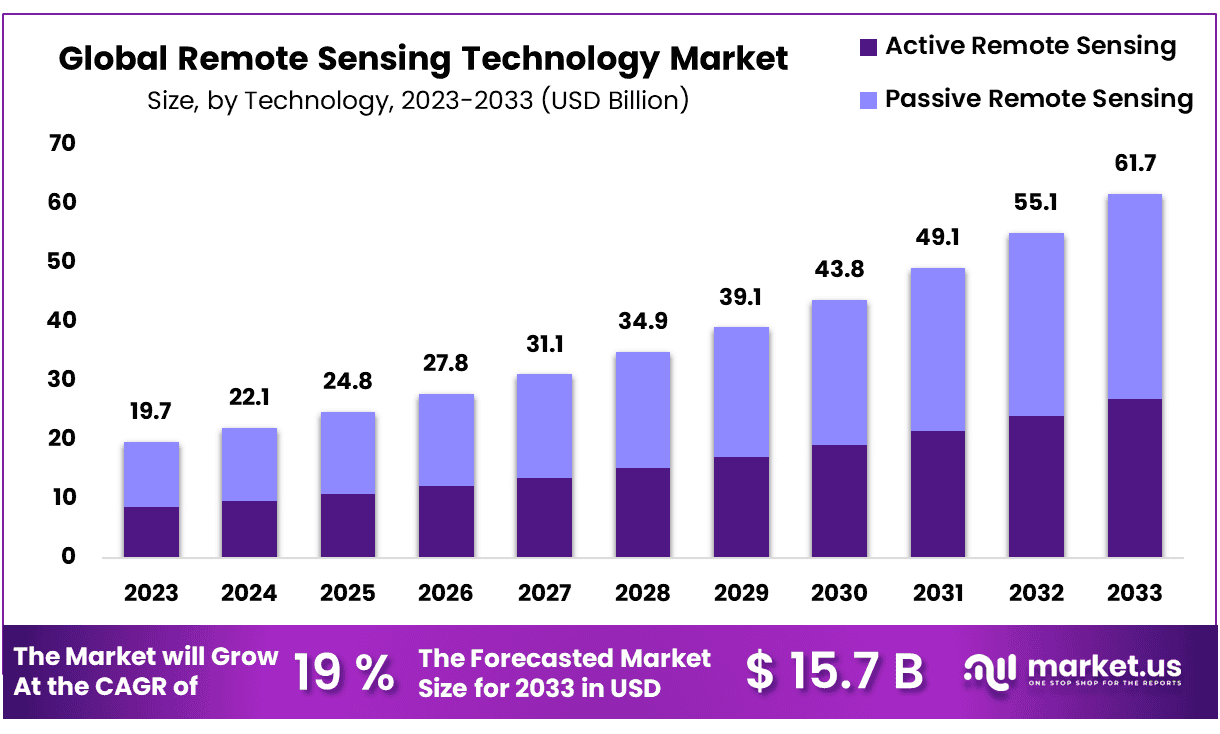
The Global Remote Sensing Technology Market size is expected to be worth around USD 61.7 Billion by 2033 from USD 19.7 Billion in 2023, growing at a CAGR of 19% during the forecast period from 2023 to 2032.
Remote sensing technology plays a crucial role in acquiring information and data about the Earth’s surface and atmosphere from a distance, impacting various facets of life. In the realm of agriculture, remote sensing technology enhances crop management by furnishing insights into crop health, moisture levels, and soil characteristics. This data is instrumental in optimizing irrigation and fertilizer application, leading to reduced water consumption and enhanced crop yields.
This technology is used to obtain data about the Earth’s surface and evaluate its characteristics. It does not require physical contact with the studied surface but instead uses reflected or released light from satellites or aircraft. The growing number of Earth observation ventures undertaken by many space agencies is the main driver of this market. Many countries took strict measures to prevent the spread of the COVID-19 virus pandemic. This directed to greater use of this technology to document environmental changes and monitor and curtail the spread of viruses.
Note: Actual Numbers Might Vary In Final Report
Key Takeaways
- Market Growth and Size: The Remote Sensing Technology Market is forecast to experience rapid expansion, reaching an estimated worth of USD 61.7 billion by 2033 and posting an impressive compound annual growth rate of 19% between 2023-2033.
- Impact on Agriculture: In agriculture, remote sensing technology is used to optimize crop management. It provides insights into crop health, moisture levels, and soil characteristics, leading to reduced water consumption and increased crop yields.
- Passive vs. Active Remote Sensing: By 2023, the passive remote sensing technology dominating the market and accounted for a huge 56.3%. This non-intrusive technology is widely used in environmental monitoring, agriculture, and meteorology. However active remote sensing although significant, holds less of a market share because of its higher cost and a limited number of applications.
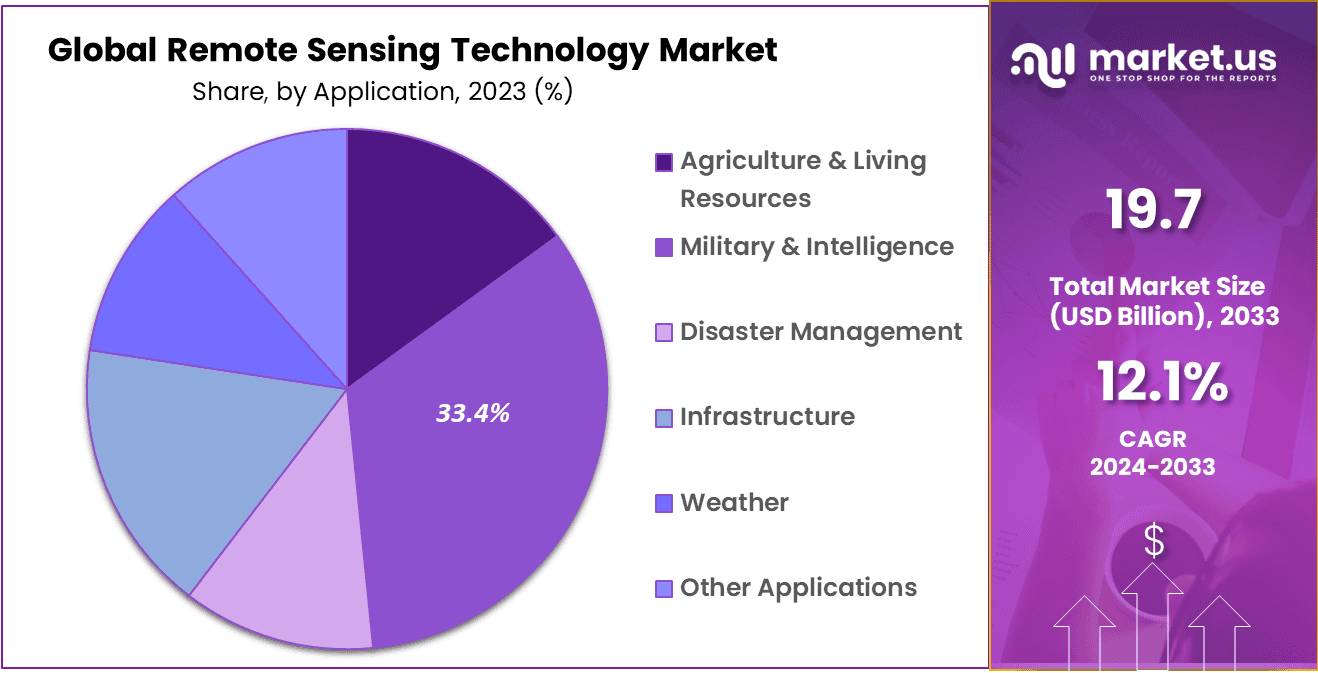
- Applications: In the military and intelligence sector has a substantial market share of 33.4% by 2023. due to the widespread use of technology to monitor and stopping criminal activities. Disaster management technology is expected to experience rapid growth, providing crucial information during natural disasters.
- Platforms: Aerial systems, including drones, accounted for 68% of the market in 2023. Drones offer cost-effective data collection and are particularly valuable for aerial mapping. The satellite sector is predicted to have a high growth rate due to increased earth observation initiatives and reliance on weather satellite imagery.
- Driving Factors: The growth of the Remote Sensing Technology Market is propelled by factors such as the increasing demand for earth observation data, advancements in satellite technology, government initiatives and funding, and rising awareness of climate change.
- Challenges: High initial costs, data privacy and security concerns, regulatory challenges, and competition from alternative technologies pose challenges to the market’s expansion.
- Growth Opportunities: Precision agriculture, disaster management and response, infrastructure development, and the expanding space economy offer significant growth opportunities within the remote sensing technology market.
- Key Market Trends: Integration of artificial intelligence and machine learning, miniaturization of satellites, multi-sensor fusion, and a focus on environmental sustainability are key trends shaping the market.
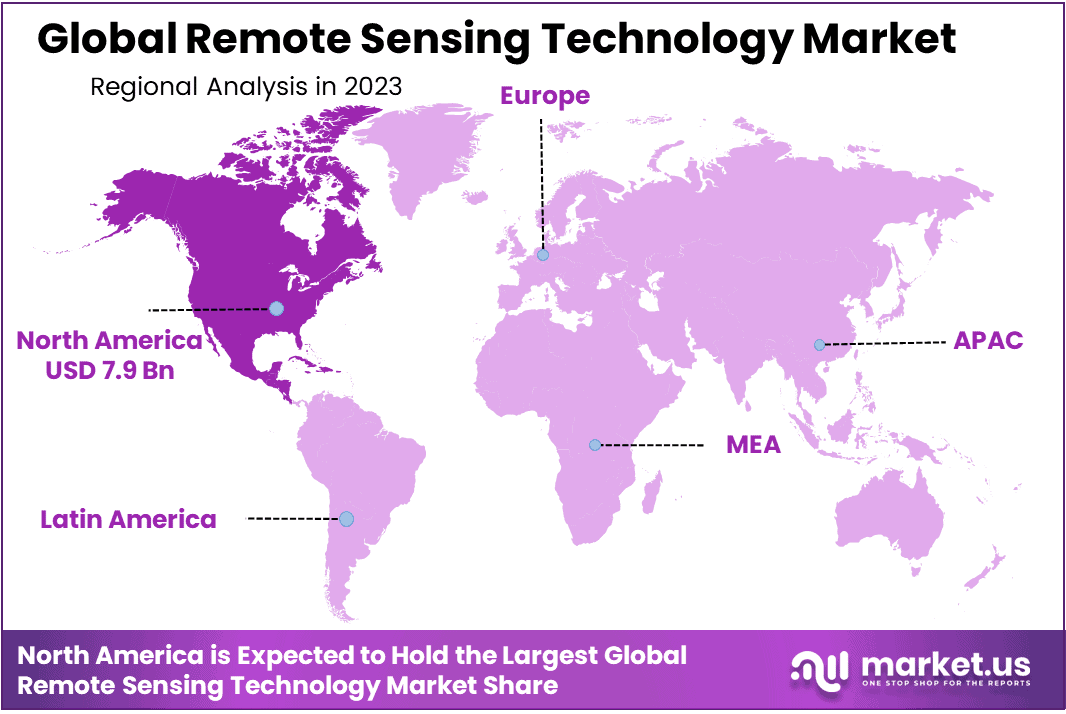
- Regional Analysis: North America holds a dominant position in the market, accounting for over 40% of the share in 2023, followed by Europe and Asia-Pacific. Latin America and Africa are also emerging as potential growth regions.
- Key Players: Leading players in the remote sensing technology market include DigitalGlobe, Esri, General Dynamics Mission Systems, Hexagon AB, Lockheed Martin Corporation, Orbital Insight, and Planet Labs Inc.
- Recent Developments: Notable recent developments include Airbus signing a contract to develop a new hyperspectral satellite, Maxar Technologies acquiring Vricon, and BlackSky Global launching its latest satellite, SkyHawk 10
Technology Analysis
In 2023, the Passive Remote Sensing segment found itself in a commanding position within the Remote Sensing Technology Market, accounting for a substantial 56.3% share. This segment encompasses a range of technologies that are instrumental in data collection, without direct interaction with the target of interest.
Passive remote sensing is based on detecting and analyzing natural reflections and emissions usually as electromagnetic waves. Its non-intrusive nature is its major advantage, which makes it ideal for applications such as environmental monitoring, agriculture and meteorology. The dominance of this technology is because of its wide-spread use across a range of industries, with a particular focus for Earth observation. Satellite-based sensors, which are essential in collecting vital data on weather forecasting, climate and the management of natural resources are a key element in this area. Moreover, the increasing adoption of passive remote sensing technology in precision agriculture, where it aids in crop monitoring and yield prediction, has further fueled its market prominence.
On the other hand, the Active Remote Sensing segment represents a significant but slightly smaller portion of the market in 2023. This segment accounted for the remaining market share, with various applications across industries such as defense, geology, and infrastructure development.
Active remote sensing technology involves the emission of its own signals, such as radar or LiDAR, and then measures the response or reflections from the target. This method provides precise and detailed information, making it indispensable for applications like terrain mapping, object detection, and disaster management. However, the segment faces challenges such as higher costs and a limited range of applications compared to its passive counterpart.
Application Analysis
The market share held by the military and intelligence is more than 33.4% in 2023. This is due in part to the rising adoption of technology and monitoring and preventing criminal and destructive activities by developed countries. China and Russia are also focusing their efforts on satellite images for defense applications. These factors are expected to boost demand over seven years.
Disaster Management technology is projected to experience the fastest growth rate throughout its projected period, contributing essential information about natural disasters such as storms and volcanic eruptions to authorities for making informed evacuation and post-disaster actions decisions.
The technology provides continuously updated information that aids authorities in making better decisions regarding evacuations, and the actions that must be taken following a disaster. This includes weather, infrastructure, agriculture, and other living resources.
Platform Analysis
In 2023, the aerial systems segment accounted for 68.00% of the total market. This is due to the increased use of drones, or Unmanned Aerial vehicles(UAV), in aerial mapping. Drones are cheaper and can collect more data faster than traditional methods. Additionally, these devices allow for surface mapping that provides high-quality data and covers an area that cannot easily be reached by satellites.
The satellite sector is predicted high compound annual growth rate over its projected lifespan. This strong projection can be attributed to NASA’s increased earth observation initiatives as well as growing reliance on weather satellite imagery for weather forecasting – especially meteorological satellites that allow an estimate of winds near sea surface from space – providing invaluable insight for detecting and tracking cyclones.
Note: Actual Numbers Might Vary In Final Report
Driving Factor
- Increasing Demand for Earth Observation Data: The growing need for accurate and real-time earth observation data for applications like agriculture, environmental monitoring, and disaster management is a significant driver. Remote sensing technology enables precise data collection, driving its adoption across various sectors.
- Advancements in Satellite Technology: Ongoing advancements in satellite technology, such as miniaturization, improved sensors, and enhanced imaging capabilities, are propelling the remote sensing market. These innovations enable cost-effective and high-resolution data acquisition.
- Government Initiatives and Funding: Government initiatives worldwide to promote remote sensing for national security, environmental protection, and infrastructure development play a pivotal role. Substantial funding for research and development projects strengthens the market’s growth prospects.
- Rising Awareness of Climate Change: The increasing awareness of climate change and its impact on ecosystems has boosted the demand for remote sensing technology. It allows for comprehensive monitoring of environmental changes, aiding in climate research and conservation efforts.
Restraining Factor
- High Initial Costs: The implementation of remote sensing technology often involves substantial initial costs for satellite launches, ground infrastructure, and data processing. This cost barrier can limit the adoption, particularly for smaller organizations and developing countries.
- Data Privacy and Security Concerns: Remote sensing generates vast amounts of sensitive data. Data privacy and security concerns, including the risk of unauthorized access or misuse, can hinder the expansion of remote sensing applications, especially in critical sectors.
- Regulatory Challenges: Compliance with international regulations related to space activities and remote sensing can be complex and time-consuming. Navigating these regulations poses challenges for market players, potentially slowing down their operations.
- Competition from Alternative Technologies: Alternative data sources like drones and aerial surveys offer competition to satellite-based remote sensing. Depending on specific requirements, customers may opt for these alternatives, affecting market growth.
Growth Opportunity
- Precision Agriculture: The use of remote sensing technology in precision agriculture holds immense growth potential. It empowers farmers to base their decisions on data, enhancing crop yields, minimizing resource waste, and promoting sustainable farming practices.
- Disaster Management and Response: remote sensing is crucial, offering real-time information during natural disasters. Enhancing capabilities in this area offers opportunities for market expansion, especially in disaster-prone regions.
- Infrastructure Development: Remote sensing aids in infrastructure planning, monitoring, and maintenance. As countries invest in infrastructure projects, the demand for remote sensing services to assess and manage these developments is expected to grow.
- Expanding Space Economy: The rise of the space economy, driven by commercial space activities and satellite constellations, opens doors for remote sensing technology providers. Collaborations and partnerships with space industry players can fuel growth.
Key Market Trend
- Integration of AI and Machine Learning: Remote sensing is witnessing a trend of integrating artificial intelligence (AI) and machine learning (ML) algorithms for automated data analysis. This trend enhances the efficiency of data interpretation and decision-making.
- Miniaturization of Satellites: Miniaturized satellites, including CubeSats, are gaining prominence in remote sensing. They offer cost-effective options for data collection and are contributing to the democratization of space-based remote sensing capabilities.
- Multi-Sensor Fusion: To improve data accuracy and diversity, the market is moving towards multi-sensor fusion. This involves combining data from various remote sensing platforms, including satellites, drones, and ground-based sensors.
- Environmental Sustainability Focus: Market players are increasingly emphasizing environmental sustainability. From using green propulsion systems in satellite launches to reducing space debris, sustainability practices are becoming a significant trend in remote sensing technology development.
Key Market Segments
Technology
- Active Remote Sensing
- Passive Remote Sensing
Application
- Agriculture & Living Resources
- Military & Intelligence
- Disaster Management
- Infrastructure
- Weather
- Other Applications
Platform
- Satellite
- Aerial Systems
Regional Analysis
The North America held an overwhelming market position for Remote Sensing Technology Market in 2023, accounting for more than 40% of its share. This can be attributed to North America’s strong technological infrastructure, flourishing space industry, and significant investments made into R&D efforts.
The United States was an essential player, serving as a focal point for both government and private-sector space initiatives. Europe held a significant market share due to leading space agencies as well as applications such as agriculture and environmental monitoring. Asia-Pacific (APAC) showed impressive growth rates due to climate change awareness as well as expanding precision agriculture practices.
Latin America, the Middle East and Africa together held the remaining market share. Emerging economies across these regions gradually recognized the benefits of remote sensing technology across various industries. As this market evolves further, North America, Europe and APAC are expected to remain key players while Latin America and Africa could provide growth opportunities as technological adoption gains momentum.
Note: Actual Numbers Might Vary In Final Report
Key Regions and Countries Covered in this Report
- North America
- The US
- Canada
- Europe
- Germany
- France
- The UK
- Spain
- Italy
- Russia
- Netherland
- Rest of Europe
- APAC
- China
- Japan
- South Korea
- India
- Australia
- New Zealand
- Singapore
- Thailand
- Vietnam
- Rest of APAC
- Latin America
- Brazil
- Mexico
- Rest of Latin America
- Middle East & Africa
- South Africa
- Saudi Arabia
- UAE
- Rest of MEA
Key Players Analysis
The global market for remote sensing technology is extremely competitive, with a number of important players operating in the market. Companies are continuously trying to develop and innovate sophisticated remote sensing solutions that fulfill the changing requirements of different sectors such as the fields of agriculture, environmental monitoring defense as well as the development of infrastructure.
Some of the leading players in the remote sensing technology market are:
- DigitalGlobe
- Esri
- General Dynamics Mission Systems, Inc.
- Hexagon AB
- Lockheed Martin Corporation
- Orbital Insight
- Planet Labs Inc.
Recent development
- Feb. 2023, Airbus signed a contract with the European Space Agency (ESA) to develop a new hyperspectral satellite called Hyspectral InfraRed Environmental Monitoring (HIREM).
- March 2023, Maxar Technologies acquired Vricon, a provider of geospatial intelligence solutions. The acquisition is expected to strengthen Maxar’s position in the remote sensing market.
- May 2022, BlackSky Global launched its latest satellite, SkyHawk 10. The satellite is equipped with a high-resolution optical imager and a synthetic aperture radar (SAR) system.









