


Report Overview
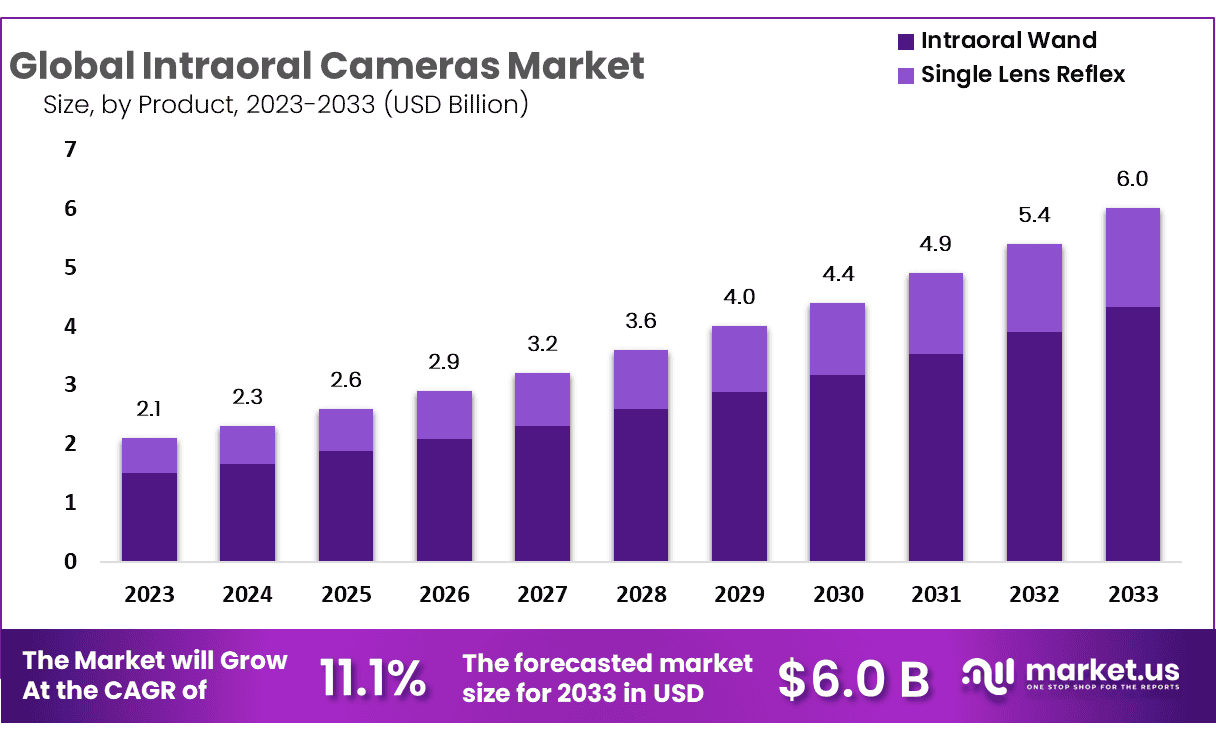
The Global Intraoral Cameras Market size is expected to be worth around USD 6.0 Billion by 2033 from USD 2.1 Billion in 2023, growing at a CAGR of 11.1% during the forecast period from 2023 to 2033.
The market for intraoral cameras is growing due to the increasing demand for dental services, better awareness, and the increased number of dental procedures being undertaken. Positive government initiatives are another factor driving the adoption of dental treatments.
As dental disorders such as tooth decay and dental caries continue to increase, patients are expected to visit dental clinics and hospitals more often for care, prompting demand for consumables such as prostheses, implants and various dental supplies – driving growth of the Intraoral Cameras Market throughout its forecast period. The Global Intraoral Cameras Market report provides an in-depth evaluation of this market with regards to essential segments, current trends, influencing drivers & restraints as well as competitive landscape considerations that have an effect on its growth potential.
The traditional intraoral camera took-up space and was difficult to use. The device was also expensive at about USD 40,000 per system. Technological advancements have made it possible to create small, lightweight devices that are both easy to use and affordable (as low as USD 5,000). This industry is expected to expand due to the advent of these technologically advanced devices.
This market report gives a detailed analysis of the Intraoral Cameras Market growth, size, share, key trends, market trends, growth opportunities, major factors, and other key factors.
*Actual Numbers Might Vary In The Final Report
Key Takeaways
- Market Size & Growth: Intraoral Cameras Market size is expected to be worth around USD 6.0 Billion by 2032 from USD 2.1 Billion in 2022, growing at a CAGR of 11.1%.
- Product Analysis: Based on Product the Intraoral Wand segment dominated this market, accounting for over 72.1% of global revenues in 2023.
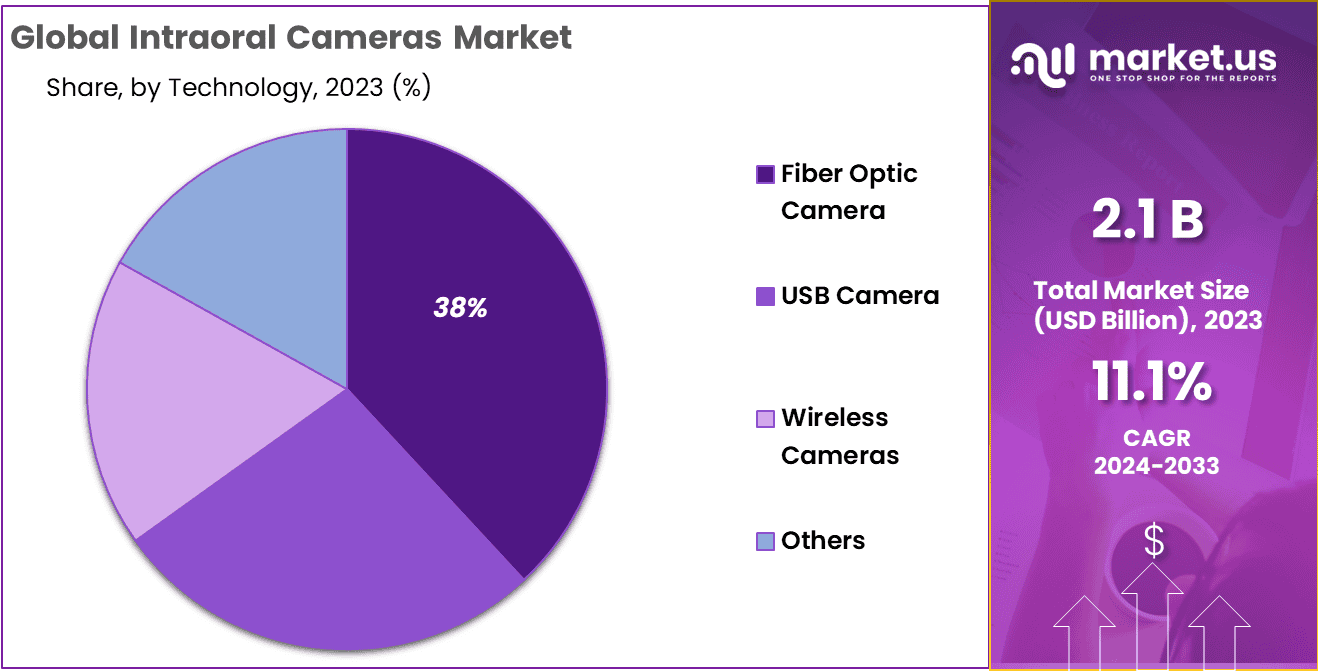
- Technology Analysis: In terms of Technology this market’s largest segment, the fiber optic camera, accounted for over 38.1% of global revenues in 2023.
- End-Use Analysis: Dental Clinics segment dominated the intraoral camera market and accounted for the highest revenue share of 80.2% in 2023.
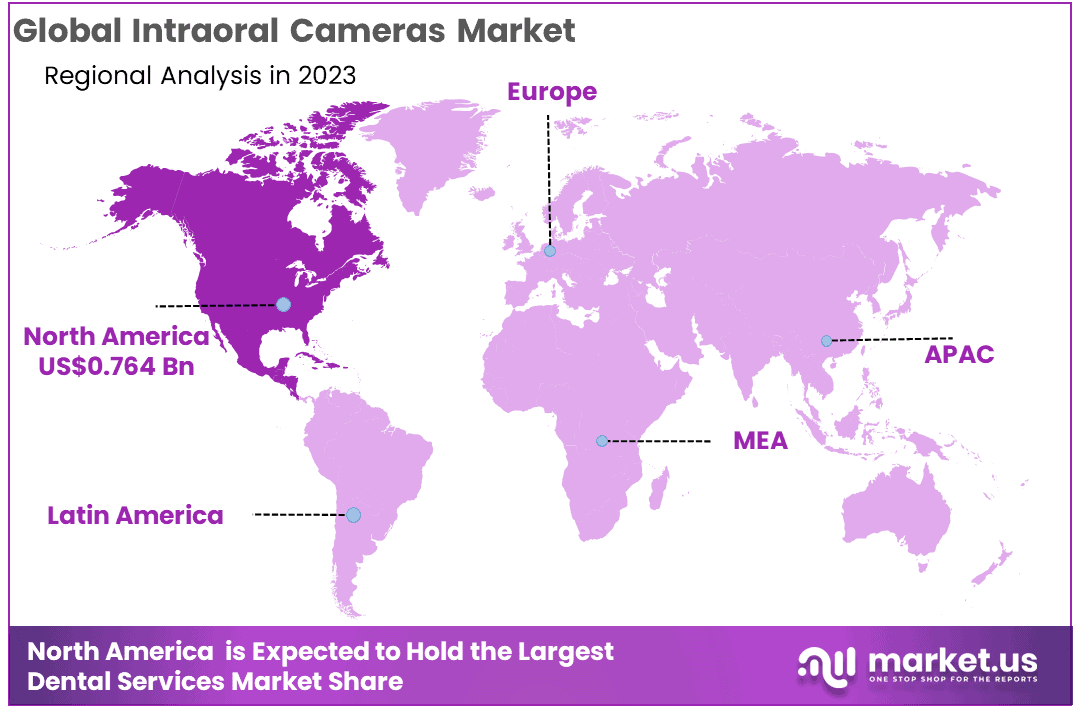
- Regional Analysis: North America was the dominant market, accounting for over 36.3% of global revenues in 2023 and holding a USD 0.764 Billion value.
Product Type Analysis
Based on Product the Intraoral Wand segment dominated this market, accounting for over 72.1% of global revenues in 2023. Because it is used within the oral cavity, the intraoral wand can provide excellent visuals and clarity. This makes it very effective in reaching the posterior parts of a mouth.
High-intensity lighting sources make the camera capable of high-level magnification. The intraoral wand segment was the most lucrative, accounting for the highest revenue share. Over the forecast period, the ‘Single-Lens Reflex’ segment is slated to grow in value.
A single-lens reflex has a lower cost, making it a more affordable device option. Because of their high-quality images, these cameras can be used for various purposes. To expand their digital camerawork, many dental photographers utilize digital single-lens reflexes.
Technology Analysis
This industry can be divided into three types based on technology: wireless cameras, fiber-optic cameras, and others. In terms of Technology this market’s largest segment, the fiber optic camera, accounted for over 38.1% of global revenues in 2023. This segment is expected to be the most dominant over the forecast period. Its high-end optical system ensures the best image quality.
Because of its unique features, like being a lightweight, portable light source with connectivity, the ‘USB Camera’ segment is expected to be the fastest growing segment in the future. A USB camera has its limitations. It is only compatible with select software programs. And the quality of these images may not be adequate for endodontic procedures.
End-Use Analysis
This market can be divided into three segments: hospitals, dental clinics, and others. Concerning End-Use the ‘Dental Clinics’ segment dominated the intraoral camera market and accounted for the highest revenue share of 80.2% in 2023.
This segment is expected to be the fastest-growing segment in the future due to the availability of specialists. This segment will be driven by a growing patient preference for treatment and diagnosis at dental clinics, as well as an increase in the number of dental clinics thanks to the increase in specialists.
Dental clinic specialists use high-quality instruments and devices, increasing the demand for intraoral cameras. Dental clinics are becoming more important due to better resources than hospitals. Dentists can use an intraoral camera to enhance oral health and identify dental problems like periodontal disease, tooth decay, and tooth damage like chipped or damaged teeth.
*Actual Numbers Might Vary In The Final Report
Kеу Маrkеt Ѕеgmеntѕ
Product
- Intraoral Wand
- Single Lens Reflex
Technology
- USB Camera
- Fiber Optic Camera
- Wireless Cameras
- Others
End-use
- Hospitals
- Dental Clinics
- Others
Drivers
Increased Incidence of Dental DisordersAs dental disorders such as tooth decay and dental caries become more widespread, demand for advanced diagnostic tools such as intraoral cameras to enable accurate examinations of oral health increases exponentially.
Increased Emphasis on Preventive DentistryThe increasing emphasis on preventive dentistry is fueling intraoral camera adoption among dental practitioners and their patients alike. Both parties recognize the significance of early detection and preventive measures when it comes to dealing with dental issues; intraoral cameras provide real-time visualization for prompt identification and intervention – aligning perfectly with preventive dentistry approaches.
Trend
Integration of Artificial Intelligence (AI) in ImagingOne trend in the Intraoral Cameras Market that stands out is its implementation of Artificial Intelligence (AI). AI algorithms enhance image analysis capabilities and aid in the identification of subtle dental issues. Not only does this advance diagnostic accuracy, but it also contributes to creating intelligent intraoral camera systems.
Wireless and Portable Intraoral Cameras
Market trends indicate an increasing popularity of wireless and portable intraoral cameras. Removing cumbersome wires increases convenience and maneuverability during dental examinations; portability caters to modern dental practices by emphasizing efficiency and patient comfort.
Restraint
High Initial Costs and Limited Affordability
One major roadblock to market growth for intraoral cameras is their high initial costs. Acquiring and installing these advanced imaging devices may pose financial barriers to some dental practices, limiting widespread adoption. Therefore, affordability concerns must be addressed to ensure wider access to such advanced diagnostic tools.
Limited Standardization and Interoperability
Intraoral Camera Market Participants face difficulty due to lack of standardized protocols and interoperability issues, making integration with existing dental imaging systems and EHRs challenging due to compatibility issues. Standardization efforts are imperative to ensure successful integration of intraoral cameras into various dental workflows.
Opportunity
Rapid Adoption of Teledentistry
An opportunity for the Intraoral Cameras Market lies in the rapid adoption of Teledentistry. Intraoral cameras play an integral part in remote dental consultations, enabling practitioners to visually assess patients’ oral health remotely. Telehealth services open doors for intraoral cameras that contribute to expanding Teledentistry services.
Technological Advancement and Innovation
Technology advances are providing an opportunity for the Intraoral Cameras Market. New developments in imaging quality, design and features have resulted in more user-friendly intraoral cameras being produced – giving manufacturers an advantage in terms of cutting edge tech to gain a competitive edge within the market.
Regional Analysis
North America was the dominant market, accounting for over 36.3% of global revenues in 2023 and holding a USD 0.764 Billion value. Market growth is attributed to the high prevalence of dental diseases like periodontics, gingivitis, caries, and gingivitis. This industry will also benefit from the increase in technologically advanced healthcare infrastructure and the number of dental clinics located in North America.
The market for intraoral cameras in the Asia Pacific is expected to expand rapidly over the forecast period, owing to the growing medical sector in emerging economies here. Industry growth is expected to be driven by a surge in dental care and the increasing demand for medical tourism.
*Actual Numbers Might Vary In The Final Report
Key Regions
North America
- The US
- Canada
- Mexico
Western Europe
- Germany
- France
- The UK
- Spain
- Italy
- Portugal
- Ireland
- Austria
- Switzerland
- Benelux
- Nordic
- Rest of Western Europe
Eastern Europe
- Russia
- Poland
- The Czech Republic
- Greece
- Rest of Eastern Europe
APAC
- China
- Japan
- South Korea
- India
- Australia & New Zealand
- Indonesia
- Malaysia
- Philippines
- Singapore
- Thailand
- Vietnam
- Rest of APAC
Latin America
- Brazil
- Colombia
- Chile
- Argentina
- Costa Rica
- Rest of Latin America
Middle East & Africa
- Algeria
- Egypt
- Israel
- Kuwait
- Nigeria
- Saudi Arabia
- South Africa
- Turkey
- United Arab Emirates
- Rest of MEA
Key Players Analysis
Industry leaders are pursuing strategic initiatives, including creating new products that can be customized to meet the needs of consumers, partnerships, collaborations, mergers & acquisitions to increase their product range and strengthen their market position in this field.
Key players will compete fiercely in the next few years as they focus more on geographic expansion, strategic collaborations and partnerships, and novel product launches. Key companies included in this market report are Danaher Corporation, Sirona Dental System, Carestream Health, Gendex, and others companies.
Кеу Маrkеt Рlауеrѕ
- Danaher Corporation
- Sirona Dental System
- Carestream Health
- Gendex
- Owandy Radiology
- TPC Advanced Technology Inc.
- Digital Doc LLC
- DEXIX
- Prodent
Recent Developments
- Rising Demand for Cosmetic Dentistry: With more and more people turning to cosmetic dentistry for procedures like teeth whitening, veneers, and orthodontics, demand is rising for intraoral cameras – devices which enable dentists to better visualize patients’ oral cavities so they can plan and perform cosmetic treatments more precisely.
- Digital dentistry adoption: As people continue their move toward digital dentistry, intraoral cameras have seen increasing adoption rates. These devices capture high-resolution images of patient teeth and gums digitally that can then be stored electronically or shared electronically between healthcare providers – providing improved patient care as well as improving communication.
- Technological Advancements: Intraoral cameras continue to evolve into increasingly user-friendly products thanks to advances in sensor technology, image processing algorithms and artificial intelligence resulting in intraoral cameras with higher resolution images, better lighting effects and expanded diagnostic abilities.
- Rising Incidence of Oral Health Issues: With more and more people experiencing oral health problems like caries, periodontal disease and oral cancer being diagnosed each year, early diagnosis has never been more critical to timely intervention and treatment plans. Intraoral cameras play a vital role in early identifying such conditions early and provide timely interventions and treatments plans.









