


Report Overview
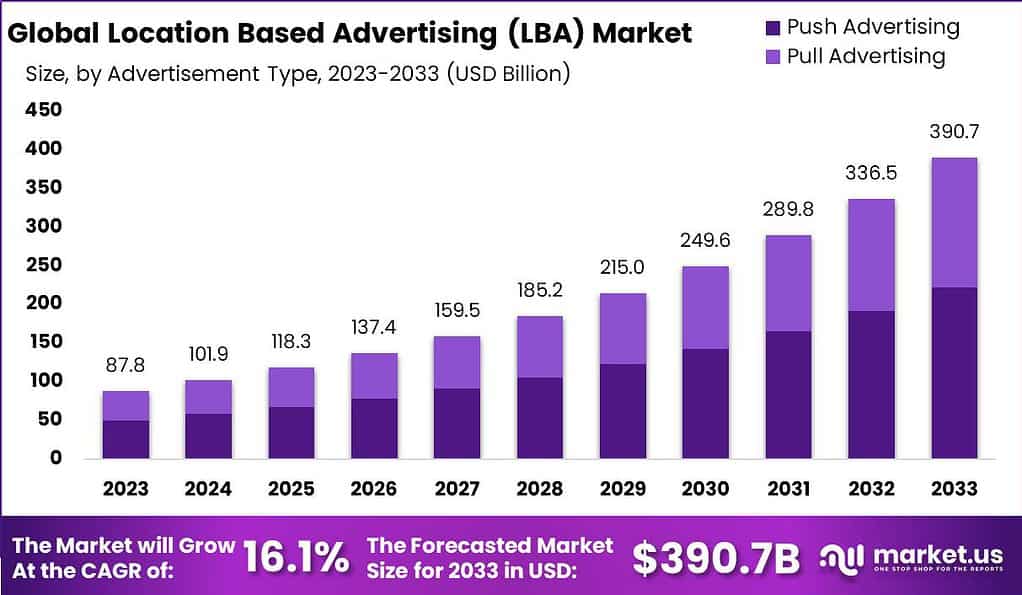
In 2024, the gross revenue of the global Location Based Advertising (LBA) Market is estimated to reach USD 101.9 Billion. A comprehensive analysis suggests that investments in the Location Based Advertising (LBA) sector could experience an annual growth rate of 16.1% from 2024 to 2033. The analysis further delves into the key determinants driving market growth, projecting a market valuation of USD 390.7 Billion by 2033.
Location-Based advertising (LBA) is a strategy for marketing that targets customers with personalised ads based on their geographical place of residence. It makes use of the location information of mobile devices, like tablets and smartphones in order to present relevant and timely ads for users who reside in certain areas.
LBA makes use of technology and services that are based on location like GPS (Global Positioning System) as well as Wi-Fi and beacons, to identify the exact position of a user. This allows advertisers to send targeted ads to people who are in some distance from the location of a physical store, event or geographical region.
Note: Actual Numbers Might Vary In Final Report
The main goal for LBA is to interact with prospective customers who are near to a business, or have a good chance of having an interest in specific product or service because of the geographical location. For instance, a retail shop could use LBA to provide a promotion discount coupon or special offer for customers who live nearby to encourage shoppers to stop by and buy something.
A Location-Based Advertisement (LBA) market is the business and the ecosystem that supports and facilitates the use of location-based advertising. The market is comprised of various stakeholders, including advertisers, advertising agencies and location data providers. mobile app developers, as well as technology platforms.
The LBA market has experienced significant growth in recent times because of the wide-spread use of smartphones as well as the growing availability of services that use location. Advertisers are now increasingly aware of that they can use LBA to interact with customers in an individualized and targeted way. This has led to the market has seen the evolution of advanced technology and platforms that allow precise and precise targeting, real-time ad delivery, as well as performance measurement.
Key Takeaways
- Market Growth Projection: The Location-Based Advertising (LBA) market is poised for significant growth, with a projected gross revenue of USD 101.9 billion in 2024 and a steady CAGR of 16.1% from 2024 to 2033. The market is expected to reach USD 390.7 billion by 2033, highlighting its substantial potential.
- Objective of LBA: The primary goal of LBA is to engage potential customers near a business location or those likely to be interested in specific products or services due to their geographical proximity. For example, retailers can use LBA to offer discounts to nearby shoppers.
- Advertisement Types: In 2023, the LBA market exhibited two primary advertisement types: Push Advertising and Pull Advertising. Push Advertising, with over 57% market share, delivers targeted ads to users based on their location without explicit requests. Pull Advertising involves users actively seeking location-specific information.
- Promotion Types: LBA is segmented into various promotion types, with Search Result Promotion leading the way, holding a substantial share exceeding 24%. Search Result Promotion delivers targeted promotions within search results, aligning with user intent.
- Application Segmentation: The Public Spaces segment emerged as a frontrunner in 2023, commanding over 35% of the market share. Public spaces provide a dynamic environment for advertisers to engage with diverse audiences.
- Industry Verticals: The Retail & E-commerce segment dominated the LBA market in 2023, securing a significant share exceeding 31%. This underscores the impact of location-based advertising on consumer behavior within the retail sector.
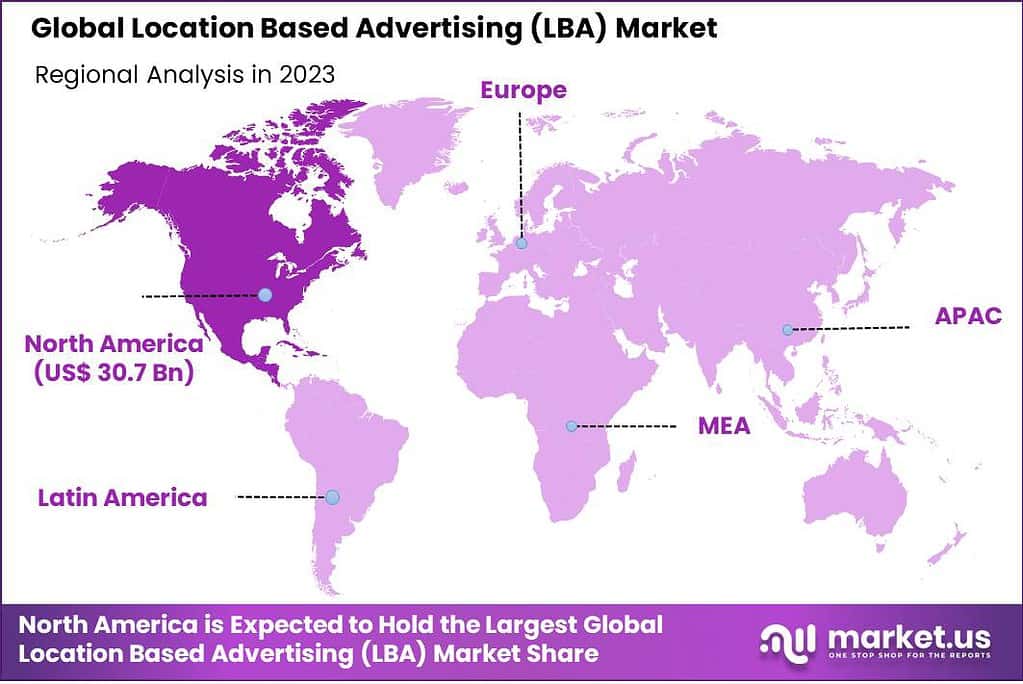
- Regional Analysis: North America led the LBA market in 2023, capturing over 35% of the market share. The region’s advanced technological infrastructure and widespread smartphone usage contributed to its dominance.
- Key Market Players: Key players in the LBA market include Cidewalk Technologies Inc., Facebook (Meta Platforms Inc.), Google LLC, Foursquare, and IBM Corporation, among others. GroundTruth was recognized with the “Best Geolocation Platform” award in 2023.
- Driving Factors and Challenges: Factors driving LBA growth include rising consumer demand for personalized experiences, continuous technological evolution, and a business focus on immediate engagement. Privacy concerns and ad-blocking software pose challenges to adoption.
- Growth Opportunities: LBA presents growth opportunities through integration with augmented reality (AR), expansion in emerging markets, partnerships with mobile apps and platforms, and innovative campaign formats.
- Key Market Trends: Dynamic geotargeting, contextualized messaging, AI-powered personalization, and offline attribution analytics are key trends shaping the LBA landscape.
Advertisement Type
In 2023, the Location-Based Advertising (LBA) market exhibited a clear segmentation based on advertisement type, primarily categorized into Push Advertising and Pull Advertising. The dynamics within these segments offer valuable insights into prevailing market trends and advertiser preferences.
Initiating with the Push Advertising segment, it emerged as the dominant force in the market, securing a substantial share exceeding 57%. Push Advertising, characterized by targeted ads delivered to users based on their geographic location without explicit requests, demonstrated its effectiveness in engaging users within proximity to specific businesses or events. This form of location-based advertising is often employed through notifications, messages, or alerts to mobile devices, providing advertisers with a direct and proactive means to reach potential customers.
On the other hand, the Pull Advertising segment, though not holding the dominant market share, showcased its significance in the LBA landscape. Pull Advertising involves users actively seeking information or offers based on their location, typically through mobile apps or platforms that provide location-specific content. While Pull Advertising held a comparatively smaller market share, its personalized and user-initiated nature contributed to its relevance in catering to consumers actively seeking localized information.
The preference for Push Advertising in 2023 can be attributed to its real-time engagement capabilities, allowing businesses to seize immediate opportunities by reaching users in close proximity. The ability to send timely promotions, discounts, or relevant information directly to users’ devices when they are physically near a store or event has proven effective in influencing consumer behavior.
Moreover, the dominance of Push Advertising aligns with the increasing reliance on mobile devices and the growing popularity of location-based services. Businesses leverage Push Advertising to create a sense of urgency, driving foot traffic to physical locations and fostering immediate interactions with potential customers.
Looking ahead, the LBA market is expected to witness a continued growth trajectory, with both Push and Pull Advertising segments playing crucial roles in meeting diverse advertising objectives. The forecasted evolution of consumer behavior, technological advancements, and the continuous refinement of location-based targeting strategies are anticipated to shape the dynamics between these segments.
Promotion Type
In 2023, the Location-Based Advertising (LBA) market experienced a distinctive segmentation based on promotion type, encompassing Banner Display/Pop-ups Promotion, Video Promotion, Search Result Promotion, E-mail and Message, Social Media Content Promotion, and Voice Calling Promotion. Notably, the Search Result Promotion segment emerged as the market leader, holding a dominant position with a substantial share exceeding 24%.
This particular form of location-based advertising demonstrated its efficacy in engaging consumers actively seeking information by delivering targeted promotions within search results. Leveraging location data to refine search result promotions, advertisers were able to offer relevant and timely content to users based on their geographic proximity, driving higher user engagement and conversion rates.
While Search Result Promotion took the lead, other promotion types also played pivotal roles in the diverse LBA landscape. Banner Display/Pop-ups Promotion, recognized for its immediate visibility on mobile devices, showcased its impact in capturing user attention, especially in high-traffic locations. Video Promotion leveraged the visual appeal to convey compelling messages, and Social Media Content Promotion utilized popular platforms to enhance brand visibility. E-mail and Message promotions provided a more direct and personalized communication channel, while Voice Calling Promotion aimed at immediate interaction.
The dominance of Search Result Promotion in 2023 can be attributed to its alignment with user intent, delivering advertisements precisely when individuals are actively seeking information. As users increasingly rely on search engines for local queries, businesses strategically harnessed this trend to enhance their visibility and connect with potential customers in real-time.
Looking forward, the evolution of Location-Based Advertising will be shaped by the dynamic interplay of these promotion types, each catering to unique consumer preferences and scenarios. As technology continues to advance and user behaviors evolve, the LBA market is poised for further diversification, with promotion types playing a pivotal role in creating impactful and personalized advertising experiences.
Application Outlooks
In 2023, the Location-Based Advertising (LBA) market witnessed a strategic segmentation based on applications, including Retail Outlets, Public Spaces, Airports, and Other Applications. Notably, the Public Spaces segment emerged as a frontrunner, commanding a dominant market position with an impressive share exceeding 35%.
This underscores the significance of location-based advertising in public areas, where businesses leverage the physical proximity of consumers to deliver targeted and impactful promotional content. Public spaces, such as parks, malls, and recreational areas, provide a dynamic environment for advertisers to engage with a diverse audience, offering opportunities for timely promotions and fostering immediate interactions.
While the Public Spaces segment took center stage, other application segments played pivotal roles in shaping the landscape of LBA. Retail Outlets, a key focus for location-based advertising, demonstrated its efficacy in influencing consumer behavior by delivering tailored promotions to individuals in close proximity to physical stores. Airports, characterized by high foot traffic and diverse demographics, presented a strategic avenue for advertisers to reach a broad audience with targeted campaigns. The category of Other Applications encompassed a range of diverse settings, showcasing the adaptability of LBA across various contexts.
The dominance of the Public Spaces segment in 2023 can be attributed to the dynamic nature of public environments, offering advertisers opportunities to capture the attention of consumers engaged in various activities. As individuals spend time in public spaces, the potential for immediate interaction and conversion is heightened, making it a preferred setting for location-based advertising campaigns.
Industry Vertical
In 2023, the Location-Based Advertising (LBA) market demonstrated a distinctive segmentation based on industry verticals, encompassing Retail & E-commerce, Hospitality, Healthcare, Entertainment & Media, Automotive & Transportation, and Other Industry Verticals. Notably, the Retail & E-commerce segment emerged as a market leader, securing a dominant position with an impressive share exceeding 31%.
This highlights the significant impact of location-based advertising within the retail and e-commerce landscape, where businesses capitalized on the physical proximity of consumers to enhance engagement and drive targeted promotions. Retail outlets and online commerce platforms utilized location-based strategies to deliver personalized offers, promotions, and product information to individuals based on their geographic location, thereby influencing purchasing decisions.
While Retail & E-commerce held a substantial market share, other industry verticals also played pivotal roles in the diverse LBA landscape. The Hospitality sector leveraged location-based advertising to enhance guest experiences and promote services within proximity, while Healthcare explored opportunities for targeted communications in medical facilities. Entertainment & Media engaged audiences with location-specific content, and the Automotive & Transportation industry utilized LBA to reach consumers during their journeys. The category of Other Industry Verticals encompassed a range of sectors, showcasing the versatility of location-based advertising applications.
The dominance of the Retail & E-commerce segment in 2023 is reflective of the industry’s recognition of the profound impact of location-based strategies on consumer behavior. The ability to deliver relevant and timely promotions to individuals in close proximity to retail outlets or online shopping locations significantly contributed to the segment’s market position.
As the LBA market continues to evolve, industry-specific strategies are expected to further shape the landscape, catering to the unique needs and dynamics of each sector. The numerical data associated with these segments provides valuable insights into the market’s composition, guiding businesses in tailoring effective location-based advertising campaigns to specific industry verticals and optimizing their outreach efforts.
Driving Factors
- Rising Consumer Demand for Personalized Experiences: The increasing desire for personalized interactions among consumers is a notable trend, and location-based advertising serves as a platform for businesses to deliver custom-tailored and pertinent content based on individual preferences and geographic location.
- Continuous Evolution in Location Technologies: The ongoing progress in technologies like GPS, Wi-Fi, and beacons contributes to the refinement of location-based advertising. These advancements enhance the precision and effectiveness of campaigns, providing advertisers with more potent tools to create targeted and impactful promotional initiatives.
- Business Focus on Immediate Engagement: Location-based advertising’s capability to connect with consumers in real-time, delivering messages that are timely and contextually relevant, aligns seamlessly with the growing emphasis on immediate interactions. This emphasis is instrumental in driving conversions and fostering brand loyalty, reflecting the evolving landscape of consumer engagement strategies.
Restraining Factors
- Privacy Concerns: Heightened concerns about privacy and data security pose challenges to the widespread adoption of location-based advertising, as users become more cautious about sharing their location information.
- Limited Infrastructure in Some Regions: Uneven development of location-based infrastructure, especially in less urbanized or remote areas, can restrict the effectiveness of location-based advertising campaigns in certain regions.
- Battery Life Concerns: Continuous location tracking can impact the battery life of mobile devices, leading to user reluctance and potential disengagement from location-based advertising efforts.
- Data Accuracy Challenges: Inaccuracies in location data can arise from various sources, including signal interferences or outdated information, affecting the precision of targeted advertisements.
Growth Opportunities
- Integration with Augmented Reality (AR): The integration of location-based advertising with augmented reality presents a unique opportunity to enhance user experiences by overlaying digital content onto the physical world.
- Expansion in Emerging Markets: The untapped potential in emerging markets provides significant growth opportunities for location-based advertising, as businesses explore new avenues to connect with diverse consumer bases.
- Partnerships with Mobile Apps and Platforms: Collaborations between advertisers and popular mobile apps or platforms offer opportunities to leverage existing user bases for more extensive and targeted reach.
- Innovative Campaign Formats: Exploring innovative campaign formats, such as gamification or interactive experiences tied to specific locations, can capture user attention and drive engagement.
Challenges
- Ad-Blocking Software: The prevalence of ad-blocking software poses a challenge to location-based advertising efforts, as users seek to avoid intrusive or irrelevant ads.
- Saturation and Overwhelm: Overwhelming users with excessive location-based advertisements can lead to saturation and disengagement, necessitating a balance in frequency and relevance.
- Regulatory Compliance: Adhering to evolving privacy regulations and ensuring compliance with data protection laws pose ongoing challenges for businesses engaged in location-based advertising.
- Competition for User Attention: The competitive landscape for user attention in the digital space presents a challenge, requiring advertisers to create compelling and differentiated location-based campaigns.
Key Market Trends
- Dynamic Geotargeting: The trend of dynamic geotargeting, adjusting advertisements based on changing user locations and behaviors, enhances the relevance and effectiveness of location-based campaigns.
- Contextualized Messaging: Advertisers are increasingly adopting contextualized messaging, tailoring content to specific locations and situations to create more meaningful connections with users.
- AI-Powered Personalization: The integration of artificial intelligence (AI) for personalized targeting and content recommendations enhances the effectiveness of location-based advertising by analyzing user behavior and preferences.
- Offline Attribution Analytics: The focus on offline attribution analytics, measuring the impact of location-based advertising on in-store visits and purchases, highlights the importance of tangible outcomes and return on investment.
Key Market Segments
Advertisement Type
- Push Advertising
- Pull Advertising
Promotion Type
- Banner Display/Pop-ups Promotion
- Video Promotion
- Search Result Promotion
- E-mail and Message
- Social Media Content Promotion
- Voice Calling Promotion
Application
- Retail Outlets
- Public Spaces
- Airports
- Other Applications
Industry Vertical
- Retail & E-commerce
- Hospitality
- Healthcare
- Entertainment & Media
- Automotive & Transportation
- Other Industry Verticals
Regional Analysis
In 2023, North America emerged as the frontrunner in the Location-Based Advertising (LBA) market, securing a dominant market position by capturing over 35% of the share. The region’s supremacy is attributed to its advanced technological infrastructure, widespread smartphone usage, and a mature digital advertising ecosystem. The demand for Location Based Advertising in North America reached USD 30.7 billion in 2023, and there are optimistic projections for significant growth in the foreseeable future.
The adoption of location-based advertising strategies by businesses in North America was particularly robust, leveraging the sophistication of location technologies to deliver highly targeted and personalized campaigns.
Europe closely followed, displaying a substantial market presence driven by increased consumer acceptance of location-based services. The Asia-Pacific (APAC) region exhibited remarkable growth potential, fueled by expanding smartphone penetration, urbanization, and a burgeoning e-commerce landscape. Latin America experienced a surge in location-based advertising adoption, driven by the region’s growing digital connectivity.
The Middle East and Africa, while presenting emerging opportunities, showcased a gradual uptake due to varying levels of technological infrastructure. As businesses continue to recognize the value of location-based advertising, these regional dynamics are anticipated to evolve, with North America and Europe maintaining influential positions, while APAC steadily asserts its significance in the global LBA landscape.
Note: Actual Numbers Might Vary In The Final Report
Key Regions and Countries Covered in this Report:
- North America
- The US
- Canada
- Europe
- Germany
- France
- The UK
- Spain
- Italy
- Russia
- Netherland
- Rest of Europe
- APAC
- China
- Japan
- South Korea
- India
- Australia
- New Zealand
- Singapore
- Thailand
- Vietnam
- Rest of APAC
- Latin America
- Brazil
- Mexico
- Rest of Latin America
- Middle East and Africa
- South Africa
- Saudi Arabia
- UAE
- Rest of MEA
Key Players Analysis
The examination of key players in the Location-Based Advertising (LBA) Market involves a thorough analysis of prominent companies within the LBA sector. This assessment encompasses the evaluation of strategies, offerings, market presence, and contributions made by these key players in the realm of location-based advertising. The analysis yields valuable insights into the competitive landscape, market dynamics, and future outlook of the LBA industry.
Top Key Players
- Cidewalk Technologies Inc.
- Facebook (Meta Platforms Inc.)
- Enradius
- Google LLC
- Foursquare
- GroundTruth
- IBM Corporation
- Near Intelligence Inc.
- Yelp Inc.
- Emodo (Placecast)
- PlaceIQ
- Telenity
- Cuebiq Group LLC
- Other Key Players
Recent Development
- In the sixth annual MarTech Breakthrough Awards program held in August 2023, GroundTruth secured the prestigious “Best Geolocation Platform” award, recognizing its excellence in the field.
- In January 2023, Apple implemented stringent privacy policies, introducing tighter controls on how developers collect and utilize user location data. This policy adjustment has significant implications for the Location-Based Advertising (LBA) industry, necessitating explicit consent from users before their location can be tracked.
- February 2023 witnessed the launch of Google’s innovative “Nearby” feature, allowing users to explore nearby businesses and discover offers tailored to their location. This new addition significantly amplifies the efficacy of Location-Based Advertising (LBA) campaigns.
- In April 2023, Foursquare entered into a strategic partnership with Walmart, aiming to provide robust LBA solutions for in-store marketing campaigns. This collaboration facilitates targeted promotions and personalized experiences for shoppers, showcasing the continued evolution and integration of LBA strategies in diverse industry sectors.









