


Report Overview
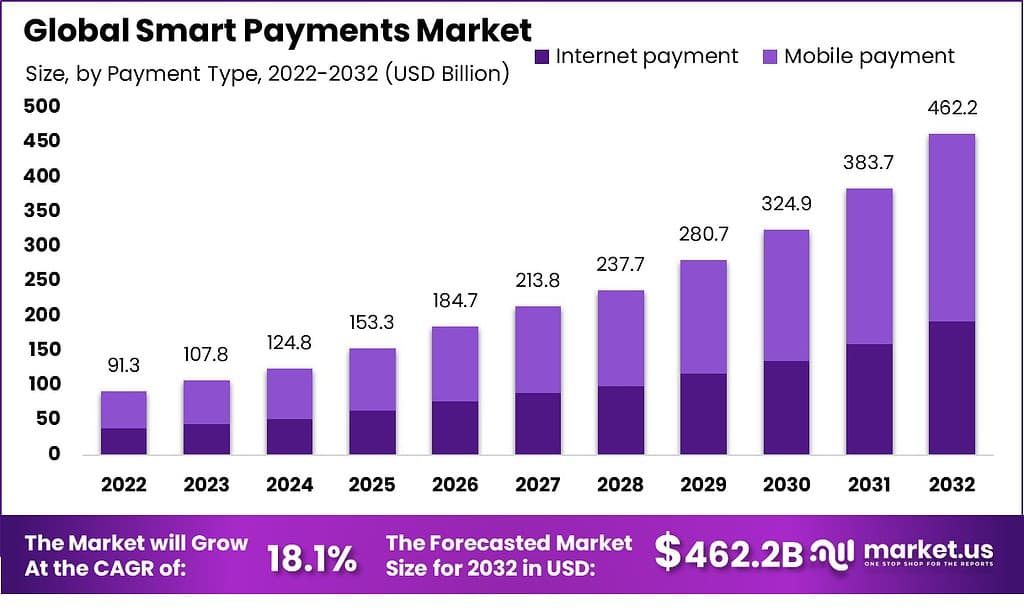
The Global Smart Payments Market Sales are estimated to Surpass USD 462.2 Billion by 2032 from USD 107.8 Billion in 2022, Projected to Achieve 18.1% CAGR during the forecast period 2023 to 2032.
Smart payments are transactions automatically finished utilizing modern technologies such as artificial intelligence and machine learning algorithms. It allows customers to complete payments via smart platforms rather than traditional methods. The demand for smart payments is fueled by convenience, security, technological advancements, changing consumer behavior, and evolving business practices. As these factors evolve, adopting smart payment methods will likely grow further, reshaping how financial transactions are conducted globally.
Note: Actual Numbers Might Vary In The Final Report
Key Takeaways
- Market Growth Projection: The global smart payments market is projected to reach USD 462.2 billion by 2032, with an estimated CAGR of 18.1% between 2023 and 2032.
- Mobile Payments Lead: Mobile payments dominated the market in 2022, accounting for 58.5% of the total share, driven by increased smartphone adoption and improved network infrastructure.
- Retail Sector’s Influence: The retail sector claimed a significant market share of 33.0% in 2022, fueled by the surge in online transactions and the adoption of digital payment solutions.
- Driving Factors: The market’s growth is propelled by the increasing demand for smartphones and internet access, the rise of e-commerce, and government initiatives promoting digital transactions.
- Challenges Faced: Technical issues and security concerns pose challenges to market growth, with potential technical failures and security threats impacting customer confidence and transaction security.
- Opportunities Ahead: Opportunities lie in the continuous adoption of new technologies, including IoT and blockchain, presenting avenues for innovation and diverse payment methods.
- Emerging Trends: The integration of blockchain technology and the rise of decentralized finance platforms are notable trends reshaping the smart payments landscape.
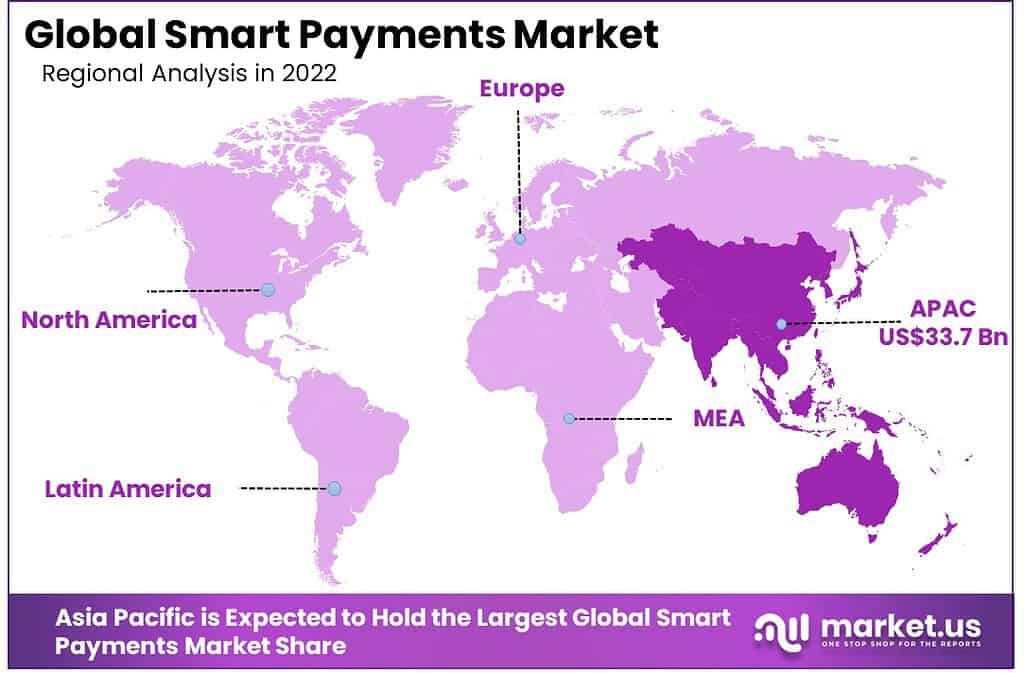
- Regional Dynamics: The Asia-Pacific region, particularly China and India, exhibited robust growth, accounting for the largest market share in 2022 (37.0%), driven by rapid economic growth and technological advancements.
Payment Type Analysis
Mobile Payment accounted for The Largest Market Share.
The Market is segmented based on payment types such as Internet and mobile. In 2022, Mobile payment accounted for the market share of 58.5% among other payment types. The global network infrastructure has significantly improved and smartphone adoption is rising. Various retailers can set up mobile-based payment solutions for their clients because of the accessibility of high-speed internet connectivity. The other reason is every person in the current scenario has a phone on which he can easily operate smart payment systems and maintain privacy.
End-use Industry Analysis
The retail sector leads due to many online transactions and bill payments.
Based on the end-use industry, the market is further divided into retail, transportation, hospital, media and entertainment, and other end-use industries. Among these, the retail sector accounted for the largest market share 33.0% in 2022. The reason for this is the rise of the mobile market which is helping people to make payments digitally. This bolstered digital transactions, and people are using smart payment systems for day-to-day purchases of products and bill payments. There are several advantages of digital payments, such as no need to carry cash, ease of use, special offers, free from theft, and many more that motivate customers to use smart payment systems daily.

Note: Actual Numbers Might Vary In The Final Report
Key Market Segments
By Payment Type
- Internet Payments
- Mobile Payments
By End-use Industry
- Retail
- Transportation
- Hospital
- Media and Entertainment
- Other End-use Industry
Driving Factors
Rising demand for smartphones, as well as an increase in internet users
One of the most significant factors growing the demand for smart payment is a rise in smartphone demand and an increase in internet users. In today’s world, everyone is aware of the mobile phone and it has become a part of every person’s life. The availability of the internet in every place of the world is propelling the usage of smart payments. Smart payment is convenient, has low transaction cost, no theft risk, less money handling, easy setup, and reaches a global audience. These factors are also motivating people to adopt smart payment. Adoption of contactless technology like NFC-enabled cards and mobile wallets.
Rise in E-commerce
The increase in online shopping and digital commerce has strongly boosted the need for smart payment methods. The swift expansion of e-commerce has transformed how consumers behave and what they anticipate, resulting in a greater dependence on secure and contemporary payment options. Smart payments, encompassing mobile wallets, digital payment platforms, and contactless solutions, are crucial in catering to the changing requirements of e-commerce transactions.
Government Initiatives
Government initiatives are crucial in shaping the demand for smart payment solutions. By fostering an environment of financial inclusion, security, and innovation, governments encourage individuals, businesses, and institutions to adopt modern payment methods that align with the digital age and contribute to the growth and development of their economies. Thus, key government initiatives will likely propel market growth during the projected time.
Restraining factors
Technical Problems May Hinder Growth
Just like other software, smart payment is also dependent on technology and those are subject to failure and downtime. While tech maintenance operations are scheduled in advance and typically occur at night, it can sometimes frustrate online buyers. Numerous businesses come across high bounce rates, especially when they arise unexpectedly. Such technical problems are likely to affect market growth negatively.
Security Concerns Are Restraining The Market Growth
By exploiting weaknesses in applications, cybercriminals can gain access to sensitive financial details like account credentials and passwords. Furthermore, hackers may focus on vulnerable applications to infiltrate payment transactions, manipulating them to their advantage. Various fraudulent techniques, such as account takeover, identity theft, and phishing, pose risks to smart payment systems. The repercussions of these fraudulent activities can lead to substantial monetary losses for individuals and enterprises. Such security threats may hamper market growth over the forecast period.
Opportunity
Increasing Adoption of New Technology
Smart payments will get more intelligent, efficient, and secure along with the development of new technologies like the Internet of Things (IoT) and blockchain.
For instance, devices powered by the Internet of Things enabled automatic payments in various settings, such as connected automobiles and smart homes. Blockchain technology can modify how we think about payments by making them even more effective because of its decentralized and transparent nature.
Partnering with fin-tech businesses to promote innovation
Fin-tech companies are partnering with enterprises to enhance revenue and manage cash flow by creating diverse payment methods and open Application Programming Interfaces (APIs) that connect businesses with consumers and each other. Through this collaboration, fin-tech firms provide additional payment choices and facilitate system integration, reducing expenses and increasing efficiency.
Market Trends
Utilization Of Blockchain Technology and Rising Decentralized Finance Platforms
The utilization of blockchain technology and cryptocurrencies is being investigated to improve the security and effectiveness of cross-border and person-to-person transactions. Stablecoins and central bank digital currencies (CBDCs) are progressively gaining recognition as possible substitutes for conventional fiat currencies. The rise of decentralized finance platforms challenges traditional financial systems by offering decentralized lending, borrowing, and trading options, often built on blockchain networks. Thus, the utilization of blockchain technology and cryptocurrencies and the rise of decentralized finance platforms are emerging trends likely to propel market growth during the estimated period.
Regional Analysis
Asia-Pacific Region Holds Significant Share of the Global Smart Payments Market
Asia-Pacific held the largest market share of 37.0 % in 2022. The Asia-Pacific region, particularly countries such as China and India, has been experiencing rapid economic growth, leading to increased technology. The region’s growth can be related to evolving lifestyles, the most recent developments in online retail, and the increasing use of smartphones. Government initiatives to go cashless in the nations of the Asia-Pacific region have contributed to the regional market expansion even more.
The increased use of mobile technology in developing nations has created new potential for banks and fin-tech companies to offer mobile banking services to underprivileged and non-bank consumers in remote regions. Governments in the Asia Pacific area have supported digital payments to expand financial inclusion, decrease cash use, and urge economic growth. The Unified Payments Interface (UPI) and the Bharat Interface for Money (BHIM) app are only two policies and programs the Indian government has implemented to improve the usability and accessibility of digital payments.
Note: Actual Numbers Might Vary In The Final Report
Key Regions and Countries Covered in this Report:
- North America
- The US
- Canada
- Europe
- Germany
- France
- The UK
- Spain
- Italy
- Russia
- Netherlands
- Rest of Europe
- APAC
- China
- Japan
- South Korea
- India
- Australia
- New Zealand
- Singapore
- Thailand
- Vietnam
- Rest of APAC
- Latin America
- Brazil
- Mexico
- Rest of Latin America
- Middle East & Africa
- South Africa
- Saudi Arabia
- UAE
- Rest of MEA
Key Players Analysis
The smart payments market showcases a diverse distribution of market share influenced by technological advancements, consumer adoption, and competitive strategies. Digital wallet providers like Apple Pay, Google Pay, and Samsung Pay hold significant shares due to mobile payment adoption. Established card networks like Visa and Mastercard integrate contactless and digital payment features. Fintech startups like PayPal and Square drive innovation, while global e-commerce platforms like Amazon and Alibaba secure shares in online transactions. Key players like Ant Group’s Alipay and Paytm dominate regional markets. The landscape continues to evolve, impacted by new entrants and shifting consumer preferences.
Market Key Players
The competitive landscape of the smart payments market is characterized by a dynamic interplay of established financial institutions, tech giants like Apple and Google, innovative fintech startups such as Square and Stripe, and traditional players like Visa and Mastercard integrating contactless and digital wallet features. Additionally, cryptocurrency and blockchain players, regional providers, e-commerce platforms like Amazon and Alibaba, and collaborative initiatives further shape the competitive dynamics. The landscape is in constant flux due to technological advancements, evolving consumer preferences, regulatory shifts, and strategic partnerships, emphasizing the need to consult recent industry reports for a comprehensive competitive analysis.
The following are some of the major players in the industry
- American Express Company
- Apple Inc.
- Google LLC
- MasterCard
- One Communication Limited
- PayPal Holdings Inc.
- Samsung
- Amazon.com, Inc.
- Square. Inc.
- Other Key Players
Recent Development
- June 2022: Verizon Business explored the possibility of partnering with First National Bank of Omaha (FNBO) and Mastercard to introduce a credit card designed to offer advantages to small business owners. The Verizon Business Mastercard is accessible to companies possessing an online account and having less than 100 connections. Using the card will involve accruing reward points for every transaction completed.
- December 2021: Xiaomi officially announced the introduction of Mi Smart Band 6, a new and advanced product developed in collaboration with MasterCard, offering the crucial ability to perform contactless payments at terminals that support MasterCard transactions.









