


Report Overview
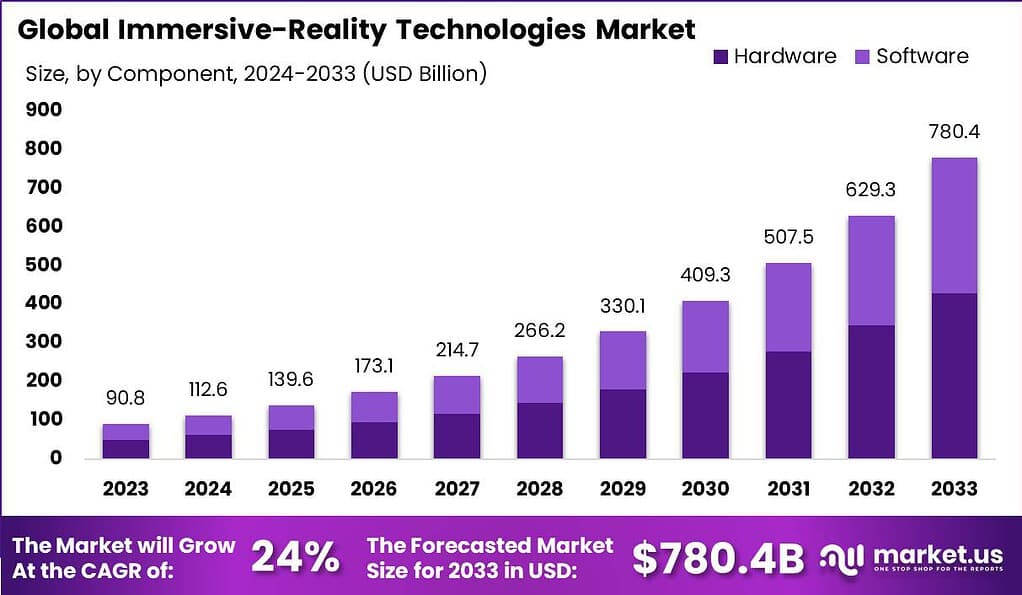
The Global Immersive-reality Technologies market size is poised to cross USD 90.8 Billion in 2023 and is likely to attain a valuation of USD 780.4 Billion by 2033, with a CAGR of 24% during the forecast period 2024-2033.
Immersive reality technologies include a range of technologies that generate highly interactive and immersive experiences that blend the digital and physical worlds. These technologies include virtual reality (VR), augmented reality (AR), and mixed reality (MR). VR creates entirely digital environments, AR superimposes digital content onto the real world, and MR integrates virtual objects with the real-world environment.
Immersive reality technologies market encompasses the design, production and adoption of these technologies along with their associated hardware and software. It is a rapidly expanding sector used in gaming, entertainment, education, training healthcare and various other sectors – offering opportunities for innovation, content production and immersive experiences.
Note: Actual Numbers Might Vary In Final Report
Key Takeaways
- Market Size and Growth: Immersive reality technologies market is likely to reach a valuation of USD 780.4 billion by 2033.
- Dominance of Hardware: In 2023, the Hardware segment held a commanding share of over 55% within the Immersive Reality Technologies market. Hardware components, including headsets, sensors, and processing units, play a pivotal role in shaping the immersive reality landscape.
- Software’s Vital Role: While Hardware dominates, the Software segment also contributed substantially. Dynamic and responsive software solutions are in demand for enhancing user experiences through immersive content, applications, and simulations.
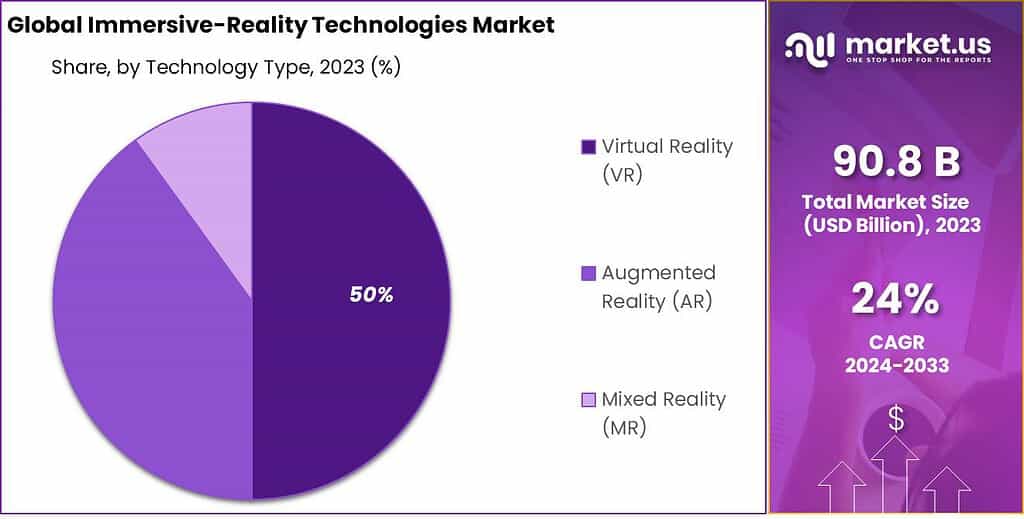
- VR Leading the Way: Among technology types, Virtual Reality (VR) took the lead with over 50% market share. Its wide-ranging applications in entertainment, gaming, education, healthcare, and training are driving its growth.
- Augmented Reality’s Rise: Augmented Reality (AR) demonstrated notable growth in 2023, finding applications in industries like retail, remote assistance, maintenance, and navigation systems.
- Mixed Reality’s Potential: Mixed Reality (MR) exhibited promising growth, especially in professional applications like manufacturing, design visualization, and remote collaboration.
- Key Applications: Entertainment & Gaming emerged as the dominant application segment, commanding over 30% of the market share in 2023. Healthcare is also a significant player, harnessing VR and AR for medical training and patient rehabilitation.
- Enterprise Adoption: The Enterprise segment captured a substantial share of more than 71% in 2023. Businesses are increasingly recognizing the value of immersive technologies in areas such as employee training, product design, remote collaboration, and data visualization.
- Global Regional Analysis: North America led the market in 2023, with the United States playing a pivotal role. Europe and Asia-Pacific exhibited significant growth potential, driven by progressive regulations, technology advancements, and investments.
- Key Players: Top key players in the Immersive-Reality Technologies Market include Facebook Technologies LLC (Meta Platforms Inc.), Sony Corporation, HTC Corporation, Microsoft Corporation, Google LLC, and Samsung Electronics Co. Ltd.
Component Analysis
In 2023, the Immersive Reality Technologies market exhibited a clear dominance within its segments, with the Hardware segment emerging as the frontrunner, securing a commanding share of over 55%. This remarkable foothold was a testament to the critical role that hardware components play in shaping the immersive reality landscape.
Hardware components, including headsets, sensors, and processing units, have consistently driven market growth by offering users a seamless and immersive experience. Their substantial market share underscores their significance in meeting the demands of an ever-expanding user base seeking more advanced and sophisticated immersive solutions.
On the other hand, the Software segment, while a vital part of the ecosystem, contributed with a substantial share as well, complementing the hardware’s functionality. In 2023, software offerings for immersive reality technologies saw a notable surge in demand, owing to their role in enhancing user experiences through immersive content, applications, and simulations. This segment, with its dynamic and responsive software solutions, enabled users to explore new dimensions of immersive reality, thus contributing significantly to the market’s overall growth.
Technology Type Analysis
In 2023, the Immersive Reality Technologies Market showcased a dynamic landscape, with several key technology segments driving the industry’s growth. Within these segments, Virtual Reality (VR) stood out as the leading factor, taking over 50% of market. This market share is believed to be explained by the broad use of VR technology across different industries.
Virtual Reality (VR) technology offers users an immersive and simulated environment, typically experienced through specialized headsets or goggles. In 2023, the VR segment held the top position, accounting for nearly 50% of the immersive technology market. This dominance is due to its wide-ranging usage in entertainment and gaming and its expanding applications in education, healthcare and training. The VR market’s expansion is driven by the need for real and interactive experiences, be it for gamers or medical professionals performing surgical procedures in virtual environments, or for educators offering an immersive environment for learning.
Augmented Reality (AR) is another significant segment within the immersive reality technologies market. AR overlays digital information onto the real world, enhancing the user’s perception of their surroundings. In 2023, the AR segment demonstrated notable growth, capturing a substantial market share.
This growth is primarily fueled by the increasing adoption of AR in industries like retail, where it is used to enhance customer experiences through interactive shopping applications. Additionally, AR is finding applications in remote assistance, maintenance, and navigation systems. As AR technology continues to evolve, its adoption across various industries is expected to expand further.
Mixed Reality (MR) represents an exciting convergence of both virtual and augmented realities, allowing digital objects to interact with the physical environment. In 2023, the MR segment exhibited promising growth, although it held a smaller market share compared to VR and AR.
MR technology is gaining traction in industries such as manufacturing, where it is used for design visualization, remote collaboration, and hands-free work instructions. The MR segment’s growth is driven by its potential to bridge the gap between the digital and physical worlds, offering enhanced experiences in various professional applications.
Note: Actual Numbers Might Vary In Final Report
Application Analysis
In 2023, the Entertainment & Gaming Segment of the Immersive Reality Technologies Market emerged as the frontrunner, commanding a dominant market share of over 30%. This segment’s supremacy is a testament to the profound impact of immersive reality technologies on the entertainment and gaming industries. Immersive Reality, which includes Virtual Reality (VR) and Augmented reality (AR) has transformed our way of consuming entertainment and play video games.
VR-enabled headsets as well as AR applications have introduced an the introduction of a new dimension to gaming, providing gamers with an immersive, interactive experience like they’ve never had before. Additionally, the entertainment sector has witnessed the integration of AR technology in live events, concerts, and theme parks, enhancing audience engagement and enjoyment.
Furthermore, in the healthcare sector, immersive reality technologies have shown remarkable promise. The Healthcare Segment has been a key player in harnessing the potential of VR and AR for medical training, patient rehabilitation, and even surgical procedures. These technologies enable medical professionals to practice and refine their skills in a safe and controlled virtual environment, ultimately leading to improved patient care and safety.
In the field of education and training, immersive reality technologies have opened doors to innovative and effective learning methods. The Education & Training Segment has seen substantial growth as educational institutions and corporate training programs incorporate VR and AR tools to make learning more engaging and practical. Students and trainees can explore historical sites, conduct virtual experiments, or undergo realistic simulations, enhancing their comprehension and retention of information.
Moreover, in the Manufacturing & Industrial Sector, immersive reality technologies have streamlined processes and improved efficiency. AR-based instructions and remote assistance have become valuable tools for technicians and engineers, reducing errors and downtime in industrial settings.
In the Retail & E-commerce Segment, AR applications have transformed the way consumers shop online and in physical stores. Virtual try-ons, interactive catalogs, and AR-guided shopping experiences have become integral in boosting customer engagement and driving sales.
The Automotive Segment has benefited from immersive reality technologies as well, with AR-enhanced heads-up displays (HUDs) providing drivers with crucial information in a non-intrusive manner. This innovation enhances road safety and the overall driving experience.
Aerospace & Defense is another sector leveraging immersive reality technologies for pilot training, maintenance, and simulation applications. This segment continues to invest in cutting-edge VR and AR solutions to enhance operational readiness. Lastly, various other applications across industries are exploring immersive reality technologies for diverse purposes, from architectural visualization to tourism and beyond.
End-User Outlook
In 2023, the Enterprise segment asserted its dominance in the Immersive-Reality Technologies market, capturing more than an impressive 71% share. This prominence can be attributed to the growing adoption of immersive-reality solutions in various industries for enterprise applications. Enterprises have increasingly recognized the value of immersive technologies in areas such as employee training, product design and visualization, remote collaboration, and data visualization.
The segment’s market share reflects the significant investments made by businesses to enhance productivity, improve decision-making, and streamline operations using immersive-reality technologies. As enterprises continue to integrate these technologies into their workflows to gain a competitive edge, the enterprise segment is expected to maintain its substantial position.
In contrast, the Consumer segment, while significant, held a comparatively smaller market share in 2023. This segment caters to individual consumers seeking immersive experiences primarily for entertainment, gaming, and personal use. While the popularity of technologies that allow for immersive experiences is increasing but it’s also faced with issues like affordability and availability of content. Many consumers are investing in devices such as virtual reality headsets, for entertainment and gaming purposes.
The market share of the consumer segment reflects the growing interest in immersive experiences but also underscores the need for addressing affordability and content-related barriers to further accelerate adoption. As the consumer segment continues to evolve and as immersive-reality technologies become more accessible, it is expected to expand its market presence.
Driving Factors
- User Experience Enhancement: Immersive reality technology, which includes the VR and AR. AR greatly enhance the experience of users in many applications like entertainment, gaming, as well as training.
- Industry-Specific Applications: Immersive reality technologies find applications in diverse industries, from healthcare to manufacturing. This versatility is driving adoption as businesses realize the potential for improved training, simulation, and real-time data visualization.
- Technological Advancements: Ongoing advancements in hardware, software, and connectivity are expanding the capabilities of immersive reality devices. The introduction of 5G networks, more powerful GPUs, and lighter, more comfortable headsets is fueling growth in the market.
- Cost Reduction: As technology matures and economies of scale come into play, the cost of immersive reality devices and solutions is decreasing. This affordability is making these technologies accessible to a broader consumer base and more businesses.
Restraining Factors
- High Initial Investment: Implementing immersive reality technologies often requires a significant initial investment in hardware and software. This can be a barrier for smaller businesses or organizations with limited budgets.
- Complexity and Learning Curve: Using immersive reality technologies may require training and adaptation, especially in industries like manufacturing and healthcare. Employees and users need to become familiar with these new tools, which can pose challenges.
- Content Creation Challenges: Generating high-quality and relevant content for immersive reality experiences can be time-consuming and expensive. This can limit the availability of compelling experiences, particularly in niche markets.
- Privacy and Security Concerns: Immersive reality technologies often collect user data for various purposes. Ensuring the privacy and security of this data is a growing concern, and regulatory compliance adds complexity to implementation.
Growth Opportunities
- Healthcare and Medical Training: The healthcare sector presents significant growth opportunities for immersive reality technologies. Medical training, surgical simulations, and patient rehabilitation applications are expected to expand rapidly.
- E-commerce Integration: Retail and e-commerce can benefit from immersive reality solutions, such as virtual try-ons and augmented reality shopping experiences. These technologies have the potential to reshape the online shopping landscape.
- Remote Work and Collaboration: The growth of remote work and collaboration via virtual technology is fueling use of VR and AR for remote training, meetings and even immersive workspace solutions. The trend is expected to continue to increase.
- Education and EdTech: Immersive reality technologies are poised to disrupt the education sector, offering innovative and engaging learning experiences. EdTech companies and educational institutions are exploring these opportunities.
Challenges
- Content Standardization: Ensuring compatibility and standardization of content across different immersive reality platforms and devices is a challenge. This fragmentation can hinder seamless experiences.
- Motion Sickness and Health Concerns: Some users may experience motion sickness or discomfort when using immersive reality devices for extended periods. Addressing these health concerns is crucial for broader adoption.
- Regulatory Hurdles: Regulations and compliance requirements related to data privacy, safety, and content approval can be complex and vary by region. Companies must navigate these regulatory challenges.
- Cost of Maintenance and Upkeep: Beyond the initial investment, immersive reality technologies require ongoing maintenance, software updates, and technical support. Managing these costs can be a challenge for businesses.
Key Market Trends
- Metaverse and Social Interaction: The concept of the metaverse, a virtual shared space, is gaining traction. Immersive reality technologies are key enablers of social interaction and collaboration within this evolving digital landscape.
- Integration with IoT: The integration of immersive reality with the Internet of Things (IoT) is a growing trend. This convergence allows for more dynamic and interactive experiences, particularly in smart homes and industrial applications.
- Enterprise Adoption: Immersive reality technologies are increasingly being adopted by businesses for training, design, and remote collaboration. This trend is reshaping the way enterprises operate and innovate.
- Accessibility and Inclusivity: Efforts are being made to make immersive reality technologies more accessible and inclusive. This includes designing for individuals with disabilities and addressing concerns related to digital equity and access.
Key Market Segments
Component
- Hardware
- Software
Technology Type
- Virtual Reality (VR)
- Augmented Reality (AR)
- Mixed Reality (MR)
Application
- Entertainment & Gaming
- Healthcare
- Education & Training
- Manufacturing & Industrial
- Retail & E-commerce
- Automotive
- Aerospace & Defense
- Other Applications
End-User
- Consumer
- Enterprise
Regional Analysis
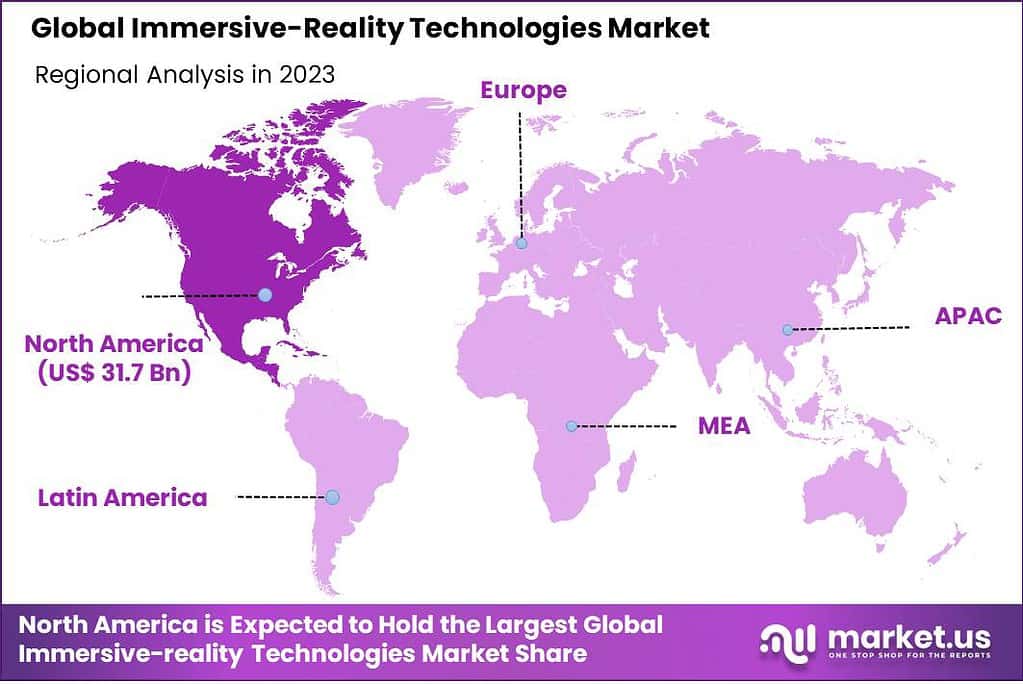
In 2023, North America held a dominant market position, capturing more than a 35% share. The regional dominance can be attributed to the early embrace of immersive reality technologies, a robust ecosystem of technology companies, and substantial investments in research and development. The demand for Immersive-reality Technologies Market in North America was valued at USD 31.7 billion in 2023 and is anticipated to grow significantly in the forecast period
The United States, in particular, has played a pivotal role in propelling growth, boasting a flourishing VR/AR industry and a formidable presence of key market players. North America’s leadership is expected to persist as enterprises embrace immersive reality for various applications, from gaming and entertainment to healthcare and education.
Europe also played a substantial role in the Immersive Reality Technologies Market, accounting for a significant share in 2023. The region’s adoption of these technologies has been accelerated by progressive regulations and initiatives that promote innovation and digital transformation.
Countries like Germany, the UK, and France have witnessed rapid growth in immersive reality applications across sectors such as automotive design, healthcare, and manufacturing. As the European market matures, collaborations between local startups, established enterprises, and research institutions are expected to drive further advancements.
The Asia-Pacific region exhibited promising growth potential in the Immersive Reality Technologies Market. With countries such as China, Japan, and South Korea at the forefront in technology advancement, APAC has seen increased investment in VR/AR infrastructure as well as applications.
China particularly is a major player in the VR gaming industry. Japan has the top position when it comes to AR applications, particularly in the retail market. The large and tech-savvy population, along with the rapid growth of smartphones, is driving the rise of immersive reality technology.
While in the nascent stages, Latin America made strides in the adoption of immersive reality technologies. Countries such as Brazil and Mexico have seen the emergence of startups and initiatives that leverage VR and AR for various purposes, including marketing, education, and tourism. Regulatory changes and a focus on financial inclusion are paving the way for further growth in the region’s immersive reality ecosystem.
The Middle East and Africa are emerging markets in the Immersive Reality Technologies segment. Governments and financial authorities in these regions are increasingly recognizing the potential of immersive reality for various industries, including education and training, healthcare, and entertainment. Initiatives aimed at boosting financial innovation and inclusion are laying the groundwork for future growth in the MEA market.
Note: Actual Numbers Might Vary In Final Report
Key Regions and Countries Covered in this Report:
- North America
- The US
- Canada
- Europe
- Germany
- France
- The UK
- Spain
- Italy
- Russia
- Netherland
- Rest of Europe
- APAC
- China
- Japan
- South Korea
- India
- New Zealand
- Singapore
- Thailand
- Vietnam
- Rest of Asia Pacific
- Latin America
- Brazil
- Mexico
- Rest of Latin America
- Middle East & Africa
- South Africa
- Saudi Arabia
- UAE
- Rest of MEA
Key Players Analysis
Key Players Analysis involves identifying and evaluating the most important players or businesses who play a major role in a certain market or industry. This analysis aids in understanding the market dynamics, and strategies used by the key players to get an edge. By studying the strengths and weaknesses, as well as the opportunities and threats from these competitors, companies can make informed choices and devise successful strategies to compete on the market.
Top Key Players
- Facebook Technologies LLC (Meta Platforms Inc.)
- Sony Corporation
- HTC Corporation
- Microsoft Corporation
- Google LLC
- Samsung Electronics Co. Ltd
- Magic Leap Inc.
- Qualcomm Incorporated
- Epson America Inc.
- Pimax Technology (Shanghai) Co. Ltd
- Acer Inc.
- Avegant Corporation
- Other Key Players
Recent Developments
October 2023:
- Meta Platforms announced the launch of the next-generation Quest Pro VR headset, aimed at professional users.
- Microsoft unveiled its Mesh platform for creating collaborative virtual experiences.
- Apple is rumored to be developing its own AR headset, potentially launching in 2024.
November 2023:
- Sony Interactive Entertainment announced PlayStation VR2, the next-generation VR headset for PlayStation 5.
- HTC released the Vive Flow VR glasses, designed for wellness and relaxation.
- Varjo unveiled the VR-3 headset, offering the highest resolution VR experience available.
December 2023:
- Meta Platforms reports strong adoption of Quest Pro in enterprise and research sectors.
- Google announces partnerships with leading universities to develop educational VR experiences.
- Niantic Labs launches Lightship ARDK, a platform for building real-world AR experiences.









